
Property Capital Gains: Indexation vs 12.5% (2026-27)
October 15, 2026 · 10 min read · by Shivam Kushwaha, HeyArtha founder
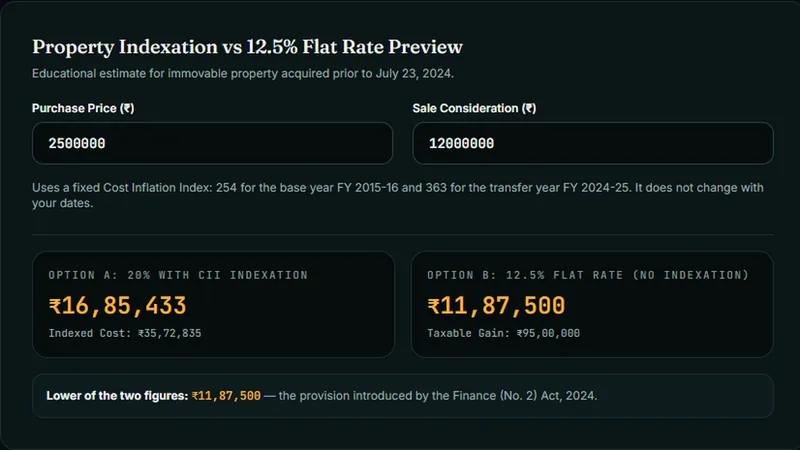
Capital Gains Preview
Compare 20% with indexation against 12.5% without indexation for one property sale.
You have a flat or a plot bought some years ago, and a buyer is ready to pay. Before anything else, one question comes up: after the 2024 change, do you pay 12.5% on the plain gain, or 20% after indexing the cost?
Property capital gains: is 20% with indexation or 12.5% lower?
For a resident individual or HUF selling land or a building bought before 23 July 2024, the lower of two taxes applies: 12.5% on the plain gain, or 20% on the gain after indexing the cost. Which one is lower depends mostly on how much the property has appreciated.
The Property Capital Gains Preview puts both numbers side by side for one sale. This guide covers the rule behind it, each field and card, three worked cases you can type in, and what the Preview leaves out. It is general information, not tax advice.
What the Act says: s.197(3)
I read this from the Income-tax Act, 2025 as amended by the Finance Act, 2026, with the old section in brackets.
| Point | Rule | Section |
|---|---|---|
| Long-term land or building | Held for more than 24 months before transfer | s.2(101) (s.2(42A)) |
| Default rate on long-term gains | 12.5%, without indexation | s.197(1)(b) (s.112) |
| The choice | Resident individual or HUF, land or building acquired before 23 July 2024: the excess tax is ignored | s.197(3) (proviso to s.112(1)) |
| Indexed cost | Cost multiplied by the index ratio | s.72(8)(b), s.72(2) (s.48) |
| Indexed improvement cost | Improvement cost multiplied by its own index ratio | s.72(8)(c) |
Section 197(3) works through a small formula. A is the tax at 12.5% on the gain without indexation. B is the tax at 20% on the gain after replacing the cost of acquisition and cost of improvement with their indexed versions. If A is higher than B, the excess (A minus B) is ignored. In plain words, you pay the lower of A and B.
Two conditions matter. The property must have been acquired before 23 July 2024, and the section speaks of an individual or HUF who is a resident. For property acquired on or after that date, only the 12.5% rate without indexation applies.
How the indexed cost is worked out
Indexed cost of acquisition is the cost multiplied by the Cost Inflation Index (CII) of the year of transfer, divided by the CII of the first year you held the asset, or the year beginning 1 April 2001 if that is later (s.72(8)(b)). The Central Government notifies the index (s.72(8)(a)). I am not quoting a table of index values here because the notified values are the ones to use, not a number from an article.
The Preview does not ask for any dates. It uses a fixed pair: 254 for the base year FY 2015-16 and 363 for the transfer year FY 2024-25. So indexed cost is purchase price times 363 divided by 254, about 1.4291 times the purchase price. The Act uses the index of the year in which you actually transfer the property, so a sale in a later year can give a different Option A figure.
- Option A: 20% of (sale consideration minus indexed cost)
- Option B: 12.5% of (sale consideration minus purchase price)
Type this: three cases from the Preview
Both fields open with values already in them, so overwrite both. The numbers below are illustrative, not real people's data.
| Case | Purchase price | Sale consideration | Option A: 20% with CII | Option B: 12.5% flat | Lower figure |
|---|---|---|---|---|---|
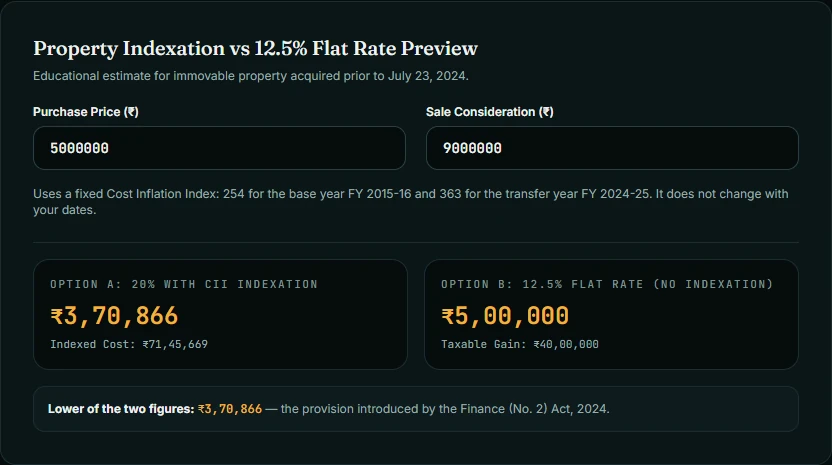
| A (the opening values) | ₹50,00,000 | ₹90,00,000 | ₹3,70,866 (indexed cost ₹71,45,669) | ₹5,00,000 (gain ₹40,00,000) | Option A, ₹3,70,866 |
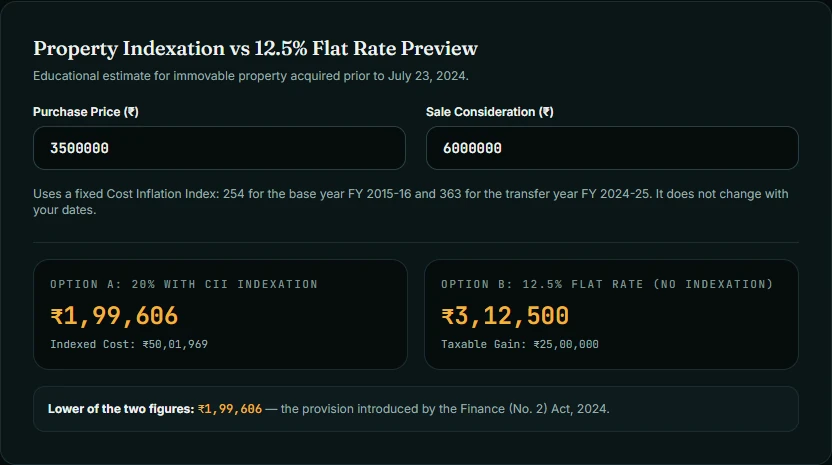
| B | ₹35,00,000 | ₹60,00,000 | ₹1,99,606 (indexed cost ₹50,01,969) | ₹3,12,500 (gain ₹25,00,000) | Option A, ₹1,99,606 |
| C | ₹25,00,000 | ₹1,20,00,000 | ₹16,85,433 (indexed cost ₹35,72,835) | ₹11,87,500 (gain ₹95,00,000) | Option B, ₹11,87,500 |
Here is the working for Case A, so you can check the Preview yourself.
- Indexed cost: 50,00,000 × 363 ÷ 254 = ₹71,45,669.
- Indexed gain: 90,00,000 − 71,45,669 = ₹18,54,331. At 20% that is ₹3,70,866.
- Plain gain: 90,00,000 − 50,00,000 = ₹40,00,000. At 12.5% that is ₹5,00,000.
- Option A is lower by ₹1,29,134.
Case C flips. Indexed cost is 25,00,000 × 363 ÷ 254 = ₹35,72,835, so the indexed gain is ₹84,27,165 and the tax is ₹16,85,433. The plain gain is ₹95,00,000 and 12.5% of it is ₹11,87,500. Here Option B is lower by ₹4,97,933.
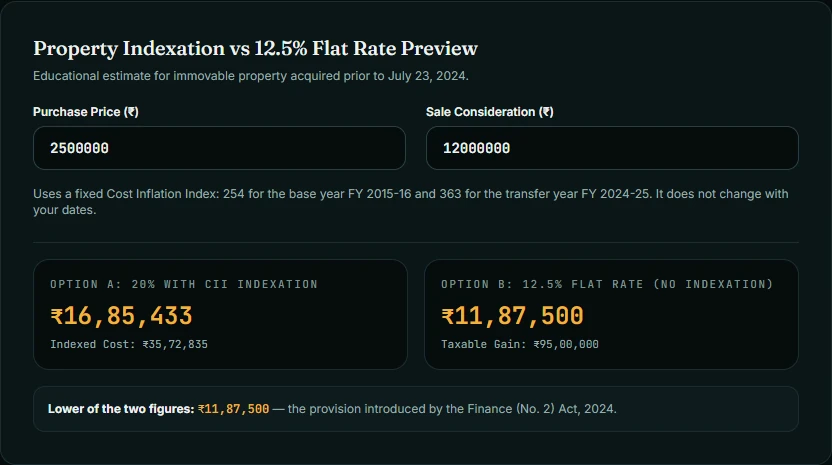
All three figures are before cess and surcharge.
Where the two options cross over
Set the two taxes equal using the Preview's fixed ratio: 0.20 × (S − 1.4291 × P) = 0.125 × (S − P), where S is the sale price and P the purchase price. That gives S of about 2.14 × P. In the Preview, Option B becomes the lower figure once the sale price is more than about 2.14 times the purchase price. For a ₹50,00,000 purchase, that is roughly ₹1.07 crore.
The cases agree. Case A sold at 1.8 times, Case B at about 1.7 times, and both favour Option A. Case C sold at 4.8 times and favours Option B.
This crossover belongs to the Preview's fixed index pair. With your real purchase year and any improvement cost, it will sit somewhere else. Use it as a feel for the rule, not as a threshold to plan around. For four more sale prices worked line by line, including one where indexation removes the tax entirely, see property capital gains worked examples: 20% vs 12.5%.
Reading the Preview: fields, cards and the lower figure
There are two inputs.
- Purchase Price (₹)
- Sale Consideration (₹)
Three results follow.
- Option A: 20% with CII Indexation shows the tax and the "Indexed Cost" used.
- Option B: 12.5% Flat Rate (No Indexation) shows the tax and the "Taxable Gain".
- Lower of the two figures: shows the smaller tax, with a note that the provision came from the Finance (No. 2) Act, 2024.
Your figures are calculated in your browser. Analytics and the optional feedback form are separate; see the Privacy page.
Two edge behaviours are worth knowing. If the sale price is below the purchase price, both options and the lower figure show ₹0, with no loss message. If the sale price sits above the purchase price but below the indexed cost, Option A shows ₹0 while Option B still shows tax, so the lower figure is ₹0. The Preview does not report a loss amount or a carry-forward in either case. The page has a "Report something wrong" button if a result looks off to you.
Limits: what the Preview does not do
Honest limits matter more than a long feature list, so here is what it leaves out.
- It covers only land or a building. Listed shares, mutual funds, gold and other assets are not included.
- The index values are fixed at 254 (FY 2015-16) and 363 (FY 2024-25), with no purchase-year or sale-year selector. Option A is right only for a case where those two values fit. Which index applies to a sale in a later year is a point to confirm with your CA.
- There is no input for cost of improvement or transfer expenses.
- There is no cess, no surcharge and no tax on your other income.
- It does not check the 24-month holding period, the 23 July 2024 acquisition date or your residential status.
- It does not model exemptions under s.82, s.85 or s.86, or the basic exemption adjustment in s.197(2).
- It takes the sale consideration you type. If the stamp duty value of the property is different, the Act may treat a different figure as the sale consideration (the Act defines stamp duty value in s.2(105)). Confirm this with your CA.
- There is no PDF or export.
Some contested or case-specific points depend on the facts, including inherited property and the index base year. Confirm those with your CA.
After the sale: what to look at next
A capital gain can also be reduced by reinvesting under the exemption sections. Section 82 (old s.54) deals with gains on a residential house reinvested in another house. Section 85 (old s.54EC) deals with gains on land or building invested in specified bonds within six months, with a ₹50 lakh limit. Section 86 (old s.54F) deals with gains on an asset that is not a residential house. Each has conditions, so read them or ask your CA before you rely on any. If the proceeds are going into another purchase, Cash vs Loan: Pay Upfront or Take an EMI? compares paying outright with borrowing. If that purchase is a car, How Much Down Payment Should You Put on a Car Loan? isolates what changing only the down payment does.
Tax on the gain may also fall due before you file your return. How advance tax and the s.425(4) safe harbour treat capital gains is covered in After the Calculator: Advance Tax and What Traders File, and you can test your own figures in the Advance Tax Calculator. For the slab-rate side of your income, the Old vs New Regime Calculator is the companion tool. If you also trade, How Trading Income Is Taxed in India shows how listed-equity gains fit in.
The method behind the Preview is on the capital gains methodology page, and its sources are on the sources page. The rule itself is in the Income-tax Act, 2025, available through the Income Tax Department website.
Last reviewed: October 2026, for tax year 2026-27. Rates and index values can change with each Finance Act and notification, so check the current ones before you file.
Next in series: After the Calculator: Advance Tax and What Traders File covers advance tax instalments and what the s.425(4) safe harbour does and does not cover.
Quick answers
Things people usually want to know.
Is property capital gains tax 12.5% or 20% in India now?
Long-term property gains are taxed at 12.5% without indexation (s.197(1)(b)). For a resident individual or HUF selling land or a building bought before 23 July 2024, the excess over the 20%-with-indexation tax is ignored (s.197(3)). So the lower of the two applies.
Is indexation still available when I sell property?
Only as a comparison, and only for a resident individual or HUF selling land or a building acquired before 23 July 2024 (s.197(3)). For property acquired on or after that date, only 12.5% without indexation applies. Check your acquisition date first.
How is the indexed cost of acquisition calculated?
Cost of acquisition multiplied by the Cost Inflation Index of the year of transfer, divided by the index of the first year you held the asset, or FY 2001-02 if later (s.72(8)(b)). The Government notifies the index each year.
When is a property a long-term capital asset?
Land or a building is long-term if you held it for more than twenty-four months before the transfer. Up to twenty-four months it is short-term (s.2(101)). Different holding rules apply to listed shares and equity funds, which are not covered here.
Does the Property Capital Gains Preview include cess and surcharge?
No. Both figures are before health and education cess and before any surcharge. The Preview also leaves out tax on your other income, so treat the two numbers as a comparison of the capital gains tax, not a final tax bill.
Which Cost Inflation Index values does the Preview use?
The Preview uses a fixed pair, 254 for the base year FY 2015-16 and 363 for the transfer year FY 2024-25, so indexed cost is purchase price times 363 divided by 254. If your real purchase and sale years differ, your Option A figure will differ.
Can I add improvement cost or brokerage in the Preview?
No. It has two inputs, purchase price and sale consideration. The Act deducts transfer expenses incurred wholly and exclusively for the transfer and the cost of improvement (s.72(1)), and indexes the improvement cost separately (s.72(8)(c)). Work those out separately.
Can I save capital gains tax by reinvesting the proceeds?
Possibly. Sections 82, 85 and 86 (old s.54, 54EC and 54F) give exemptions on reinvestment in a house or specified bonds, each with conditions, time limits and caps. The Preview does not model them. Confirm eligibility with your CA.
What does the Preview show if the sale price is lower than the purchase price?
It shows zero for both options and for the lower figure, with no loss message and no carry-forward. How a capital loss is treated depends on the facts, so confirm it with your CA instead of relying on the Preview.
Can an NRI choose between the two options?
Section 197(3) names an individual or HUF who is a resident. The Preview does not check residential status. If you are not a resident, do not assume this comparison applies to you and ask a CA.
More from HeyArtha
Other things we've been writing about.
How Trading Income Is Taxed in India (2026-27)
How trading income is taxed in India for 2026-27: delivery, intraday, F&O, currency, commodity and prop payouts, with the head, section and loss rule for each.
After the Calculator: Advance Tax and What Traders File (2026-27)
Advance tax for traders in India, 2026-27: the Rs 10,000 test, four instalment dates, s.424 and s.425 interest, which ITR form applies and a records checklist.
Brokerage & Tax on Trading Income in India (2026 Guide)
What Zerodha actually charges, how STT changed in 2026, and how F&O, intraday and delivery profits are taxed, in a real numbers breakdown.