
After the Calculator: Advance Tax and What Traders File (2026-27)
October 15, 2026 · 10 min read · by Shivam Kushwaha, HeyArtha founder
Trader Tax Calculator
Compute tax on equity delivery, intraday speculation and F&O derivatives with FIFO lot matching, turnover and multi-head income consolidation.
Do traders have to pay advance tax?
Yes. If the tax you expect to owe for the year, after TDS and TCS, is Rs 10,000 or more, you pay advance tax during the year instead of one lump sum when you file (s.404, earlier s.208). F&O and intraday income is business income, so being a trader does not exempt you. The exemption for senior citizens (60 and above) applies only when you have no business income (s.403(3)).
Section numbers here are from the Income-tax Act, 2025 as amended by the Finance Act, 2026 (tax year 2026-27), with the 1961 Act section in brackets. This is the last article in the trader series. Start with how each kind of trading income is taxed if you have not read it, because the numbers below assume you already know your bucket.
The four instalments and their dates
For business income, advance tax is paid in four cumulative instalments (s.408, earlier s.211):
| Pay by | Cumulative share of the year's tax |
|---|---|
| 15 June | 15% |
| 15 September | 45% |
| 15 December | 75% |
| 15 March | 100% |
"Cumulative" is the part people miss. By 15 September you should have paid 45% in total, so the September payment is the extra 30%, not 45% again.
If you have declared profit under the presumptive scheme in s.58(2) (Table Sl. 1 or 3), the rule is different: the whole advance tax is due by 15 March (s.408(2)). Whether the presumptive scheme can be used for F&O is contested, so treat that as depends, confirm with your CA.
What advance tax means when your profit is uneven
Trading profit rarely arrives in tidy quarters. You can lose in April and make most of the year's profit in January. The law still measures you against the tax due on your final returned income. Section 425 (s.234C) compares what you paid by each date with 15%, 45%, 75% and 100% of that final tax.
There is a safe harbour in s.425(4), but it is narrow. It covers a shortfall caused by under-estimating capital gains, income covered by s.2(49)(n), dividend, and business income arising for the first time, provided you pay the tax on that income in a later instalment or by 31 March. Ongoing F&O or intraday profit that builds up over the year is not on the list. For property capital gains, Property Capital Gains: Indexation vs 12.5% compares the two tax figures. If this is your first year of trading, your CA can tell you whether the first-time business income limb helps you.
Two practical points:
- You can revise your estimate. s.406(2) lets you adjust the amount in later instalments if your income estimate changes. If losses cut your profit, you can pay less.
- Setting money aside as you book profits is a planning idea, not a legal rule. Many traders keep a fixed share of each realised profit in a separate account so the instalment is ready on the due date. The Trader Tax Calculator has a view built for exactly this, shown below.
What happens if you miss one
Two different interest charges can apply, and they are not the same thing.
s.425 (earlier s.234C): deferment interest. 3% on the shortfall for the June, September and December instalments, and 1% for March. There is no s.425 interest for the first two instalments if you paid at least 12% of the final tax by 15 June and at least 36% by 15 September (s.425(2)). For interest, the tax amount is rounded down to a multiple of Rs 100 and each month or part of a month counts in full (rule 269 of the Income-tax Rules, 2026).
s.424 (earlier s.234B): default interest. If you did not pay advance tax at all, or paid less than 90% of the assessed tax, interest is 1% for every month or part of a month. It starts on 1 April after the tax year and runs until the return is processed or the assessment is completed. Assessed tax is your final tax less TDS, TCS and foreign tax credit, as set out in s.424(2).
If you missed a date, pay the shortfall as soon as you can. Interest is counted month by month, so every extra month of delay adds to it. The advance tax guides on HeyArtha walk through a missed instalment, and the s.234C explainer shows how the interest is built.
Worked example: type this into the Tax Reserve tab
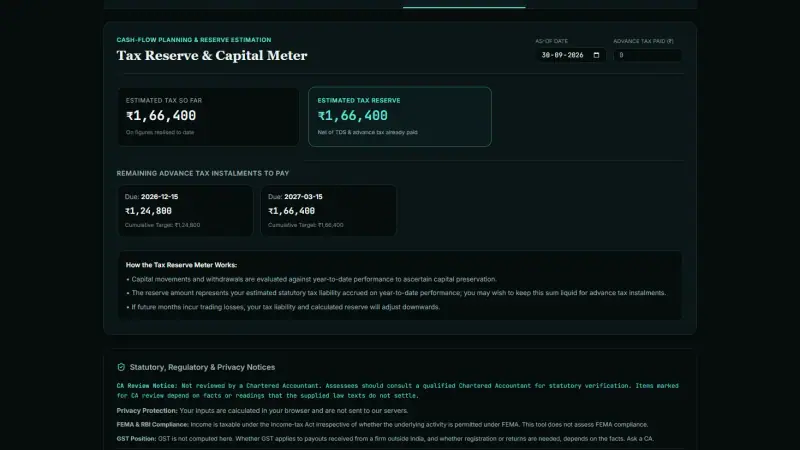
Take an illustrative F&O trader who has booked Rs 18,00,000 of net profit by 30 September 2026, under the new regime, with no other income and no brokerage left to deduct. Open the Trader Tax Calculator, enter the F&O result, and open the Tax Reserve tab.
Typing:
- In the F&O card, set Realised Net P&L (₹) to 18,00,000 and Brokerage & Direct Expenses (₹) to 0. Overwrite the sample figures that the card opens with, and fill the turnover so no "Turnover looks too low" warning appears.
- In the Tax Reserve tab, set As-of date to 30 September 2026 and leave Advance tax paid (₹) empty.
By hand. Under the new regime slabs in s.202 (earlier s.115BAC), tax on Rs 18,00,000 is Rs 1,60,000 before cess: nil to 4,00,000, 5% on 4,00,000 to 8,00,000 (Rs 20,000), 10% on the next 4,00,000 (Rs 40,000), 15% on the next 4,00,000 (Rs 60,000) and 20% on 16,00,000 to 18,00,000 (Rs 40,000). Add 4% cess and the total is Rs 1,66,400. The rebate under s.156(2)(a) stops at Rs 12,00,000 of income, so it does not apply.
The cumulative targets are then:
| Instalment | Share | Cumulative target |
|---|---|---|
| 15 June | 15% | Rs 24,960 |
| 15 September | 45% | Rs 74,880 |
| 15 December | 75% | Rs 1,24,800 |
| 15 March | 100% | Rs 1,66,400 |
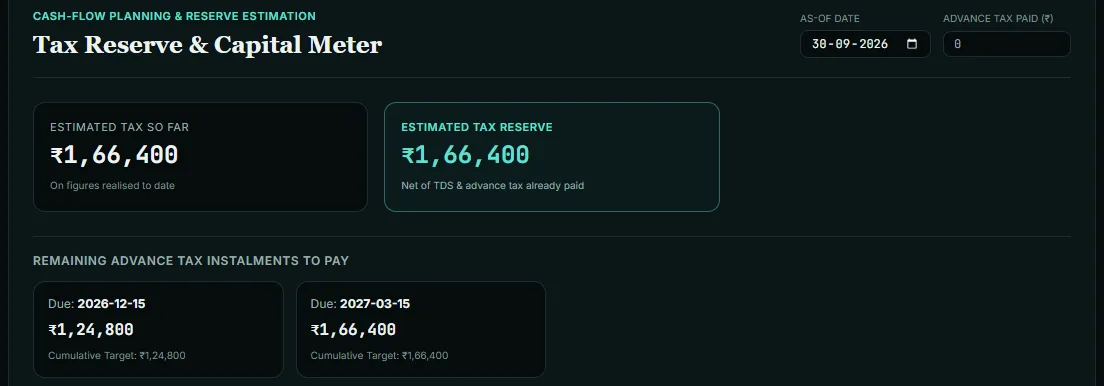
What the tool shows. Estimated Tax So Far is Rs 1,66,400, on figures realised to date. Estimated Tax Reserve is also Rs 1,66,400, because you have paid nothing. The remaining instalments listed are 15 December 2026 (cumulative target Rs 1,24,800) and 15 March 2027 (cumulative target Rs 1,66,400). June and September have already passed on that as-of date, so the tab does not list them.
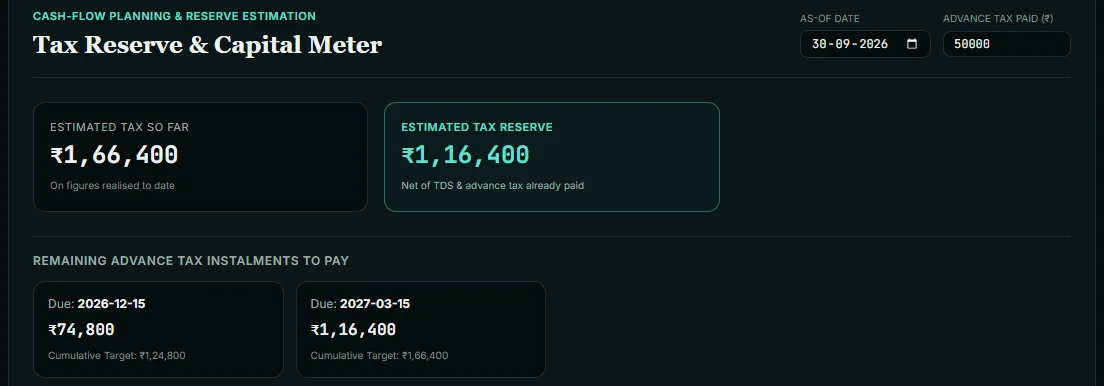
Now enter Rs 50,000 in Advance tax paid. The reserve drops to Rs 1,16,400, and the instalment cards show Rs 74,800 for 15 December and Rs 1,16,400 for 15 March. Those are amounts you still need to have paid by each date, counted from where you are today. So after paying Rs 74,800 in December, Rs 41,600 more is left for March.
Change the as-of date to 31 December 2026 and only the March instalment remains. Enter a loss of Rs 2,00,000 instead of a profit, and the reserve is zero and no instalments are shown.
If nothing were paid on any date, the PDF Pack section "Advance Tax Instalment Schedule & Deferment Risk" shows the s.425 interest per instalment: Rs 747, Rs 2,244, Rs 3,744 and Rs 1,664, a total of Rs 8,399. The first figure is 3% on Rs 24,900 (the Rs 24,960 shortfall rounded down to a multiple of Rs 100). That total covers deferment interest only. If you pay nothing at all, s.424 interest comes on top.
What you file after the year ends
The calculator's What You File box names the form. The rule behind it is rule 164 of the Income-tax Rules, 2026:
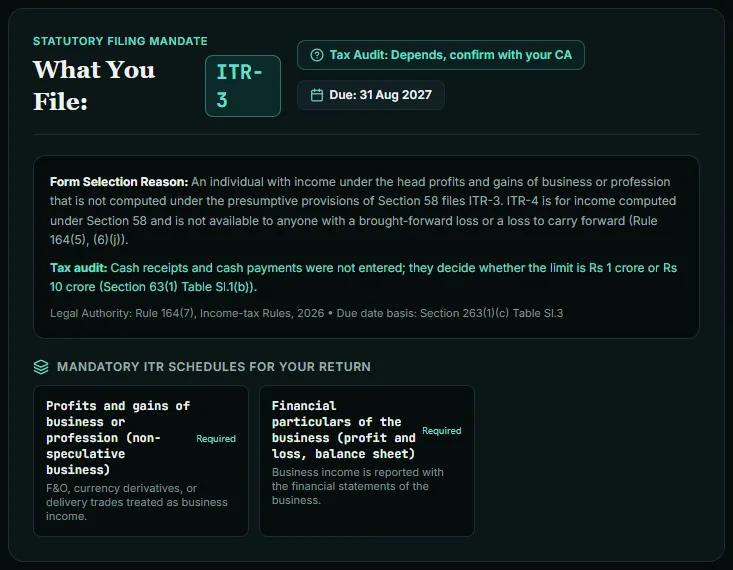
- ITR-3 for most F&O and intraday traders, because the income is business income not computed under the presumptive provisions.
- ITR-4 only where the income is declared under s.58. It is not available if you hold foreign assets or have a brought-forward or carry-forward loss.
- ITR-2 if you have no business income at all, for example a delivery-only investor with capital gains.
Read the form instructions for the year before filing, because they are the final word on eligibility.
Due dates. The statutory due dates in the s.263(1) Table are 31 July for most individuals, 31 August for business income without an audit, and 31 October where an audit applies. These are the dates written in the Act. The CBDT sometimes extends them by notification, so check CBDT news for the current date, and read the table itself in Section 263.
Audit. s.63 (earlier s.44AB) decides whether a tax audit applies. In outline it looks at business turnover (Rs 1 crore, or Rs 10 crore if cash receipts and payments are each 5% or less), profession receipts (Rs 50 lakh), and a trap where presumptive profit is claimed below the deemed rate. The audit report is due one month before the return due date. Turnover for F&O is counted by the ICAI method, not by summing buys and sells; the mistakes guide covers it with an example.
Why filing on time matters. A loss is carried forward only if it was determined in a return filed by the due date (s.121, earlier s.80, read with s.263(1)). A late return can cost you the carry-forward of the speculative loss in the worked example from the previous article, among other things.
Records checklist
Keep these together through the year, not in March:
- Broker's tax P&L and the Excel version of the trade-wise statement (how to read it)
- Contract notes and the ledger
- Charges summary: brokerage, STT, exchange fees, GST
- Your turnover working, with the method you used
- Bank statements showing deposits and withdrawals to the broker
- Form 26AS and the AIS, to match TDS and TCS
- Advance tax challans, one per payment
- For prop payouts: payout statements, fee receipts and the exchange rates used (rule 206 and 207 for the conversion rate)
Limits of this guide and the tool
- The Tax Reserve tab treats your profit to date as the full-year base. It does not annualise. If you expect more profit later in the year, your real reserve will be higher; if you expect losses, it will be lower.
- The calculator is built for trading income. Check the result against your whole-year picture if you also have salary, interest, rent or capital gains.
- It does not decide your ITR form, your audit status or your investor-or-trader question for you.
- Whether prop payouts, presumptive taxation for F&O or a carried-forward loss under the new regime work for you is a CA question, not a tool question.
- For a full-year advance tax estimate across all income, the Advance Tax Calculator and its do I need to pay guide are the next stop.
Not reviewed by a Chartered Accountant. This is general information, not tax advice; consult a CA for your own return. Last reviewed October 2026, for tax year 2026-27. Your inputs are calculated in your browser and are not sent to our servers.
Quick answers
Things people usually want to know.
Do traders have to pay advance tax in India?
Yes, if the estimated tax for the year, after TDS and TCS, is Rs 10,000 or more (s.404, earlier s.208). F&O and intraday income is business income, so there is no exemption for being a trader. The only age-based exemption, for 60+ taxpayers, does not apply when you have business income (s.403(3)).
What are the advance tax due dates for traders?
Business income is paid in four instalments: 15% by 15 June, 45% by 15 September, 75% by 15 December and 100% by 15 March (s.408, earlier s.211). The percentages are cumulative, so each date has a running target, not a fresh amount.
I made most of my F&O profit in the last two months. Do I still owe interest for earlier instalments?
It can, because s.425 (earlier s.234C) compares what you paid by each date with the tax due on your final returned income. The safe harbour in s.425(4) lists capital gains, dividend and business income arising for the first time, not ongoing F&O. Pay as profit is realised and confirm your own case with your CA.
What is the interest if I miss an advance tax instalment?
Under s.425 (s.234C) it is 3% on the shortfall for the 15 June, 15 September and 15 December instalments and 1% for 15 March. Separately, s.424 (s.234B) charges 1% a month if the advance tax you paid is under 90% of the assessed tax.
Which ITR form should an F&O or intraday trader file?
Usually ITR-3, because the income is business income not computed under the presumptive provisions. ITR-4 is limited under rule 164 of the Income-tax Rules, 2026, and ITR-2 is for people with no business income, for example delivery-only investors. Check the form instructions for the year.
Is a tax audit mandatory for F&O traders?
It depends on turnover and the other s.63 (s.44AB) conditions, not on profit alone. Turnover is counted by the ICAI method, not by adding up every buy and sell. Check the limits for your case and confirm with your CA.
Can I use presumptive taxation for F&O to avoid advance tax instalments?
Whether presumptive taxation under s.58 can be used for F&O is contested. If someone does qualify under s.58(2) Table Sl. 1 or 3, advance tax is paid in a single instalment by 15 March (s.408(2)). Depends, so confirm with your CA before relying on it.
Do intraday losses reduce my advance tax on F&O profit?
No. Intraday equity is speculative business income, and a speculation loss can be set off only against speculative profit (s.113, earlier s.73). It does not reduce your F&O profit, so it does not reduce the base for your instalments.
What happens if I overpay advance tax?
Excess advance tax is adjusted against your final tax when you file, and any balance comes back as a refund. If your income falls later in the year, you can revise your estimate in the remaining instalments (s.406(2)).
What records should a trader keep for filing?
Keep the broker's tax P&L, contract notes, the ledger, bank statements, the charges and STT summary, your turnover working, Form 26AS and AIS, and every advance tax challan. For prop payouts, keep payout statements, fee receipts and the exchange rates you used.
More from HeyArtha
Other things we've been writing about.
How Trading Income Is Taxed in India (2026-27)
How trading income is taxed in India for 2026-27: delivery, intraday, F&O, currency, commodity and prop payouts, with the head, section and loss rule for each.
Trader Tax Calculator India: Every Field, Card and PDF
How to use the trader tax calculator India traders need for 2026-27: what to type in each field, what every result card means, and what the PDF shows.
Trading Tax Examples India: Delivery, F&O and Prop Payout
Three trading tax example cases for India in 2026-27: salary with delivery, intraday and F&O; an options seller with a past loss; and USD prop payouts.