
Cash vs Loan: Pay Upfront or Take an EMI? (2026-27)
October 15, 2026 · 10 min read · by Shivam Kushwaha, HeyArtha founder
Cash vs Loan Calculator
Compare paying in cash against taking a loan while your money stays invested. Break-even return, taxes and a bad-luck test, all shown.
You have found the car, or the flat, and you have the savings to pay for it outright. The dealer or builder has also shown you an EMI. Do you empty the account, or borrow and keep the money invested?
Cash vs loan: what does the calculator actually compare?
The Cash vs Loan Calculator compares two ways of buying the same asset: pay the full price from savings, or pay a down payment, take a loan, and keep the rest of your savings invested. It ends with the net wealth of each option at the end of the loan, after tax and fees, and shows the difference in rupees.
This guide explains the rules behind it, what to type, how to read every card, two worked cases you can check by hand, and what the tool leaves out. It is general information, not advice. The tool never says "take the loan" or "avoid the loan".
How the two options are built
Both options have the same monthly outflow on paper. The difference is where the money sits.
| Option A: Cash upfront | Option B: Loan and invest kept money | |
|---|---|---|
| At purchase | Pay the full price from savings | Pay the down payment and upfront loan costs |
| Savings left to invest | Savings minus price minus any reserve | Savings minus down payment minus loan costs minus any reserve |
| Every month | Invests an amount equal to the EMI | Pays the EMI from salary, invests nothing new |
| At the end | Net wealth after tax | Net wealth after tax |
Two points trip people up. The loan amount itself is never invested: it goes to the seller. And the emergency reserve you enter is taken out of your leftover savings in both options and kept as plain cash, not invested in either.
Invested money grows at your expected yearly return, converted to a monthly rate. The loan runs on the usual reducing-balance EMI, using the quoted yearly rate divided by twelve.
The tax rules behind the numbers
I read these from the Income-tax Act, 2025 as amended by the Finance Act, 2026, with the old section in brackets.
| Point | Rule used | Section |
|---|---|---|
| Equity long-term gains | 12.5% on gains above Rs 1,25,000 a year (STT paid), plus 4% cess, so 13.0% effective | s.198 (s.112A) |
| Equity short-term gains | 20% plus 4% cess, so 20.8% effective | s.196 (s.111A) |
| Specified debt mutual funds bought on or after 1 April 2023 | Treated as short-term, taxed at slab rate | s.76 (s.50AA) |
| Capital loss set-off | Short-term loss against any capital gain, long-term loss only against long-term gain | s.108(2) |
| Home loan interest, self-occupied | Capped at Rs 2,00,000 a year, old regime only in the tool | s.22(1)(b) and (2)(a) (s.24(b)) |
| Principal repayment deduction | Within the Rs 1,50,000 limit, old regime only | s.123 (s.80C) |
Bank fixed deposit interest is not a capital gain. The tool taxes it at your slab plus cess at the end of each financial year, so tax reduces the amount that keeps compounding.
For a personal car or consumer loan, the tool assumes there is no deduction for the interest. I did not find a provision allowing one for personal use, but confirm it with your CA if a business use is involved. The 18% GST on the processing fee comes from GST law, which is outside the Income-tax Act, so I have not checked that figure against a statute here.
Type this: two cases from the calculator
Several fields open with values in them, so overwrite them. The numbers below are illustrative, not real people's data. All figures include 4% cess and exclude surcharge.
Case 1: a car, equity as the destination
| Field | Value |
|---|---|
| Asset | Car / Vehicle |
| Price | ₹10,00,000 |
| Savings | ₹15,00,000 |
| Down payment | ₹2,00,000 |
| Emergency reserve | ₹1,00,000 |
| Loan rate, tenure | 8.5%, 60 months |
| Destination, expected return | Equity / Index Funds, 13% |
| Other upfront costs (in the advanced section) | ₹5,000 |
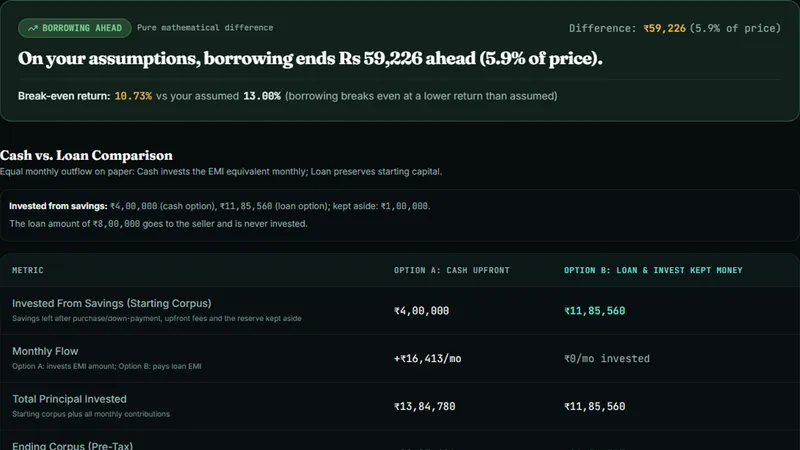
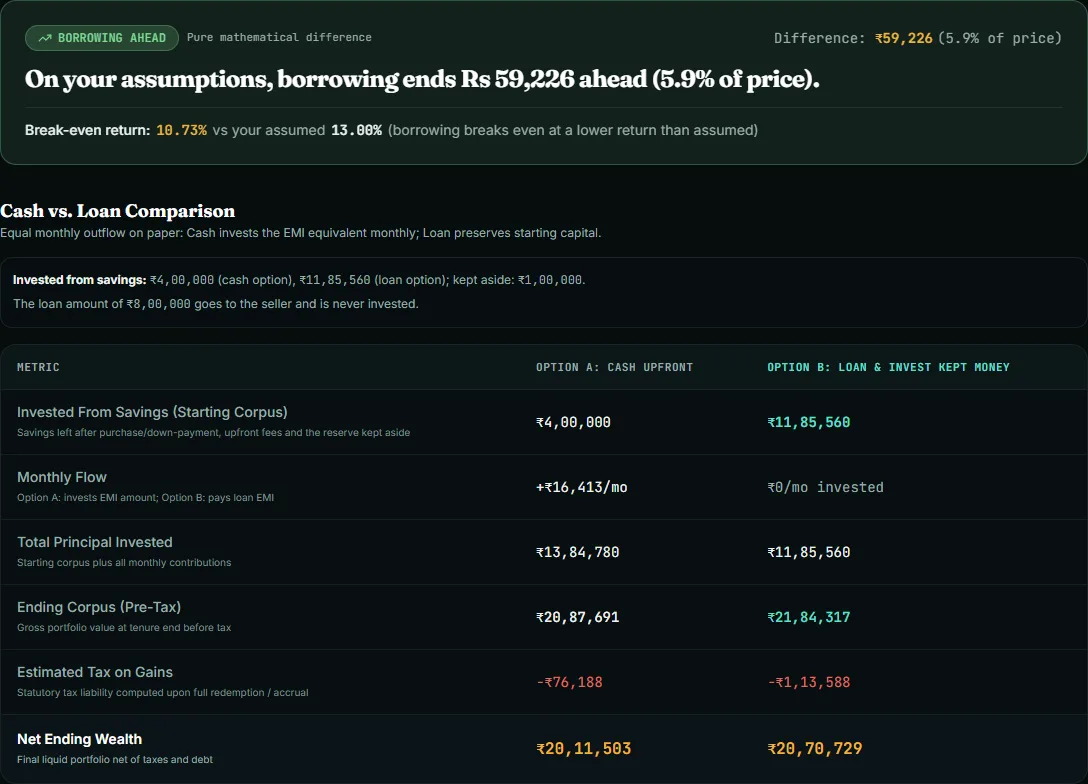
The calculator shows Borrowing ahead by ₹59,226, which is 5.9% of the price, with a break-even return of 10.73% against your assumed 13.00%. Net ending wealth is ₹20,11,503 for cash and ₹20,70,729 for the loan.
Here is the working, so you can check it.
- Loan: 10,00,000 − 2,00,000 = ₹8,00,000. EMI at 8.5% over 60 months is ₹16,413. Total interest is ₹1,84,794.
- Upfront loan costs: 1% of 8,00,000 is ₹8,000, GST on it is ₹1,440, plus ₹5,000 other costs, so ₹14,440.
- Cash option starts with 15,00,000 − 10,00,000 − 1,00,000 = ₹4,00,000 and invests ₹16,413 every month.
- Loan option starts with 15,00,000 − 2,00,000 − 14,440 − 1,00,000 = ₹11,85,560 and invests nothing more.
- At 13% a year for five years, the loan option grows to ₹21,84,317, a gain of ₹9,98,757. After the ₹1,25,000 exemption, 13.0% tax is ₹1,13,588. Net: ₹20,70,729.
- The cash option grows to ₹20,87,691 in total. Its tax is ₹76,188: the monthly purchases from the last twelve months are short-term and taxed at 20.8%, the rest at 13.0%. Net: ₹20,11,503.
- Difference: 20,70,729 − 20,11,503 = ₹59,226.
Case 2: a car, bank FD as the destination
| Field | Value |
|---|---|
| Price, savings, down payment | ₹12,00,000, ₹15,00,000, ₹3,00,000 |
| Emergency reserve | ₹50,000 |
| Loan rate, tenure | 10%, 48 months |
| Destination, expected return | Bank Fixed Deposit, 6.5% |
| Processing fee, other upfront costs | 1.5%, ₹3,000 |
| Investing discipline | 90% |
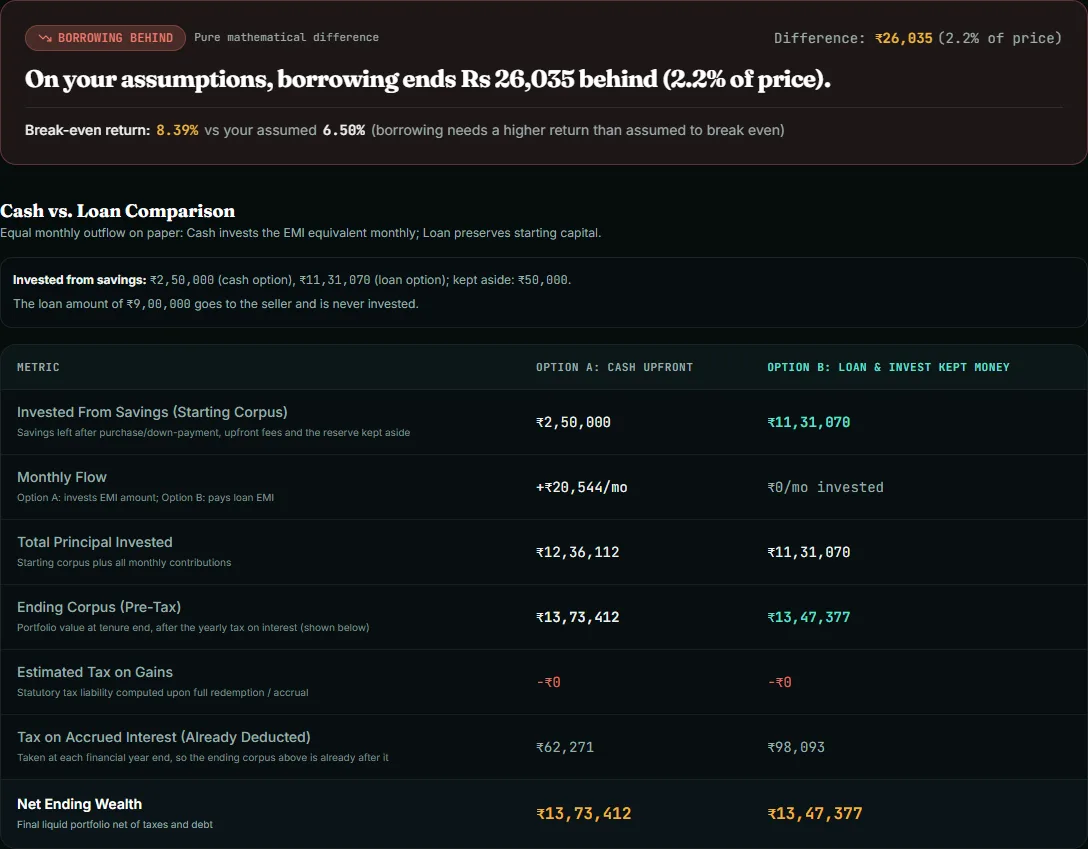
Now the calculator shows Borrowing behind by ₹26,035, which is 2.2% of the price. Break-even is 8.39% against your assumed 6.50%. Net ending wealth is ₹13,73,412 for cash and ₹13,47,377 for the loan.
The loan is ₹9,00,000 with an EMI of ₹22,826. The cash buyer invests 90% of that, ₹20,544 a month, from a starting ₹2,50,000. The loan buyer starts with ₹11,31,070 after ₹18,930 of upfront costs. FD interest is taxed at 31.2% each year, which comes to ₹62,271 over the term for the cash option and ₹98,093 for the loan option.
Same car type, same kind of structure, opposite sign. The change came from the destination of the money: a 6.5% FD, taxed every year, does not out-earn a 10% loan. Equity at 13% did.
Break-even return and "Too close to call"
The break-even return is the yearly return at which both options end level. It is not the loan rate. Fees, tax on gains and the monthly investing in the cash option all shift it, which is why Case 1 breaks even at 10.73% on an 8.5% loan.
Read it as a comparison with your own assumption. In Case 1, you assumed 13%, which is above 10.73%, so borrowing ends ahead. In Case 2, you assumed 6.5%, which is below 8.39%, so borrowing ends behind.
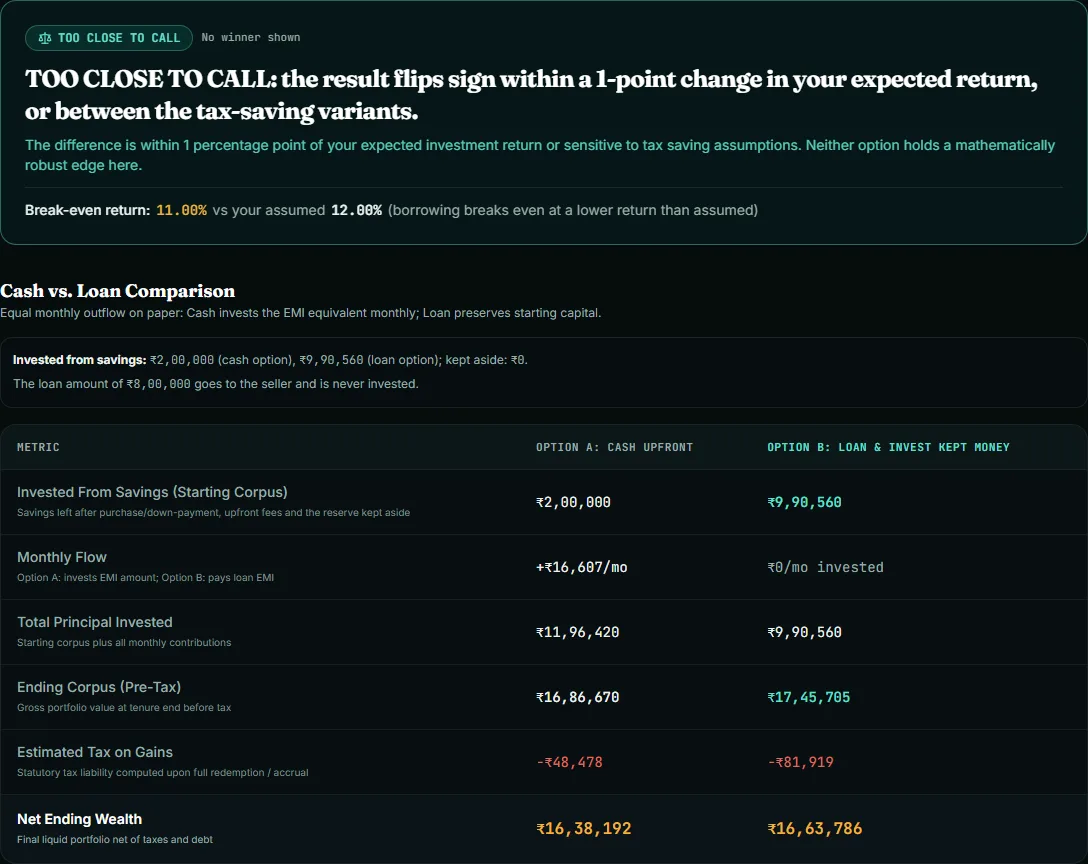
If you leave every field at its opening value, the page shows Too close to call. The break-even is 11.00% and the assumed return is 12.00%. The tool checks the result at 1 point below and 1 point above your assumed return. If the sign flips inside that band, it declines to name a winner, because the answer depends on a return nobody knows. A tool that always names a winner would be less honest here.
What the stress panels show
Below the comparison are panels that change one assumption at a time. These two use Case 1 and I checked them by hand.
- Discipline drag. The cash option assumes you invest the EMI amount every month. If you invest only 75% of it, the gap in favour of borrowing grows from ₹59,226 to ₹3,84,748. At 50% it is ₹7,10,269. The cash option only wins on paper if the saved EMI really gets invested.
- Floating rate shock. If the loan rate were 1 point higher from day one, at 9.5%, the EMI becomes ₹16,801 and borrowing is still ahead by ₹28,425. At 2 points higher, 10.5%, the EMI is ₹17,195 and borrowing is behind by ₹2,803. The verdict flips within two points.
There is also a sequence-of-returns test for equity over three years or more. Its note says that with the EMI paid from salary, the loan option's lump sum ends at the same value in any order of returns, while the cash option's monthly investing depends on the order, and a bad start helps it. For a car, a negative-equity panel shows how many months the loan balance sits above the vehicle's depreciated value.
Reading the inputs and results
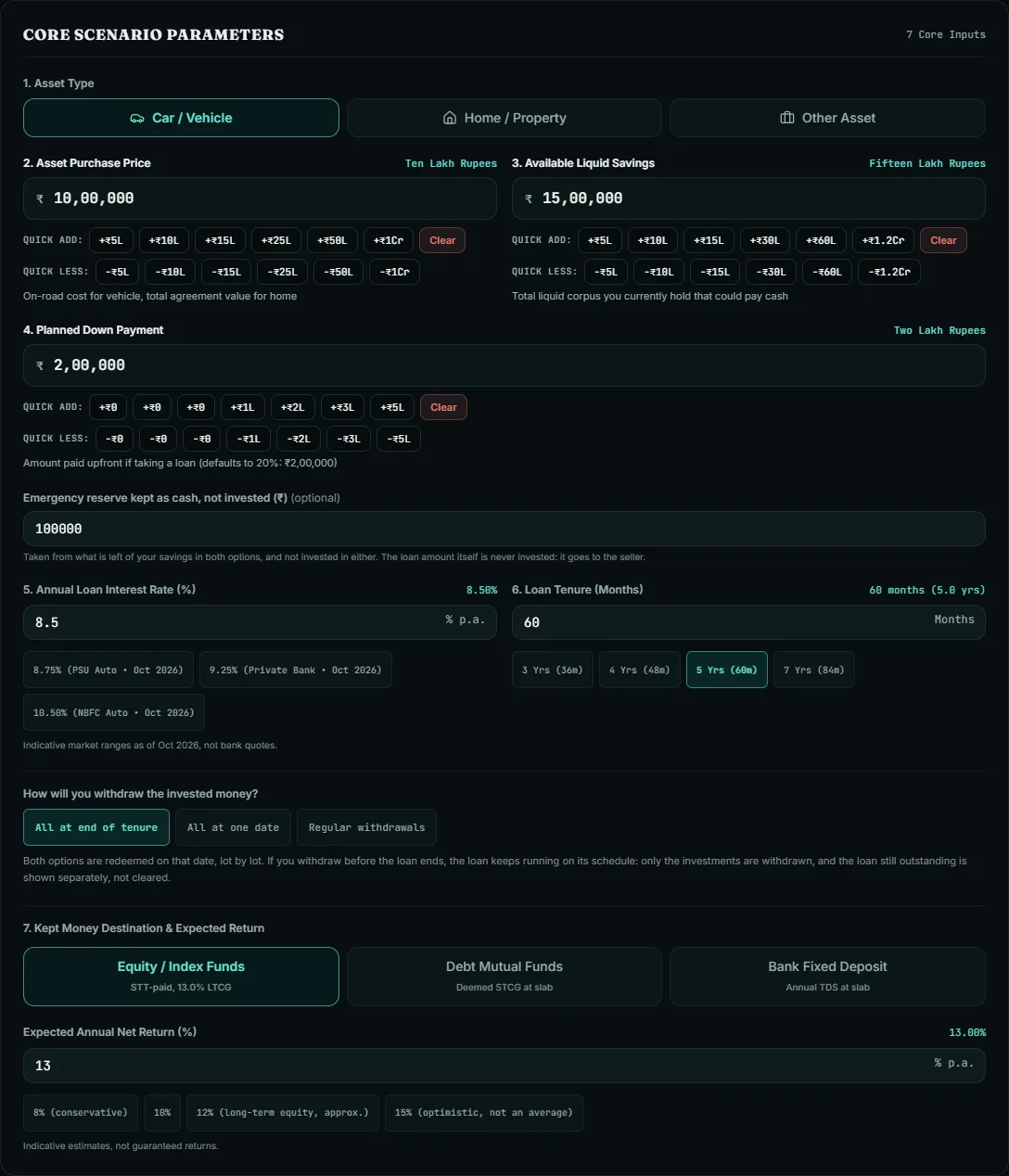
The core card has seven inputs: asset type, price, savings, down payment, loan rate, tenure and where the kept money goes with its expected return. Optional fields include an emergency reserve and how you plan to withdraw the invested money: all at the end, all at one date, or regular withdrawals. The advanced section adds the processing fee, other upfront costs, investing discipline, the equity exemption already used this year, the month the loan starts, your slab, car depreciation and, for homes, the regime and deductions.
The results appear in order. First the banner with the rupee difference and break-even. Then the side-by-side table, with starting corpus, monthly flow, ending corpus, tax and net ending wealth. Then the tax and cost schedule, the stress panels, six numbered assumptions the math depends on, and a guardrails panel.
The guardrails panel uses your income, existing EMIs and living expenses. It reports your fixed-obligation ratio against a 40% line, a car check of 20% down, a tenure of 48 months or less and an EMI of 10% of income or less, and months of expenses covered after the purchase. Case 1 shows a ratio of 10.9% but misses the car check on tenure and EMI share. These checks do not change the headline number. To check more money rules against your numbers, see the Principle Check calculator.
Limits: what the calculator does not do
- It uses deterministic inputs. Your return and loan rate are assumptions, not forecasts. It does not predict interest rate cycles.
- It leaves out surcharge, the section 156 rebate and other capital gains in the same year.
- The bank deposit TDS threshold affects cash flow timing only and is not modelled.
- It does not cover commercial vehicles, let-out or rental property, or joint co-borrowers.
- Pre-construction interest in five instalments is not modelled, and the Rs 2,00,000 home loan interest cap (s.22(2)(a)) assumes completion within five years, or it drops to Rs 30,000 (s.22(2)(b)).
- It does not suggest what to do. The page states that it is pure mathematics, not advice.
- The tool is not reviewed by a Chartered Accountant, and neither is this guide.
Several rate and deduction points depend on your facts. Confirm them with your CA before you act.
Before you decide
If the asset is a property you may sell later, the tax on that sale is a separate question. Property Capital Gains: Indexation vs 12.5% covers it. For four sale prices worked line by line, see Property Capital Gains Worked Examples: 20% vs 12.5%. Your slab input comes from your own income, and the Old vs New Regime Calculator helps with that. If part of your investing is trading income, How Trading Income Is Taxed in India explains how it is classified, and After the Calculator: Advance Tax and What Traders File covers the instalments that follow. To see what changing only the down payment does, read How Much Down Payment Should You Put on a Car Loan?. More tools sit on the Money tools page, and all guides are on the HeyArtha blog.
The method is on the Cash vs Loan methodology page and the sources are on the sources page. The rules are in the Income-tax Act, 2025, available through the Income Tax Department website.
Last reviewed: October 2026, for tax year 2026-27. Rates, slabs and rules can change with each Finance Act, so check the current ones before you decide.
Next in series: Property Capital Gains: Indexation vs 12.5% covers what tax applies when a property you financed is sold.
Quick answers
Things people usually want to know.
Is it better to pay cash or take a car loan in India?
It depends on your loan rate, the return you expect on the money you keep, the tax on that return and the fees on the loan. The calculator shows the difference in rupees for your inputs. It does not tell you what to choose.
What does "Borrowing ahead" mean in the Cash vs Loan Calculator?
It means that, on your assumptions, the loan option ends with more net wealth than the cash option, and the gap is outside the one-point sensitivity band. The page shows the rupee gap and its share of the asset price.
What is the break-even return?
It is the yearly return on invested money at which the cash option and the loan option end with the same net wealth. If your assumed return is above it, borrowing ends ahead. If it is below, borrowing ends behind.
Why does the tool say "Too close to call"?
The tool recomputes the result at your return minus one point and plus one point. If the winner flips inside that range, or between tax-saving variants for a home loan, it shows no winner, because a small change in your assumption would reverse the result.
Does the calculator include the processing fee and GST?
Yes. The processing fee is a percentage of the loan, 1% by default for a car or other asset and 0.5% for a home, with 18% GST added on the fee. You can also enter other upfront costs such as stamp duty or documentation.
How is tax on the invested money treated?
For equity funds, long-term gains above Rs 1,25,000 a year are taxed at 12.5% plus 4% cess under s.198, and short-term gains at 20% plus cess under s.196. Debt funds are taxed at slab rate, and bank FD interest is taxed each year at slab plus cess.
Is the loan amount invested in the tool?
No. The loan amount goes to the seller. Only the savings left after the down payment, upfront loan costs and any emergency reserve are invested in the loan option. In the cash option, the money left after the purchase is invested, plus the monthly EMI equivalent.
Can I use it for a home loan?
Yes, with extra fields for tax regime and home loan deductions. Under the new regime the tool models no home loan deduction. Let-out or second homes, joint borrowers and pre-construction interest are not supported, so confirm those with your CA.
Can I use it for a business or commercial vehicle?
No. It is built for personal assets. A vehicle used in a business can bring depreciation and interest deductions that the tool does not model. Ask your CA how those apply to your case.
Are my inputs sent anywhere?
No. The page says the calculation runs in your browser and your inputs stay there. You can save named scenarios on your own device and download a PDF report of the result.
More from HeyArtha
Other things we've been writing about.
Property Capital Gains: Indexation vs 12.5% (2026-27)
Property capital gains tax India 2026-27: compare 20% with indexation against 12.5% without, with the rule (s.197(3)), worked numbers and limits.
How Trading Income Is Taxed in India (2026-27)
How trading income is taxed in India for 2026-27: delivery, intraday, F&O, currency, commodity and prop payouts, with the head, section and loss rule for each.
After the Calculator: Advance Tax and What Traders File (2026-27)
Advance tax for traders in India, 2026-27: the Rs 10,000 test, four instalment dates, s.424 and s.425 interest, which ITR form applies and a records checklist.