
How Trading Income Is Taxed in India (2026-27)
October 15, 2026 · 9 min read · by Shivam Kushwaha, HeyArtha founder
Trader Tax Calculator
Compute tax on equity delivery, intraday speculation and F&O derivatives with FIFO lot matching, turnover and multi-head income consolidation.
How is trading income taxed in India?
Trading income in India is taxed according to what you traded and how it settled, not according to the app you used. Delivery-based equity is usually capital gains. Intraday equity is speculative business income. Exchange-traded F&O is non-speculative business income. Currency, commodity and prop payouts need a closer read, covered below.
Here is the whole picture on one page. Section numbers are from the Income-tax Act, 2025 as amended by the Finance Act, 2026 (tax year 2026-27), with the 1961 Act section in brackets.
| Bucket | Head of income | How it is taxed | Loss treatment |
|---|---|---|---|
| Delivery equity (listed, STT paid) | Capital gains | Short-term 20% s.196 (s.111A); long-term 12.5% above Rs 1,25,000, s.198 (s.112A) | Capital loss only against capital gains; carry forward 8 years, s.111 (s.74) |
| Intraday equity | Business, speculative | Slab rates, s.66(31) with s.26(3) (s.43(5), s.28) | Only against speculative profit; carry forward 4 years, s.113 (s.73) |
| F&O on a recognised exchange | Business, non-speculative | Slab rates, s.66(33) (s.43(5)) | Against other heads except salary; carry forward 8 years, s.112 (s.72) |
| Currency and commodity derivatives | Business, depends on the contract | Slab rates | Follows whichever of the two business rows applies |
| Prop firm payout | Depends, confirm with your CA | Depends | Depends |
Two rules sit under every row. A loss is carried forward only if it was determined in a return filed under s.263(1) (due date), per s.121 (s.80). And "slab rates" means whichever regime you file under; the new regime for 2026-27 starts at nil up to Rs 4,00,000 and reaches 30% above Rs 24,00,000 (s.202 (s.115BAC)).
If you want to see these buckets side by side with your own numbers, the Trader Tax Calculator runs them together, and the field-by-field guide explains each input.
Delivery trades: capital gains, usually
When you buy shares and take delivery, the gain on sale is normally capital gains. For listed equity where STT is paid, short-term gains are taxed at 20% under s.196 (s.111A). Long-term gains are taxed at 12.5% on the amount above Rs 1,25,000 under s.198 (s.112A). Short-term here means held for up to 12 months. Surcharge and cess apply on top.
Three consequences follow from the statute text:
- STT is not a deduction. s.72(3)(b) (s.48) keeps it out of the capital gains computation.
- Capital losses stay in their lane. A capital loss cannot be set off against income under any other head (s.109(2)). Short-term loss can be set off against any capital gain, long-term loss only against long-term gain (s.108(2)).
- Carry-forward is eight years, per s.111 (s.74), and again needs the loss to be in a return filed on time.
Can I switch to business income for delivery trades?
Some people do trade delivery shares often enough that a business view is arguable. Whether yours qualifies is a question of facts (frequency, holding period, intent, how you reported earlier years), not a toggle. Jumping between capital gains and business from year to year invites questions. Treat this as depends, confirm with your CA, and be consistent once you decide.
Intraday equity: speculative business income
A speculative transaction is one where a contract to buy or sell stocks or shares is settled otherwise than by actual delivery (s.66(31)). Intraday equity squares off the same day, so it lands here. Where such transactions are frequent enough to be a business, s.26(3) treats the speculation business as distinct and separate from any other business you carry on.
What that means in practice:
- Income is taxed at your slab rate, not at the flat capital-gains rates.
- STT is deductible as a business expense under s.32(k) (s.36(1)(xv)), because the income is under the business head.
- A loss can be set off only against speculative profit. s.113(1) (s.73) says so directly, and s.113(3) limits carry-forward to four tax years.
The last point is where traders get caught: an intraday loss cannot reduce your F&O profit. The mistakes guide has that one worked through in full.
F&O: non-speculative business income
Futures and options are carved out of the speculative definition. s.66(31)(a) excludes a "specified derivative transaction", and s.66(33) defines that as trading in derivatives carried out through a registered stock broker or other registered intermediary (or, for banks and mutual funds, electronically on a recognised exchange's screen-based system) and supported by a time-stamped contract note showing your client ID and PAN. So exchange-traded F&O is non-speculative business income, regardless of how long you hold it.
That is the answer to a question traders ask often: if you take an F&O position overnight and sell it the next morning, or buy and sell on the same day, it is still F&O under s.66(33). Holding period does not make it speculative.
What follows for tax:
- Head: profits and gains of business or profession, taxed at slab rates.
- Expenses: brokerage, STT, exchange charges and similar costs that are genuinely business expenses reduce the profit. The brokerage and taxation guide covers what usually counts.
- Loss: set off against income under other heads for the year, except salary (s.109(1)(a)), and carried forward up to eight tax years under s.112 (s.72), against business income only.
- Audit and turnover: s.63 (s.44AB) thresholds and the ICAI method for counting F&O turnover are covered in the mistakes guide, so they are not repeated here.
F&O losses under the new regime
Section 112 itself carries no condition about which tax regime you file under. s.202 (s.115BAC), however, bars set-off of a carried-forward loss when that loss is attributable to specific deductions listed in s.202(2). Whether your loss falls into that group is a question for your CA. Do not assume either way.
Currency and commodity derivatives: read the contract
These two do not get one blanket answer.
Commodity derivatives. s.66(33) covers non-agricultural commodity derivatives that are chargeable to commodities transaction tax under Chapter VII of the Finance Act, 2013, and agricultural commodity derivatives if they meet the exchange, intermediary and contract-note conditions. Those behave like F&O: non-speculative business income.
Currency derivatives. The first limb of s.66(33) refers to derivatives as defined in the Securities Contracts (Regulation) Act, 1956, s.2(ac). The wording for currency contracts is less direct than the commodity limb, so whether your exchange-traded currency contracts sit inside it is a point to confirm with your CA.
Anything outside the definition. A contract that is not a specified derivative and is settled without actual delivery falls back to the speculative definition in s.66(31). Forex or CFD products offered through offshore platforms are a different category and are not covered on this page.
Prop firm payouts: where opinions differ
This is the least settled bucket. Funded-trader programmes pay you out of an account you do not own, usually in foreign currency, and the tax classification is argued both ways in practice. Some filers report the payout as business income. Others report it differently, as a foreign-source receipt. Most published views come from parties with a commercial interest, so this page does not pick a side.
What can be said from the rules:
- If the payout is treated as business income and received in foreign currency, the Income-tax Rules, 2026 convert it at the telegraphic transfer buying rate. For business income, rule 206 uses the last day of the tax year, and rule 207 defines the rate.
- Foreign-asset reporting (Schedule FA) comes from the ITR form instructions in force when you file, not from the Act. Check those instructions for the year.
- Whether presumptive taxation under s.58 can apply is also disputed.
If you receive prop payouts, ask your CA how they should be reported before you file, and keep the payout statements and fee receipts together.
Worked example: type this into the tool
Take an illustrative trader with a small intraday loss and a small F&O profit in the same year. Open the Trader Tax Calculator and enter:
- Intraday card: Realised Net P&L (₹) = -35,000, turnover Rs 1,50,000.
- F&O card: Realised Net P&L (₹) = 60,000, Brokerage & Direct Expenses (₹) = 0, turnover Rs 9,00,000.
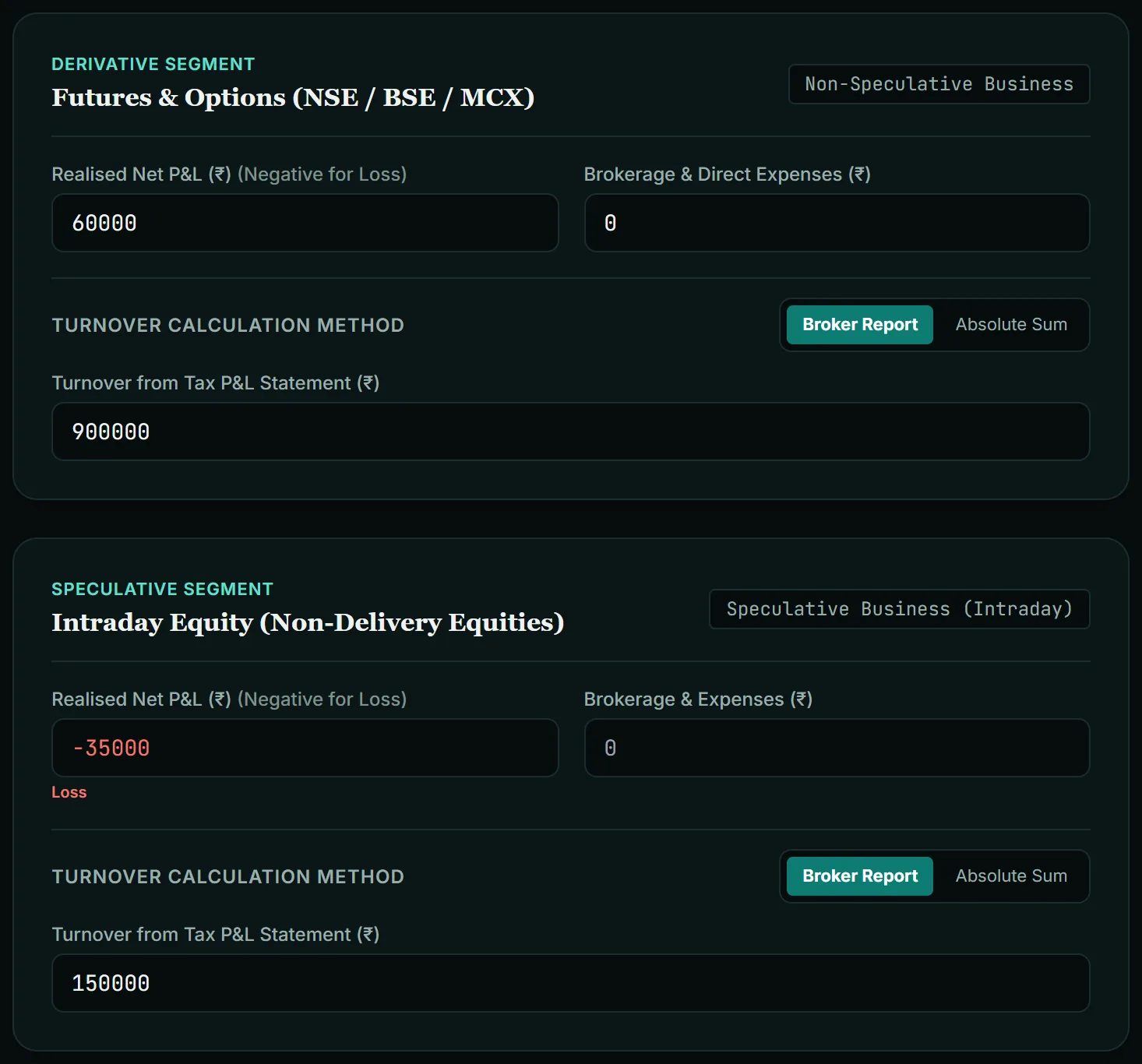
The F&O card opens with sample figures, so overwrite each field and set expenses to 0 to match this example. Fill the turnover on both cards: if turnover is left blank or is lower than the profit or loss, the tool shows a "Turnover looks too low" warning.
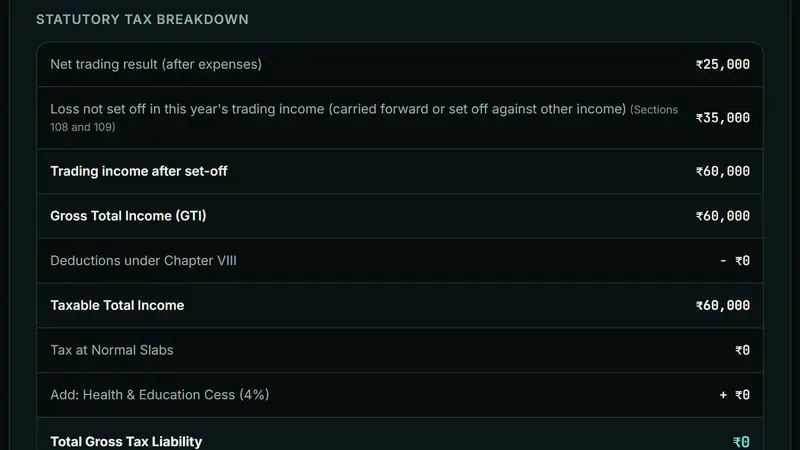
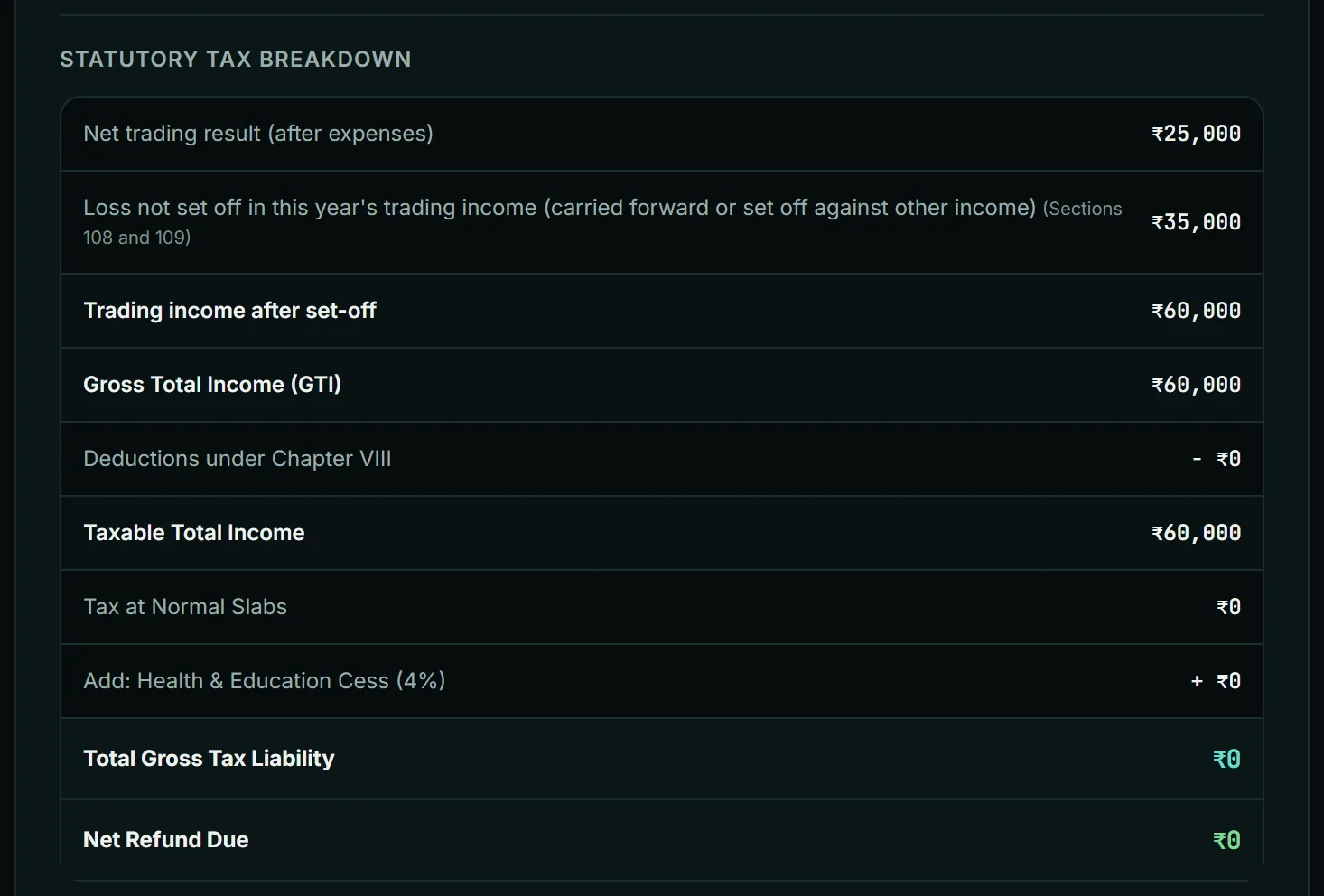
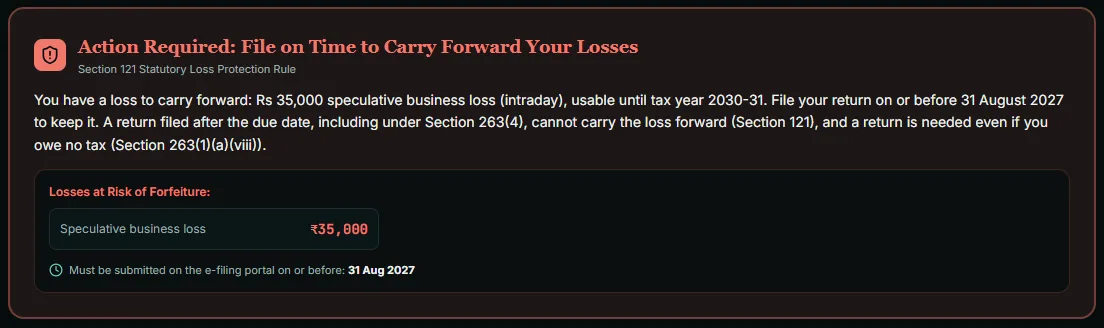
By hand: intraday is a speculation loss of Rs 35,000. F&O is non-speculative profit of Rs 60,000. Because s.113(1) lets a speculation loss be set off only against speculative profit, the Rs 35,000 cannot reduce the F&O profit. Trading income after set-off is Rs 60,000, and Rs 35,000 is carried forward as a speculation loss, usable against speculative profit until TY 2030-31 (four tax years after 2026-27), provided the return is filed on time.
The tool shows the same. "Trading income after set-off" is Rs 60,000, and the Rs 35,000 appears as a speculative business loss, usable until tax year 2030-31. You will also see "Net trading result (after expenses)" at Rs 25,000: that is just the two results added together, not the taxable figure, because the speculative loss cannot be set off against the F&O profit. The audit box shows "Tax Audit Not Required" (total turnover is far below the s.63 limit), and the What You File box shows ITR-3, since the business income is not computed under the presumptive provisions. The Loss Protection card then reminds you that the carry-forward is kept only if you file on or before the due date.
Three further personas with full numbers show delivery, F&O and a funded-trader case.
What this page does not cover
- It explains the rule for each bucket. It does not decide for you whether you are an investor or a trader, or which ITR form applies.
- The Trader Tax Calculator has no age selector, no foreign tax credit and no GST on prop payouts, so use it as a first read, not as the final return.
- Advance tax, interest and what to file are the next step after the calculation. That is the next article in this series, After the Calculator: Advance Tax and What Traders File.
- Tax audit due dates change by notification. Check the current CBDT notices on CBDT news rather than relying on a date quoted here.
Not reviewed by a Chartered Accountant. This is general information, not tax advice; consult a CA for your own return. Last reviewed October 2026, for tax year 2026-27. Your inputs are calculated in your browser and are not sent to our servers.
Next in series: After the Calculator: Advance Tax and What Traders File.
Quick answers
Things people usually want to know.
How is trading income taxed in India?
It depends on what you traded. Delivery-based equity is usually capital gains, intraday equity is speculative business income, and exchange-traded F&O is non-speculative business income. Each bucket has its own head of income, section and loss rule.
If I take a trade in F&O by selecting overnight and sell it on the same day, is it speculative or non-speculative?
Exchange-traded F&O is a specified derivative transaction under s.66(33) (s.43(5)), so it is not speculative whatever the holding period. Square-off on the same day does not turn it into speculative income. Confirm your own facts with your CA.
Is intraday trading income taxed as capital gains?
No. Intraday equity is settled without delivery, so it falls in the speculative transaction definition in s.66(31) (s.43(5)). The result is speculative business income, taxed at your slab rate, and kept separate from your other business.
Can I carry forward an intraday loss?
Yes, but only against speculative profit. s.113 (s.73) lets a speculation loss be carried forward for four tax years after the year it arose, and s.121 (s.80) requires the loss to be shown in a return filed by the due date under s.263(1).
Can an F&O loss be set off against salary?
No. A business loss cannot be set off against salary income under s.109(1)(a) (s.71). It can go against other heads such as capital gains or interest for that year, and the rest is carried forward up to eight tax years under s.112 (s.72).
Is STT deductible for traders?
STT is deductible under s.32(k) (s.36(1)(xv)) only when the trades are in the course of business and the income is business income. For delivery trades taxed as capital gains, STT is not deductible under s.72(3)(b) (s.48).
What is the tax rate on short-term and long-term gains on listed shares?
For STT-paid listed equity, short-term gains are taxed at 20% under s.196 (s.111A). Long-term gains above Rs 1,25,000 are taxed at 12.5% under s.198 (s.112A). Capital gains rates are before surcharge and cess.
Can I switch from showing equity trades as capital gains to business income?
Classification depends on facts such as frequency, intent and how you have reported in earlier years, and flipping between years invites questions. This is a judgement call, not a tick-box. Discuss it with your CA before you file.
How are prop firm payouts taxed in India?
There is no single settled answer. Some filers treat payouts as business income, others report them differently as foreign-source receipts. Foreign-currency conversion and Schedule FA reporting may also apply. Treat it as depends, and confirm with your CA.
Do currency and commodity trades follow the F&O rules?
Exchange-traded commodity derivatives that are chargeable to commodities transaction tax fit the specified derivative definition in s.66(33). For exchange-traded currency derivatives, confirm the wording with your CA. Contracts outside the definition and settled without delivery fall back to speculative.
More from HeyArtha
Other things we've been writing about.
Trader Tax Calculator India: Every Field, Card and PDF
How to use the trader tax calculator India traders need for 2026-27: what to type in each field, what every result card means, and what the PDF shows.
Trading Tax Examples India: Delivery, F&O and Prop Payout
Three trading tax example cases for India in 2026-27: salary with delivery, intraday and F&O; an options seller with a past loss; and USD prop payouts.
F&O Tax Mistakes India: Turnover, Audit, Schedule FA
15 F&O tax mistakes Indian traders make on turnover, audit limits, loss set-off, advance tax and Schedule FA, each with the rule and the fix. TY 2026-27.