
Property Capital Gains Worked Examples: 20% vs 12.5%
October 15, 2026 · 9 min read · by Shivam Kushwaha, HeyArtha founder
Capital Gains Preview
Compare 20% with indexation against 12.5% without indexation for one property sale.
A flat bought for ₹30 lakh sells for ₹65 lakh. Do you pay 20% after indexing the cost, or 12.5% on the plain gain? These property capital gains worked examples answer that with four sale prices, and the answer flips at a ratio you can calculate yourself. Every figure below is what the Capital Gains tool displays for the same inputs, and I recomputed each one by hand.
How do you compare 20% with indexation and 12.5% on a property sale?
For a resident individual or HUF selling land or a building bought before 23 July 2024, you work out tax two ways: 12.5% on the plain gain, and 20% on the gain after indexing the cost. Under s.197(3), the extra tax over the indexed figure is ignored, so you pay the lower of the two.
The rate sits in s.197(1)(b) of the Income-tax Act 2025 (s.112 of the 1961 Act). Subsection (3) gives the formula E = A − B, where A is tax at 12.5% and B is tax at 20% on a gain computed with the indexed cost of acquisition. Section 72(2) tells you to swap "cost of acquisition" for "indexed cost of acquisition" when computing B. The full rule, the dates and the holding-period test are in our guide to property capital gains: indexation vs 12.5%.
The calculation has four steps:
- Option B gain = sale price − purchase price. Tax = 12.5% of that.
- Indexed cost = purchase price × CII of the sale year ÷ CII of the purchase year.
- Option A gain = sale price − indexed cost. Tax = 20% of that, or nothing if the gain is negative.
- Compare the two taxes and take the lower.
The tool fixes the index pair at 254 for FY 2015-16 and 363 for FY 2024-25. That gives a multiplier of 363 ÷ 254 = 1.4291 (my arithmetic; the page shows the two index values, not the ratio). How the tool works is explained on its methodology page.
What do you type into the Capital Gains tool, and what does the result card show?
Two boxes only: Purchase Price (₹) and Sale Consideration (₹). The page describes itself as an educational estimate for immovable property acquired before 23 July 2024.
The result card then shows:
- Option A: 20% with CII indexation, the tax amount, with the Indexed Cost underneath.
- Option B: 12.5% flat rate (no indexation), the tax amount, with the Taxable Gain underneath.
- Lower of the two figures, the smaller of A and B.
The page also says both figures exclude cess and surcharge, and tax on your other income. It does not show a multiplier or the indexed gain. In the examples I calculate the indexed gain myself as sale price minus the displayed Indexed Cost, so you can follow the working.
Example 1: ₹40 lakh to ₹55 lakh, when indexation removes the tax
Type: Purchase Price 40,00,000, Sale Consideration 55,00,000.
| Line | Working | Tool shows |
|---|---|---|
| Indexed Cost | 40,00,000 × 1.4291 | ₹57,16,535 |
| Option A | Sale 55,00,000 is below indexed cost, so no indexed gain | ₹0 |
| Taxable Gain (Option B) | 55,00,000 − 40,00,000 | ₹15,00,000 |
| Option B | 15,00,000 × 12.5% | ₹1,87,500 |
| Lower of the two | ₹0 |
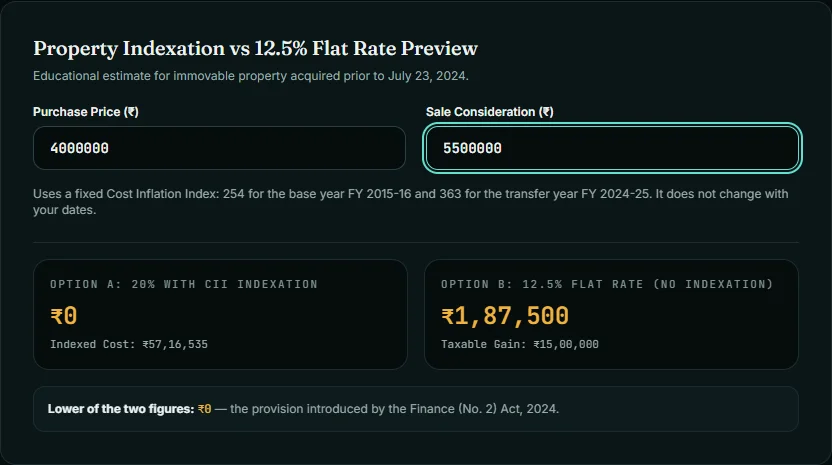
The sale price is only 1.375 times the purchase price, and inflation indexing alone lifts the cost past it. So Option A is ₹0 and the comparison picks it. The page shows ₹0 with no loss note.
One point worth stating plainly: your plain gain is still ₹15,00,000, so there is no loss on the ordinary computation. The ₹0 comes from comparing tax figures under s.197(3), not from a loss being created. If you are in this situation, ask your CA how the indexed shortfall is treated in your return.
Example 2: ₹20 lakh to ₹40 lakh, indexation wins
Type: Purchase Price 20,00,000, Sale Consideration 40,00,000.
| Line | Working | Tool shows |
|---|---|---|
| Indexed Cost | 20,00,000 × 1.4291 | ₹28,58,268 |
| Indexed gain | 40,00,000 − 28,58,268 | ₹11,41,732 (my working) |
| Option A | 11,41,732 × 20% | ₹2,28,346 |
| Taxable Gain (Option B) | 40,00,000 − 20,00,000 | ₹20,00,000 |
| Option B | 20,00,000 × 12.5% | ₹2,50,000 |
| Lower of the two | ₹2,28,346 |
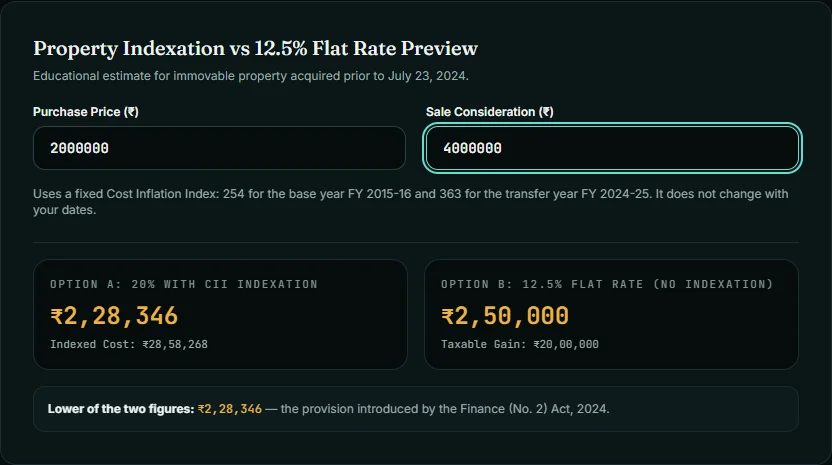
The sale price is double the purchase price. Indexation gives the lower figure by ₹21,654. The plain gain (₹20,00,000) is about 75% bigger than the indexed gain (₹11,41,732), but a 12.5% rate on the bigger gain is not enough to catch up with 20% on the smaller one. Notice that the rate gap does not decide this alone. The size of the indexed deduction does, and that depends on how far the index has moved between your two years.
Example 3: ₹30 lakh to ₹65 lakh, just past the crossover
Type: Purchase Price 30,00,000, Sale Consideration 65,00,000.
| Line | Working | Tool shows |
|---|---|---|
| Indexed Cost | 30,00,000 × 1.4291 | ₹42,87,402 |
| Indexed gain | 65,00,000 − 42,87,402 | ₹22,12,598 (my working) |
| Option A | 22,12,598 × 20% | ₹4,42,520 |
| Taxable Gain (Option B) | 65,00,000 − 30,00,000 | ₹35,00,000 |
| Option B | 35,00,000 × 12.5% | ₹4,37,500 |
| Lower of the two | ₹4,37,500 |
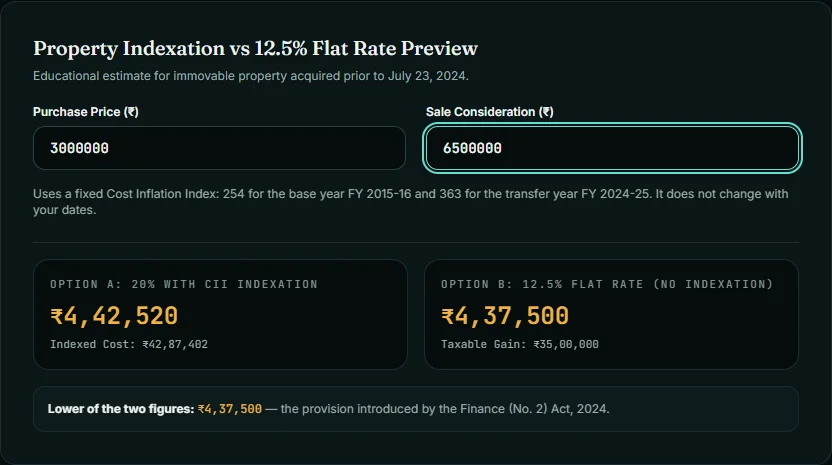
Here the sale price is about 2.17 times the purchase price. The lower figure switches to Option B, but only by ₹5,020. This is the zone where the choice barely matters, and where small differences in your real purchase and sale years can tip it either way.
Example 4: ₹60 lakh to ₹1.5 crore, 12.5% wins clearly
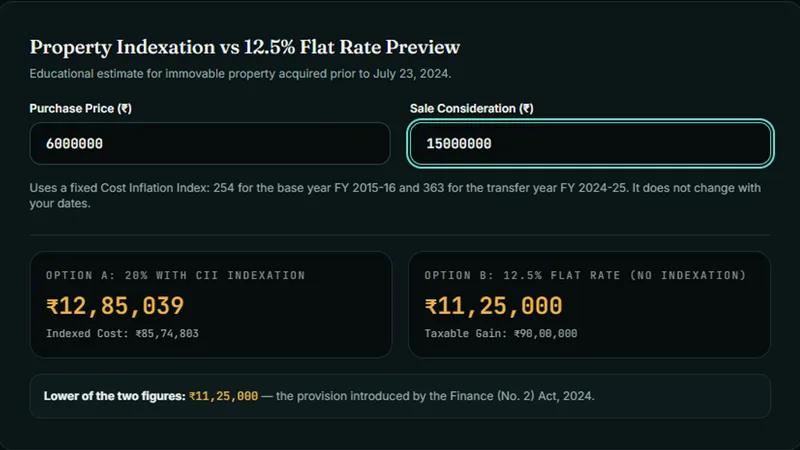
Type: Purchase Price 60,00,000, Sale Consideration 1,50,00,000.
| Line | Working | Tool shows |
|---|---|---|
| Indexed Cost | 60,00,000 × 1.4291 | ₹85,74,803 |
| Indexed gain | 1,50,00,000 − 85,74,803 | ₹64,25,197 (my working) |
| Option A | 64,25,197 × 20% | ₹12,85,039 |
| Taxable Gain (Option B) | 1,50,00,000 − 60,00,000 | ₹90,00,000 |
| Option B | 90,00,000 × 12.5% | ₹11,25,000 |
| Lower of the two | ₹11,25,000 |
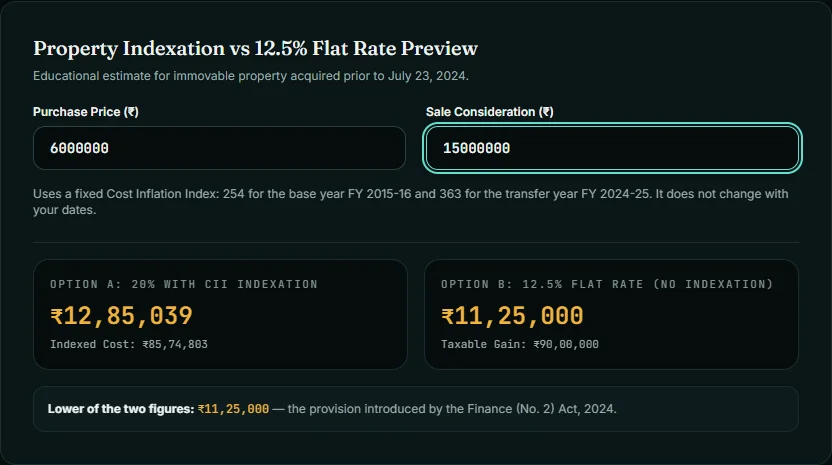
At 2.5 times the purchase price, the plain 12.5% route is lower by ₹1,60,039. The faster the property grew compared with the index, the less indexation helps.
Property capital gains worked examples side by side: what pattern do the four show?
| Purchase → Sale | Sale ÷ purchase | Option A | Option B | Lower shown | Gap |
|---|---|---|---|---|---|
| ₹40L → ₹55L | 1.375 | ₹0 | ₹1,87,500 | A: ₹0 | ₹1,87,500 |
| ₹20L → ₹40L | 2.0 | ₹2,28,346 | ₹2,50,000 | A: ₹2,28,346 | ₹21,654 |
| ₹30L → ₹65L | 2.167 | ₹4,42,520 | ₹4,37,500 | B: ₹4,37,500 | ₹5,020 |
| ₹60L → ₹1.5Cr | 2.5 | ₹12,85,039 | ₹11,25,000 | B: ₹11,25,000 | ₹1,60,039 |
The pattern depends on the ratio of sale price to purchase price, not on the rupee size. You can find the switch point yourself. Set 20% × (S − 1.4291P) equal to 12.5% × (S − P), where S is the sale price and P the purchase price. That gives 0.075 S = 0.1608 P, so S ≈ 2.144 P. Below about 2.14 times, Option A is lower. Above it, Option B is lower.
This holds for the tool's fixed index pair. With your actual purchase year and sale year the multiplier changes, and so does the switch point. Confirm the index values for your own years with your CA before you rely on any ratio.
Three things move your own answer more than anything else:
- The multiplier. A longer gap between purchase and sale year means a bigger index ratio, which pushes the switch point higher and makes indexation more useful. A short gap does the opposite.
- How much the price grew. Fast growth favours the flat 12.5% route. Slow growth, close to the index, favours indexation.
- Costs you add back. Improvement cost and transfer expenses reduce both gains. The tool leaves them out, so a real computation can land on either side of a close call like Example 3.
If your own ratio sits near 2.1 times, treat the two figures as roughly equal and spend your effort on the inputs rather than on the choice.
What does the tool not do?
Treat the output as a comparison, not a return. It leaves out:
- Costs other than the purchase price. No cost of improvement and no expenditure on the transfer, both of which s.72(1) allows as deductions.
- Your real dates. The index pair is fixed, so purchase and sale years do not change the multiplier.
- Cess, surcharge and other income. Also the basic-exemption adjustment for residents in s.197(2).
- Exemptions. For example s.85, which can leave gains uncharged when invested within six months in specified bonds, capped at ₹50 lakh under the Act.
- Holding-period checks and post-23-July-2024 purchases. It assumes a long-term asset acquired before that date.
- Loss handling. A negative indexed gain simply shows ₹0.
Last reviewed: October 2026. Tax year: 2026-27. All numbers use the tool's fixed index pair of 254 and 363.
Once the sale is done and the gain is known, the next question is when to pay. Next in series: how advance tax instalments and interest work. If the proceeds are going into a purchase and you are weighing cash against a loan, cash vs loan: pay upfront or take an EMI shows the same style of worked comparison. More tool guides are on the blog hub.
Sources: Income-tax Act 2025 as amended by the Finance Act 2026, s.72, s.85 and s.197; the HeyArtha Capital Gains tool; Section 197, Income-tax Act 2025.
Quick answers
Things people usually want to know.
Is indexation still available on property in India after July 2024?
For a resident individual or HUF selling land or a building bought before 23 July 2024, s.197(3) ignores any tax above the 20%-with-indexation figure, so you pay the lower of two numbers. For property bought on or after that date, only the 12.5% route applies.
What is the tax rate on long-term capital gains on property?
Section 197(1)(b) of the Income-tax Act 2025 sets 12.5% on long-term capital gains. For eligible pre-23-July-2024 property, the extra over a 20% indexed calculation is ignored. These figures exclude cess, surcharge and your other income.
How do I calculate the indexed cost of acquisition?
Multiply the purchase cost by the Cost Inflation Index of the sale year and divide by the index of the purchase year. The HeyArtha tool fixes 254 (FY 2015-16) and 363 (FY 2024-25), a multiplier of about 1.4291.
At what sale price does 12.5% beat indexation?
With the tool's fixed index pair, 12.5% starts to give the lower tax when the sale price is above roughly 2.14 times the purchase price. Below that ratio, indexation gives the lower figure. Your own years change the multiplier, so recheck with your CA.
Can indexation create a capital loss on a property sale?
In the tool's comparison, a larger indexed cost than the sale price simply shows ₹0 for Option A. Your plain gain is still positive, so the comparison does not produce a loss. How an indexed shortfall is treated in your case is a question for your CA.
Does the Capital Gains tool include cess and surcharge?
No. The page states that both figures exclude cess and surcharge, and tax on your other income. Treat the output as the base capital gains tax comparison, then add your own cess, surcharge and other-income effects separately.
Does the tool include improvement cost or transfer expenses?
No. The tool accepts only a purchase price and a sale consideration. Section 72(1) allows expenditure on the transfer and the cost of improvement as deductions, so a real computation can differ. Add those with your CA before relying on a figure.
Can I reduce property capital gains tax by investing in bonds?
Section 85 of the Income-tax Act 2025 can leave gains uncharged if invested within six months in specified long-term bonds, with a cap of ₹50 lakh. Conditions apply, and the tool does not model it. Confirm eligibility with your CA.
Why does Option A show ₹0 in some cases?
Option A indexes the purchase cost upward. When that indexed cost is higher than the sale price, there is no indexed gain to tax at 20%, so the tool shows ₹0 and picks it as the lower figure. Example 1 above shows this.
Is the HeyArtha Capital Gains tool a substitute for a CA?
No. It is an educational comparison for one property sale using a fixed index pair. Actual tax depends on your purchase and sale years, expenses, exemptions and other income. Use it to understand the rule, then confirm your figures with a Chartered Accountant.
More from HeyArtha
Other things we've been writing about.
Property Capital Gains: Indexation vs 12.5% (2026-27)
Property capital gains tax India 2026-27: compare 20% with indexation against 12.5% without, with the rule (s.197(3)), worked numbers and limits.
Cash vs Loan: Pay Upfront or Take an EMI? (2026-27)
Cash vs loan calculator India 2026-27: how paying upfront compares with an EMI plus investing the rest, with worked numbers, tax rules and limits.
After the Calculator: Advance Tax and What Traders File (2026-27)
Advance tax for traders in India, 2026-27: the Rs 10,000 test, four instalment dates, s.424 and s.425 interest, which ITR form applies and a records checklist.