
How Much Down Payment Should You Put on a Car Loan? (2026-27)
October 15, 2026 · 9 min read · by Shivam Kushwaha, HeyArtha founder
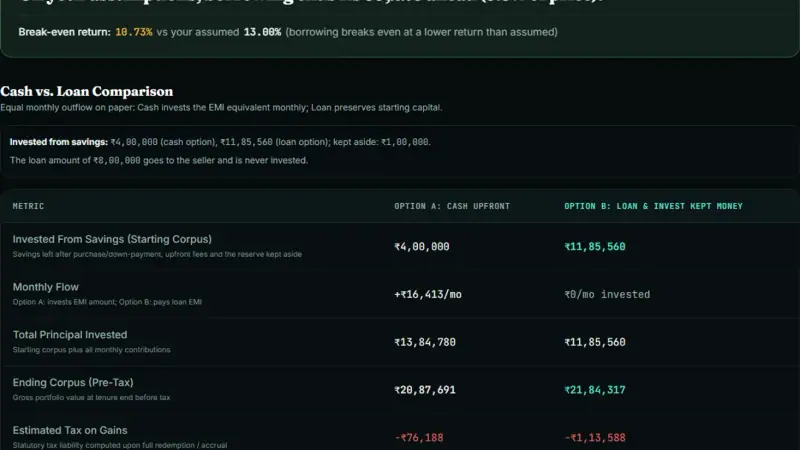
Cash vs Loan Calculator
Compare paying in cash against taking a loan while your money stays invested. Break-even return, taxes and a bad-luck test, all shown.
A dealer's finance desk usually asks one question first: how much will you put down? It sounds like a form field. It is really a choice between keeping money in your hands and sending it to the dealer today. This guide shows what that choice does to your wealth at the end of the loan, using four down payments on the same ₹10 lakh car. Every number comes from the Cash vs Loan Calculator, and I recomputed each one by hand.
How much down payment should you put on a car loan?
There is no universal answer. In the calculator, the down payment decides how much you borrow, and the loan amount decides how big the gap between cash and loan can get. On a ₹10 lakh car with the assumptions below, borrowing came out ahead by ₹67,712 at ₹1 lakh down and by only ₹8,309 at ₹8 lakh down. The tool does not tell you to borrow or avoid borrowing.
If you have read the main Cash vs Loan guide, this article zooms into one input. If you have not, read its section on how the two options are built first. It takes five minutes.
What stays fixed and what changes
I kept everything the same except the down payment, so any change in the result comes from that one input.
| Input | Value |
|---|---|
| Car price | ₹10,00,000 |
| Savings | ₹15,00,000 |
| Emergency reserve (stays as plain cash) | ₹1,00,000 |
| Loan rate and tenure | 8.5% for 60 months |
| Where invested money goes | Equity or index funds at 13% a year |
| Other upfront costs | ₹5,000 |
| Processing fee | 1% of the loan, plus 18% GST on the fee |
| Investing discipline | The tool's default (all of the monthly amount is invested) |
The two options are built the same way as in the main guide. In the cash option you pay ₹10 lakh from savings and invest what is left after the reserve, which is ₹4,00,000 in every case. You also invest each month the amount you would have paid as EMI. In the loan option you pay the down payment, the fee and the other costs, keep the reserve, and invest everything else. The loan amount itself is never invested.
The 13% is an assumption I picked so the tool has something to compute. It is not a forecast. I come back to this because it drives the whole result.
Four down payments on the same car
Here are the four cases side by side. Each row is its own comparison of cash against loan. Do not compare the cash column across rows, because a bigger down payment means a smaller EMI, and the cash buyer's monthly investing follows the EMI.
| Down payment | Share of price | Loan | EMI | Upfront costs | Net wealth, cash | Net wealth, loan | Borrowing ahead by | Gap as % of price | Break-even return |
|---|---|---|---|---|---|---|---|---|---|
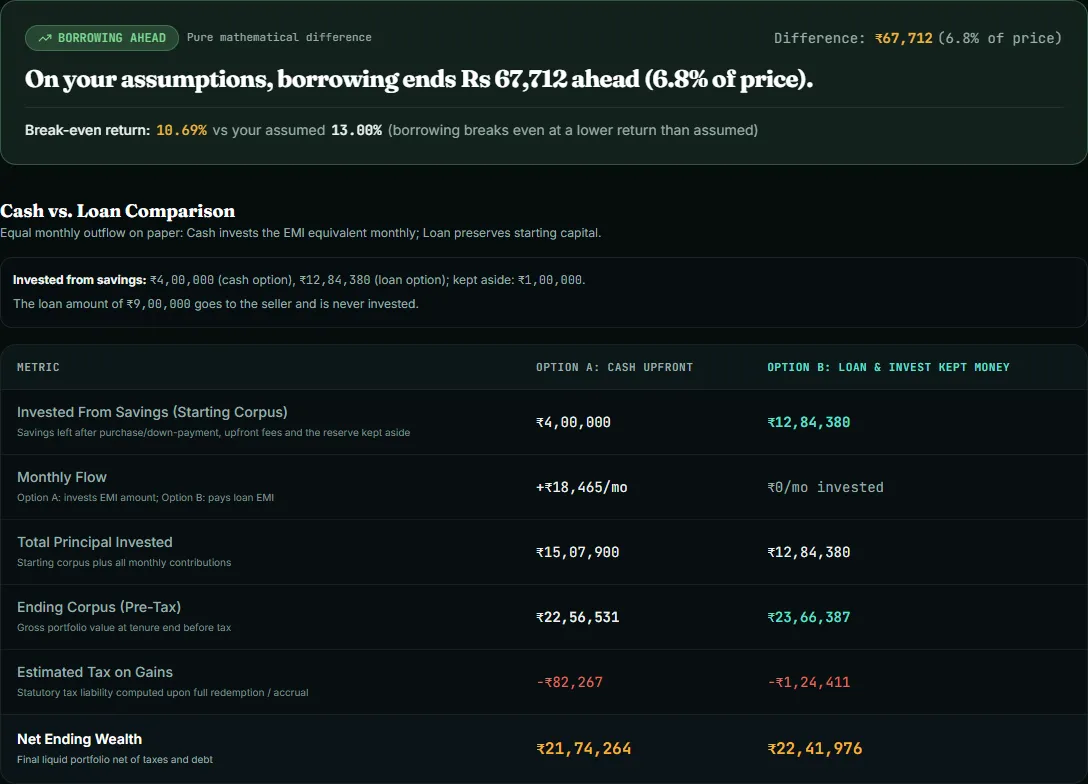
| ₹1,00,000 | 10% | ₹9,00,000 | ₹18,465 | ₹15,620 | ₹21,74,264 | ₹22,41,976 | ₹67,712 | 6.8% | 10.69% |
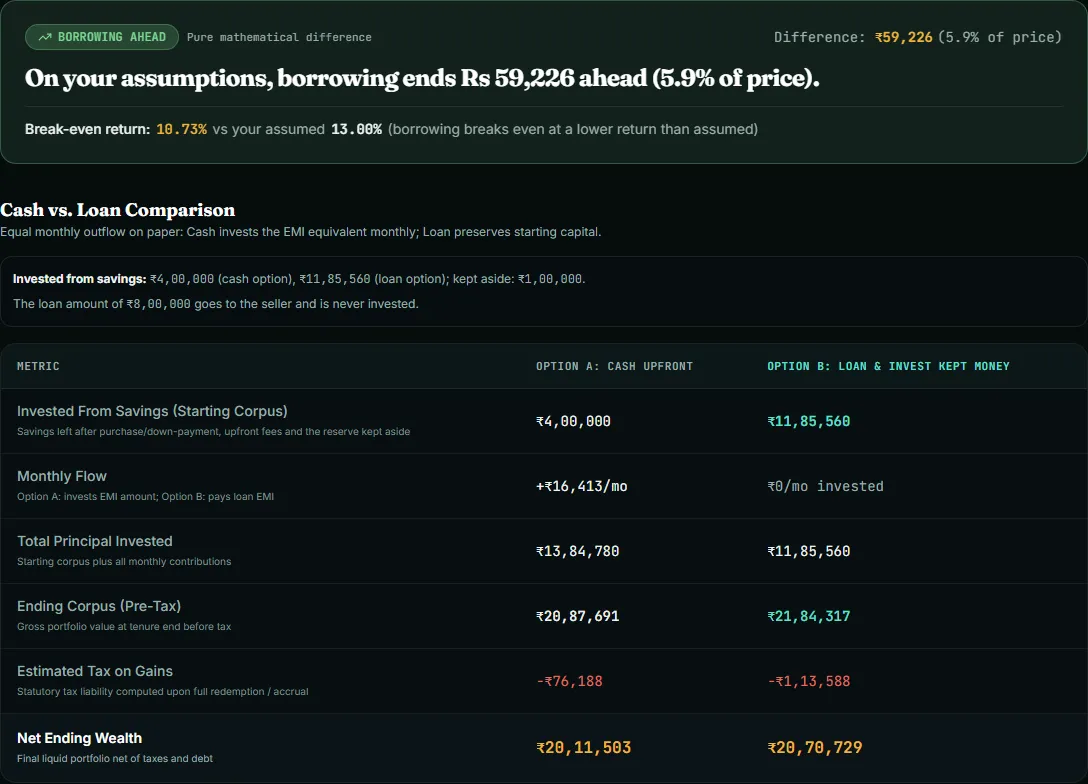
| ₹2,00,000 | 20% | ₹8,00,000 | ₹16,413 | ₹14,440 | ₹20,11,503 | ₹20,70,729 | ₹59,226 | 5.9% | 10.73% |
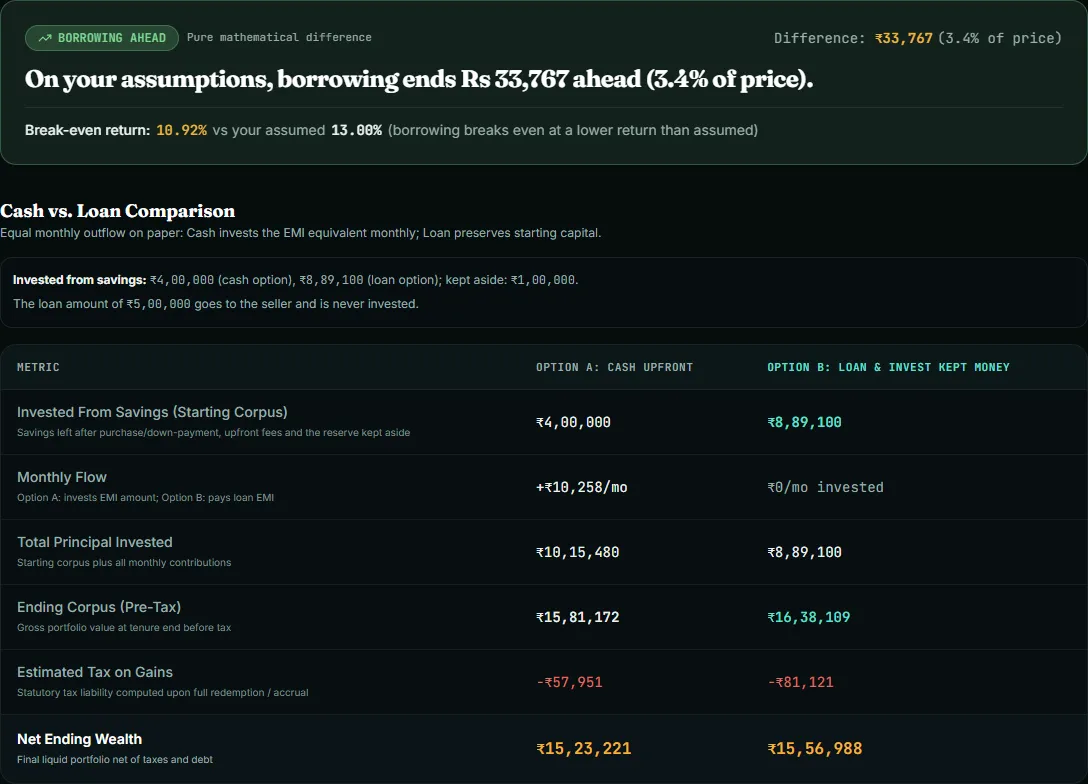
| ₹5,00,000 | 50% | ₹5,00,000 | ₹10,258 | ₹10,900 | ₹15,23,221 | ₹15,56,988 | ₹33,767 | 3.4% | 10.92% |
| ₹8,00,000 | 80% | ₹2,00,000 | ₹4,103 | ₹7,360 | ₹10,34,938 | ₹10,43,247 | ₹8,309 | 0.8% | 11.71% |
Net wealth means the value of the invested pot at the end of the loan, after tax on gains.
These are the calculator's own results for the four cases, in the same order as the table.
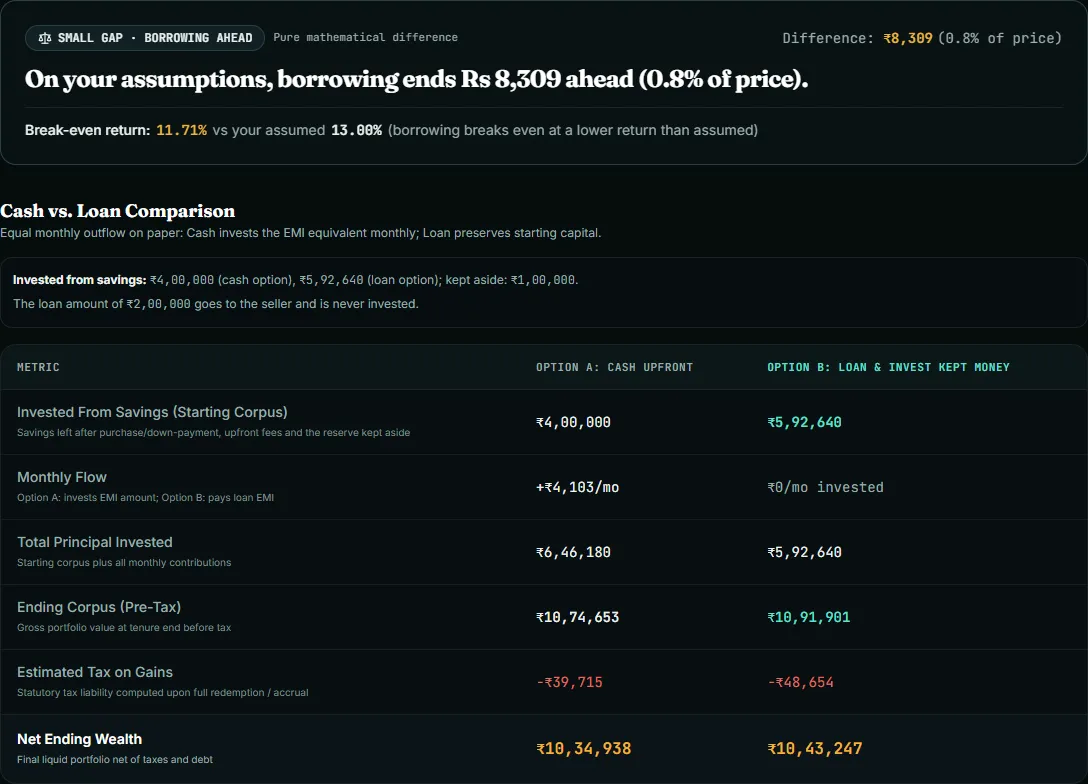
Working for the ₹2 lakh case
This case is the same as Case 1 in the main guide, so you can check it against that article. The loan is ₹8,00,000. The monthly rate is 8.5% divided by 12, and the EMI over 60 months is ₹16,413. Total interest is the EMI times 60 less the loan, which is about ₹1,84,794 when the unrounded EMI (₹16,413.23) is used. Upfront costs are 1% of ₹8,00,000 = ₹8,000, plus 18% GST on that = ₹1,440, plus ₹5,000 of other costs, which gives ₹14,440.
The loan option starts with ₹15,00,000 − ₹1,00,000 − ₹2,00,000 − ₹14,440 = ₹11,85,560 invested. The cash option starts with ₹4,00,000 and adds ₹16,413 every month. After 60 months and tax at the rates the tool uses, the cash option ends at ₹20,11,503 and the loan option at ₹20,70,729. The gap is ₹59,226.
Working for the ₹8 lakh case
The loan is ₹2,00,000 and the EMI is ₹4,103. Total interest is about ₹46,198 when the unrounded EMI (₹4,103.31) is used. Upfront costs are ₹2,000 fee plus ₹360 GST plus ₹5,000 = ₹7,360. The loan option starts with ₹5,92,640 invested. The gap at the end is ₹8,309, which is 0.8% of the car's price. The tool labels this case "Small gap · Borrowing ahead" because the gap is under 2% of the price, so it does not present it as a clear win for borrowing.
Why the gap shrinks, and the break-even that decides it
The result in this tool comes from one comparison: the loan costs 8.5% a year, and the money you keep invested is assumed to earn 13%. Each borrowed rupee is a bet on that difference, after tax and fees.
A bigger down payment means fewer borrowed rupees. The loan falls from ₹9 lakh to ₹2 lakh across the four cases, and the gap falls from ₹67,712 to ₹8,309. The fee falls with the loan too, from ₹15,620 to ₹7,360 in upfront costs.
This is worth saying plainly. Borrowing stays ahead in all four cases only because the tool assumes 13%. The tool is not telling you that a small down payment is wise. It is telling you what the arithmetic gives if 13% actually happens.
The break-even return is the yearly return at which cash and loan end with the same net wealth. Look at the last column of the table: 10.69%, 10.73%, 10.92% and 11.71%.
If you expect your invested money to earn more than the break-even for your down payment, the model says borrowing wins. If you expect less, cash wins. The break-even moves up as the down payment grows, because with a small loan there is less room for the investment return to beat the interest cost plus fees.
So the question to ask is not "what is the best down payment?" It is "what do I honestly expect my invested money to earn after tax, and by how much does that clear the break-even?" Anyone who expects a bank FD rate would compare against a very different number. In the main guide, the FD case showed borrowing behind, even at a 10% loan rate.
The tool also has a rule for results that sit too close to call. When the break-even is within one percentage point of the return you assumed, it says "Too close to call" and does not name a winner. Our four cases were not that close, but you will see the label as you change the return.
What the 20/4/10 guardrail says about these cases
The tool carries a guardrail panel based on a common rule of thumb called 20/4/10: put down at least 20% of the price, keep the loan to 4 years or less, and keep the EMI under 10% of your income. It is a rule of thumb. No statute sets it. To test other money rules against your own numbers, try the Principle Check calculator.
All four of our cases show Stretched. We used a 60-month tenure, which is longer than 4 years, so every case trips the tenure check. The ₹1 lakh case, at 10% down, also falls under the 20% mark.
The guardrail does not know your income, so the 10% EMI check needs your own figure. Notice what this means for the exercise. A tool can show that borrowing is ahead in rupees and still flag the loan as stretched. Those are two different questions: what the arithmetic says, and whether the monthly outflow is comfortable for you.
How to test your own down payment
Open the Cash vs Loan Calculator and type the following to reproduce the ₹2 lakh case: price ₹10,00,000, savings ₹15,00,000, down payment ₹2,00,000, emergency reserve ₹1,00,000, loan rate 8.5%, tenure 60 months, equity return 13%, other costs ₹5,000. You should see an EMI of ₹16,413, upfront costs of ₹14,440 and borrowing ahead by ₹59,226 (5.9% of the price). If you do not, one of the inputs differs.
Then change only the down payment and watch three numbers: the gap, the break-even return and the guardrail. Next, lower the equity return until the label flips. That is the point where the answer depends on your own expectation, not on the tool.
For how the numbers are built, read the Cash vs Loan methodology and the sources page.
Limits: what this does not tell you
- The inputs are assumptions. The 13% return and the 8.5% loan rate are not forecasts, and interest-rate cycles are not predicted.
- The tool assumes a personal car loan with no tax deduction on the interest. A car used for business can be treated differently.
- Tax on the invested pot uses the rates for 2026-27: 20% on short-term equity gains (s.196, earlier s.111A), 12.5% on long-term gains above ₹1.25 lakh (s.198, earlier s.112A), plus 4% cess. Surcharge is not modelled.
- The 18% GST on the processing fee is the tool's assumption. Your sanction letter has the actual charge.
- The tool does not model a prepayment charge, a foreclosure charge, insurance, fuel or the car's resale value.
- It does not cover commercial vehicles, rental use, home loans or joint borrowers.
- It does not tell you what to do. Neither the tool nor this guide has been reviewed by a Chartered Accountant, and I am a CA Intermediate student, not a CA.
Before you decide
Treat the down payment as two questions. First: how much monthly outflow can you carry comfortably? The EMI column helps there, and the guardrail panel makes you think about it. Second: what return do you honestly expect, after tax, on the money you would keep? The break-even column helps there.
For the tax side of the invested money, the property capital gains guide explains how the 12.5% and indexation choice works, and how trading income is taxed covers the line between investing and trading. For rupee-by-rupee numbers on a property sale, see Property Capital Gains Worked Examples: 20% vs 12.5%. Rules for equity gains are on the Income Tax Department website. You can also browse all HeyArtha guides.
Last reviewed: October 2026, for tax year 2026-27. Rates, slabs and rules can change with each Finance Act, so check the current ones before you decide.
Next in series: After the calculator: advance tax and what traders file. If your invested pot comes from active trading, that guide shows how the tax on it is paid during the year.
What number did you type into the down payment box first, and did it change after you saw the break-even?
Quick answers
Things people usually want to know.
How much down payment should I put on a car loan in India?
There is no single right number. The Cash vs Loan Calculator shows how the gap between paying cash and borrowing changes as the down payment moves. In our four cases it fell from ₹67,712 at ₹1 lakh down to ₹8,309 at ₹8 lakh down.
Is 20% a good down payment for a car?
The calculator's 20/4/10 guardrail uses 20% down, a loan of at most 4 years and an EMI of at most 10% of income. It is a rule of thumb, not a legal rule. At 20% down on a ₹10 lakh car, the down payment is ₹2 lakh.
Does a bigger down payment always save money?
Not in the tool's arithmetic. Because it assumes 13% on invested money against an 8.5% loan, borrowing stays ahead at every down payment we tried. A bigger down payment only shrinks that gap. If your real return is lower than the break-even, the result flips.
What is the break-even return in the Cash vs Loan Calculator?
It is the yearly return on invested money at which cash and loan end with the same net wealth. In our four cases it moved from 10.69% at ₹1 lakh down to 11.71% at ₹8 lakh down, against an assumed 13%.
Why does the gap shrink when I put more money down?
A bigger down payment means a smaller loan. Fewer borrowed rupees are working at the difference between the assumed investment return and the loan rate, so the possible gain, or loss, gets smaller.
Do processing fees change with the down payment?
Yes. The tool applies the processing fee, plus 18% GST on it, to the loan amount, so a smaller loan means a lower fee. In our cases upfront costs fell from ₹15,620 to ₹7,360 as the down payment rose. Check your sanction letter for the real fee.
Why does the tool show Stretched for all four cases?
The 20/4/10 guardrail checks tenure against 4 years, and we used 60 months. Every case therefore shows Stretched. The case with ₹1 lakh down also falls below the 20% down payment mark.
Does the calculator tell me to take the loan?
No. It reports each option's net wealth after tax and fees, and the rupee gap. The inputs are assumptions, not forecasts, and the result depends on them. It is arithmetic, not advice.
Is the loan interest on a personal car loan tax deductible?
The tool assumes no deduction for interest on a personal car loan. If you use the car for business, the position can differ. Confirm with your CA before relying on any deduction.
Are my inputs sent anywhere?
The site does use analytics and advertising, and the feedback box sends what you type into it. Read the privacy page for what the site collects before you enter personal figures.
More from HeyArtha
Other things we've been writing about.
Cash vs Loan: Pay Upfront or Take an EMI? (2026-27)
Cash vs loan calculator India 2026-27: how paying upfront compares with an EMI plus investing the rest, with worked numbers, tax rules and limits.
Property Capital Gains: Indexation vs 12.5% (2026-27)
Property capital gains tax India 2026-27: compare 20% with indexation against 12.5% without, with the rule (s.197(3)), worked numbers and limits.
After the Calculator: Advance Tax and What Traders File (2026-27)
Advance tax for traders in India, 2026-27: the Rs 10,000 test, four instalment dates, s.424 and s.425 interest, which ITR form applies and a records checklist.