
F&O Tax Mistakes India: Turnover, Audit, Schedule FA
October 15, 2026 · 11 min read · by Shivam Kushwaha, HeyArtha founder
Trader Tax Calculator
Compute tax on equity delivery, intraday speculation and F&O derivatives with FIFO lot matching, turnover and multi-head income consolidation.
F&O tax trouble often starts well before March. It can start in the broker's P&L file, when someone sees "turnover" printed next to a number that is not the turnover the Income-tax Act cares about. Then the audit question, the ITR form and the loss carry-forward all inherit that one wrong number.
This guide goes through 15 F&O tax mistakes in India, in the order they usually bite. Each one has the rule, the section and what to do instead. Numbers are for tax year 2026-27 (assessment year 2027-28), and the 2025 Act section comes first with the 1961 section in brackets. I am a CA Intermediate student, not a CA, so treat this as a map of the rules and not as advice for your return.
What are the common F&O tax mistakes in India?
The mistakes that decide whether you are audited and whether your loss survives are: counting notional value as turnover, treating F&O as capital gains, mixing intraday and F&O losses, and missing the return in a loss year. Several of the others are narrower versions of these four.
Here is the full list in one place. The rest of the article takes them in groups.
| # | Mistake | The rule | Section |
|---|---|---|---|
| 1 | Using notional value as turnover | Absolute total of differences | ICAI Guidance Note on Tax Audit |
| 2 | Mixing or splitting turnover wrongly | Separate businesses for loss rules; turnover test read on the total (confirm) | s.26(3), s.63 |
| 3 | Ignoring the cash test | Rs 10 crore limit needs cash at 5% or less | s.63(1) (s.44AB) |
| 4 | Quoting the wrong thresholds | Rs 1 crore business, Rs 10 crore with cash test | s.63(1) |
| 5 | Falling into the presumptive trap | Lower-than-deemed profit can trigger audit | s.58(2), s.63 |
| 6 | Picking the wrong ITR | Business income needs the business form | Form instructions |
| 7 | Reporting F&O as capital gains | F&O is business income | s.66(33), s.26(3) |
| 8 | Setting intraday loss against F&O profit | Speculation loss only against speculation profit | s.113 (s.73) |
| 9 | Putting an F&O loss under the speculative head | Non-speculative loss runs 8 years, speculative 4 | s.112, s.113 |
| 10 | Copying F&O rules to currency derivatives | Read the carve-out for your contract | s.66(33) |
| 11 | Switching classification year to year | Pick a position and stay consistent | Confirm with CA |
| 12 | Missing the return in a loss year | Loss needs a return filed on time | s.121 (s.80) |
| 13 | Paying advance tax late | Rs 10,000 test and interest | s.404, s.424, s.425 |
| 14 | Leaving out a foreign broker account | Schedule FA reporting | Form instructions |
| 15 | Assuming prop payouts are untaxed | Classification is contested | Rule 206 if business income |
Turnover mistakes: notional value, mixing and the cash test
Mistake 1: using notional value as turnover. Some guides say turnover is the contract value times quantity. That is wrong for tax audit. The ICAI Guidance Note on Tax Audit takes the absolute total of favourable and unfavourable differences. Premium received on sold options is also part of the ICAI method, with care taken not to count it twice if it is already in the net profit. I could not check the paragraph numbers against ICAI's own document, so I am not citing any, for derivatives or for intraday and delivery turnover. Read the current edition or ask your CA.
Mistake 2: mixing or splitting turnover wrongly. Intraday equity and F&O are separate businesses under s.26(3) (s.28 / 43(5)), and the loss rules follow that split. The audit limit in s.63 is worded around turnover "in business", so I read it as a test on the total. That is my reading of the text, not a settled rule. Work out each figure and the sum. If your number sits near the line, ask your CA before you decide it does not apply.
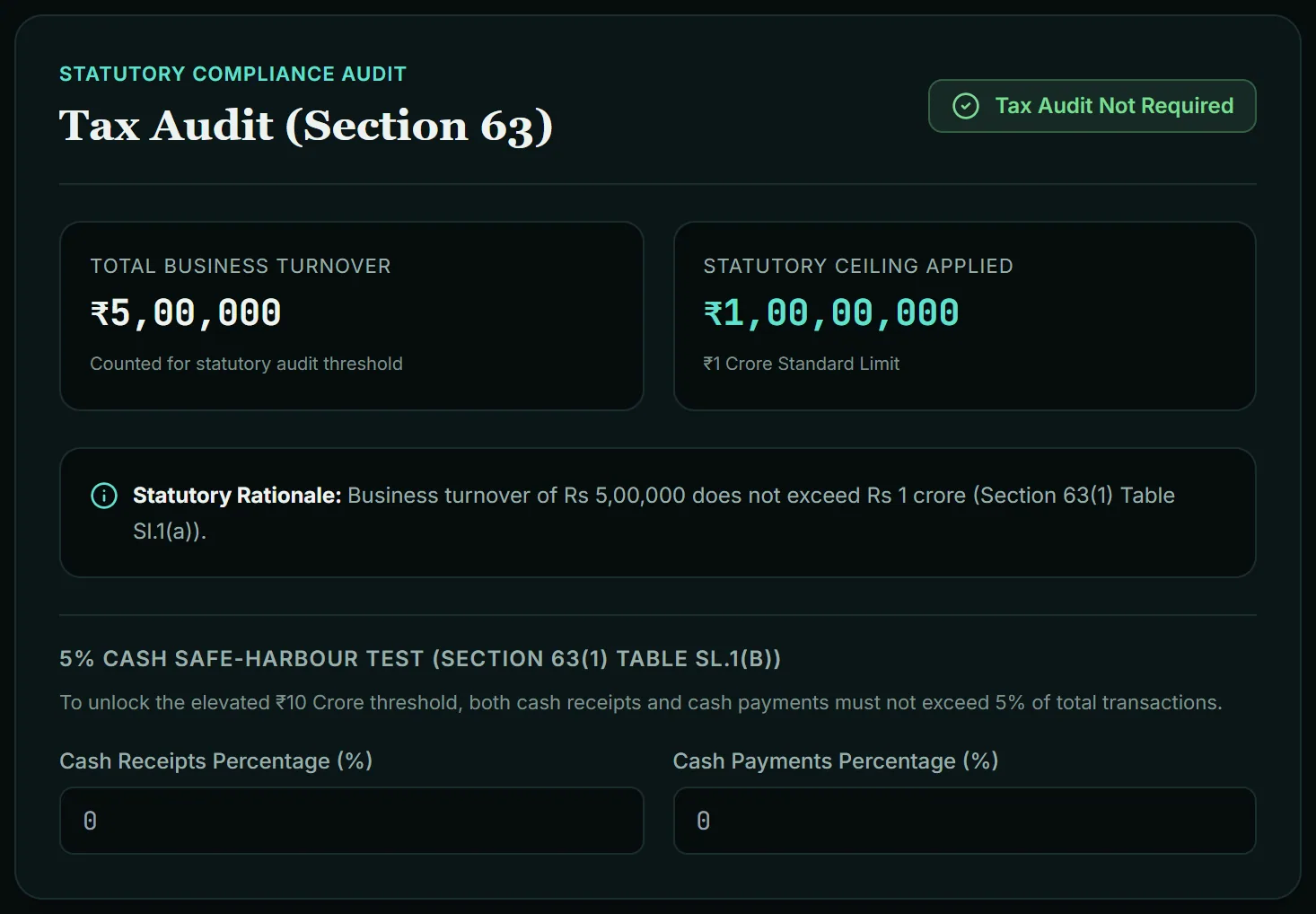
Mistake 3: ignoring the cash test. The Rs 10 crore limit is not automatic. It applies only if cash receipts and cash payments are each 5% or less. Check your own cash receipts and payments instead of assuming the test is met.
Type this: turnover is not notional value
Take four F&O trades closed in a year. The differences are +Rs 2,40,000, −Rs 1,10,000, +Rs 65,000 and −Rs 85,000.
- Turnover (absolute total of differences): 2,40,000 + 1,10,000 + 65,000 + 85,000 = Rs 5,00,000
- Net profit: 2,40,000 − 1,10,000 + 65,000 − 85,000 = Rs 1,10,000
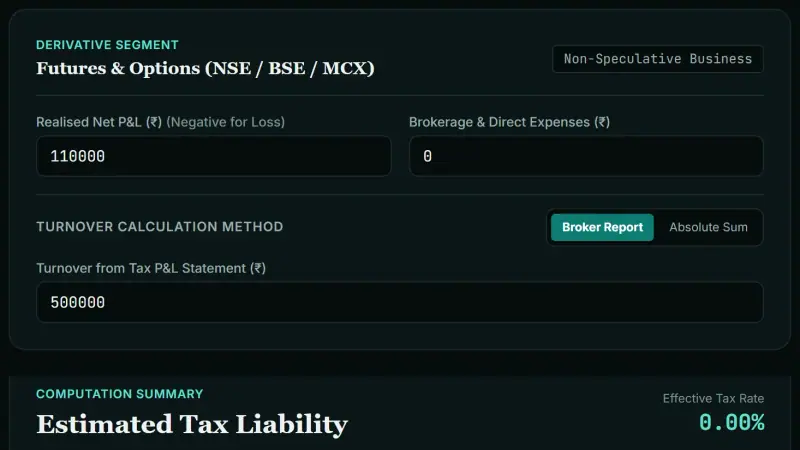
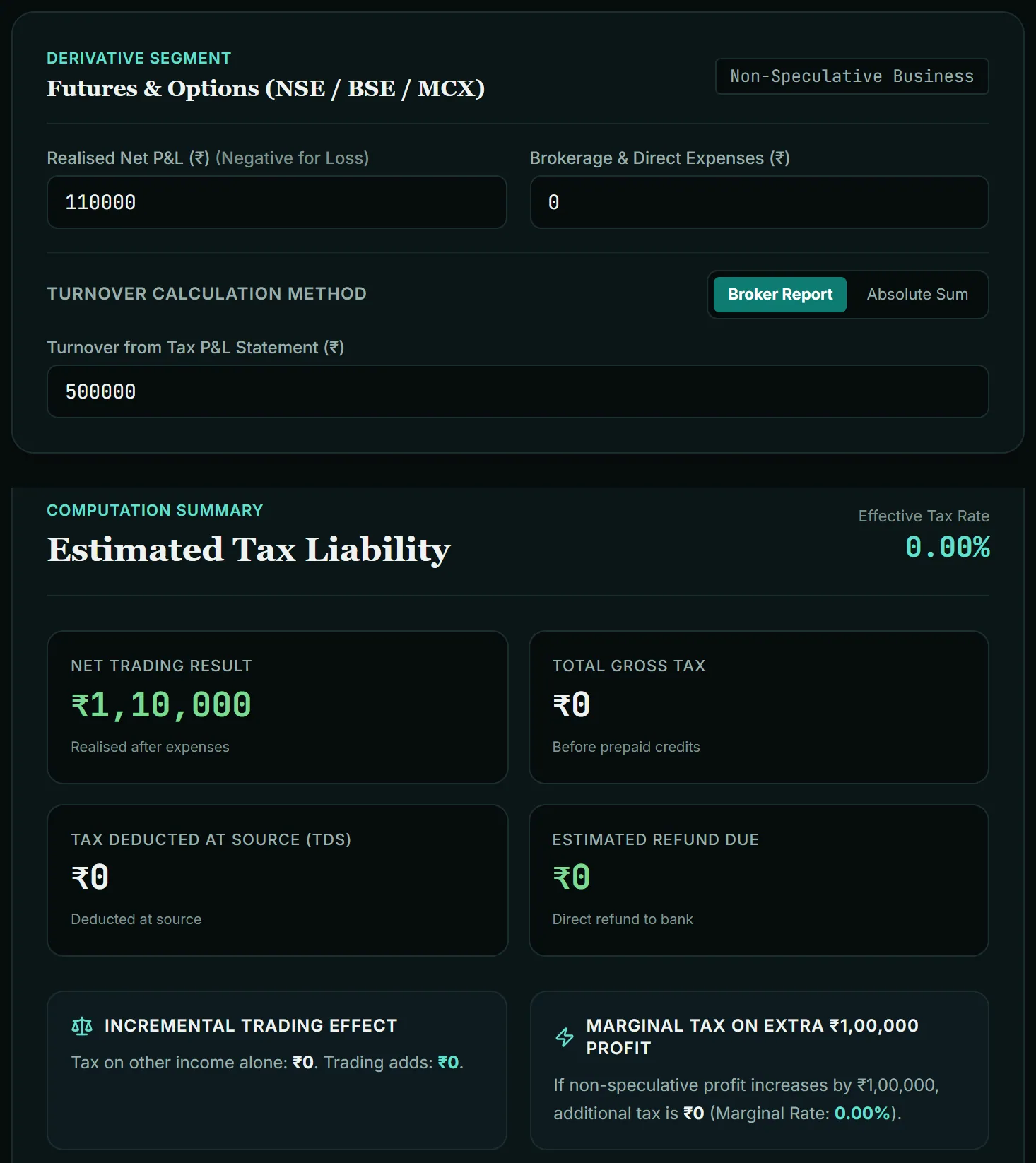
If each trade was on a futures lot worth Rs 15 lakh, a notional count would say 4 × 15,00,000 = Rs 60 lakh for the same Rs 1.1 lakh profit. That is the number that scares people into an audit they do not need, or the reverse mistake when a real figure is understated. To repeat this in the calculator, put 5,00,000 in the turnover field and 1,10,000 in Realised Net P&L. The tool pre-fills a sample Brokerage & Direct Expenses of Rs 25,000, so set it to 0 to match this hand example. Enter your own figures in the trader tax calculator and read the result against the rule on the methodology page. The calculator field guide lists every input in the order the page shows it.
Audit mistakes: thresholds, the presumptive trap and the ITR form
Mistake 4: quoting the wrong thresholds. Online guides contradict each other: Rs 1 crore with 8%, Rs 2 crore with 6%, Rs 3 crore. The 6% and 8% rates and the Rs 2 crore and Rs 3 crore limits are the presumptive figures in the s.58(2) (s.44AD) Table, not the audit limit. The audit limit in s.63(1) (s.44AB) is business turnover above Rs 1 crore, or Rs 10 crore if the cash test is met, and Rs 50 lakh for a profession. Treat anything else as a different rule.
Mistake 5: falling into the presumptive trap. Declaring profit under s.58(2) (s.44AD) takes you out of the audit Table (s.63(2)). But if you claim presumptive profit lower than the deemed figure, the Table brings audit back. Whether presumptive is open to an F&O trader at all is something to settle with your CA, not by copying a competitor's blog.
Mistake 6: choosing the wrong ITR. F&O profit or loss is business income, so a form meant only for salary and capital gains is the wrong one. I could not verify the 2026-27 forms as notified. Read the instructions on the ITR page at the time you file, and do not assume last year's form number. The calculator's What You File box shows what it expects you to file for your inputs. Treat it as a pointer and check it against the form instructions in force.
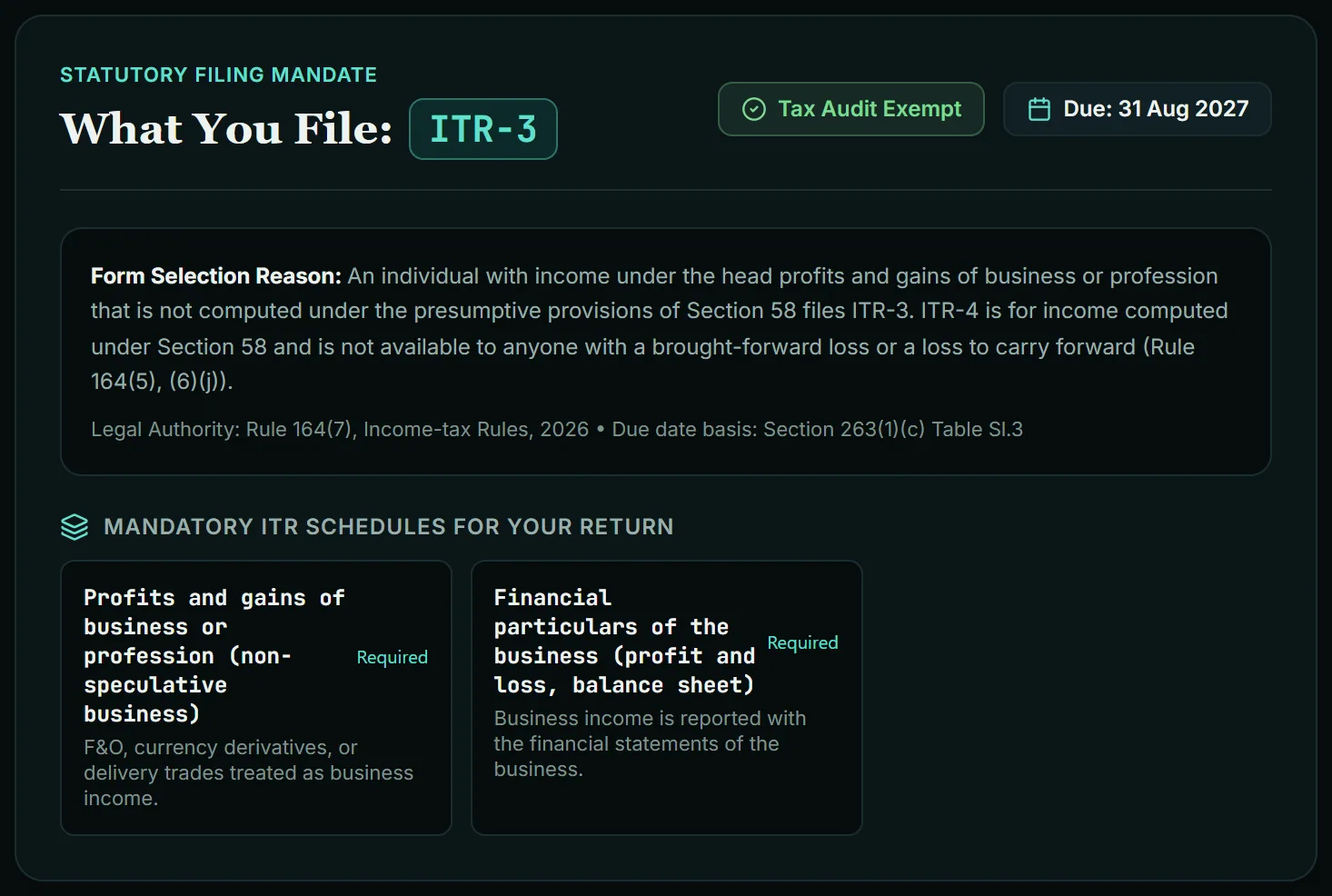
On timing: the audit report is due one month before the return due date (s.63(5)(a)). I am not printing calendar dates here because CBDT extends them in some years. Check the current notification.
Classification mistakes: capital gains, speculative loss and switching
Mistake 7: reporting F&O as capital gains. Specified derivatives on a recognised exchange are carved out of the speculative definition by s.66(33) (s.43(5)), and the income is business income. Delivery equity is different. Its short-term gain is taxed at 20% under s.196 (s.111A), and STT is not deductible there (s.72(3)(b) (s.48)). For F&O, STT is deductible only if the transactions are in the course of business and the income sits under that head (s.32(k) (s.36(1)(xv))).
Mistake 8: setting an intraday loss against F&O profit. Intraday equity is speculative under s.66(31). F&O is not. Under s.113 (s.73), a speculation loss is set off only against speculation profit. Say you have an intraday loss of Rs 35,000 and an F&O profit of Rs 60,000, the same pair Rohan has in Trading Tax Examples. The F&O profit stays fully taxable. The Rs 35,000 goes forward, for four tax years, if the return is filed on time.
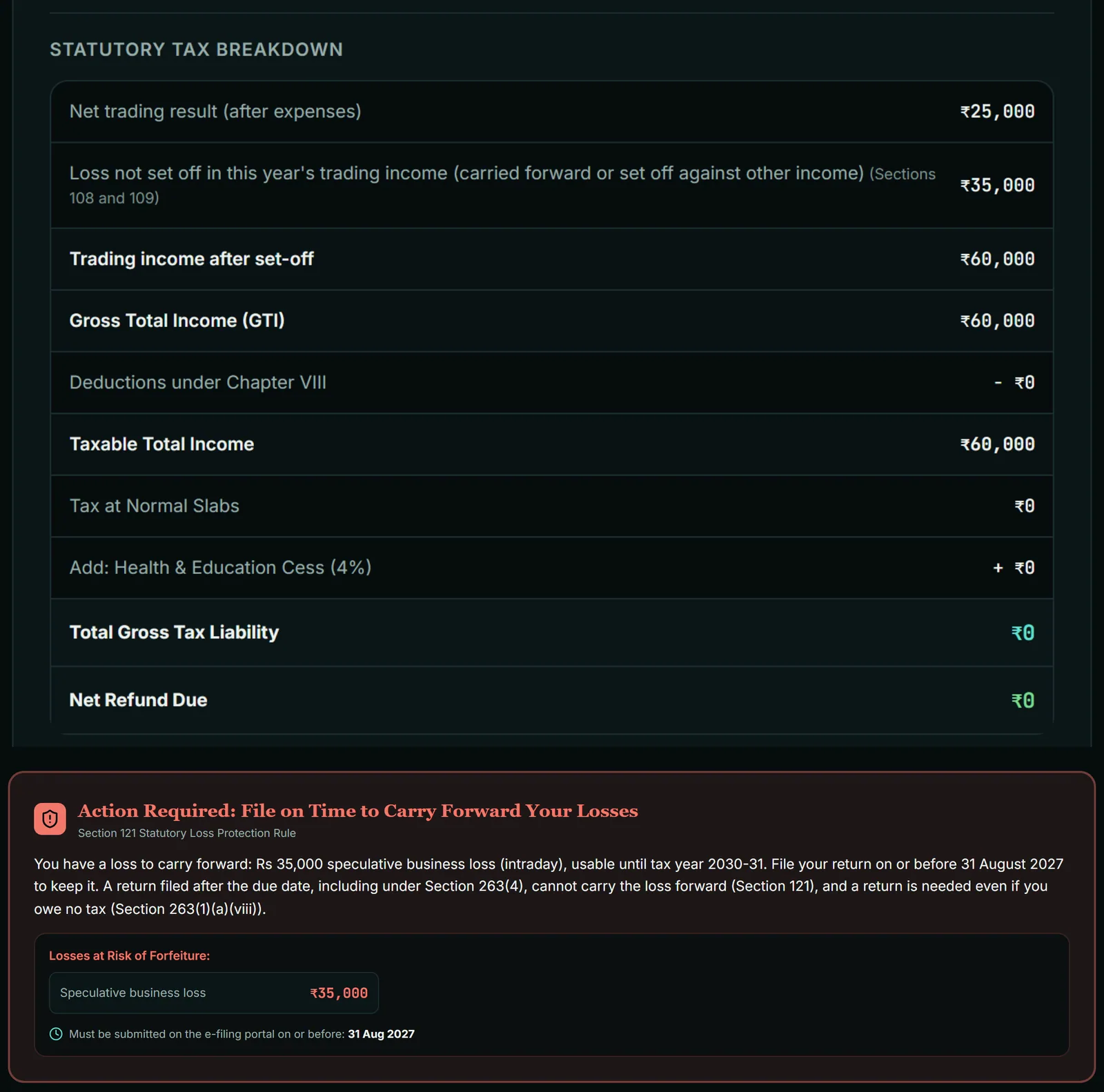
Mistake 9: putting an F&O loss under the speculative head. The head matters because the carry-forward differs. A non-speculative business loss goes forward up to 8 tax years (s.112 (s.72)). A speculation loss goes forward 4 (s.113). Labelling an F&O loss as speculative shortens its life and narrows what it can be set against.
Mistake 10: copying F&O rules to currency derivatives. Traders often assume currency contracts behave exactly like index options. Read s.66(33) for the contract you actually trade, then confirm with your CA before copying the F&O treatment.
Mistake 11: switching classification. People ask whether they can move from showing equity trades as capital gains to business income this year, and back next year. I did not find a verified rule I can quote for this, so I will not invent one. Consistency across years is the safe default, and a switch is a question for your CA.
Loss and advance tax mistakes: the return you skip and the instalment you miss
Mistake 12: not filing in the loss year. A loss can be carried forward only if it was determined in a return filed by the due date under s.263(1) (s.121, which replaces s.80). Skipping the return because "there is no tax" quietly deletes the loss. Whether the loss survives in the new regime is flagged as unsettled in this series. The text of s.112 that I read has no regime condition, but check s.202 (s.115BAC) with your CA.
Mistake 13: paying advance tax late. Advance tax applies when the tax is Rs 10,000 or more (s.404 (s.208)). Interest for default and deferment comes under s.424 and s.425 (s.234B, s.234C). A common slip is to lean on the s.425(4) safe harbour. It covers under-estimation of capital gains, s.2(49)(n) income, first-time business income and dividend, if paid in the remaining instalments or by 31 March. Speculative or F&O business income is not in that list. Some guides also say advance tax is four equal payments, which I could not support.
Foreign broker and prop firm mistakes
Mistake 14: leaving out a foreign broker account. Per the ITR form instructions, resident and ordinarily resident taxpayers report foreign assets in Schedule FA on a calendar-year basis, using the peak balance. I could not verify the 2026-27 form, so read the instructions in force when you file. I am not quoting Black Money Act penalties because I could not find a verified figure.
Mistake 15: assuming prop payouts are untaxed. Payout classification is contested. One reading puts it as business income in Schedule BP. Another treats it as foreign-source income with Schedule FSI and FA. The sources I found are mostly prop firms, affiliates or filing services, so none is neutral. If your CA treats payouts as business income, foreign-currency amounts convert at the TT buying rate on the last day of the tax year (Income-tax Rules 2026, rule 206, with the rate defined in rule 207). Ask your CA, and keep every payout statement.
What this guide and the calculator do not cover
- The tool does not file your return or choose between contested positions.
- It has no age selector, no foreign tax credit, no GST for prop income, and no expenses box for delivery trading treated as business.
- I did not verify the 2026-27 ITR forms as notified, Black Money Act penalty amounts or any extended due date.
- The prop payout position and the new-regime loss carry-forward are open questions here, not answers.
- Every number above is illustrative. Nothing is a trade call or tax advice.
Last reviewed: October 2026. Tax year: 2026-27. Sources: Income-tax Act 2025 as amended by Finance Act 2026, Income-tax Rules 2026, ICAI Guidance Note on Tax Audit, and all-Acts.
What to read next
You have the mistakes. The next step is the full map of how each kind of trading income is taxed. Next in series: How Trading Income Is Taxed in India (2026-27). For the tool itself, start with the trader tax calculator or go back to the blog hub.
Which of these 15 did you not know about before today?
Quick answers
Things people usually want to know.
Trading turnover calculation - Intraday and F&O turnover separate?
Compute each separately, then add them. The loss and set-off rules treat intraday (speculative) and F&O (non-speculative) as separate businesses under s.26(3) (s.28 / 43(5)). The audit limit in s.63 (s.44AB) speaks of turnover in business, so I read it as a test on the total. That is my reading, not a settled rule. Confirm with your CA.
How is F&O turnover calculated for tax audit?
The ICAI Guidance Note on Tax Audit uses the absolute total of favourable and unfavourable differences. Premium received on sold options is also part of the ICAI method, without counting it twice if it is already in the net profit. It is not the notional value of the contracts. Check the current edition or ask your CA.
Is a tax audit compulsory for an F&O loss?
The Table in s.63(1) (s.44AB) has no separate loss limb. Audit depends on turnover against the limit, or on claiming presumptive profit lower than the deemed figure. A loss alone does not trigger it, as I read the Table. To carry the loss forward you still need a timely return (s.121). Confirm with your CA.
If someone doesn't opt for presumptive business income, is audit still applicable?
Yes, if turnover crosses the s.63(1) (s.44AB) limit: Rs 1 crore, or Rs 10 crore when cash receipts and cash payments are each 5% or less. Declaring profit under s.58(2) (s.44AD) takes you out of the Table (s.63(2)), but only if you are eligible, and whether F&O qualifies is contested. Staying outside presumptive does not remove the turnover test.
Can an intraday loss be set off against F&O profit?
No. Intraday equity is a speculative transaction under s.66(31) (s.43(5)), and F&O on a recognised exchange is carved out by s.66(33). Under s.113 (s.73) a speculation loss is set off only against speculation profit, and carried forward four tax years.
Can I carry forward an F&O loss in the new tax regime?
Some guides say no. The text of s.112 (s.72) that I read carries no regime condition, but I have not verified how s.202 (s.115BAC) interacts with it. Treat it as unsettled for your own return and confirm with your CA before relying on it.
Is it compulsory to pay advance tax on F&O income?
Advance tax is payable if the tax for the year is Rs 10,000 or more (s.404 (s.208)). F&O income is business income, and the s.425(4) safe harbour for under-estimation does not list it. Late or short payment attracts interest under s.424 and s.425 (s.234B, s.234C).
Which ITR form should a salaried person doing F&O use?
F&O profit or loss is business income, so the form meant for business income applies, not the one for salary and capital gains only. I could not verify the 2026-27 forms as notified, so check the form instructions on incometax.gov.in when you file, or ask your CA.
Do I need to report a foreign broker account in Schedule FA?
Per the ITR form instructions, resident and ordinarily resident taxpayers report foreign assets, including a foreign trading account, in Schedule FA on a calendar-year basis with the peak balance. I could not verify the 2026-27 form, so read the instructions in force when you file.
Is a prop firm payout taxable in India?
The classification is contested. Some read payouts as business income in Schedule BP, others as foreign-source income reported with Schedule FSI and FA. No source I found settles it. If treated as business income, conversion uses the TT buying rate on the last day of the tax year. Ask your CA.
More from HeyArtha
Other things we've been writing about.
Trader Tax Calculator India: Every Field, Card and PDF
How to use the trader tax calculator India traders need for 2026-27: what to type in each field, what every result card means, and what the PDF shows.
Trading Tax Examples India: Delivery, F&O and Prop Payout
Three trading tax example cases for India in 2026-27: salary with delivery, intraday and F&O; an options seller with a past loss; and USD prop payouts.
Brokerage & Tax on Trading Income in India (2026 Guide)
What Zerodha actually charges, how STT changed in 2026, and how F&O, intraday and delivery profits are taxed, in a real numbers breakdown.