
Trading Tax Examples India: Delivery, F&O and Prop Payout
October 14, 2026 · ~11 min read · by Shivam Kushwaha, HeyArtha founder
Trader Tax Calculator
Compute tax on equity delivery, intraday speculation and F&O derivatives with FIFO lot matching, turnover and multi-head income consolidation.
Rules make more sense once you see them land on actual rupees. This trading tax example India guide takes three invented traders for tax year 2026-27 (a salaried person who dabbles, an options seller with a past loss, and a funded prop trader) and works out each one's tax by hand, step by step, then checks it against the calculator.
Trading tax example India: three cases, three different answers
The same rules give very different bills. Rohan, salaried with delivery, intraday and F&O trades, owes ₹1,27,920. Priya, an options seller, owes nil because a past F&O loss absorbs her profit. Arjun, a funded trader with USD payouts, owes nil because his income stays within the ₹12 lakh rebate limit.
All three people are invented. Their numbers are illustrative, chosen to show the rules, not anyone's real return. Every figure below matched the Trader Tax Calculator when I ran it in October 2026. If you have not used the calculator before, the field-by-field guide explains each box.
Last reviewed: October 2026. Figures refer to tax year 2026-27 (1 April 2026 to 31 March 2027), Income-tax Act 2025 as amended by Finance Act 2026. All three use the new regime, resident, under 60.
| Rohan | Priya | Arjun | |
|---|---|---|---|
| What he or she trades | Delivery, intraday, F&O, plus salary | F&O options only | Firm-funded account, USD payouts |
| Total income | ₹15,80,000 | Nil | ₹7,14,000 |
| Tax payable | ₹1,27,920 | Nil | Nil |
| Loss carried forward | ₹35,000 intraday | ₹1,50,000 F&O | None |
| ITR form shown | ITR-3 | ITR-3 | ITR-3 |
| Tax audit | Not required | Not required | Not required |
The rules every example uses
These rules do the work in all three examples. The 1961 section is in brackets so you can match older guides.
| Rule | Where it comes from |
|---|---|
| F&O on a recognised exchange is non-speculative business; intraday equity is speculative | s.66(31), s.66(33) (s.43(5)); speculation is a separate business, s.26(3) (s.28 / 43(5)) |
| Speculative loss: only against speculative profit, carried forward 4 tax years | s.113 (s.73) |
| Non-speculative business loss: carried forward 8 tax years | s.112 (s.72) |
| A loss carries forward only if that year's return was filed by the due date | s.121 (s.80 read with s.139(3)) |
| Short-term gains on listed shares with STT: 20% | s.196 (s.111A) |
| Rebate for a resident individual on the new-regime rates with income up to ₹12 lakh: 100% of tax, capped at ₹60,000 | s.156(2) (s.87A) |
| Tax audit if business turnover exceeds ₹1 crore (₹10 crore if cash receipts and payments are each within 5%) | s.63 (s.44AB) |
Slab income is taxed on the new-regime rates for 2026-27: nil up to ₹4 lakh, then 5% (₹4–8 lakh), 10% (₹8–12 lakh), 15% (₹12–16 lakh), 20% (₹16–20 lakh), 25% (₹20–24 lakh) and 30% above ₹24 lakh. Health and education cess of 4% is added to the tax.
Example A: Rohan, salary plus delivery, intraday and F&O
Rohan earns a salary and trades on the side. To keep the arithmetic visible, assume no TDS; in real life your employer's TDS would reduce the balance.
| Input | Amount |
|---|---|
| Net taxable salary (after standard deduction) | ₹14,00,000 |
| Delivery: short-term capital gain | ₹1,20,000 |
| Intraday: realised loss | −₹35,000 |
| F&O: realised profit (no separate charges) | ₹60,000 |
| F&O turnover (broker report) | ₹9,00,000 |
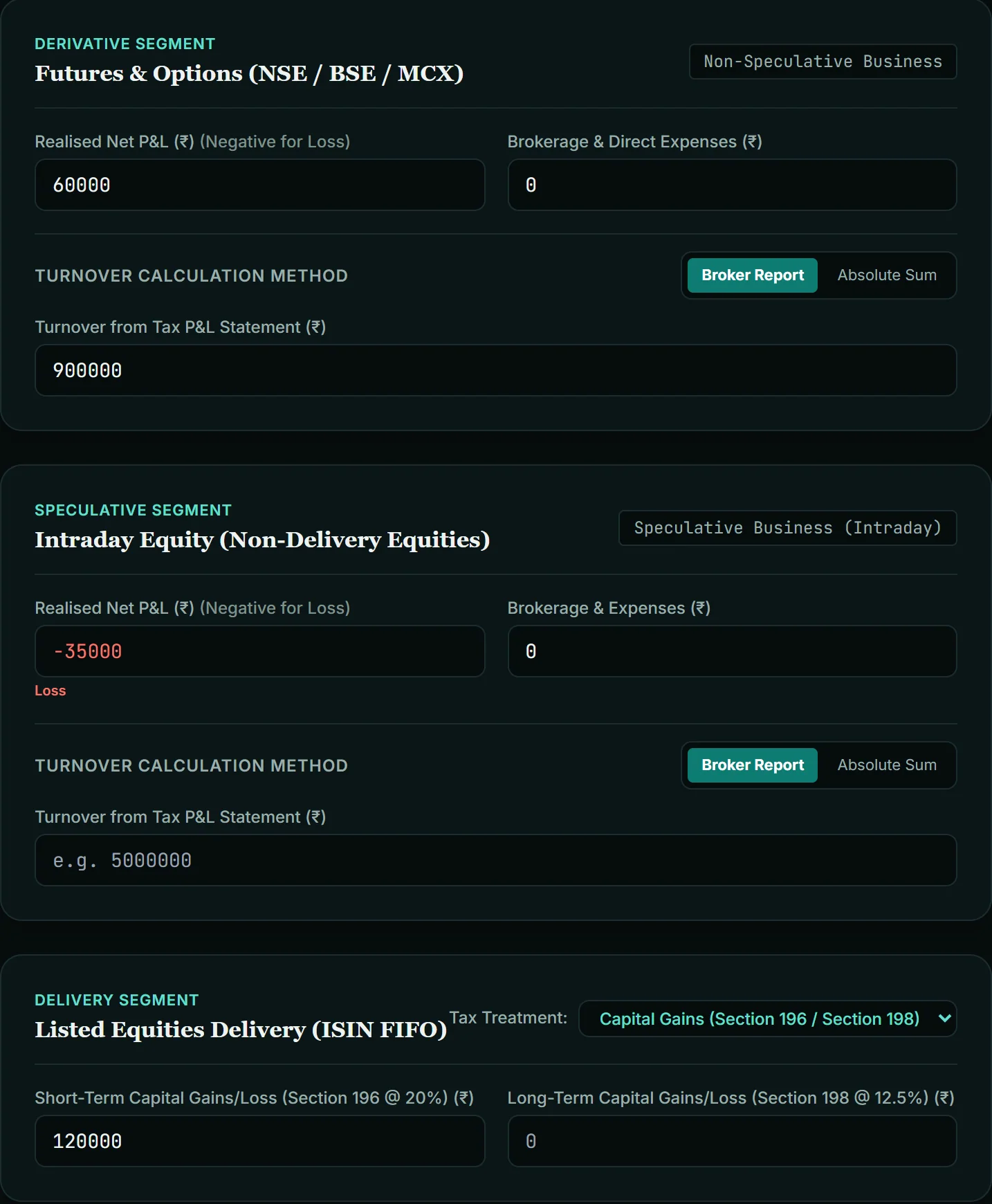
Step 1, sort each result into its bucket. F&O is non-speculative business: ₹60,000. Intraday is speculative: −₹35,000. Delivery is a short-term capital gain: ₹1,20,000.
Step 2, set off what the law allows. The intraday loss cannot touch the F&O profit, the capital gain or the salary, s.113 (s.73). With no speculative profit this year, all ₹35,000 carries forward, usable until tax year 2030-31.
Step 3, total income. ₹14,00,000 + ₹60,000 + ₹1,20,000 = ₹15,80,000.
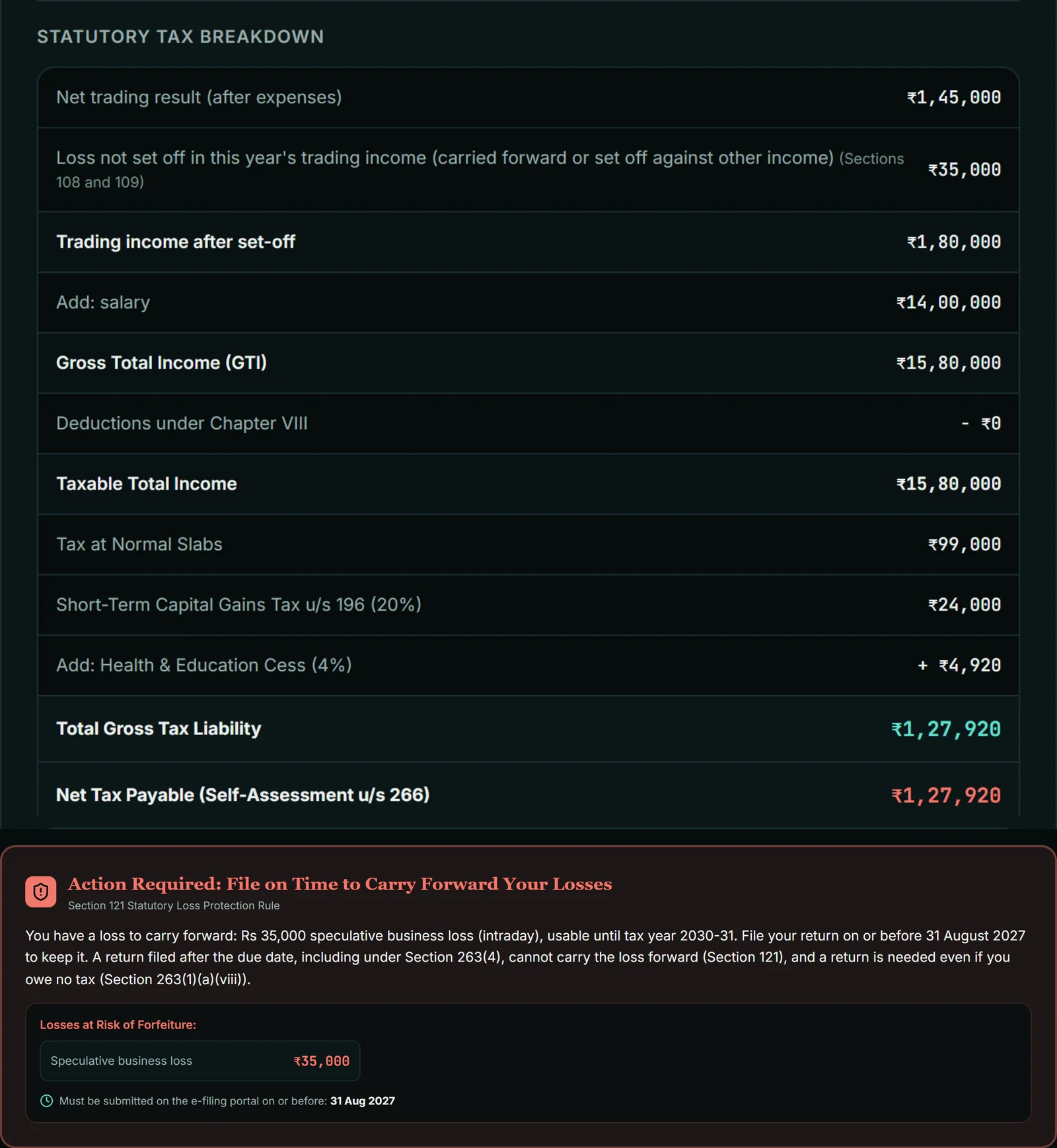
Step 4, tax.
| Line | Working | Amount |
|---|---|---|
| Slab income | 14,00,000 salary + 60,000 F&O | ₹14,60,000 |
| Slab tax | 5% of 4,00,000 (20,000) + 10% of 4,00,000 (40,000) + 15% of 2,60,000 (39,000) | ₹99,000 |
| STCG tax | 20% of 1,20,000, s.196 (s.111A) | ₹24,000 |
| Rebate | Income above ₹12 lakh; the s.156(2)(b) relief does not apply because tax (₹1,23,000) is less than the excess over ₹12 lakh (₹3,80,000) | Nil |
| Cess | 4% of 1,23,000 | ₹4,920 |
| Total tax | ₹1,27,920 |
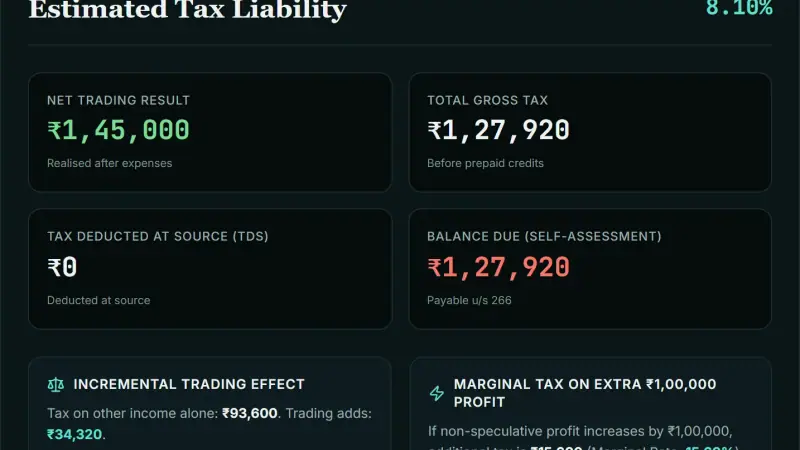
The tool shows the same ₹1,27,920, an effective rate of 8.10% (1,27,920 ÷ 15,80,000), ITR-3 and no tax audit (turnover ₹9,00,000 is far below ₹1 crore).
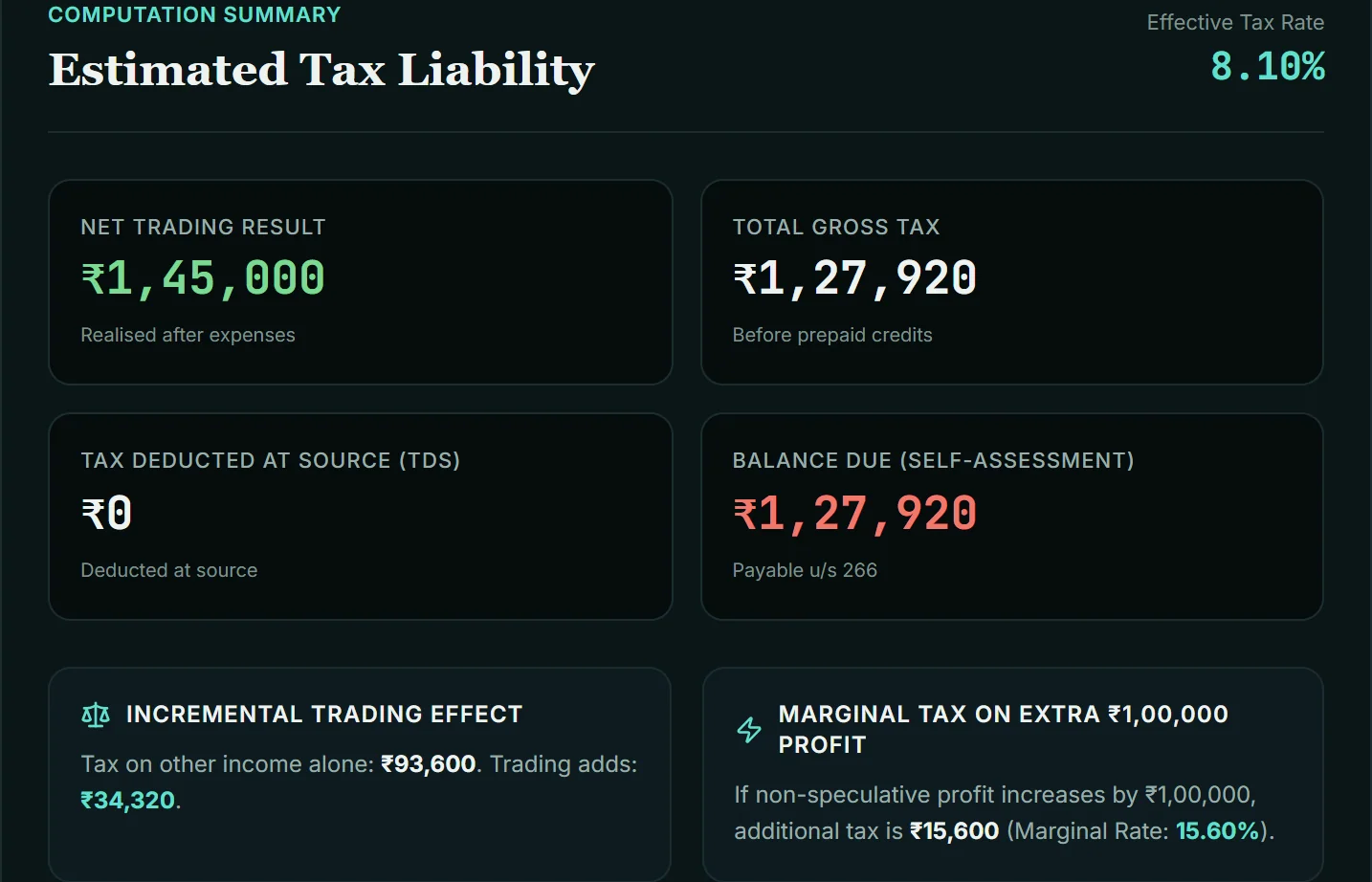
Two cards are worth reading. Incremental Trading Effect says tax on salary alone would be ₹93,600 (₹90,000 slab tax plus cess) and trading adds ₹34,320: that is ₹9,000 on the F&O profit at 15% plus ₹24,000 on the gain, plus cess. Marginal tax says another ₹1,00,000 of F&O profit would cost ₹15,600, because it falls in the 15% band.
Since ₹1,27,920 is well above ₹10,000, advance tax applies, s.404 (s.208). The tool also warns that the gains window was not entered, so it assumes the gain came by 15 June. That is the cautious reading; s.425(4) relief exists for capital gains realised later. The ₹35,000 loss survives only if Rohan files by the due date, which the Loss Protection note spells out.
One honest gap: the brief gives no intraday turnover, so the tool shows "Turnover looks too low". On your own return, enter the turnover from your broker report.
Example B: Priya, an options seller with a past loss
This is the F&O tax example most option sellers will recognise: big gross numbers, a small net.
| Input | Amount |
|---|---|
| F&O favourable differences (gross profits) | ₹18,00,000 |
| F&O unfavourable differences (gross losses) | ₹15,00,000 |
| Brokerage, STT and other charges | ₹2,50,000 |
| Brought-forward F&O loss from 2025-26, return filed on time | ₹2,00,000 |
| Salary or other income | Nil |
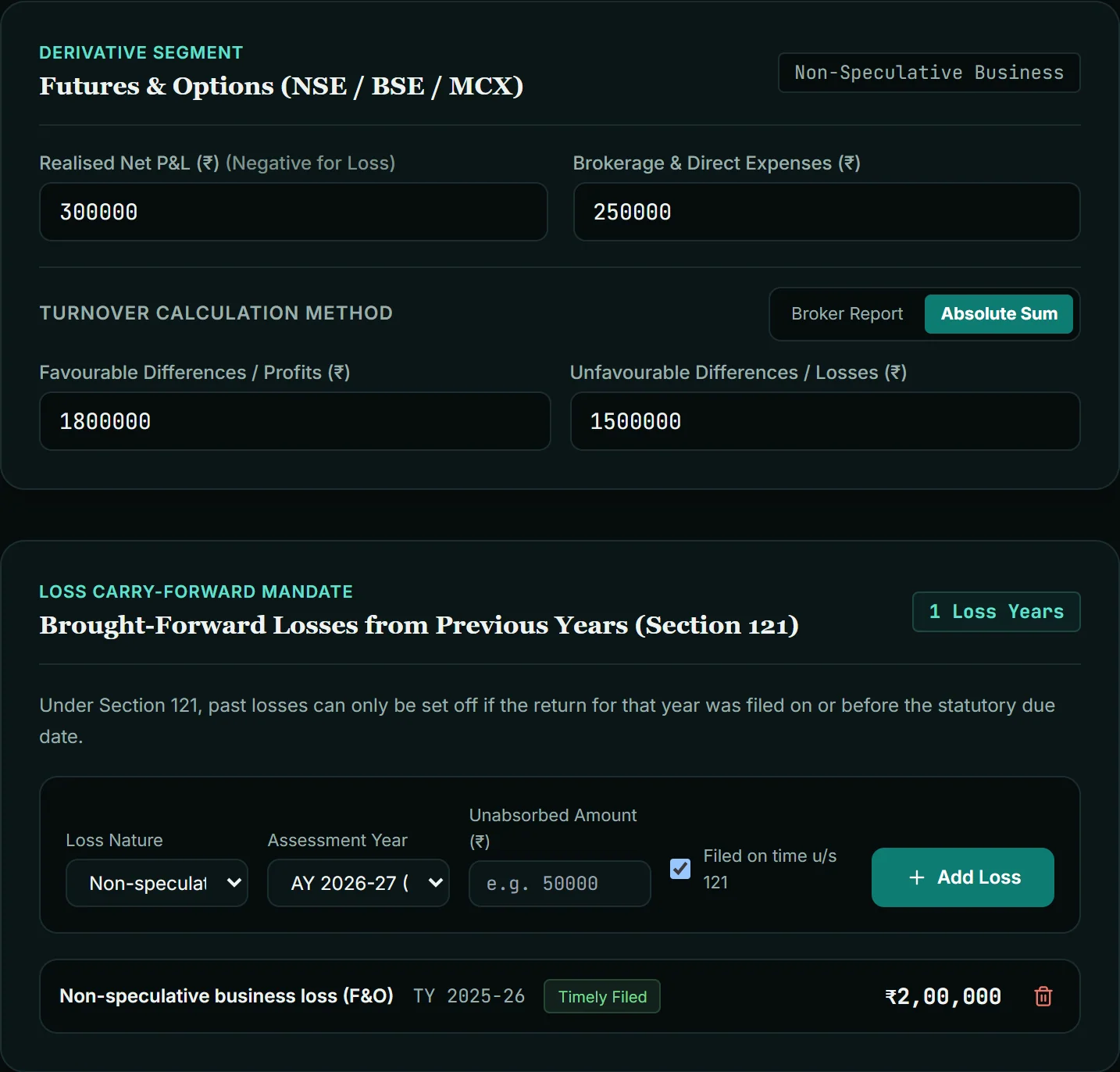
Step 1, current-year F&O income. Realised P&L is 18,00,000 − 15,00,000 = ₹3,00,000. Charges are deductible against business income; STT specifically under s.32(k) (s.36(1)(xv)). So 3,00,000 − 2,50,000 = ₹50,000.
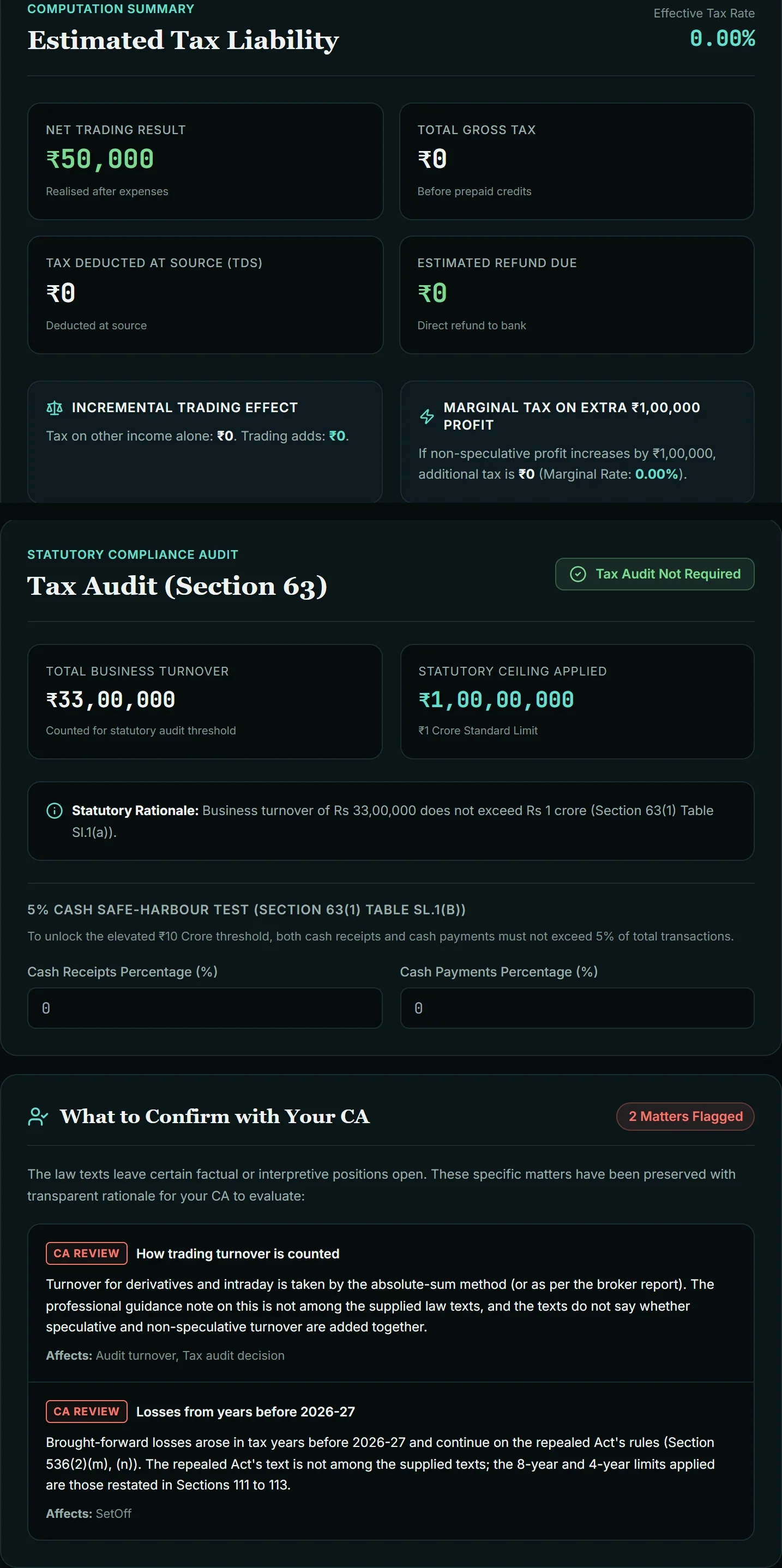
Step 2, turnover. By the absolute-sum method, 18,00,000 + 15,00,000 = ₹33,00,000, following the ICAI Guidance Note on Tax Audit, para 5.11(b). For an option seller, check whether premium is already inside those profit figures; the Guidance Note says not to count it twice. ₹33 lakh is below ₹1 crore, so no tax audit under s.63 (s.44AB). Some guides use the notional value of contracts instead, which would put her turnover in crores. The Guidance Note does not.
Step 3, use the old loss. A non-speculative loss can be set off against business profit of a later year, s.112 (s.72). ₹50,000 of the ₹2,00,000 is used, leaving ₹1,50,000 to carry forward, usable until tax year 2033-34.
Step 4, tax. Total income is nil, so tax is nil.
The ₹2,00,000 counted only because her 2025-26 return was filed by its due date, s.121 (s.80 read with s.139(3)). Untick "Filed on time u/s 121" for that loss and the tool drops it: her ₹50,000 becomes taxable income (still under ₹4 lakh, so still nil tax here, but the loss is gone for later years too).
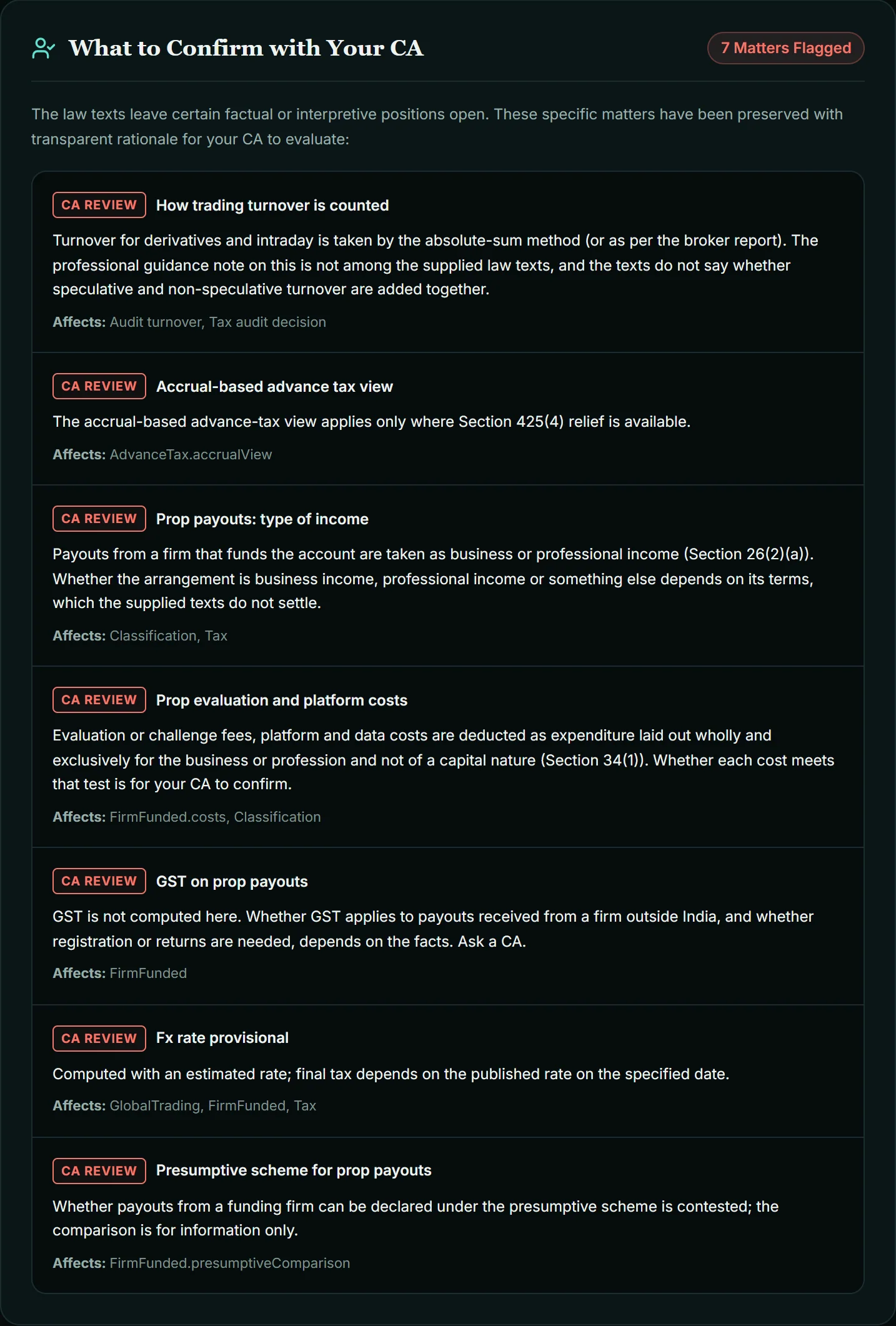
The tool lists two items for her CA. One is how turnover is counted. The other is that losses from years before 2026-27 continue under the old Act's rules, which it applies through the same 8-year and 4-year limits. The tool does not mark a 2026-27 return as compulsory for her. Whether to file one anyway, to show the set-off and the balance carried forward, is a fair question for her CA.
Example C: Arjun, a funded trader with USD payouts
Arjun trades a firm-funded account and gets paid in dollars.
| Input | Amount |
|---|---|
| Payouts | USD 3,000 each in July 2026, October 2026 and January 2027 |
| Challenge fee and platform fee | USD 300 + USD 300 |
| Exchange rate | ₹85 per USD, marked as an estimate |
| Payouts received online | 100% |
| Salary or other income | Nil |
On a fresh Firm-Funded desk the F&O sample card is still switched on, so the page starts at a net trading result of ₹10,39,000 with 6 CA items. Switch the F&O chip off first, so the page shows Arjun's ₹7,14,000 and 7 items.
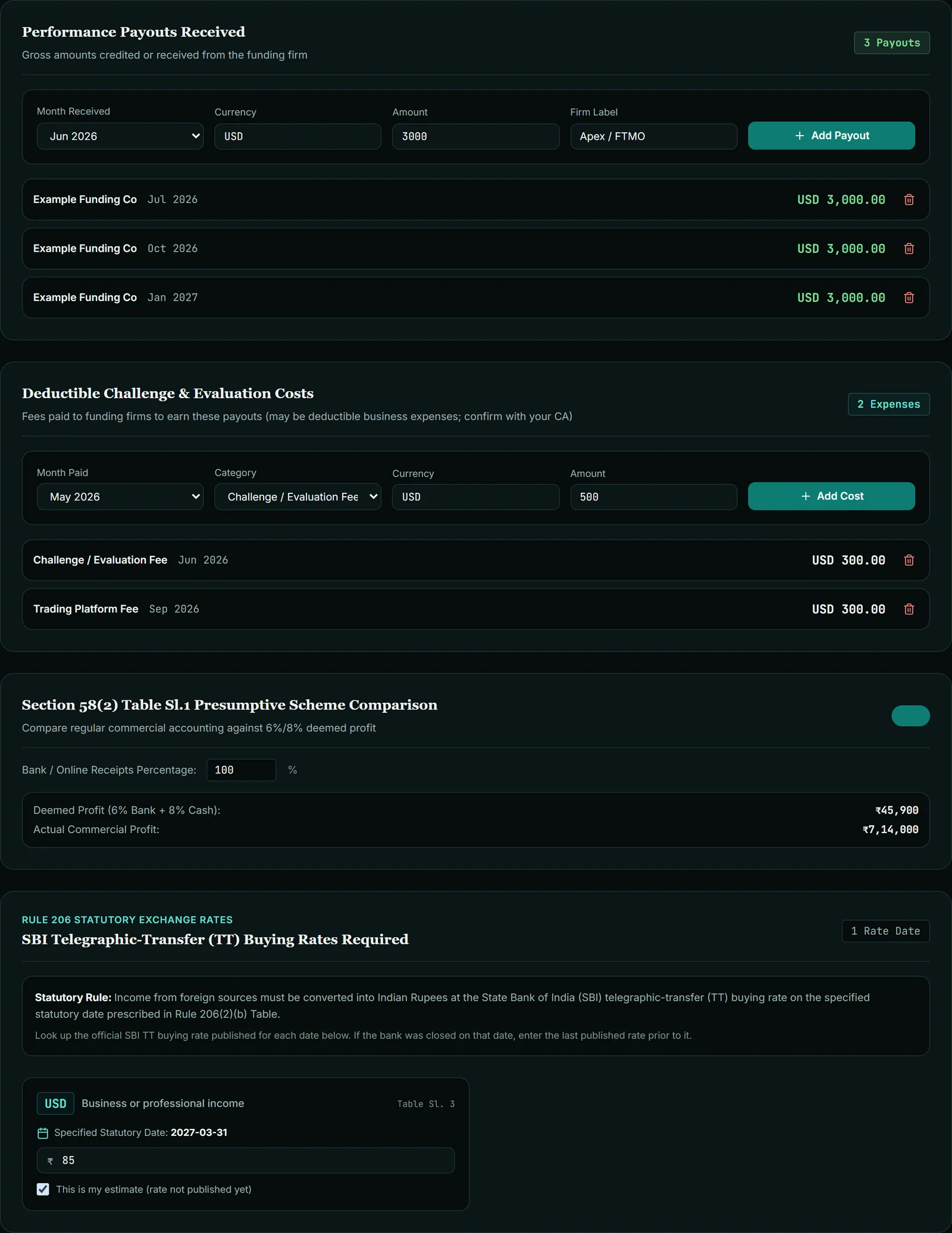
Step 1, convert. Under Rule 206 (rule 115 of the 1962 Rules), business income is converted at the SBI TT buying rate on the last day of the tax year: one rate, 31 March 2027, not a rate for each payout date. That rate is not published yet, so ₹85 is an estimate and the result is marked provisional.
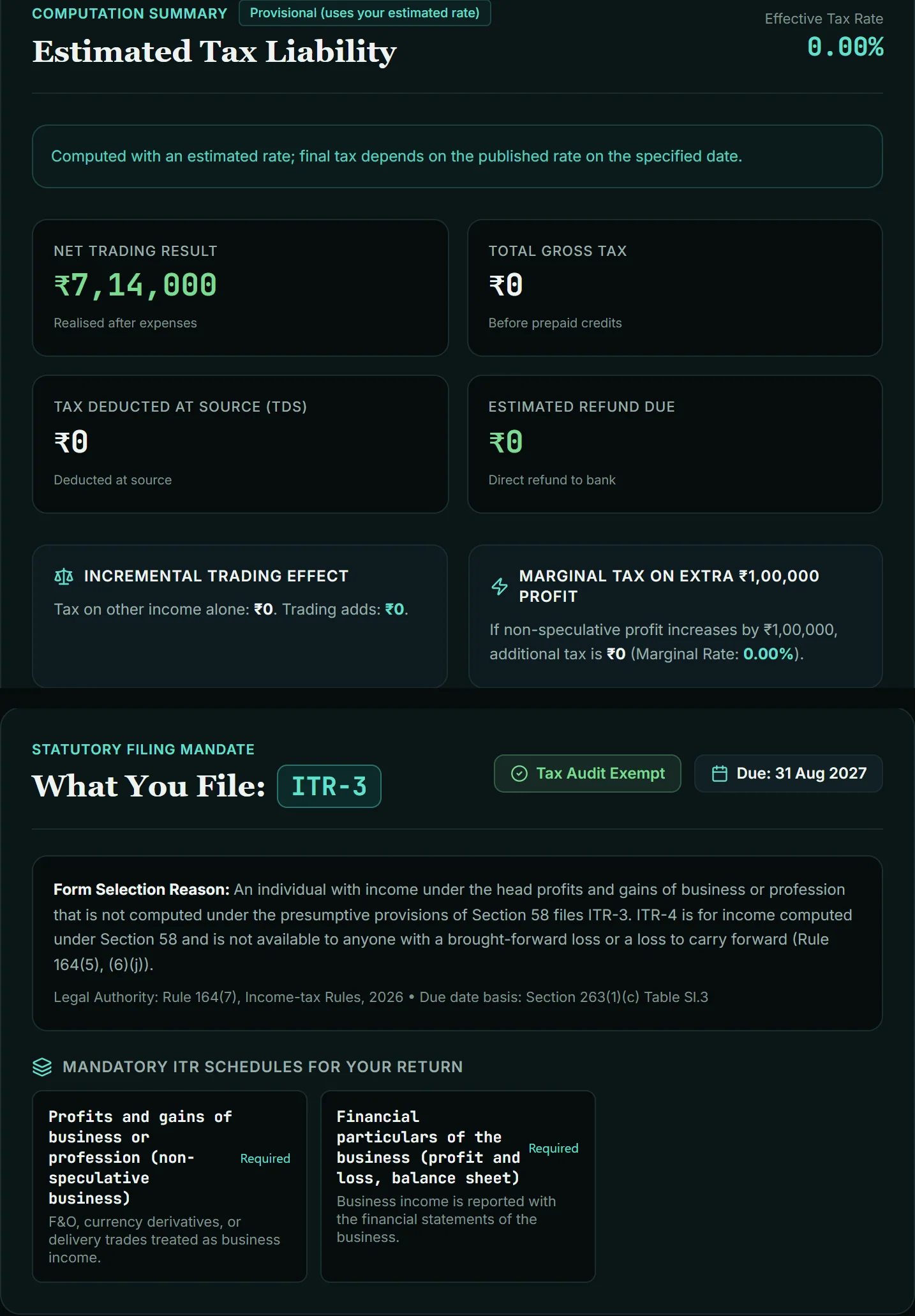
Step 2, net income. Payouts: 9,000 × 85 = ₹7,65,000. Costs: 600 × 85 = ₹51,000. Net: ₹7,14,000.
Step 3, tax. Slab tax: nil up to ₹4 lakh, then 5% of 3,14,000 = ₹15,700. Arjun is a resident individual taxed on the new-regime rates, and his income of ₹7,14,000 does not exceed ₹12 lakh. So s.156(2)(a) (s.87A) gives a rebate of the lesser of 100% of the tax and ₹60,000: ₹15,700. Tax after rebate is nil, and 4% cess on nil is nil.
The estimate matters less than it looks. His net is USD 8,400, so the rate would have to exceed ₹142.86 for income to pass ₹12 lakh. Even so, replace ₹85 with the published rate once it is out.
Nil tax does not mean no return. The tool shows a return is required because his income is above the amount not chargeable to tax, and it points to ITR-3. Check the What You File box in the tool’s results, which names the form and whether an audit applies. Advance tax and what traders file explains the form choice and the instalments.
Why Arjun's classification is not settled
The tool treats the payouts as business income, deducts the challenge and platform fees, and flags seven items for his CA. That treatment is one view, not the only one.
- View 1: business income. The payouts are receipts of a trading business, reported with the business schedules, with fees deducted as business expenses. That is how the tool computes them. If the arrangement were read as professional income instead, the audit limit would be ₹50 lakh of receipts, s.63 (s.44AB), not ₹1 crore.
- View 2: foreign-source income, reported differently. Some guides treat payouts from an overseas firm as foreign-source income reported in other schedules, which changes where they go in the return.
Every source I found on this sells something to prop traders, so I am not picking a side. It depends on the contract and the facts, so confirm with your CA. The same applies to the tool's presumptive comparison, which shows a deemed profit of ₹45,900 (6% of ₹7,65,000) for information only. Whether that scheme is open to payouts like these is contested. GST is not computed either.
If any payout came in USDT or another crypto asset, it is outside the tool and outside this example. Leave it out and take it to your CA. For background on how these firms work, see how prop firms evaluate funded accounts.
Where your own numbers will differ
These examples are deliberately clean. Your return will not be, and these are the places it usually shifts:
- TDS. Rohan has none here. Your salary TDS cuts the balance due, though not the tax itself.
- Charges. Priya's ₹2,50,000 is one line. Your broker's tax P&L may already be net of charges; if so, enter nil charges so nothing is deducted twice. How to read your trading P&L statement shows which report holds which number, and brokerage and tax on trading income breaks down each charge.
- Regime and age. All three are on the new regime and under 60. The old regime or a senior citizen's slabs give different answers.
- Timing. Rohan's advance tax depends on when gains and profits arrived.
- Facts the tool cannot see. Whether internet or rent is a trading cost, whether a prop contract makes you a business or a professional: those are for your CA.
Limits of these examples
- The three people are invented and their numbers illustrative.
- Arjun's exchange rate is an estimate, and his classification is contested.
- Crypto or USDT payouts are outside the tool and these examples.
- GST and foreign tax credit are not computed.
- The calculator has not been reviewed by a Chartered Accountant. It shows its working so your CA can check it quickly, not instead of that check.
Run your own numbers through the Trader Tax Calculator. The methodology page shows each formula. The mistakes these cases avoid are listed in F&O tax mistakes in India. For the bucket-by-bucket map of the rules these cases use, see How Trading Income Is Taxed in India.
Sources: Income-tax Act 2025 as amended by Finance Act 2026, Income-tax Rules 2026 (Income Tax Department), ICAI Guidance Note on Tax Audit (Revised 2025). Full list: trading tax sources.
Quick answers
Things people usually want to know.
Should I use the P&L from my broker's tax P&L report, or adjust it first?
Start from the broker's tax P&L. It is the figure every example here begins with. The calculator does not recompute charges or per-trade profit, so enter realised P&L before charges in one box and the charges in the other. If your broker's figure is already after charges, enter nil charges.
Can STT and brokerage be set off against F&O trading profit?
Against business income, yes. STT is deductible when the trades are in the course of the business and the income is taxed under that head, s.32(k) (s.36(1)(xv)). In Priya's example, ₹2,50,000 of charges cut her F&O profit to ₹50,000. STT is not deductible against capital gains, s.72(3)(b) (s.48).
Can I claim all trading charges, internet bills and room rent as a deduction?
Charges that are part of trading, such as brokerage and STT, sit in the expenses box. Internet, rent and similar costs are shared with personal use, and how much of them relates to the trading business is a question of facts. Confirm with your CA before claiming them.
Why is Rohan's intraday loss not set off against his F&O profit?
Intraday equity is a speculative business, and a speculative loss can only be set off against speculative profit, s.113 (s.73). F&O on a recognised exchange is non-speculative, s.66(31), s.66(33) (s.43(5)). So the ₹35,000 loss waits for future intraday profit, for up to 4 tax years.
Why does Rohan pay 20% on his delivery gains instead of his slab rate?
Short-term gains on listed shares where STT is charged are taxed at 20% under s.196 (s.111A), separately from slab income. In his example that is 20% of ₹1,20,000, or ₹24,000, before cess. Long-term gains follow s.198 (s.112A) instead.
How did Priya's F&O turnover become ₹33,00,000?
By the absolute-sum method: favourable differences of ₹18,00,000 plus unfavourable differences of ₹15,00,000. That follows the ICAI Guidance Note on Tax Audit, para 5.11(b). It is far below the ₹1 crore audit limit in s.63 (s.44AB), so no tax audit applies.
Does a past F&O loss carry forward if I filed that year's return late?
No. A loss carries forward only if it was determined in a return filed by the due date, s.121 (s.80 read with s.139(3)). Priya's ₹2,00,000 counts because her 2025-26 return was on time. Untick "Filed on time" in the tool and it drops out.
Why does Arjun pay no tax on ₹7,14,000 of prop income?
On the new-regime rates his tax is ₹15,700. A resident individual whose income does not exceed ₹12 lakh gets a rebate of that tax up to ₹60,000, s.156(2) (s.87A), so nothing is left to pay. He still has to file a return.
Which exchange rate converts USD prop payouts into rupees?
Under Rule 206 (rule 115 of the 1962 Rules), business income is converted at the SBI TT buying rate on the last day of the tax year, one rate for the year. For 2026-27 that is 31 March 2027. Arjun's ₹85 is an estimate until that rate is published.
Do I still file a return if my trading tax comes to nil?
Often yes. A person whose total income, before deductions, exceeds the amount not chargeable to tax must file under s.263(1) (s.139), and so must anyone who wants to carry a business or capital loss forward. Arjun's tax is nil after the rebate, but his income is above the limit, so he files.
Are crypto or USDT prop payouts covered by these examples?
No. Payouts received in USDT or any other crypto asset are outside the Trader Tax Calculator and outside these examples. Leave them out of the tool and take them to your CA separately.
More from HeyArtha
Other things we've been writing about.
Trader Tax Calculator India: Every Field, Card and PDF
How to use the trader tax calculator India traders need for 2026-27: what to type in each field, what every result card means, and what the PDF shows.
Brokerage & Tax on Trading Income in India (2026 Guide)
What Zerodha actually charges, how STT changed in 2026, and how F&O, intraday and delivery profits are taxed, in a real numbers breakdown.
How to Read Your Trading P&L Statement (India Guide)
Contract note, tax P&L, turnover: what each report actually shows and why your bank credit never matches the number on screen.