
Everyones P&L Screenshot Is Real. Thats Still Not the Whole Story.
June 17, 2026 · ~6 min read · Updated September 4, 2026 · by Shivam Kushwaha, HeyArtha founder
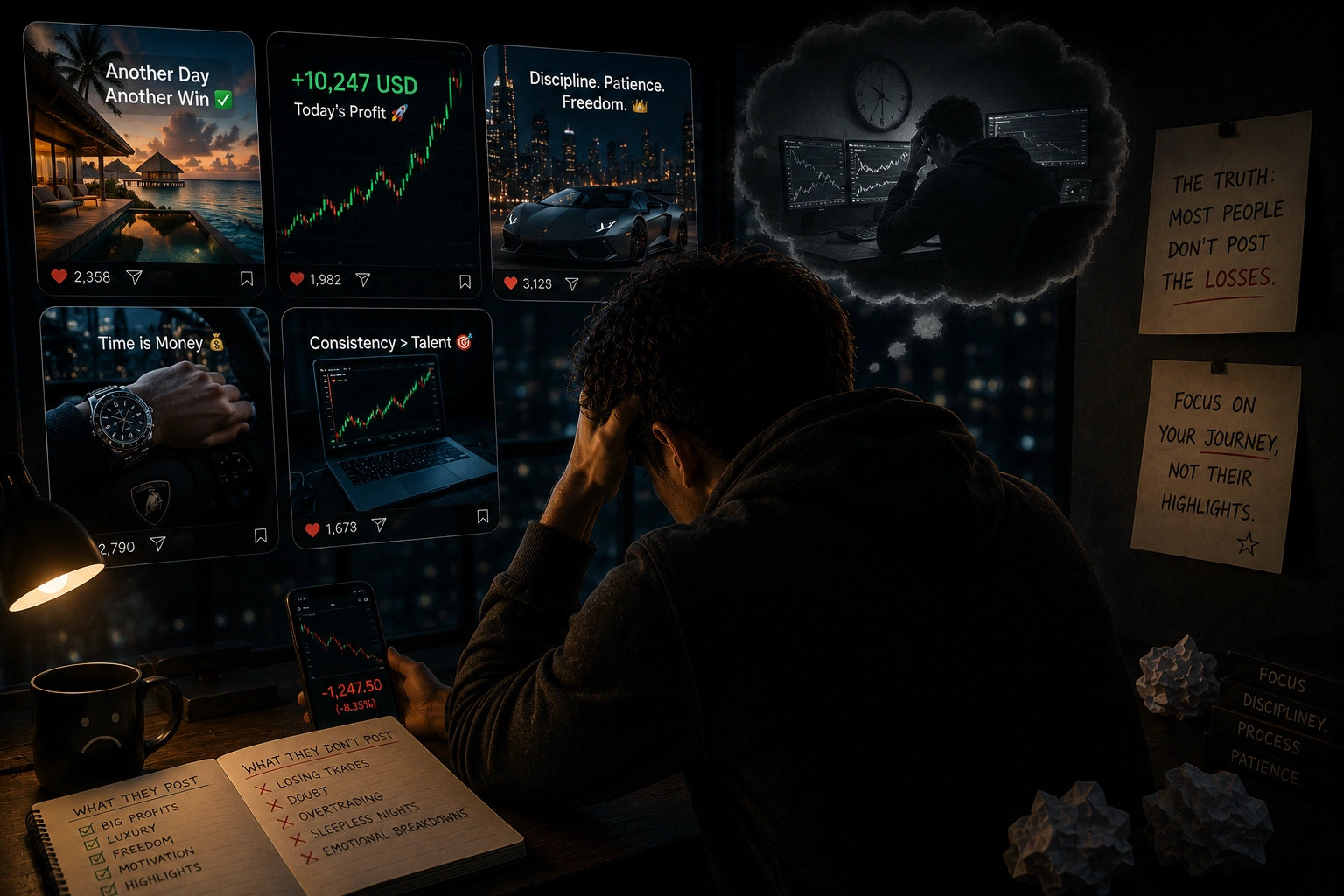
You scroll through trading Twitter on your lunch break and every third post is someone's account turning a few thousand into a few lakhs overnight. Green numbers, confident captions, replies full of fire emojis. You close the app and open your own broker app, where the number is red, ordinary, unremarkable. You didn't do anything wrong today. It just doesn't feel that way anymore.
The math your feed is quietly hiding from you
Here's the mechanism worth understanding clearly: a trader who makes a large gain on a single trade will very likely post the screenshot. A trader who loses an equivalent amount almost never will. This isn't a minor bias — it's systematic. If you follow two hundred traders and each shares only their best trade of the month, your feed becomes a continuous stream of spectacular outcomes, with the losses, the blown accounts, and the average, boring Tuesday completely absent from what you see. The sample you're being shown isn't representative of what trading actually looks like. It's a highlight reel, curated by a selection bias nobody announces out loud.
Just how lopsided the real numbers are
It's worth grounding this in the actual data, because the gap between the feed and reality is larger than most people assume. Regulatory data from India showed that over 91% of retail traders in the derivatives segment lost money in a recent year, with combined losses crossing ₹1 lakh crore. That means the vast majority of the people actually trading — including plenty of the same accounts posting green screenshots — are net losers over any meaningful period. The wins get posted. The overall picture, which is mostly red, doesn't.
Why this specific comparison hurts more than it should
There's a well-documented psychological reason a missed win stings more than an equivalent loss: research on regret aversion consistently finds that the pain of missing an opportunity often exceeds the pain of a comparable loss — the same asymmetry that makes a missed setup replay in your head long after a real loss has closed. Watching someone else's win on your screen activates something close to that same "missed opportunity" pain. Your brain reacts to the screenshot almost as if it were your own missed chance, which is exactly the mechanism that makes trading social media feel so personally deflating even when nothing about your own trading has actually gotten worse.
What you're not seeing behind the screenshot
Beyond the simple selection bias of wins-over-losses, there's a second layer worth knowing: the specific trades that go viral tend to be outliers by design — the 200% winner, the perfect entry at the exact low, a small account turned into something dramatic overnight. Even among traders who do occasionally post real wins, these specific outlier trades are wildly unrepresentative of their own average results, let alone anyone else's. You're not just seeing a curated slice of other people's outcomes. You're seeing the most extreme slice of an already-curated slice, and comparing your entire ordinary week against it.
What actually helps with this specific comparison spiral
The most consistently recommended fix isn't complicated: reducing exposure to trading social media specifically during market hours, when a screenshot can actually trigger an impulsive chase. Checking it after the close, once you're no longer in a position to act on the urgency, removes most of the danger without requiring you to quit the communities entirely. Some traders also find it useful to deliberately track when comparison-driven trades happen in their own journal — noting the pattern of "saw someone else's win, felt behind, took a trade I wouldn't have otherwise" — since naming the pattern tends to weaken its pull the next time it shows up.
It also helps to remember, concretely, what you genuinely don't know about any screenshot you see: the account size behind the percentage gain, the risk actually taken to get there, how many losing trades came before it, a red stretch nobody screenshots the way they screenshot the win, or whether the account is even still funded by the time you're seeing the post. A win with no context isn't really information. It's just a feeling wearing the costume of information.
Where Artha fits into this
Saying "I saw someone's win today and it wrecked my whole afternoon" out loud, to someone who's had the exact same reaction to a screenshot that told them nothing real about their own trading, matters more than it sounds, the same kind of honesty that's easy to lose track of alone with a chart.
The number worth actually tracking
Your results aren't worse because everyone else is winning more than you. They're not worse at all, most likely — you're just being shown a version of everyone else that was never designed to be representative in the first place. The only P&L worth genuinely comparing yourself against is your own, from last month, not a stranger's best trade of the year dressed up as their average one.
Quick answers
Things people usually want to know.
Why does my trading feed seem to show everyone winning except me?
Traders overwhelmingly post winning trades and rarely post losses, creating a systematic selection bias where your feed shows a highly unrepresentative, curated slice of outcomes rather than actual average results.
What percentage of retail traders actually lose money?
Regulatory data from India showed over 91% of retail traders in the derivatives segment lost money in a recent year, with combined losses crossing ₹1 lakh crore — meaning the overwhelming majority of traders, including many who post occasional wins, are net losers over time.
Why does seeing someone else's trading win feel worse than my own loss?
Research on regret aversion shows that the pain of missing an opportunity often exceeds the pain of an equivalent loss, so watching someone else's win can trigger a similar emotional response as if you'd personally missed that exact opportunity.
Are the trades people post on social media representative of their actual results?
Usually not — the trades that go viral tend to be extreme outliers even for the person posting them, not their typical or average outcome, making the comparison doubly misleading.
How can I reduce the negative impact of trading social media on my mindset?
A commonly recommended approach is limiting exposure specifically during market hours, when a screenshot could trigger an impulsive trade, and instead checking social media after the market closes when you can't act on the urgency.
Should I stop following trading accounts on social media entirely?
Not necessarily — many traders find value in the community and information these accounts provide, but being deliberate about when you check them, and skeptical of what any single screenshot actually represents, tends to matter more than quitting entirely.
What information is missing from a typical trading win screenshot?
Screenshots rarely show the account si
More from HeyArtha
Other things we've been writing about.
Brokerage & Tax on Trading Income in India (2026 Guide)
What Zerodha actually charges, how STT changed in 2026, and how F&O, intraday and delivery profits are taxed, in a real numbers breakdown.
Budget Day Brain: Why Feb 1 Turns Disciplined Traders Reckless
Union Budget day making your trading brain go haywire? Heres an honest look at the psychology of high-volatility event days, no calls, just the mindset.
What the CFA Charter Actually Gets You in India: A Realistic View
₹32.4 lakh average for recent charterholders, ₹66.6 lakh overall. Heres what those numbers actually mean, and what they dont.