
The Losing Streak Nobody Posts About
June 15, 2026 · ~4 min read · Updated September 4, 2026 · by Shivam Kushwaha, HeyArtha founder
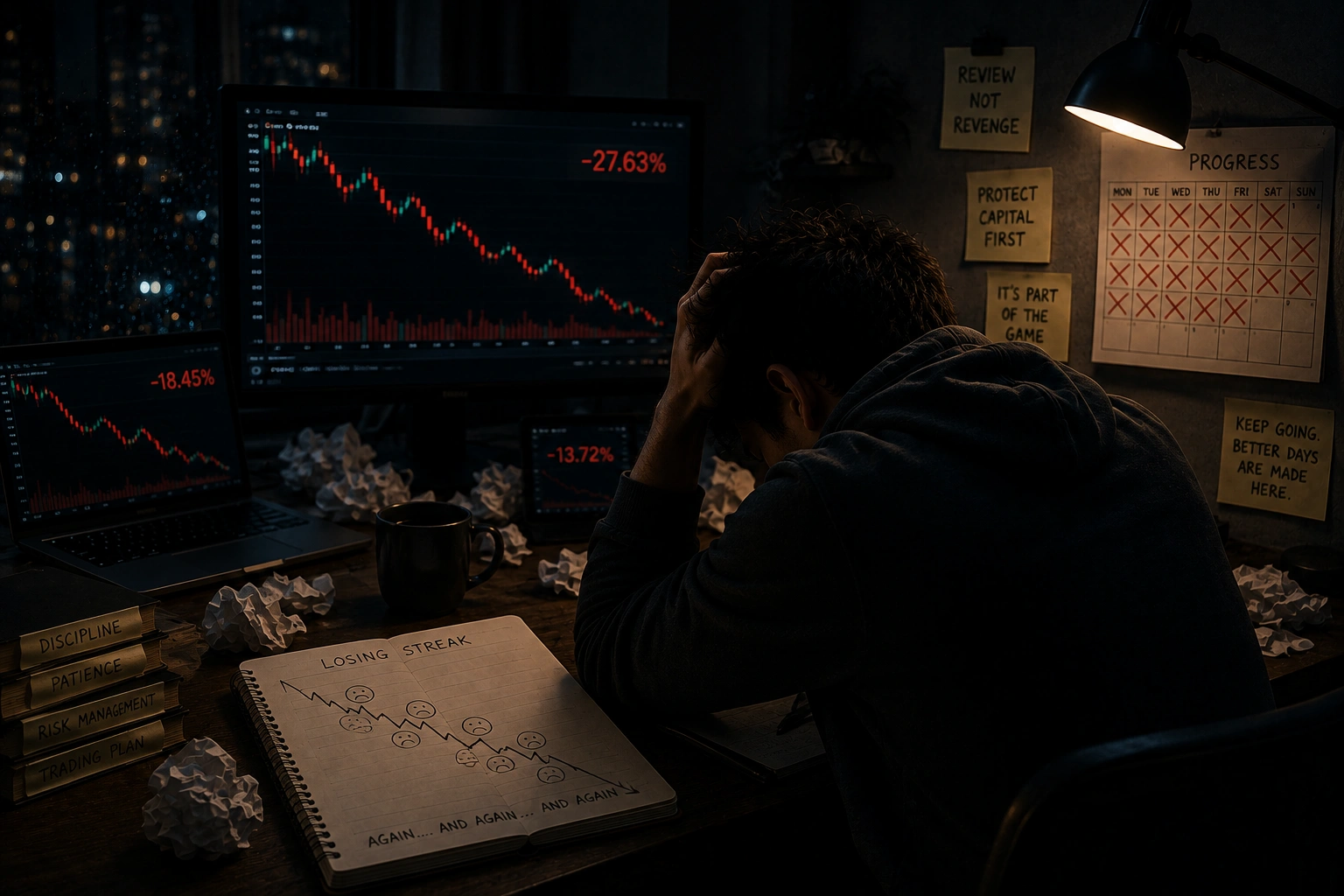
Three losses in a row, and you're still telling yourself the fourth trade will fix it. It doesn't. Neither does the fifth. By the time you actually stop, the number on the screen isn't just a loss anymore — it's a question about whether you were ever as good at this as you thought.
Nobody posts this part. Trader Twitter shows the green screenshots. The red ones get quietly deleted before anyone sees them.
Why a losing streak hits harder than the math suggests
There's a specific piece of math that makes losing streaks worse than they look on paper: a 50% drawdown needs a 100% gain just to get back to even. That asymmetry means the deeper a streak goes, the disproportionately harder the climb back becomes — which is exactly why the instinct to trade bigger to recover faster feels so tempting and is so often the thing that turns a bad week into a destroyed account.
The psychological damage tends to matter more than the financial damage. It's not really about the money lost — it's what a losing streak does to everything around the money. Confidence erodes. Decision-making gets cloudy. The sense of "am I actually good at this" starts to crack, and the harder you try to trade your way back to certainty, the deeper the hole usually gets.
The part that makes it worse: doing it in silence
Most public trading spaces are built for wins. So the losing streak — arguably the part where a trader most needs to talk to someone — is exactly the part with the least social permission to talk about. People quietly manage it alone, which tends to make the confidence spiral worse, not better, since isolation gives the doubt nowhere to go except in circles inside your own head.
What actually helps, according to people who've been through it
A genuine break — one to three days fully away from charts, not paper trading, not "just checking" — shows up consistently as the first real step. This isn't weakness; professional traders and even hedge funds treat it the same way an athlete treats an injury: you don't play through it, you rest and come back when you can actually perform. Continuing to trade while emotionally compromised is usually how a manageable drawdown turns into an account-ending one.
The second thing that consistently helps is smaller, not bigger. Reducing position size during a drawdown — the opposite of the instinct to go bigger and recover faster — keeps a normal losing streak survivable long enough for your actual edge to reassert itself, if you have one. Most account blowups aren't really caused by a bad strategy. They're caused by a decent strategy sized for a winning streak, then met by an ordinary losing one, then doubled down on in panic.
The third, less talked about: not going through it alone. People who recover well from losing streaks tend to share notes and talk setups with someone else during the streak, not just after it's over — the same honesty that's hard to get onto a page alone — the isolation of a bad stretch is part of what makes it feel catastrophic, and having even one honest conversation during it tends to shrink that feeling back down to size.
Where Artha fits into this
This is exactly the kind of moment that is hard to talk through without the family-explanation problem getting in the way, talking to another trader currently in, or recently out of, a losing streak, without needing to post a green screenshot first to earn the right to talk about the red one.
The streak that doesn't define you
A losing streak feels like it's revealing something true about your ability. Mostly, it's just revealing that variance exists and your position sizing didn't account for it yet. The traders who come back from this aren't the ones who never have a bad stretch — they're the ones who get through it smaller, rested, and not completely alone.
Quick answers
Things people usually want to know.
Why does a losing streak feel worse than the actual money lost would suggest?
Because a 50% drawdown requires a 100% gain just to break even, an asymmetry that makes losses compound psychologically. The damage to confidence and decision-making often outweighs the financial hit itself.
Is it normal for even experienced or professional traders to go through losing streaks?
Yes — losing streaks happen to every trader, including professionals, and aren't a reliable sign of skill loss. What differs is how the streak is handled, not whether it happens.
Should I take a break from trading during a losing streak?
Many experienced traders and even hedge fund psychologists recommend a genuine 1-3 day break, fully away from charts, since continuing to trade while emotionally compromised often turns a manageable drawdown into a much worse one.
More from HeyArtha
Other things we've been writing about.
Passed All the Exams, Still Not Qualified: The ACCA/CFA Limbo
You cleared every paper. Youre still not a member or a charterholder. Heres why that gap exists, and what to actually do about it.
ACCA Exemptions After CA or B.Com: What You Actually Skip
A CA can skip up to 9 of 13 ACCA papers. A B.Com grad usually skips 3-4. Heres exactly what you keep, what you still sit, and what it costs.
ACCA Job Prospects in India: Beyond the Only Useful Abroad Myth
ACCA freshers in India earn 4-10 LPA, and GCCs actively prefer it. Heres the honest picture of what ACCA actually opens up domestically.