
Overtrading Isnt Always Revenge Trading — Heres the Difference
June 16, 2026 · ~6 min read · Updated September 4, 2026 · by Shivam Kushwaha, HeyArtha founder
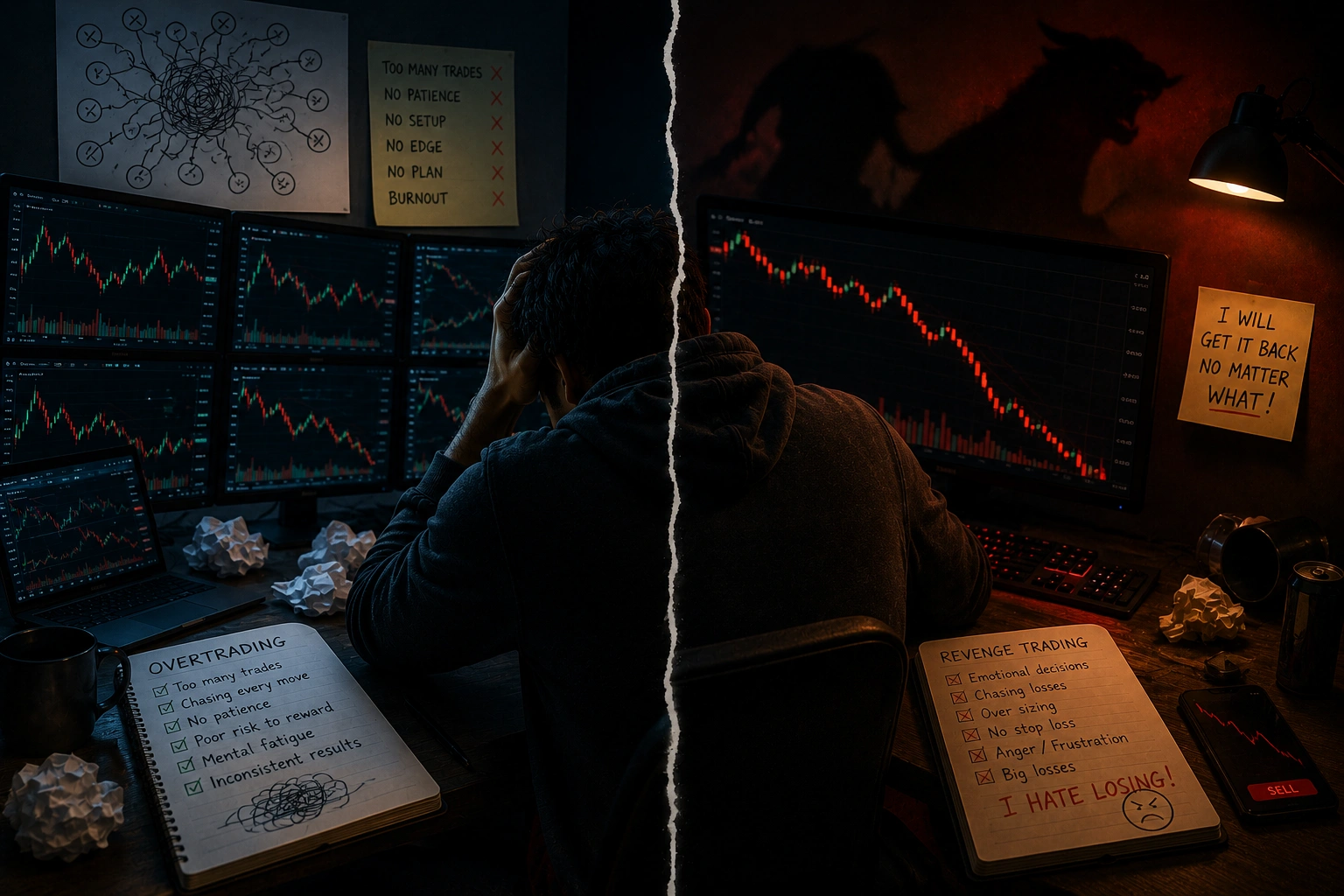
Nothing's actually gone wrong today. No big loss, no reason to be angry at the market. You've just been staring at a quiet chart for forty minutes, and a setup that's maybe 60% there starts looking like it's 90% there, mostly because sitting still has started to feel unbearable. You take it. It doesn't work. You take another one twenty minutes later, for the same reason.
Nobody would call this revenge trading. There's no loss to avenge. But it's costing you the same way, one small unnecessary trade at a time.
Why these two get lumped together
Revenge trading gets talked about constantly in trading psychology content, and for good reason — it's dramatic, it's easy to describe, and it produces vivid stories of accounts wiped out in an afternoon. Overtrading gets mentioned far less specifically, often folded into the same conversation as if it's just a milder version of the same thing. It isn't. They share a family resemblance — both involve taking trades that don't meet your actual criteria — but the trigger, and often the damage pattern, is genuinely different.
What actually separates them
Revenge trading has a clear, identifiable trigger: a loss, immediately followed by the urge to recover it. The emotional logic is specific — "I need to fix this right now" — and the trade that follows exists to close a psychological debt, not to express a genuine edge. It's usually loud, in the sense that you can point to the exact moment it started.
Overtrading is quieter and has more varied triggers. Boredom during a slow market. The discomfort of sitting in cash while everyone else seems to be doing something. Overconfidence after a string of wins, where you start seeing "opportunities" that are really just noise dressed up as signal, the same overconfidence that shows up when an early win gets mistaken for proof of skill. FOMO, pulling you into a move that's already mostly over. None of these require an actual loss to set them off — they can happen on a green day just as easily as a red one, which is part of why overtrading is so much easier to miss in yourself than revenge trading is.
Why the distinction actually matters
If you only watch for revenge trading — the loud, loss-triggered version — you can go long stretches feeling like you're managing your psychology well, because you haven't blown up after a bad trade recently. Meanwhile, a slower, quieter leak from boredom-trading or FOMO-trading can be draining the account just as effectively, just without the dramatic story attached to it. Overtrading rarely announces itself the way a revenge-trade spiral does. It just shows up later as an account that's smaller than the win rate would suggest, with no single moment you can point to as the cause.
The research behind why this actually costs money
This isn't just a psychological framing exercise — it's been measured directly. In a landmark study, researchers Brad Barber and Terrance Odean analyzed 66,465 household brokerage accounts and found that the most active traders in the sample earned significantly lower returns than less active ones, even before accounting for the extra transaction costs of all that additional activity. More trades didn't produce more profit. They mostly produced more fees, more mistakes, and lower average trade quality — the direct financial signature of overtrading, regardless of whether any individual trade was triggered by boredom, FOMO, or a loss.
Why professional traders take fewer trades, not more
One of the more counterintuitive patterns in trading psychology is that experienced, consistently profitable traders often trade less frequently than beginners, not more. This runs against the instinct that activity equals productivity — that sitting in cash feels like doing nothing, so it must be the wrong move. In practice, the opposite tends to be true: overtrading means trading beyond what your own strategy actually calls for, and for most strategies, that threshold is lower than it feels like it should be when you're staring at a live chart.
What actually helps with the quieter version
Revenge trading responds well to a hard rule — a mandatory pause after a loss past a certain size, decided in advance. Overtrading needs a slightly different kind of structure, because there's no single trigger moment to build a rule around. What tends to help instead is a predetermined daily trade limit, set before the market opens, that isn't renegotiated in the moment no matter how tempting the next setup looks. It also helps to name the actual feeling driving the urge before acting on it — boredom, FOMO, or the itch to feel active — the same emotional-field discipline that turns a vague feeling into a specific, bounded note — since simply noticing which one it is tends to strip some of its pull.
Where Artha fits into this
The quieter version of this pattern is worth describing out loud too, the boredom-trades and the FOMO-trades that don't come with a dramatic loss attached, because they're easy to dismiss as noise rather than recognised as the same thing in a different costume.
The trades that don't feel like a problem
Revenge trading feels like a problem while it's happening — the urgency is impossible to miss. Overtrading rarely feels like anything at all in the moment, which is exactly what makes it more dangerous over time, not less. The account doesn't care which one drained it. It's worth watching for both, not just the one that comes with a good story attached.
Quick answers
Things people usually want to know.
What's the main difference between overtrading and revenge trading?
Revenge trading has a clear trigger — a loss, followed immediately by the urge to recover it. Overtrading has more varied, quieter triggers like boredom, FOMO, or overconfidence, and doesn't require a loss to set it off.
Can overtrading happen even on a profitable trading day?
Yes — since overtrading is often driven by boredom or the discomfort of inactivity rather than a specific loss, it can occur regardless of whether the day's results are positive or negative.
Is there research showing overtrading actually reduces returns?
Yes — a landmark study by researchers Barber and Odean analy
More from HeyArtha
Other things we've been writing about.
Brokerage & Tax on Trading Income in India (2026 Guide)
What Zerodha actually charges, how STT changed in 2026, and how F&O, intraday and delivery profits are taxed, in a real numbers breakdown.
Budget Day Brain: Why Feb 1 Turns Disciplined Traders Reckless
Union Budget day making your trading brain go haywire? Heres an honest look at the psychology of high-volatility event days, no calls, just the mindset.
What the CFA Charter Actually Gets You in India: A Realistic View
₹32.4 lakh average for recent charterholders, ₹66.6 lakh overall. Heres what those numbers actually mean, and what they dont.