
Why Missing a Trade Hurts More Than Losing One
June 14, 2026 · ~4 min read · Updated September 4, 2026 · by Shivam Kushwaha, HeyArtha founder
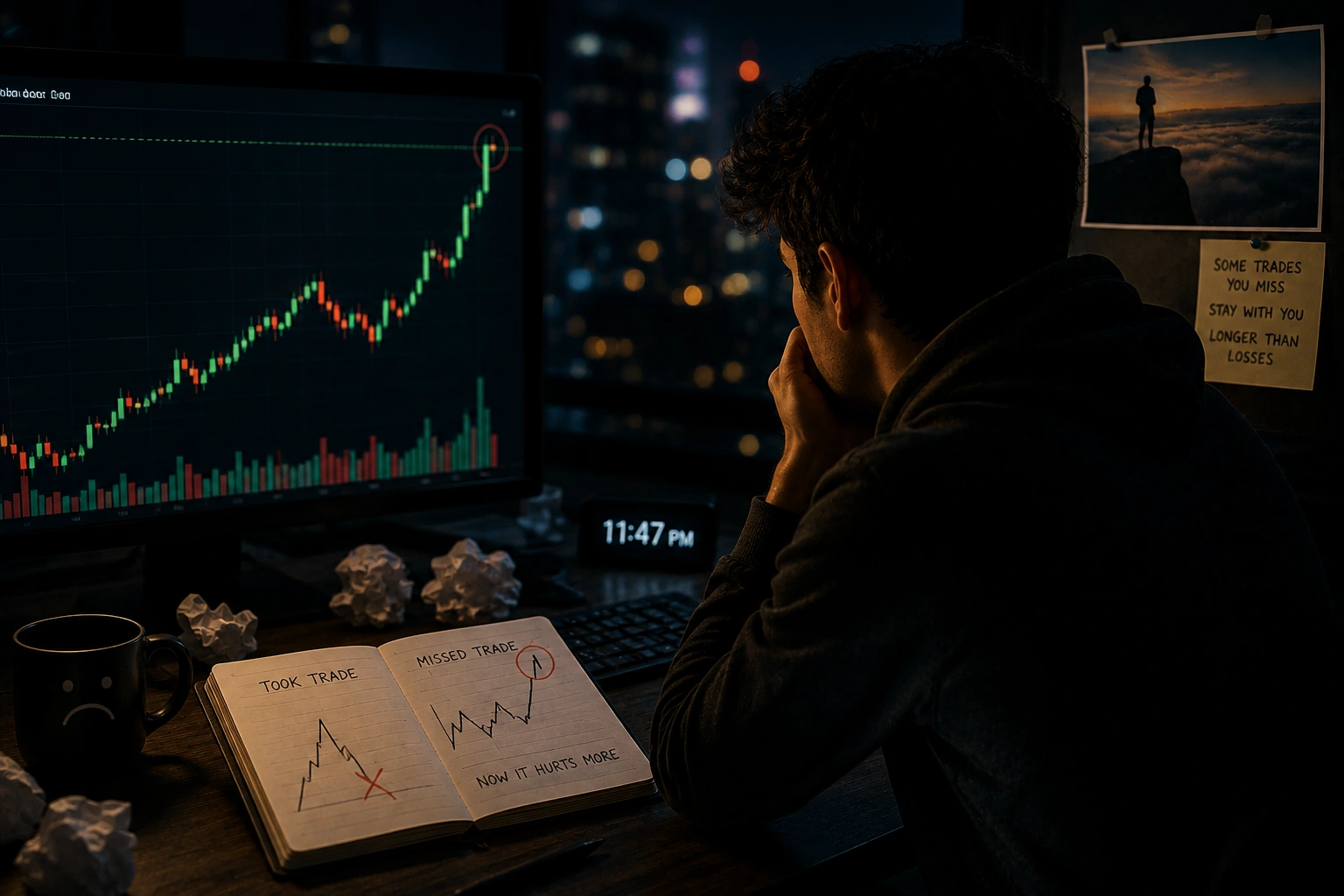
You saw it. You even had the order half-typed. Then you hesitated for one reason or another, closed the tab, and came back twenty minutes later to a chart that had run exactly the way you thought it would — without you in it.
A real loss at least ends somewhere. This doesn't. You just keep replaying the moment you didn't click.
Why this specific regret is louder than a loss
There's a well-documented reason a missed trade sits heavier than a losing one: a loss is bounded. You know the number, you can review the decision, and eventually it closes. A missed trade stays open in your head indefinitely, because there's no final number to close the loop — just an imagined outcome that keeps expanding the longer you think about it.
Psychologists have studied a version of this for decades. One of the clearest illustrations comes from behavioral scientists Kahneman and Tversky, who described two travelers who both missed the same flight — one by 5 minutes, one by 30. Objectively, both missed it equally. But almost everyone predicts the 5-minute traveler feels worse, because how close they came makes the alternate outcome easier to imagine. A missed trade works the same way. The clearer the setup was, the more the "almost" version of it plays on repeat.
The pattern that follows
Missing a good setup rarely stays contained to that one moment. The more common pattern is what happens next — the same spiral that shows up after a bad losing streak nobody talks about: watching for the next similar-looking setup with more urgency than usual, entering a little too early or a little too late because the first miss is still on your mind, and sometimes taking a worse trade just to feel like you're back in the game. The second trade isn't really about the second setup. It's an attempt to undo the first one.
What actually helps
Research on regret consistently finds that regret over things you didn't do tends to fade slower than regret over mistakes you made — inaction regret has a longer half-life than action regret, even though action regret usually stings harder in the moment. Which means the discomfort of a missed trade is real and somewhat expected to linger a bit, not a sign that something's wrong with how you're processing it.
What tends to help isn't forcing yourself to "let it go" immediately. It's naming what actually happened: a setup existed, you didn't take it, and that's a closed data point now, not an open one. Some traders find it useful to log missed setups the same way they log actual trades — not to punish themselves, but to turn the vague, expanding feeling into a specific, bounded note they can look back at later.
Where Artha fits into this
Talking through the specific replay-loop of a missed trade with someone who's had the exact same afternoon, closer to the moment than a strategy guide ever gets, without turning it into either a pep talk or a strategy session, sometimes closes a loop that the chart itself never will.
The trade that got away isn't the whole story
A missed setup is one data point in a very long series of trades you'll take over your career. It feels bigger in the moment because it's still open in your head, not because it's actually bigger than everything else you've done right — the same distortion that makes a public performance feed look nothing like a real, honest track record. Let it close the way a real trade closes — reviewed, noted, and behind you.
Quick answers
Things people usually want to know.
Why does missing a trade feel worse than actually losing money on one?
A loss is a closed, known outcome you can review and move past. A missed trade stays open-ended in your mind because there's no final number — just an imagined "what if" that can keep expanding the more you think about it.
Is there real psychological research on why missed opportunities feel this bad?
Yes — researchers Kahneman and Tversky documented that near-misses (like missing a flight by 5 minutes versus 30) create stronger regret than clear misses, because the closeness makes the alternate outcome easier to imagine.
How long should regret over a missed trade actually last?
There's no fixed timeline, but research suggests regret over things you didn't do tends to fade more slowly than regret over mistakes you made, so lingering discomfort for a while is a fairly normal response, not a red flag.
Why do I keep chasing trades after I miss one?
It's a common pattern — the urge to take the next similar setup, sometimes at a worse price or worse timing, is often an attempt to emotionally undo the first miss rather than a genuine, independent decision.
Does logging missed trades in a trading journal actually help?
Many traders find it useful, since it turns a vague, expanding feeling into a specific, bounded note you can review later — similar to how you'd log an actual trade.
Is FOMO the same thing as regret over a missed trade?
They're related but not identical — FOMO is often the anticipatory fear of missing something before it happens, while this specific regret is the aftermath once the setup has already played out without you.
Should I just force myself to stop thinking about a missed trade?
Trying to suppress it immediately often backfires. Naming what actually happened — a setup existed, you didn't take it, it's a closed data point now — tends to work better than forcing yourself to feel nothing.
How is talking to another trader about this different from journaling alone?
Journaling helps process the specifics, but talking to someone who's had a similar moment can close the loop in a way a private note sometimes can't, since it's no longer just replaying in your own head.
Is missing a big move a sign my strategy is wrong?
Not usually — missing individual setups is a normal part of trading for everyone, including experienced traders. It's a single data point, not a verdict on your overall approach.
More from HeyArtha
Other things we've been writing about.
Brokerage & Tax on Trading Income in India (2026 Guide)
What Zerodha actually charges, how STT changed in 2026, and how F&O, intraday and delivery profits are taxed, in a real numbers breakdown.
Budget Day Brain: Why Feb 1 Turns Disciplined Traders Reckless
Union Budget day making your trading brain go haywire? Heres an honest look at the psychology of high-volatility event days, no calls, just the mindset.
What the CFA Charter Actually Gets You in India: A Realistic View
₹32.4 lakh average for recent charterholders, ₹66.6 lakh overall. Heres what those numbers actually mean, and what they dont.