Budget Day Trading Psychology: When Policy Meets Panic
November 4, 2026 · 9 min read · by Shivam Kushwaha, Artha founder
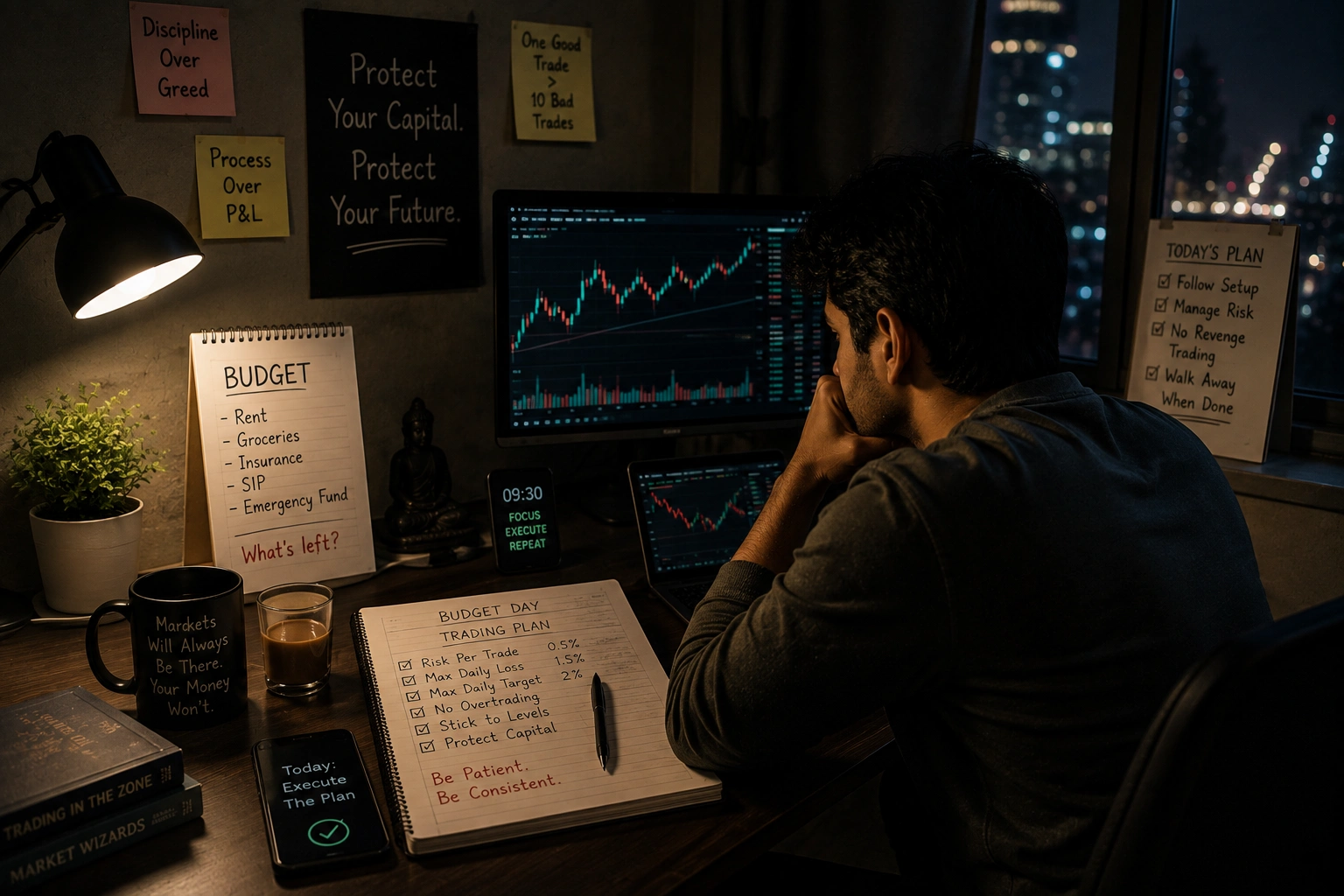
11am, Budget day. The Finance Minister's still mid-speech and your trading terminal is already a mess of red and green flickering so fast you can barely track which stock just moved. Someone in your trading Telegram group has posted "BUY EVERYTHING" in caps. Someone else has posted "SELL SELL SELL." You have three positions open that you weren't planning to touch today, and your thumb is hovering over the exit button on all three at once, not because you have a plan, but because everyone around you sounds so certain and you have no idea who's actually right.
Why Budget Day Breaks Even Disciplined Traders
Here's the honest truth about Budget day volatility: it's specifically designed, by the nature of the event itself, to punish exactly the kind of reactive trading that normally gets you in trouble on an ordinary Tuesday. Every other trading day, markets move on a slow accumulation of information. Budget day compresses months of potential policy impact into a two-hour speech, and the market tries to price all of it in almost instantly, which produces exactly the kind of violent, directionless whipsaw that makes even experienced traders second-guess positions they were completely confident in an hour earlier.
The specific danger of Budget day isn't that the moves are big, big moves happen on plenty of days. It's that the moves are fast, reverse without warning, and get amplified by an entire trading community reacting to the same headlines within seconds of each other. A single line in the speech, a customs duty change, a tax tweak, a sector-specific announcement, can send a stock swinging five percent in either direction before you've even finished reading the headline properly, let alone forming a considered view on what it actually means.
That first reversal is usually the most dangerous part of the whole day. A stock spikes on an initial, incomplete read of an announcement, traders pile in chasing the move, and then the market corrects once the fuller context of the same announcement gets properly priced in ten or fifteen minutes later. Anyone who entered on the initial spike, without waiting for that correction, is often left holding a position that looked brilliant for a few minutes and painful shortly after.
There's also a specific social pressure that makes Budget day worse than ordinary volatility. Every trading community you're part of is reacting in real time, loudly, confidently, often contradicting each other within the same minute. That noise creates a powerful illusion that everyone else understands what's happening better than you do, when in reality most of the confident calls flying around a Telegram group during a live Budget reaction are guesses dressed up as certainty, made under exactly the same time pressure you're under.
Financial news channels add their own version of this pressure, anchors and panelists speaking in the same urgent, high-energy register they use for every market event, whether the actual news justifies that urgency or not. It's genuinely hard to tell, in the moment, whether a specific announcement is actually significant or just being covered with the same breathless tone as everything else on the ticker. That constant high-alert framing makes it feel like every single line of the speech demands an immediate trading decision, when in reality most of it doesn't.
What Actually Happens to Your Decision-Making
Under this kind of compressed, high-stakes time pressure, your brain shifts noticeably away from careful analysis and toward pattern-matching and gut reaction, the same mode that's useful for genuinely urgent physical threats and genuinely unhelpful for parsing fiscal policy implications in real time. That shift isn't a personal failing, it's just what happens to decision-making under acute pressure, and it's precisely why so many Budget day trades that felt obviously right in the moment look baffling in hindsight by the next morning.
This is also exactly the kind of day where position sizing creep tends to accelerate fastest. A position you sized conservatively at 9am can feel undersized by 11:15, once you've watched it move favorably for fifteen minutes and started adding to it without a clear plan for why. Conviction that builds mid-trade, fueled by watching a number go green in real time, is a very different, much less reliable kind of conviction than the conviction you had before the position was open.
There's a specific trap that catches even experienced traders on Budget day, the urge to have a position in literally every sector that gets mentioned, just in case it moves. That urge isn't really about a genuine read on any specific announcement. It's closer to FOMO wearing the costume of preparedness, trying to be everywhere at once so you don't miss whatever the "big move" of the day turns out to be, and it usually results in more trades, more fees, and more exposure to noise than any single well-considered position would have.
Brokerage and transaction costs quietly compound on a day like this in a way that's easy to underestimate in the moment. Five or six reactive trades placed in the space of an hour, each one small on its own, add up to a meaningful drag on the day's overall result once fees, slippage, and spread are all accounted for, even before you factor in whether any individual trade actually worked out. Budget day trading volume spikes precisely because so many people are making exactly this mistake at once, treating a single news event as a reason to multiply their activity rather than sharpen it.
The Herd Effect Makes It Worse
Budget day amplifies herd behavior in financial markets more than almost any other single trading day of the year, because the same headline reaches millions of traders within the same few seconds, and a large portion of them react with roughly the same instinct at roughly the same time. That kind of synchronized reaction is a well-documented driver of excess volatility in financial markets, price moves that overshoot what the actual underlying information would justify, purely because so many people are reacting to the same signal simultaneously rather than forming independent judgments (research on herding behavior and excess volatility in financial markets). Knowing that the extreme move you're watching might be more about crowd psychology than genuine fundamental repricing doesn't make it easier to sit still, but it's useful context before you chase a candle that's already moved five percent in ninety seconds.
If you've ever noticed yourself moving a stop loss mid-trade because "it'll come back," Budget day is exactly the environment where that instinct gets triggered hardest, high emotion, high noise, and a genuine sense that everyone else already knows something you don't. That combination is precisely why so many traders struggle to leave a stop loss alone on exactly the days when discipline matters most.
What Actually Helps on Budget Day
The single most protective thing you can do is decide your Budget day plan the night before, specifically, in writing, while you're calm. Which positions you'll hold regardless of noise. Which sectors you'll actually trade, if any, and with what maximum size. What conditions would make you exit early. Deciding this in advance means you're not negotiating with your own adrenaline in real time, you're just executing a plan you already trusted yourself to make.
It's worth writing that plan down somewhere you'll actually look at during the day, a sticky note on your monitor, a pinned note on your phone, not just something you thought through once and expect your stressed, adrenaline-flooded self to remember accurately three hours later. The whole point of pre-deciding is to have something external to check against, since your in-the-moment judgment is precisely the thing Budget day is designed to compromise.
It also helps enormously to mute or leave trading group chats during the speech itself, at least temporarily. The confident, contradictory calls flying around those groups add noise, not signal, and reacting to a stranger's all-caps message is rarely a better basis for a trade than your own pre-planned read of the situation. If you genuinely need the information those groups provide, check them after the initial volatility settles rather than during the most chaotic thirty minutes of the day.
A hard rule some traders swear by is a mandatory pause before any Budget day trade that wasn't part of the pre-planned list, even just sixty seconds, enough time to ask "am I acting on the plan I made last night, or on the adrenaline I'm feeling right now." That pause rarely feels necessary in the moment, urgency is exactly what makes Budget day trading feel so compelling, but it's precisely the moments that feel most urgent where a sixty-second pause tends to prevent the most regrettable decisions.
For a lot of traders, the most disciplined move on Budget day is simply trading less, not more, deliberately sitting out the loudest, most reactive hour and re-engaging once prices have found some real direction instead of pure noise. That restraint doesn't feel exciting in the moment, especially watching a group chat celebrate gains you didn't participate in, but it protects capital far better than trying to catch every single swing of a day built almost entirely out of swings.
That same restraint matters just as much around other high-volatility calendar events, expiry Thursdays carry a similar flavor of compressed, reactive pressure, just on a weekly rhythm instead of an annual one. If you notice the same pattern of panicked, reactive trading showing up on both Budget day and expiry day, that's a useful signal that the trigger isn't the specific event at all, it's how your system responds to compressed time pressure generally, which is worth addressing directly rather than treating each event as an isolated one-off.
Where Artha Fits, If It Does
A lot of what makes Budget day hard isn't the market itself, it's the isolation of watching your account swing wildly while everyone around you seems to be either celebrating or panicking louder than you are, with no one to actually talk through the decision with in real time. That's part of why Traders' Talk exists inside Artha, a place to say "I have no idea what I'm doing right now and the group chat isn't helping" to someone anonymous who's lived through this exact chaos before, rather than making a rushed decision alone under pressure.
Budget day rewards the trader who can sit still more than the trader who can react fastest, even though every instinct in the room is screaming the opposite. The position you didn't take out of panic is often the best trade you made all day, even though nobody ever posts a screenshot celebrating the trade they wisely chose not to make.
What's the Budget day trade you regret most, and what were you actually reacting to when you made it?
Quick answers
Things people usually want to know.
Why is Budget day so much more volatile than a normal trading day?
Because months of potential policy impact get compressed into a two-hour speech, and the market tries to price all of it in almost instantly. That produces fast, directionless whipsaws that punish reactive trading harder than an ordinary Tuesday would.
Should I trade actively during the Budget speech itself?
For most traders, no. A lot of experienced traders find the most disciplined move is trading less during the loudest hour and re-engaging once prices find real direction instead of pure noise.
Why do stocks reverse suddenly right after a Budget announcement?
A stock often spikes on an initial, incomplete read of an announcement, traders chase it, then the market corrects once the fuller context gets properly priced in ten or fifteen minutes later. Entering on that first spike is usually the most dangerous move of the day.
Should I follow my trading Telegram group's calls during Budget day?
Be cautious. Most confident calls flying around a group chat during a live reaction are guesses dressed up as certainty, made under the same time pressure you're under, not genuine informed analysis.
How do I avoid panic trading on Budget day?
Decide your plan the night before, in writing, while you're calm, which positions to hold, which sectors to trade, and at what size. Write it down somewhere visible so you're not negotiating with your own adrenaline in the moment.
Why does my position sizing get out of control on Budget day?
Conviction that builds mid-trade, from watching a number go green in real time, is a much less reliable kind of conviction than what you had before the position was open. It's easy to add to a position without a clear plan for why.
Is it better to trade every sector Budget mentions, just in case?
That urge is usually FOMO wearing the costume of preparedness, not a genuine read on any announcement. It tends to just produce more trades, more fees, and more noise exposure than one well-considered position would.
What is herd behavior and why does it matter on Budget day?
It's when a large number of traders react to the same headline with roughly the same instinct at the same time, which is a documented driver of excess volatility, price moves overshooting what the actual information justifies.
How do transaction costs affect Budget day trading?
Five or six reactive trades placed within an hour, each small on its own, add up to a meaningful drag once fees and slippage are counted, even before you factor in whether any single trade worked out.
What's one simple rule to protect myself on Budget day?
A mandatory sixty-second pause before any trade that wasn't part of your pre-planned list. It rarely feels necessary in the moment, but it's exactly the moments that feel most urgent where that pause prevents the most regrettable decisions.