
Trading While Female: Notes on Indias Most Male-Dominated Hobby
June 26, 2026 · ~10 min read · by Shivam Kushwaha, HeyArtha founder
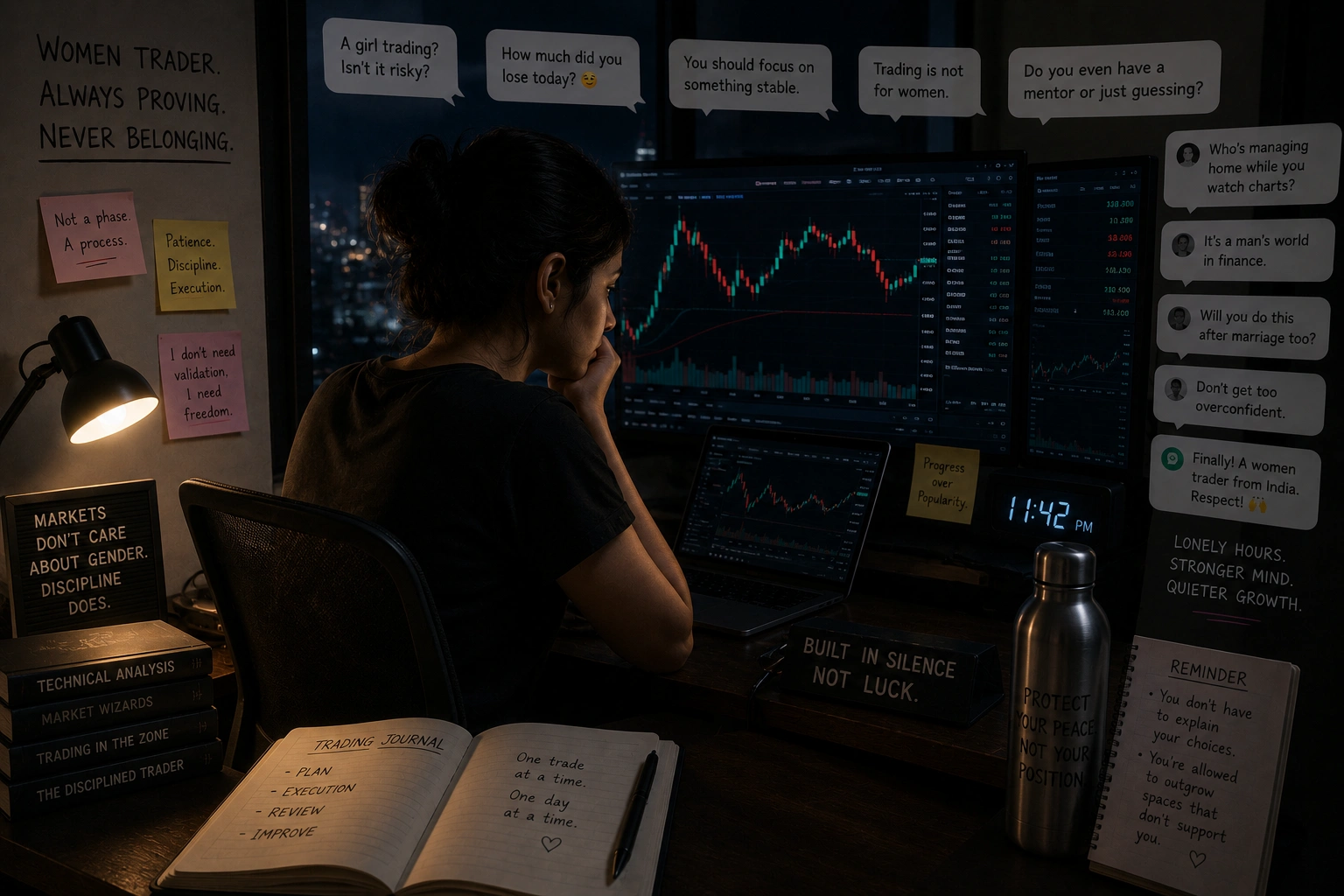
You mentioned it at a family dinner, almost casually, that you'd had a good week in the market. The reaction wasn't hostile, just strange, a beat of surprise before someone asked, half-joking, if your husband knew you were doing this. You've gotten used to being the only woman in every trading Telegram group you're part of, the only one whose questions get answered with a slightly different tone, more careful, sometimes more condescending, than the ones asked by men with clearly less experience than you. Nobody's told you outright that you don't belong here. The room just keeps reminding you, quietly, that you're the exception in it.
The Isolation Is Real, and So Is the Shift Underneath It
Here's the honest, two-part truth worth holding at once: trading in India remains a heavily male-dominated space, women make up roughly a fifth of the country's retail investor base by some industry estimates, and the isolation that comes with being a clear minority in nearly every trading community, family conversation, and online forum is a genuine, common experience, not something you're imagining or overreacting to. At the same time, that picture is shifting faster than the isolation itself has caught up to, participation among women has grown substantially in recent years, which means the loneliness a lot of women traders describe often sits oddly alongside real, measurable progress happening around them that doesn't always feel present in their own day-to-day experience of the space.
Both things are true simultaneously, and neither cancels the other out. The isolation is real. The shift is also real. You can be part of a genuinely growing group and still feel, in your own specific Telegram group or family conversation, like the only one in the room.
Why the Isolation Feels Different for Women Specifically
Trading isolation affects everyone to some degree, the solitary nature of watching a screen, making decisions alone, carrying wins and losses without much outside witness. For women, that baseline isolation often comes with an added layer, the specific experience of having your competence quietly, persistently questioned in ways male traders with identical track records simply don't encounter as often. A wrong call from a man tends to get read as a bad trade. A wrong call from a woman more often gets read, even unconsciously, as evidence she shouldn't really be doing this.
There's also a specific financial-decision-making dynamic that shows up in a lot of Indian households, where women, even accomplished, financially literate women, are still often expected to defer major financial decisions to husbands, fathers, or brothers, which means the simple act of actively trading your own capital can itself become a small act of departure from an unspoken family script, before a single trade has even been placed.
What's Actually Changing, and Why It Matters to Know
It's worth being specific here rather than leaving the picture vague, because the actual trajectory of change matters for how isolating this genuinely still is versus how isolating it merely feels from inside one quiet group. India's leading discount broker reported in 2025 that women now make up nearly 30% of its customer base, up from just 2 to 3% roughly a decade earlier, a shift its own leadership has described as dramatic. A related survey from the same brokerage found that half of women investors now manage their accounts entirely independently, rather than through a male family member, a meaningful marker of the exact kind of autonomy the family-deference dynamic described above tends to work against.
That said, the honest broader picture still shows real distance to cover. Industry data comparing India to other markets has found women making up roughly 21 out of every 100 investors here, a gap wider than several other Asian markets, which means the loneliness a lot of women traders describe isn't a distortion, it's a reasonably accurate read of a space that's changing quickly but is still, today, a clear numerical minority experience.
How This Plays Out Differently for Different Women Traders
For some, the isolation shows up mainly in online spaces, Telegram groups, trading forums, comment sections, where being visibly identifiable as a woman changes the tone of responses, more scrutiny, occasionally outright dismissiveness, in ways that push some women toward using gender-neutral usernames or staying quieter about their own results than male peers with similar track records feel any need to.
For others, the isolation is more domestic than public, a spouse or parent who's supportive in principle but subtly skeptical in practice, asking more follow-up questions about a trading loss than they would about a job setback, treating the activity itself as slightly less serious or slightly more reckless than an equivalent risk taken by a brother or husband.
For a third group, particularly younger women who came to trading through friend groups or workplace peers rather than family, the isolation is less pronounced day to day, but still shows up sharply at specific moments, a family function, a matrimonial conversation, where "she trades" gets treated as a slightly unusual detail to explain, in a way "he trades" rarely requires the same explanation.
There's a fourth pattern worth naming too, specific to women who trade alongside a full-time career: the sense of being doubly scrutinized, once for the trading itself, and again for "having time" to trade seriously on top of a demanding job, a scrutiny male colleagues in near-identical situations rarely report facing to the same degree, as if serious hobbies and serious careers are assumed to be a more natural combination for men by default.
What Actually Helps With This Specific Isolation
Finding even one other woman trader to talk to regularly, even virtually, tends to reduce the isolation more than any amount of general trading community involvement, since the specific experience of being second-guessed for reasons unrelated to trading skill is something that mostly only registers clearly with someone who's lived a version of it too.
Naming the double standard directly, to yourself first, distinguishing "this trade didn't work" from "I'm not cut out for this because I'm a woman doing it," tends to help separate ordinary trading setbacks from the additional, unearned weight the isolation and scrutiny can quietly attach to them.
Using the actual, current data as a genuine counterweight to the isolated feeling helps too, not to dismiss the real loneliness, but to hold it alongside the accurate fact that the space is shifting, meaningfully and measurably, even when any one specific room or group hasn't caught up to that shift yet. It's the same kind of honest reframe that helps when a small account's rupee-scale frustration makes genuine percentage progress feel invisible, or when ordinary trading struggle starts to feel like a referendum on whether you belong in the market at all.
What tends not to help is assuming the isolation reflects something true about whether you belong in this space at all. The data says otherwise, clearly, and the discomfort of being an early or visible minority in a changing space is a real cost worth naming, not a signal about your actual fit for trading itself.
Where Artha Fits In
This is exactly the kind of isolation that's hard to name out loud in most trading spaces, because doing so risks becoming "the woman who complained about the group" rather than just another trader with a valid observation. Hiding losses from the people closest to them is a pattern that often carries an extra layer of complexity when the person hiding is also managing family skepticism about whether they should be trading at all.
A Small Thing Worth Saying Honestly
I don't trade myself, and I'm not a woman navigating this specific space, so I want to be honest about the limits of what I can speak to here directly. What I can say is that building Traders' Talk taught me how much of this isolation is invisible from outside the room it happens in, present in tone, in who gets asked to explain themselves and who doesn't, in ways that don't show up cleanly in participation statistics even when those statistics are genuinely moving in the right direction.
The numbers say the room is filling up. It just doesn't always feel that way from inside whichever specific corner of it you're standing in.
If the next trading group you joined were half women instead of a rare exception, would the trades you're already making feel any different, or was it never really about the trading at all?
Quick answers
Things people usually want to know.
What percentage of traders in India are women?
Industry data comparing markets has found women make up roughly 21 out of every 100 investors in India, a smaller share than several other Asian markets, though participation has grown substantially in recent years.
Has women's participation in Indian trading actually been increasing?
Yes, significantly. India's leading discount broker reported women reaching nearly 30% of its customer base by 2025, up from just 2 to 3% roughly a decade earlier, a shift its own leadership has described as dramatic.
Do women traders in India manage their own investment accounts independently?
A growing share do. A survey from a major Indian brokerage found that about half of women investors now manage their accounts entirely independently, rather than through a male family member.
Why do women traders often feel isolated even in growing trading communities?
Being a clear numerical minority in most trading spaces, combined with competence being questioned more readily than for male peers with similar results, tends to produce isolation even as overall participation numbers improve.
Is it common for Indian families to be skeptical of women who trade?
It's a common enough dynamic that many women traders describe it, often showing up as subtly more scrutiny or concern over a trading loss than an equivalent financial risk taken by a male family member would receive.
How can women traders reduce the isolation they experience in this space?
Connecting with even one other woman trader regularly tends to help significantly, since it's often the specific, gendered layer of the experience, not trading itself, that benefits most from being discussed with someone who's lived something similar.
Is trading actually more difficult for women, or just more isolating?
There's no evidence that trading skill or outcomes differ by gender. The added difficulty tends to come from social and family dynamics around the activity itself, not from any inherent difference in trading ability.
Should I hide that I'm a woman in online trading communities?
Some women do choose gender-neutral usernames to avoid differential treatment, which is a reasonable personal choice, though it's worth recogni
More from HeyArtha
Other things we've been writing about.
Brokerage & Tax on Trading Income in India (2026 Guide)
What Zerodha actually charges, how STT changed in 2026, and how F&O, intraday and delivery profits are taxed, in a real numbers breakdown.
Budget Day Brain: Why Feb 1 Turns Disciplined Traders Reckless
Union Budget day making your trading brain go haywire? Heres an honest look at the psychology of high-volatility event days, no calls, just the mindset.
What the CFA Charter Actually Gets You in India: A Realistic View
₹32.4 lakh average for recent charterholders, ₹66.6 lakh overall. Heres what those numbers actually mean, and what they dont.