
Why Your Small Trading Account Feels Impossible to Grow
June 24, 2026 · ~10 min read · Updated September 4, 2026 · by Shivam Kushwaha, HeyArtha founder
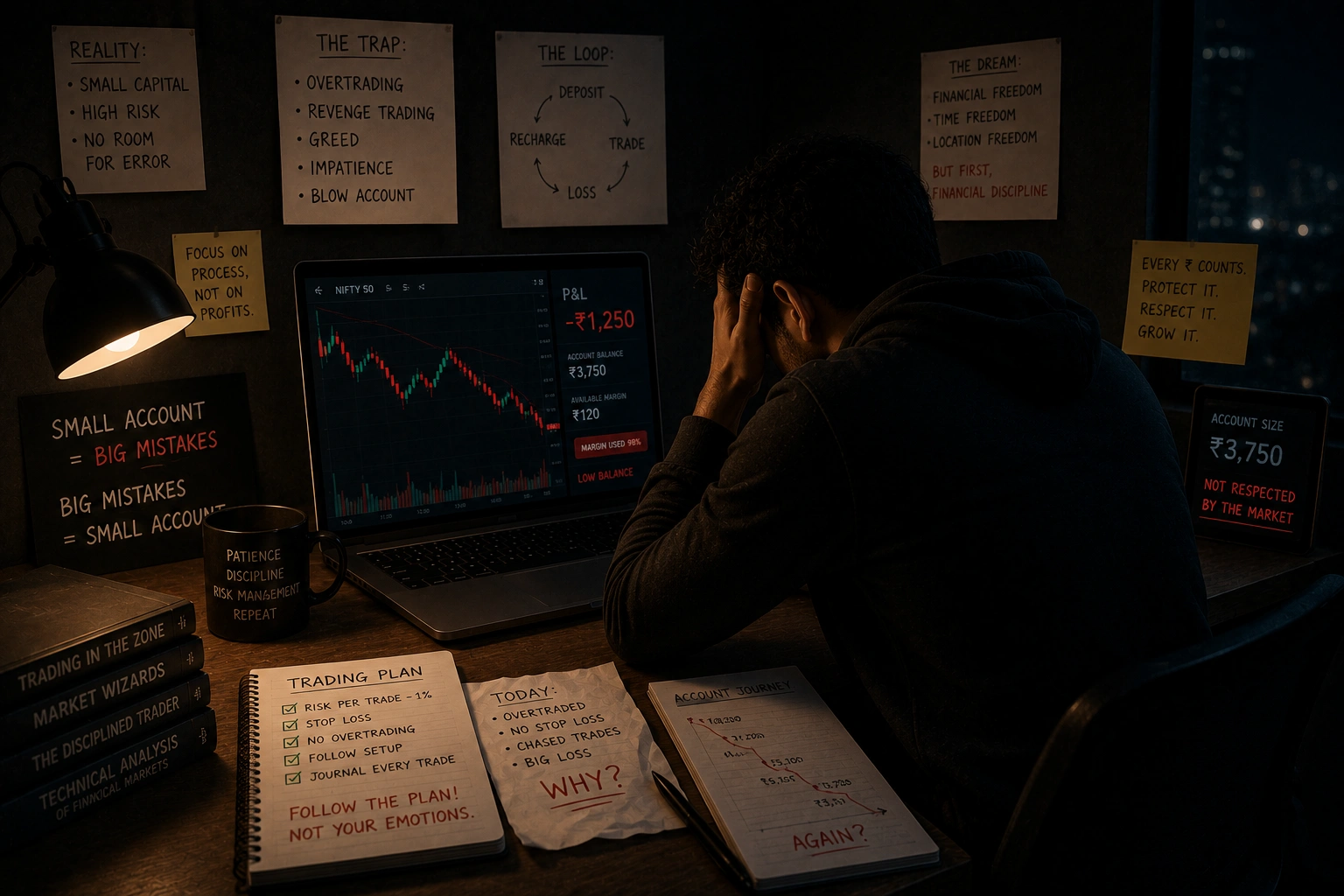
You started with forty thousand rupees, money you could actually afford to lose, which felt responsible at the time. Eight months later, the account is at thirty-one thousand, and somewhere in the last three weeks your position sizes have quietly doubled, without you consciously deciding that. You tell yourself it's because your conviction is higher now, that you understand the setups better than you did in month one. Some part of you already knows that's not really it. It's that thirty-one thousand feels too small to bother being careful with anymore, and forty thousand felt too far away to reach slowly.
Why Small Accounts Feel Stuck in a Way Bigger Ones Don't
Here's the honest mechanism behind this: a small account doesn't actually grow slower in percentage terms than a large one, the math of compounding doesn't care about the absolute number, but it feels unbearably slower, because the rupee amounts involved are too small to feel meaningful even when the percentage gains are genuinely solid. A twenty percent month on a large account changes your life. A twenty percent month on a small account buys you a nice dinner, and that gap between the percentage and the felt outcome is exactly what pushes people toward decisions the math never asked for.
That mismatch, real percentage progress that doesn't feel like progress, is the actual trap, not the account size itself.
Why This Pushes Toward Overtrading and Bigger Risk
When rupee gains feel too small to matter, the mind starts looking for a shortcut back to "meaningful," and the two most common shortcuts are trading more often or trading bigger. Both feel like solving the problem. Neither actually does, because more frequent trading mostly just multiplies transaction costs and emotional fatigue rather than multiplying edge, and bigger position sizes on a small account with the same strategy don't improve the strategy's win rate, they just raise the stakes on the exact same coin flip.
There's a specific version of this that shows up constantly with small accounts: a pivot toward cheap, far out-of-the-money options, because they're the only instrument that lets someone with limited capital chase a rupee amount that finally feels significant. The appeal is obvious, small outlay, theoretically large payoff. The reality, for most people who trade this way repeatedly, is a long string of small losses punctuated by an occasional win that doesn't come close to covering the losses that got them there, since deep out-of-the-money options expire worthless far more often than they pay off.
What Recent Regulatory Changes Have Done to Small Accounts Specifically
It's worth naming a structural shift that's made this harder for smaller accounts particularly. Through 2024 and into 2025, regulatory changes increased lot sizes and tightened position limits across index derivatives, which raised the margin required for multi-leg, defined-risk strategies considerably, in some cases roughly tripling what a spread position used to cost in margin. For a well-capitalized account, that's an adjustment. For a small account, it can make defined-risk strategies practically unaffordable, pushing traders toward simpler, undefined-risk, single-leg positions instead, often without the trader fully registering that their risk profile just changed considerably, not because their strategy evolved, but because the instrument they could still afford did.
That's a genuinely different situation from a few years ago, and it's part of why the small-account trap can feel sharper now than the general advice floating around about it accounts for.
How This Actually Plays Out Over a Typical Small-Account Journey
For a lot of traders, the first few months on a small account go reasonably well, disciplined position sizing, a few wins, a manageable rhythm. The trap tends to spring later, once a string of small losses has eaten into the account enough that the original position sizing suddenly looks too conservative to matter, and the trader increases size specifically to "make up ground faster," a phrase that shows up constantly in trader self-reports right before the losses accelerate.
A second, quieter pattern shows up in traders who never had a big losing month at all, just a long stretch of the account essentially flatlining, up a little, down a little, never meaningfully bigger. That flatline is often more dangerous than a loss, because it doesn't trigger the same alarm a drawdown would. It just slowly erodes patience until a trader takes on a much bigger, uncharacteristic position purely out of boredom with how slowly disciplined trading actually moves.
A third pattern, less discussed, involves traders who repeatedly deposit fresh capital into the same account after it shrinks, effectively resetting the account's real size without resetting the emotional relationship to the number, so the account "never really grows" in the trader's mind even though, on a total-capital-deployed basis, it's actually lost considerably more than the balance on screen suggests.
Round numbers play a specific, underrated role in this too. A trader whose account sits at forty-two thousand rupees behaves noticeably differently than one whose account sits at thirty-eight thousand, even though the actual difference is trivial, because forty thousand functions as a psychological anchor the mind keeps referencing. Getting back "above forty" or "back to fifty" becomes its own goal, disconnected from any actual trading logic, and traders will often take on distorted risk specifically to cross a round-number threshold that has no real financial significance beyond how clean it looks on a screen.
What Actually Helps With a Small Account, and What Doesn't
Measuring progress in percentage terms rather than rupee terms, deliberately, in a journal rather than just glancing at the balance, tends to help more than it sounds like it should, because it reconnects the felt sense of progress to the actual math rather than to a rupee figure too small to register emotionally. A twenty percent month written down and tracked over time looks like real progress in a way the same twenty percent, expressed as a few thousand rupees, quietly doesn't.
Separating "growing the account" from "adding fresh capital" mentally, and tracking them as two different things, helps traders see their actual trading performance clearly instead of a blurred number that mixes genuine skill with fresh deposits covering for losses.
Accepting, explicitly, that a small account's job in the early stage is to build a track record and discipline rather than to generate meaningful income yet, tends to reduce the pressure that drives overtrading. The account that's "too small to matter financially" is often, at the same stage, exactly the right size to be making mistakes on, before real money is on the line in a way that would actually hurt.
What doesn't help, in most traders' experience, is switching strategies repeatedly in search of one that grows the account faster. A strategy switch driven by impatience with the pace of a small account usually just resets the learning curve without addressing the actual problem, which was never really the strategy. It was the mismatch between rupee-scale expectations and percentage-scale reality.
Setting a genuinely small, boring rupee target for what "good progress this month" actually means, in advance, and treating hitting that modest number as a real win rather than a disappointment, sounds almost too simple to matter, but it directly counters the exact mechanism driving the trap, the mind's tendency to only register large rupee moves as meaningful. A trader who's decided in advance that two thousand rupees is a legitimately good month on a small account experiences that same two thousand rupees very differently than one who's still silently measuring every result against the forty-thousand-rupee milestone in their head, the same silent, rigged comparison that makes almost any slow, honest progress feel invisible next to an imagined finish line.
Where Artha Fits In
Admitting "I just doubled my position size and I don't fully know why" to another trader who's lived through the exact same pull, without it turning into either judgment or a strategy pitch, is the useful part. Nothing here replaces a trading journal or a genuine strategy review. It's also the same honesty that matters just as much when trading starts crossing into something closer to compulsive behavior.
A Small Thing Worth Saying Honestly
I'm not a trader myself, but I've watched the small-account frustration up close in people around me, the specific irritation of a decent, disciplined month that still doesn't feel like it moved anything, which tends to surface later as a bigger secret to hide from family.
The account was never really too small to grow properly. It was just small enough that patience felt like it wasn't working, even in the exact months it actually was.
If you measured this month's trading purely by the percentage, ignoring the rupee number on screen entirely, would you still feel like nothing's moving?
Quick answers
Things people usually want to know.
Why does my small trading account feel impossible to grow?
The percentage math of compounding works the same regardless of account si
More from HeyArtha
Other things we've been writing about.
Brokerage & Tax on Trading Income in India (2026 Guide)
What Zerodha actually charges, how STT changed in 2026, and how F&O, intraday and delivery profits are taxed, in a real numbers breakdown.
Budget Day Brain: Why Feb 1 Turns Disciplined Traders Reckless
Union Budget day making your trading brain go haywire? Heres an honest look at the psychology of high-volatility event days, no calls, just the mindset.
What the CFA Charter Actually Gets You in India: A Realistic View
₹32.4 lakh average for recent charterholders, ₹66.6 lakh overall. Heres what those numbers actually mean, and what they dont.