
When Does Trading Become Gambling? The Signs Nobody Wants to See
June 6, 2026 · ~10 min read · by Shivam Kushwaha, HeyArtha founder
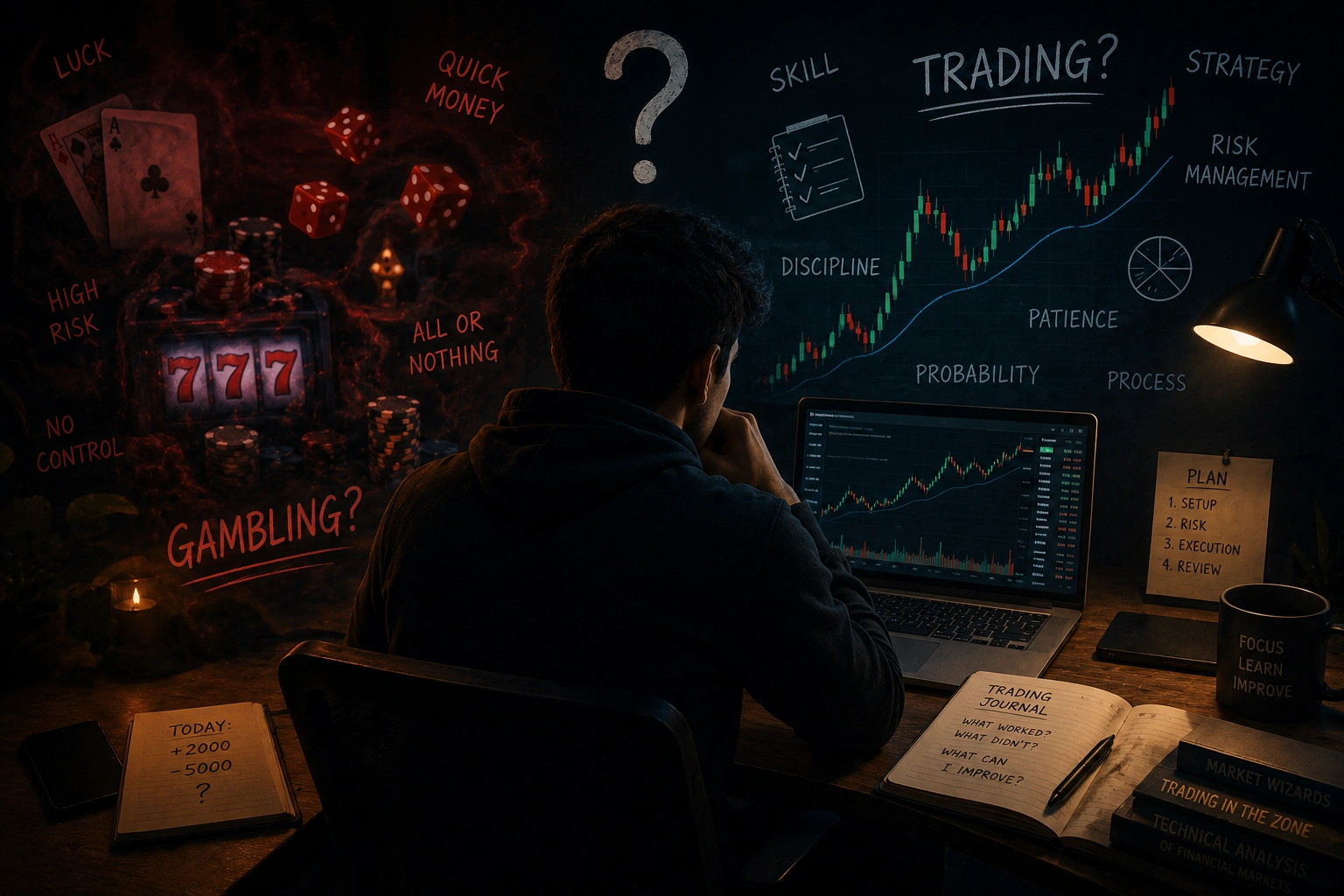
You told yourself the 9:20am trade was research-based. Chart looked right, volume looked right, you had a reason. By 9:45 it was down, and the next trade wasn't research-based at all, it was just trying to get back to zero before lunch. By 2pm you'd taken four more positions you can't fully explain, and you're sitting there with a stomach that feels like it did the one time you actually gambled, at a cousin's wedding, on a card game you didn't understand, chasing a loss that kept getting bigger the longer you stayed at the table. You close the terminal. You don't write anything in your journal. You already know what it would say.
The Question Most Traders Ask Themselves at Least Once
Here's the honest, research-backed answer: trading crosses into gambling territory not based on what instrument you're trading, but based on a specific pattern of behavior around it, chasing losses, needing increasingly large or frequent trades to feel the same rush, hiding the scale of your activity from people close to you, and being unable to stop even when you've decided to. Investing itself isn't gambling. But the way a person trades can absolutely become a gambling-like behavior, regardless of whether the underlying instrument is a stock, an option, or a coin.
That distinction is the whole point of this question. It's not about equities versus derivatives versus crypto. It's about whether your relationship to the trade looks like disciplined risk-taking or like chasing a feeling.
Why This Line Is So Easy to Cross Without Noticing
Trading and gambling activate a lot of the same psychological machinery, uncertainty, near-misses, the anticipation before an outcome resolves, and a reward system that responds almost identically to a winning trade and a winning bet. That overlap isn't a metaphor. It's the actual mechanism researchers have been documenting for years now, and it's exactly why someone can slide from calculated risk-taking into compulsive behavior without a single dramatic moment marking the shift.
What makes it harder to notice in trading specifically, compared to something like a casino, is that trading comes dressed in legitimacy. It has charts, terminology, a narrative about skill and analysis, an office-adjacent respectability that a night at the tables never has. That legitimacy makes it easy to keep calling something "research" or "strategy" long after the actual behavior driving it has shifted into something closer to compulsion.
What the Research Actually Says
A recent study developing and validating what researchers call the Trading Disorder Scale, an instrument designed specifically to identify problematic trading behavior among everyday traders, found that roughly one in ten traders assessed fell into a "disordered trading" category, showing patterns like markedly higher trading frequency, more intensive market monitoring, and significantly elevated rates of problem gambling markers, impulsivity, and substance use, compared to traders who didn't show that pattern. Another sizable group, close to 18%, fell into an "at-risk" category, not yet fully disordered but showing early signs of the same pattern.
That's not a fringe finding from one outlier study. It sits alongside a broader body of research on what's sometimes called pathological or disordered trading, work that has repeatedly found overlap between frequent, compulsive trading behavior and the same markers used to identify gambling disorder, preoccupation with the activity, escalating involvement over time, concealment from people close to you, and continuing despite clear negative consequences.
How This Actually Plays Out
For some traders this shows up as a single bad stretch that eventually resolves itself, a losing week that triggers some reckless trades, followed by a genuine step back once the initial panic passes. That's a rough patch, not a pattern, and most traders go through something like it at least once.
For others it becomes a cycle that doesn't resolve on its own. A loss triggers a revenge trade. The revenge trade triggers a bigger loss. The bigger loss triggers checking the terminal at 2am, unable to actually stop thinking about the position even when the market is closed. Somewhere in that cycle, the original reason for trading, an investment thesis, a strategy, a plan, quietly disappears, replaced by something closer to the pure need to feel the outcome resolve, win or lose, just to stop the tension of not knowing.
A third pattern shows up specifically around position sizing. Someone starts with a disciplined, small allocation, wins a few times, and gradually increases size not because their conviction in the trade has genuinely grown but because the smaller wins have stopped producing the same rush they used to. That's the exact escalation pattern researchers flag as a core marker of behavioral addiction, needing more of the activity to get the same emotional payoff.
This pattern shows up with particular intensity around India's retail futures and options trading, specifically because the low capital requirement and rapid resolution of options positions, sometimes within the same trading day, compress the entire uncertainty-and-reward cycle into a matter of minutes rather than the days or weeks a longer-term equity position would take. A faster cycle means more repetitions of that reward loop in a single session, which is part of why the pattern described here tends to develop faster in frequent options trading than in slower, longer-horizon investing.
A Few Honest Questions Worth Sitting With
None of this is a clinical diagnosis, and this isn't a checklist to self-diagnose against, but a few honest questions tend to surface the pattern more reliably than staring at your P&L ever will. Have you traded specifically to chase a previous loss, rather than because a new setup genuinely appeared. Have you hidden the frequency or size of your trading from someone close to you, not just the outcome, but the fact that you were trading at all. Have you tried to take a deliberate break and found yourself back at the terminal within a day or two, even when you'd decided otherwise. Does losing feel less like "the trade didn't work" and more like something closer to withdrawal, an itch that only another trade seems to settle.
Answering yes to one of these doesn't mean something is broken. Answering yes to most of them, honestly, is worth taking seriously rather than explaining away. One more worth sitting with: do you find yourself justifying a trade to yourself in language that sounds more like a gambler's story than an investor's thesis, "it has to bounce back eventually," "I'm due for a win," "just one more to break even," rather than anything actually tied to the setup itself. That specific kind of self-talk, reasoning backward from the outcome you want rather than forward from the evidence in front of you, tends to show up consistently in the accounts of people who later recognize they'd crossed the line without noticing at the time.
What Actually Helps, Compared to What Doesn't
A trading journal helps more than most traders expect, not because writing things down fixes the compulsion directly, but because it forces a specific, timestamped record of what you actually did and why, which is much harder to rationalize after the fact than a vague memory of "the market moved and I reacted." Reading your own journal from a losing week, a few days later, tends to make the pattern visible in a way that living through it in real time never does.
A trading break, a real one, days or weeks with the terminal genuinely closed, tends to reveal more than most traders want it to. If the break itself feels unbearable, if the pull to check charts or open a position becomes its own source of anxiety, that reaction is more diagnostic than any single losing trade could be.
Talking to a professional, a therapist familiar with behavioral addiction specifically, not just general anxiety, is worth taking seriously if the pattern includes hiding activity from people close to you, financial strain you haven't disclosed, or an inability to stop despite genuinely wanting to. This isn't something a trading forum or a strategy tweak resolves on its own when it's reached that point.
Talking to other traders, honestly, without performing confidence for them, helps in a different way, mainly by breaking the isolation that makes the pattern feel uniquely shameful, the same isolation that pushes a lot of traders toward hiding losses from the people closest to them instead of talking about it at all. Almost every trader who's been doing this for more than a year or two has had at least one stretch that looked exactly like what's described above.
Where Artha Fits In
The line between trading and gambling was never about the ticker symbol. It was always about whether you could still stop, and whether you'd notice if you couldn't. That's a harder thing to notice alone than most traders admit, which is part of why talking honestly about the comparison spiral that fuels a lot of chasing behavior in the first place matters just as much as the trade itself.
If you looked at today's trades the way you'd look at someone else's, honestly, without the story you've been telling yourself about them, would you still call it a strategy?
Quick answers
Things people usually want to know.
How do I know if my trading has become gambling?
Look at the pattern, not the outcome. Chasing losses with more trades, needing bigger positions to feel the same excitement, hiding your activity from people close to you, and being unable to stop even when you've decided to are the core markers researchers use, not whether any single trade wins or loses.
Is trading technically a form of gambling?
Investing itself isn't gambling. But research on disordered trading has found that some traders develop a compulsive, gambling-like relationship to trading specifically, marked by chasing losses, escalating involvement, and continuing despite clear harm, regardless of the instrument being traded.
What percentage of traders show signs of gambling-like behavior?
A recent study using a validated trading disorder scale found around one in ten traders assessed fell into a disordered trading category, with another roughly 18% showing early at-risk signs, both groups scoring notably higher on problem gambling and impulsivity measures.
What is revenge trading and how is it connected to gambling?
Revenge trading means opening a new position specifically to recover a previous loss quickly, rather than because a genuine new setup appeared. It mirrors the loss-chasing pattern that's a core diagnostic marker in gambling disorder research.
Can trading be addictive the same way gambling is?
Yes, according to a growing body of research. Trading and gambling activate overlapping reward pathways in the brain, particularly around uncertainty and near-miss outcomes, which is part of why compulsive trading patterns closely resemble compulsive gambling patterns.
More from HeyArtha
Other things we've been writing about.
Brokerage & Tax on Trading Income in India (2026 Guide)
What Zerodha actually charges, how STT changed in 2026, and how F&O, intraday and delivery profits are taxed, in a real numbers breakdown.
Budget Day Brain: Why Feb 1 Turns Disciplined Traders Reckless
Union Budget day making your trading brain go haywire? Heres an honest look at the psychology of high-volatility event days, no calls, just the mindset.
What the CFA Charter Actually Gets You in India: A Realistic View
₹32.4 lakh average for recent charterholders, ₹66.6 lakh overall. Heres what those numbers actually mean, and what they dont.