
When Journaling Isnt Enough: Recognising Trading Addiction
June 25, 2026 · ~10 min read · by Shivam Kushwaha, HeyArtha founder
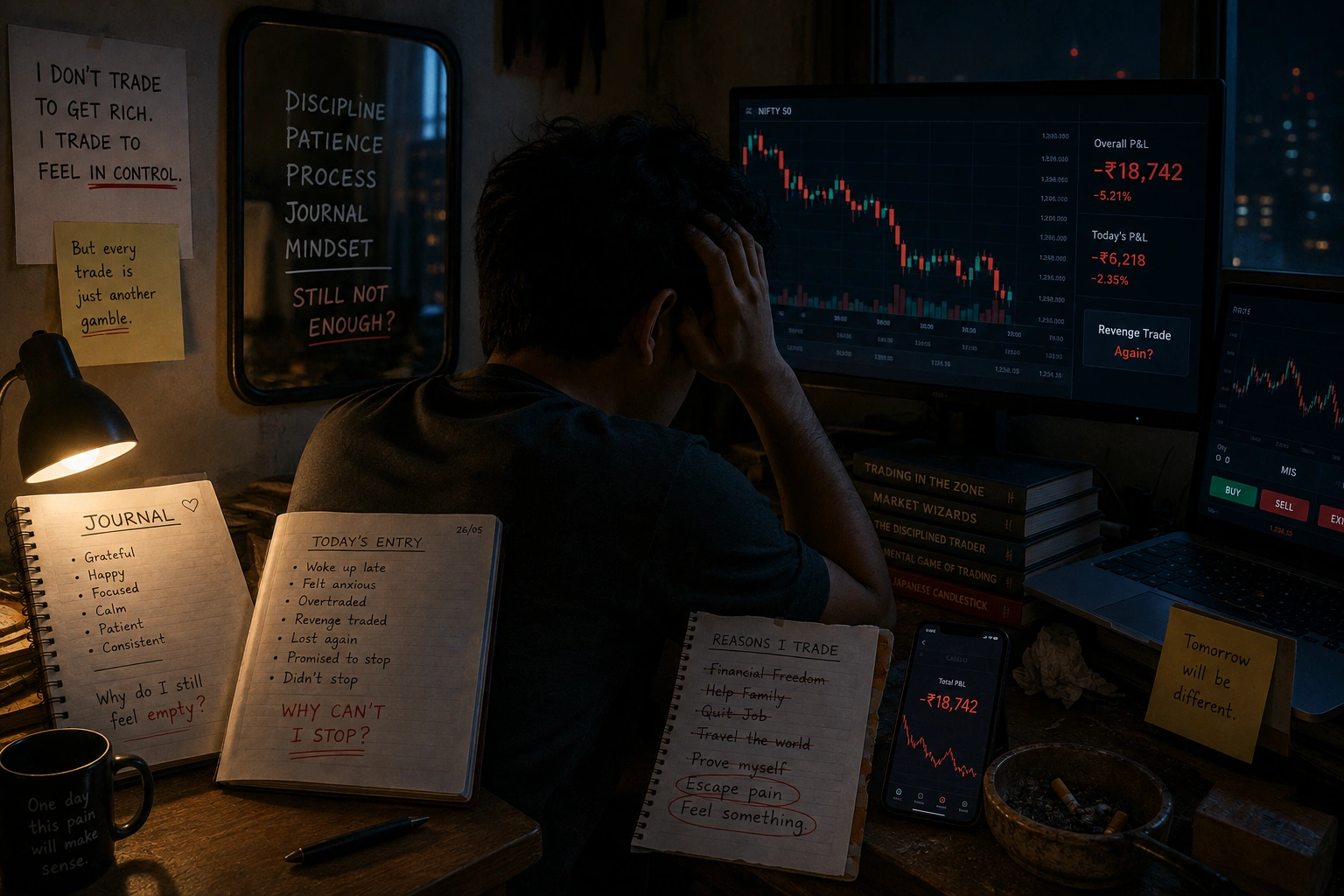
You've been journaling for four months now, every trade, every reason, every feeling attached to it, exactly the way every piece of advice told you to. You can point to the exact page where you wrote "I know I shouldn't do this again" after a losing streak, and you can point to three more pages after that where you did it again anyway, each time with a slightly different justification that felt convincing in the moment. The journal was supposed to be the fix. Instead it's become a fairly precise record of a pattern that keeps repeating despite you watching it happen, in writing, in your own handwriting, every single time.
The Honest Signal Worth Paying Attention To
Here's the distinction worth naming clearly: a trading habit that responds to self-awareness, that actually changes once you can see the pattern written down, is a habit self-help tools like journaling are genuinely built to fix. A pattern that persists even after you can see it clearly, in your own writing, trade after trade, is a different kind of problem, one where insight alone isn't the missing ingredient anymore, and that distinction is worth taking seriously rather than assuming more discipline or a better journal template will eventually close the gap.
This isn't a failure of the journaling itself. Journaling is a genuinely useful tool for the vast majority of trading psychology issues. It's just not designed to interrupt a pattern that's crossed from habit into something closer to compulsion, the same way a food diary helps most people eat more mindfully but doesn't, on its own, treat a genuine eating disorder.
Why Self-Awareness Alone Stops Working at a Certain Point
Journaling works by strengthening the gap between noticing an urge and acting on it, giving you a moment of reflection that wasn't there before. For most trading mistakes, revenge trades, oversized positions, ignored setups, that added moment of awareness is enough to actually change the behavior over time. But compulsive patterns, by definition, involve acting despite full awareness of the consequences, which means the reflective pause a journal creates simply doesn't function as a brake anymore. You can see the cliff edge clearly and still walk toward it, because the part of the pattern driving the behavior isn't a lack of information.
This is consistent with what clinicians treating this specifically have observed. Doctors at NIMHANS' SHUT Clinic in Bengaluru, which sees two to three new trading-related cases a month, describe patients as commonly having "degrees, good jobs and stable earnings," people with every practical reason and every piece of self-knowledge needed to stop, still unable to, which is precisely the marker that separates a correctable habit from something requiring outside intervention.
What Actually Distinguishes a Habit From an Addiction Here
A few honest questions tend to surface the difference more reliably than continuing to journal alone. Has the pattern persisted for more than a few months despite genuine, repeated attempts to change it, not just one broken resolution but a consistent inability to follow through on a decision you've made sincerely more than once. Has the behavior started interfering with sleep, work, or relationships in ways you've noticed but haven't fully addressed. Have you found yourself hiding the frequency or scale of your trading from people close to you, not just the outcomes, but the fact that you were trading at all.
A recently published case report from NIMHANS described a 29-year-old man whose trading involved loss of control over his own decisions, constant preoccupation with the market outside trading hours, compulsive chasing of losses, and disrupted sleep, a pattern assessed as severe using a validated clinical tool. What made his case notable wasn't that the behavior was unusual, it was that it fit a documented, recognizable clinical shape, the kind of shape that self-help alone rarely resolves on its own once it's fully formed.
How This Actually Plays Out for Different Traders
For some traders, journaling genuinely works, the awareness it builds is enough, and the patterns it surfaces get corrected within weeks or months without needing anything more. This is the majority outcome, and it's worth saying plainly so this article doesn't read as suggesting every struggling trader needs clinical intervention. Most don't.
For others, journaling reveals the pattern clearly but the behavior keeps repeating anyway, sometimes for months, each entry a near-identical variation on the last, "knew I shouldn't but did it anyway," without any real movement toward change despite the insight being right there on the page. This is the specific signal this article is about, not the presence of mistakes, but the persistence of a fully-seen pattern that refuses to respond to seeing it.
For a smaller group, the pattern has already produced real financial or relational damage, debt, strained relationships, concealment from family, before the trader recognizes journaling alone isn't going to be enough. Recognizing this earlier rather than later tends to make the eventual intervention considerably less costly, in every sense of that word.
There's a specific early version of this worth naming too, one that often shows up before the pattern reaches full compulsion: a trading rule, like honoring a stop-loss, that keeps getting broken despite being written down and reaffirmed after every single violation. Repeatedly moving a stop-loss despite knowing better is often one of the first, smaller-scale versions of exactly this dynamic, insight that isn't translating into behavior change, well before it grows into the fuller pattern described here.
What Actually Helps Once Journaling Has Hit Its Limit
Treating the recognition itself, "journaling isn't working anymore," as useful information rather than a personal failure is worth doing deliberately, since a lot of traders delay seeking further help specifically because admitting the self-help approach isn't enough feels like an additional defeat layered on top of the trading losses themselves. It isn't. It's simply accurate information about what this particular pattern needs.
Specialized support exists specifically for this in India now, not generic financial counseling, but clinical treatment for the compulsive behavior itself. NIMHANS' SHUT Clinic in Bengaluru treats technology and trading-related compulsive behavior and can be reached through the institute's main exchange at 080-26995000. Alpha Healing Center in Gujarat runs a dedicated day trading addiction treatment program specifically. Tele-MANAS, India's free national mental health helpline, is available 24x7 at 14416 or 1-800-891-4416 for anyone who wants to talk through what they're noticing before deciding on next steps.
Continuing to journal alongside seeking further support, rather than abandoning it, tends to help too, since the record you've already built becomes genuinely useful material for a professional trying to understand the specific shape of the pattern, rather than something that gets discarded once it's no longer sufficient on its own.
What tends not to help is escalating the self-help approach itself, more elaborate journaling systems, stricter personal rules, harsher self-criticism, when the pattern has already shown it doesn't respond to insight. More of the same tool that isn't working rarely becomes the tool that finally works.
Where Artha Fits In
This is exactly the kind of realization that's hard to sit with alone, because admitting "I've been watching myself do this in writing for months and I still can't stop" can feel more damning than the losses themselves. This recognition often arrives right around the same point that whether their trading has crossed into something closer to gambling and the specific shame of funding trades with money that wasn't really theirs to risk both show up.
A Small Thing Worth Saying Honestly
I'm not a trader myself, but I recognize this particular shape of stuckness from watching other kinds of patterns in people around me, the specific frustration of seeing something clearly and still not being able to change it through willpower alone. What strikes me about the research on this is how much relief traders describe once they stop treating the inability to self-correct as a character flaw and start treating it as accurate information pointing toward the kind of help that actually works for this specific problem.
The journal was never lying to you. It was doing exactly what it's supposed to do, showing you the pattern clearly. It just isn't the tool that closes the gap once seeing it clearly stops being enough on its own.
If you read back through your last month of trading journal entries as if a friend had written them, would you tell that friend to keep journaling, or would you tell them it's time to talk to someone?
Quick answers
Things people usually want to know.
How do I know if journaling isn't enough to fix my trading habits anymore?
If a pattern persists for months despite clear, written self-awareness and genuine, repeated attempts to change it, that's a signal the issue may have moved past what self-help tools alone can address, and it's worth taking seriously rather than continuing the same approach indefinitely.
What's the difference between a bad trading habit and trading addiction?
A habit typically responds to increased self-awareness over time. Addiction involves acting despite full, clear awareness of the consequences, meaning insight alone doesn't function as an effective brake the way it does for less severe patterns.
Where can I get professional help for trading addiction in India?
NIMHANS' SHUT Clinic in Bengaluru treats technology and trading-related compulsive behavior and can be reached through the institute's main exchange at 080-26995000. Alpha Healing Center in Gujarat also runs a dedicated day trading addiction treatment program.
Is it normal for trading journaling to stop working after a while?
For most people, journaling continues to help over time. When it consistently fails to change a specific, persistent pattern despite genuine effort, that's a meaningful signal worth paying attention to, not a sign the tool itself has failed in general.
What are signs that trading has become a compulsion rather than just a bad habit?
Persistence of the pattern despite clear, written self-awareness, interference with sleep, work, or relationships, and hiding the frequency or scale of trading from people close to you are core markers worth taking seriously.
Should I stop journaling if it isn't fixing my trading pattern?
Not necessarily. Continuing to journal alongside seeking further support tends to help, since the existing record becomes useful material for a professional to understand the specific shape of the pattern, even if journaling alone isn't sufficient on its own anymore.
Can trading addiction be treated the same way as gambling addiction?
There's significant overlap in the underlying behavioral patterns, and clinicians increasingly recogni
More from HeyArtha
Other things we've been writing about.
Brokerage & Tax on Trading Income in India (2026 Guide)
What Zerodha actually charges, how STT changed in 2026, and how F&O, intraday and delivery profits are taxed, in a real numbers breakdown.
Budget Day Brain: Why Feb 1 Turns Disciplined Traders Reckless
Union Budget day making your trading brain go haywire? Heres an honest look at the psychology of high-volatility event days, no calls, just the mindset.
What the CFA Charter Actually Gets You in India: A Realistic View
₹32.4 lakh average for recent charterholders, ₹66.6 lakh overall. Heres what those numbers actually mean, and what they dont.