
When UPSC Prep Breaks Your Relationship
July 8, 2026 · 10 min read · by Shivam Kushwaha, HeyArtha founder
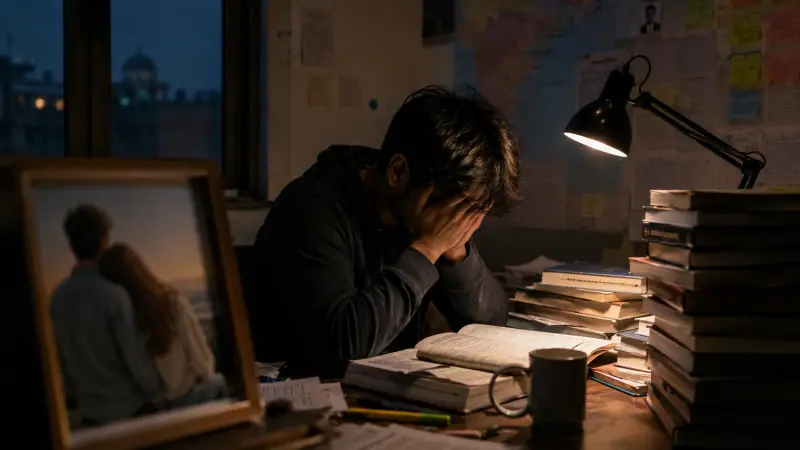
The call rang four times before it went to voicemail. You saw it happen, watched the screen light up while you were mid-sentence in a mock answer about federalism, and let it ring out anyway. Not because you didn't want to pick up. Because picking up meant losing the thread of an answer you'd already spent forty minutes building, and some quiet, exhausted part of you had already decided the answer mattered more tonight. You'll call back later, you tell yourself. You usually do. Lately, later keeps getting later.
Why UPSC Specifically Strains Relationships So Hard
UPSC preparation puts a specific kind of pressure on relationships that's different from ordinary busyness, because it demands not just time but a version of you that's mentally elsewhere even when you're physically present. It's not one dramatic fight that ends things. It's usually a slow accumulation of missed calls, shortened conversations, and a partner who starts to feel like they're competing with a syllabus for your attention, and slowly stops trying to compete at all.
The unpredictability makes it worse than a demanding job would. A job has fixed hours, evenings that are genuinely free. UPSC prep doesn't respect that boundary the same way, a mock test can eat a Sunday, a sudden wave of anxiety about current affairs can swallow an evening that was supposed to be for your partner. Your partner learns, over months, not to make plans that depend on you being fully present, because too many of those plans have already been quietly cancelled by the syllabus. Even the wait between exam stages, that specific limbo after Mains before results, doesn't actually free up the attention a partner might expect, the anxiety just changes shape without releasing any of the mental bandwidth it was consuming before.
There's also a specific kind of guilt that builds on both sides. You feel guilty for not giving enough, aware that you're asking someone to wait indefinitely for a version of you that has time again. They feel guilty for needing anything at all, aware that what they're asking for, attention, presence, plans that don't get cancelled, is something you genuinely don't have much of left to give right now. Neither person is wrong. Both are running out of the specific resource the relationship needs most, and neither of you chose to be in this particular kind of scarcity, it just happened, gradually, over a year that was never really about either of you individually.
What the Research Actually Says About Distance
It's worth being precise about what's actually causing the strain, because it's usually not distance itself. Research on long-distance relationships, reviewed in depth by a mixed-methods analysis published via ScienceDirect, consistently finds that long-distance couples report comparable, and sometimes higher, relationship satisfaction than geographically close couples, despite reporting more stress. Distance alone doesn't reliably predict a relationship ending.
What actually predicts strain is the erosion of maintenance behaviours, the small, regular acts of showing up, that any relationship needs regardless of physical distance. UPSC prep doesn't just create distance, it consumes the exact time and mental bandwidth those maintenance behaviours require. A couple living in the same city, both physically available every day, can still drift apart faster than a genuinely long-distance couple, if one partner's attention has been almost entirely claimed by something else for over a year.
That distinction matters because it changes what the actual problem is. It's not that UPSC-and-relationships are inherently incompatible. It's that the specific demands of this exam, the unpredictability, the sheer duration, the mental preoccupation even during physical presence, make ordinary relationship maintenance much harder to sustain without deliberate, conscious effort from both people.
What Actually Helps
Naming the pattern honestly to your partner, rather than letting silence do the explaining, tends to protect the relationship more than either over-apologizing or minimizing what's happening. "I'm not available the way I used to be, and it's the exam, not you" is a harder sentence to say than to imply through cancelled plans, but it lands very differently.
Protecting small, non-negotiable pockets of real presence, even fifteen genuinely undistracted minutes a day, matters more than promising a full evening you'll likely have to cancel anyway. Consistency in something small tends to rebuild trust faster than an occasional grand gesture that gets swallowed by the next mock test cycle.
It's worth being honest with yourself, too, about whether the relationship is straining under UPSC's demands specifically, or whether the exam has simply given you both permission to avoid a harder, separate conversation that predates the prep. Those are genuinely different problems, and treating one as the other rarely resolves either. If you're on your final permitted attempt, that added pressure has a way of making every relationship conversation feel higher-stakes than it might otherwise, worth naming as its own separate weight rather than folding it silently into the relationship strain itself.
If you're also dealing with the marriage-timeline pressure that runs alongside UPSC prep for a lot of aspirants, family expectations, the clock, an existing relationship, all pulling at once, that compounding pressure deserves to be named separately from the relationship strain itself, since conflating the two usually makes both harder to actually address. And if you've relocated for coaching, the specific loneliness of that move can quietly make an already strained relationship feel even more isolating, since you no longer have the easy, in-person version of connection to fall back on either.
Talking to someone who genuinely understands what this specific version of relationship strain looks like, not generic relationship advice, but the exact texture of choosing a mock test over a phone call and hating yourself a little for it, tends to help more than either defending the choice or spiraling in guilt about it alone.
What I've Noticed Building This
I'm not preparing for UPSC myself, but I've read enough conversations across Artha to recognise how often this exact pattern shows up in different exam-prep contexts, not just UPSC's. The guilt of choosing preparation over a person you love, repeatedly, over months, is one of the quieter costs nobody warns you about when they describe what this kind of exam actually demands. It rarely makes it into the coaching-centre pep talks about sacrifice and discipline, even though it's often the cost that lingers longest after the exam itself is over.
The call going to voicemail isn't really about the call. It's about what a missed call has quietly come to represent, over months, without either of you ever explicitly deciding it should mean that. What's the version of the conversation with your partner you've been avoiding, the one that isn't about tonight's mock test at all?
Quick answers
Things people usually want to know.
Is it normal for relationships to struggle during UPSC preparation?
Yes, this is a commonly reported experience among aspirants, since UPSC prep demands not just time but sustained mental presence, which makes ordinary relationship maintenance harder to keep up. It doesn't mean the relationship or the preparation is inherently flawed.
Does long-distance specifically cause UPSC relationships to fail?
Not necessarily. Research on long-distance relationships generally finds comparable or even higher satisfaction compared to geographically close couples, which suggests distance itself isn't the primary driver of strain. It's more often the erosion of small, regular relationship maintenance behaviours that causes the real damage.
How do I tell my partner that UPSC prep is affecting our relationship?
Naming the pattern directly, "I'm not as available as I used to be, and it's the exam, not you," tends to protect the relationship better than letting cancelled plans and missed calls speak for themselves. Clear communication, even when uncomfortable, usually lands better than silence.
Can a relationship survive UPSC preparation?
Many do, particularly when both people acknowledge the specific pressures involved and make deliberate, if small, efforts to maintain connection. It typically requires conscious effort from both partners rather than assuming the relationship will simply hold on its own.
Why do I feel guilty every time I choose studying over my partner?
This guilt is common and reflects a genuine tension between two things you care about, rather than evidence that you don't care enough about either. Recognising the guilt as a natural byproduct of a hard tradeoff, rather than proof you're doing something wrong, can make it easier to sit with.
Should I pause my UPSC preparation to save my relationship?
That's a deeply personal decision with no universal answer, and it depends on the specific dynamics of your relationship and preparation. Some aspirants find smaller adjustments, protecting specific pockets of presence, work better than pausing preparation entirely.
How much time should I realistically give my relationship during UPSC prep?
There's no fixed number, but consistency in small amounts of genuine, undistracted time tends to matter more than occasional larger blocks that frequently get cancelled. Even fifteen minutes of real presence daily can help maintain connection better than an unreliable promise of a full evening.
Is it my partner's fault for not understanding the pressure of UPSC prep?
Not necessarily, partners without direct experience of an exam like UPSC often genuinely struggle to grasp its unpredictability and duration. Clear, ongoing communication about what the preparation actually demands can help bridge that gap of understanding.
What if the relationship strain isn't really about UPSC at all?
It's worth being honest with yourself about whether UPSC prep is the actual cause of the strain, or whether it's providing cover for a separate, harder conversation that predates the exam. These are different problems, and misdiagnosing one as the other usually prevents either from being properly addressed.
How do I balance studying for UPSC with maintaining a healthy relationship?
Protecting small, consistent, distraction-free moments of connection, rather than promising larger blocks of time you may not be able to keep, tends to work better in practice. Honest communication about your current capacity also helps set realistic expectations on both sides.
Is it common to feel torn between preparing for UPSC and being present for a partner?
Very common, and it's one of the less-discussed emotional costs of long-term exam preparation. The tension itself doesn't mean you're failing at either the relationship or the preparation, it reflects a genuinely difficult tradeoff many aspirants face.
Does this strain get better after the exam is over, regardless of the result?
For many couples, yes, since the specific pressure driving the strain eases once the preparation phase itself ends. The relationship may still need deliberate rebuilding afterward, since the patterns of reduced presence don't always reverse automatically just because the exam is behind you.
More from HeyArtha
Other things we've been writing about.
What to Do After UPSC Mains, Before the Result
The two months after UPSC Mains before results feel like nothing. Here's why the gap hits so hard, and what actually helps you get through it.
IBPS & SBI PO vs UPSC: Career, Salary, and Odds Compared
UPSC has a 0.2% pass rate and a 1-year cycle. IBPS and SBI PO offer 1-2% odds, 6-8 month cycles, and predictable banking careers. Compare both paths.
Can You Prepare for CA and UPSC Together? The Honest Truth
Can you prepare for CA and UPSC simultaneously? Why dual prep fails during articleship, how to sequence them, and how CA serves as a strong Plan B.