
UPSC vs Shaadi: When the Clock and the Family Both Wont Wait
June 25, 2026 · ~10 min read · by Shivam Kushwaha, HeyArtha founder
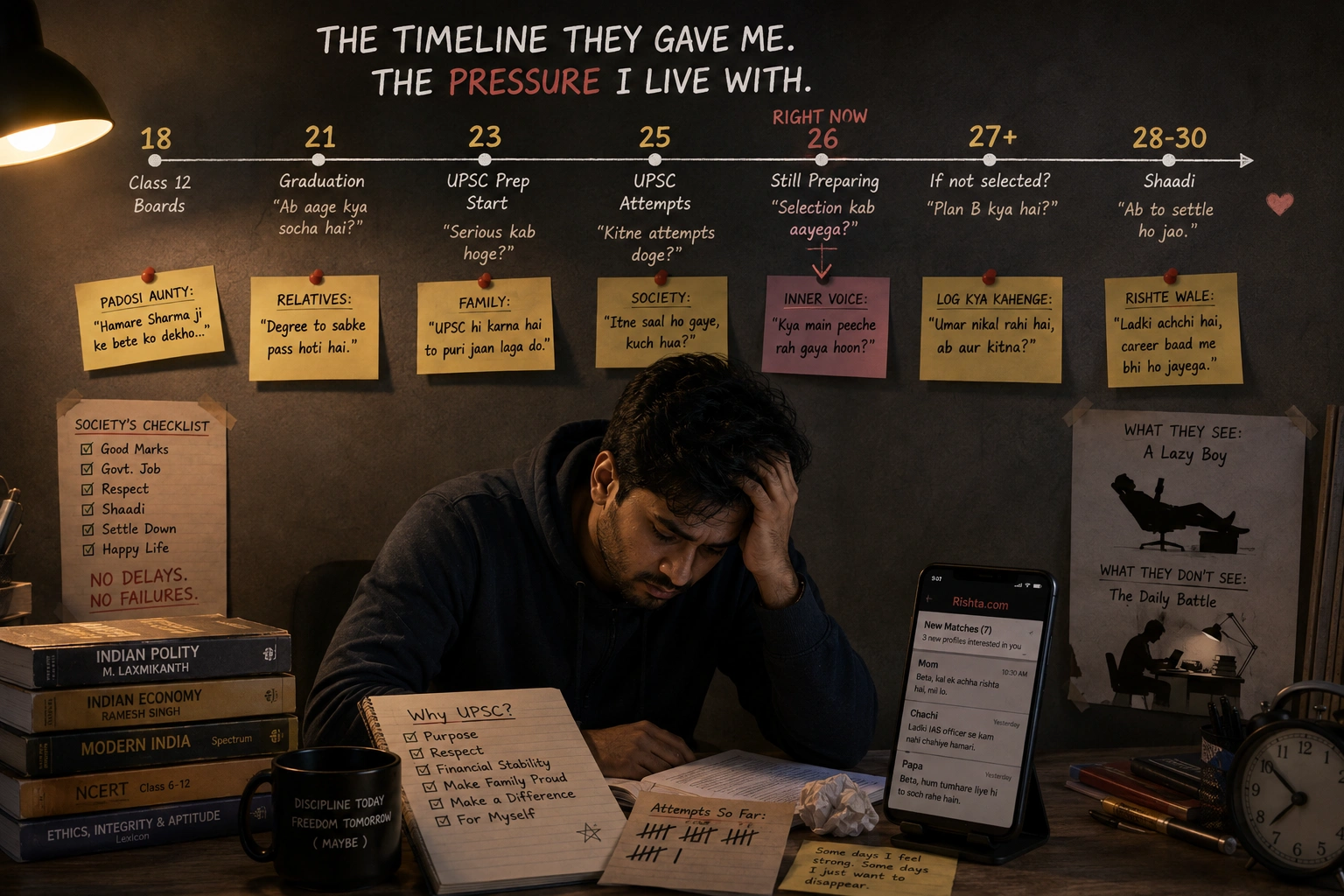
Your mother brought it up again over dinner, gently this time, the way she does when she's decided gentle hasn't worked and it's time to just say it. A family friend's daughter, your age, engaged last month. She didn't ask when you're getting married. She asked when you're "planning to settle," which you both know means the same thing, wrapped in slightly softer language. You've got mains in four months. You also know, somewhere underneath the irritation, that she isn't wrong to be counting years the way you're counting attempts. You just wish the two countdowns weren't happening in the same conversation.
Two Clocks, One Conversation
Here's the honest shape of this problem: UPSC preparation runs on its own multi-year timeline, shaped by attempts and age limits that are entirely outside your family's control, while marriage, in a lot of Indian families, runs on a separate, socially-set timeline that has nothing to do with how your mains prep is going. When those two clocks are both ticking in the same years of your life, usually your mid-to-late twenties, the pressure doesn't feel like two separate conversations. It feels like one impossible one, where succeeding at either seems to require failing at the other.
That collision is real, not imagined, and it deserves to be named as its own specific problem rather than folded into general "family pressure" advice that doesn't account for the fact that both clocks have actual deadlines attached.
Why This Hits Differently Than Ordinary Family Pressure
Most family pressure around UPSC is about comparison and judgment, "kab tak clear karoge," relatives measuring your attempts against a cousin's placement. This is different, because marriage isn't just a comparison point, it's an actual decision with its own logistics, families to coordinate, ages that matter to prospective partners' families too, and a social calendar that doesn't pause for exam season. A relative asking about your attempts is uncomfortable. A family actively trying to finalize a match while you're mid-preparation is a scheduling conflict with real consequences either way it resolves.
This pressure also lands with a specific intensity for women aspirants, in a culture where a woman's marriage age is still watched more closely and judged more harshly than a man's, even by well-meaning relatives who would never frame it that way out loud. A male aspirant delaying marriage for UPSC often gets read as ambitious. A woman doing the same is more likely to be read as running out of time, a framing that adds a layer of urgency to her preparation that a male batchmate in an identical exam position simply doesn't carry.
Worth knowing here: the family's sense of urgency is often running ahead of the actual demographic reality. India's National Family Health Survey puts the national median age at first marriage at roughly 22 for women, but that number is pulled down heavily by rural and less-educated populations, since urban, educated women in metro cities are now commonly marrying in their late twenties. The "you're running out of time" framing a lot of aspirants hear at 26 or 27 is frequently based on an outdated sense of the timeline, not the one their own education and city actually reflect.
The Structural Reality Behind the Pressure
It helps to be precise about the actual constraint driving this, since a lot of the anxiety comes from vague uncertainty rather than the real numbers. General and EWS candidates get 6 attempts up to age 32. OBC candidates get 9 attempts up to age 35. SC and ST candidates get unlimited attempts up to age 37. Whatever category applies, there's a hard ceiling, and most serious aspirants are attempting across exactly the years, roughly early to late twenties, when Indian families traditionally expect marriage conversations to begin in earnest.
That overlap isn't a coincidence of bad timing. It's simply what the exam's demographics and the culture's marriage expectations have in common, the same decade of a person's life, which means almost every serious aspirant eventually has to face some version of this collision, whether their family raises it explicitly or lets it sit quietly underneath every conversation about "what's next."
How This Actually Plays Out for Different Aspirants
For some aspirants, the family agrees to a defined pause, marriage conversations held off until after a specific attempt or a specific year, in exchange for a clear commitment from the aspirant about what happens if that attempt doesn't work out. This tends to be the least stressful version, not because the pressure disappears, but because it has a defined shape and an end date both sides have actually agreed to.
For others, the pressure runs in parallel without any real agreement, family quietly continuing to look at matches "just in case" while officially supporting the UPSC attempt, which leaves the aspirant constantly managing two half-open processes at once, never fully able to focus on either without the other tugging at their attention.
For a smaller group, marriage happens during preparation, not after it, and the aspirant continues attempting UPSC as a married person, sometimes with a supportive partner and in-laws, sometimes navigating a new household's expectations on top of an already demanding preparation schedule. This path carries its own specific pressure, proving the marriage hasn't "distracted" from the ambition, in either direction.
There's a fourth pattern too, less discussed but real: aspirants who use the marriage conversation itself as an unplanned pressure-test for whether their preparation is actually still serving them, discovering, once forced to weigh both clocks seriously, that they were more ready to let go of one of them than they'd admitted to themselves. That isn't a failure of either the marriage or the exam. It's simply what happens when a deadline forces an honest look at a decision that had been drifting along on autopilot.
What Actually Helps When Both Clocks Are Running
Naming the two pressures as genuinely separate conversations, rather than letting them blur into one vague sense of "everything is too much," tends to help aspirants think more clearly about what's actually being asked of them in each. The UPSC timeline has hard, external rules. The marriage timeline, however much it feels equally fixed, usually has more room to negotiate than it initially seems, especially once a family understands the actual attempt-and-age math involved.
Bringing the real numbers into the family conversation, specifically how many attempts remain and by when, tends to shift the discussion from vague pressure toward a concrete, time-bound plan both sides can actually work with. Families who understand there's a real, finite window, not an indefinite postponement, are often more willing to grant it than aspirants expect going in.
Talking to other aspirants who've navigated this exact collision, especially those who married during preparation rather than after, tends to surface options that don't occur to someone facing the decision for the first time, arrangements, conversations, and compromises that worked for people in a nearly identical position, the same way people navigating how much of their attempt to even share with family find that talking to someone who's actually lived it beats guessing alone.
What tends not to help is treating the two pressures as a single, all-or-nothing choice, this exam or marriage, when for most families the actual disagreement is really about timing and sequencing, not a permanent either-or. Getting specific about the timeline usually reveals more flexibility than the initial pressure suggests.
Where Artha Fits In
This is exactly the kind of collision that's hard to talk through honestly with people who love you, because your parents have their own version of urgency that isn't wrong, just different from yours. It usually sits inside the broader "log kya kahenge" pressure, and close to the harder conversations that come up when an attempt is genuinely running out.
A Small Thing Worth Saying Honestly
I've watched this exact tension play out around people close to me, the low-grade dread of a specific family conversation that everyone knows is coming but nobody wants to start first. What's struck me is how often the actual disagreement, once someone finally names the real numbers out loud, turns out to be smaller than the anxiety around it, a matter of timing that both sides can usually move on, once it stops being an abstract, endless-feeling standoff.
The two clocks were never actually running against each other. They just happened to be counting through the same years of your life, and nobody sat everyone down to say that plainly before the pressure built up around it.
If your family knew, in exact numbers, how much real time your current attempt cycle actually needs, do you think the conversation would still feel as impossible as it does right now?
Quick answers
Things people usually want to know.
How do I deal with family pressure to marry while preparing for UPSC?
Bringing the actual attempt-and-age numbers into the conversation, rather than leaving the pressure vague, tends to help families understand there's a real, finite window rather than an open-ended delay, which often makes them more willing to agree to a defined pause.
What are the UPSC attempt and age limits by category?
General and EWS candidates get 6 attempts up to age 32. OBC candidates get 9 attempts up to age 35. SC and ST candidates get unlimited attempts up to age 37, with further relaxations for PwBD candidates.
Is it harder for women UPSC aspirants to negotiate marriage timing than men?
Often, yes. Cultural expectations tend to watch a woman's marriage age more closely, which can add a layer of urgency to her preparation timeline that a male aspirant in an identical exam position doesn't typically face to the same degree.
Can I prepare for UPSC after getting married?
Yes, many aspirants do, sometimes with strong support from a spouse and in-laws. It carries its own pressures, particularly around new household expectations, but it's a genuinely common and viable path, not a rare exception.
How do I negotiate a specific timeline with my family for UPSC before marriage?
Proposing a defined pause tied to a specific attempt or year, with a clear commitment about what happens afterward either way, tends to work better than an open-ended request, since it gives both sides something concrete to agree to.
Should I tell my family my exact number of remaining UPSC attempts?
Many aspirants find that sharing the real numbers, rather than keeping the pressure abstract, helps families understand the situation has a genuine end point, which often makes them more flexible than a vague, ongoing request for "more time" would.
Is it normal to feel like UPSC and marriage are competing for the same years of my life?
Very normal. Both processes tend to unfold across the same stretch of someone's twenties, which means the overlap isn't a personal failure to plan well, it's simply how the exam's demographics and typical marriage timelines happen to intersect.
What if my family won't agree to wait until after my next UPSC attempt?
This varies by family, but many aspirants find that framing it as a specific, time-bound request, rather than an indefinite one, opens more room for negotiation than the initial conversation suggested was possible.
How do other UPSC aspirants handle this exact pressure?
Approaches vary, some negotiate a defined pause, others continue attempting while married, and some manage both processes in parallel. Talking to aspirants who've actually faced this collision tends to surface options that aren't obvious when facing it for the first time alone.
Does marriage during UPSC preparation hurt my chances of clearing the exam?
There's no evidence that marriage itself affects exam performance one way or the other; what matters more is whether the surrounding support, or lack of it, gives an aspirant the time and headspace preparation actually requires.
Why does this pressure feel different from general "log kya kahenge" comparison pressure?
Because marriage isn't just a source of comparison, it involves real logistics and other families' timelines, which makes it a genuine scheduling conflict rather than just social judgment, even though the two pressures often show up in the same conversations.
Where can I talk to other UPSC aspirants navigating marriage pressure?
Anonymous peer spaces built for aspirants, like Artha's UPSC Talk room, connect you with people who've actually negotiated this exact collision between the two timelines, without it reaching your family before you're ready for that conversation.
More from HeyArtha
Other things we've been writing about.
What to Do After UPSC Mains, Before the Result
The two months after UPSC Mains before results feel like nothing. Heres why the gap hits so hard, and what actually helps you get through it.
IBPS & SBI PO vs UPSC: Career, Salary, and Odds Compared
UPSC has a 0.2% pass rate and a 1-year cycle. IBPS and SBI PO offer 1-2% odds, 6-8 month cycles, and predictable banking careers. Compare both paths.
Can You Prepare for CA and UPSC Together? The Honest Truth
Can you prepare for CA and UPSC simultaneously? Why dual prep fails during articleship, how to sequence them, and how CA serves as a strong Plan B.