
Down to Your Last UPSC Attempt: The Pressure Nobody Prepares You For
June 7, 2026 · ~10 min read · by Shivam Kushwaha, HeyArtha founder
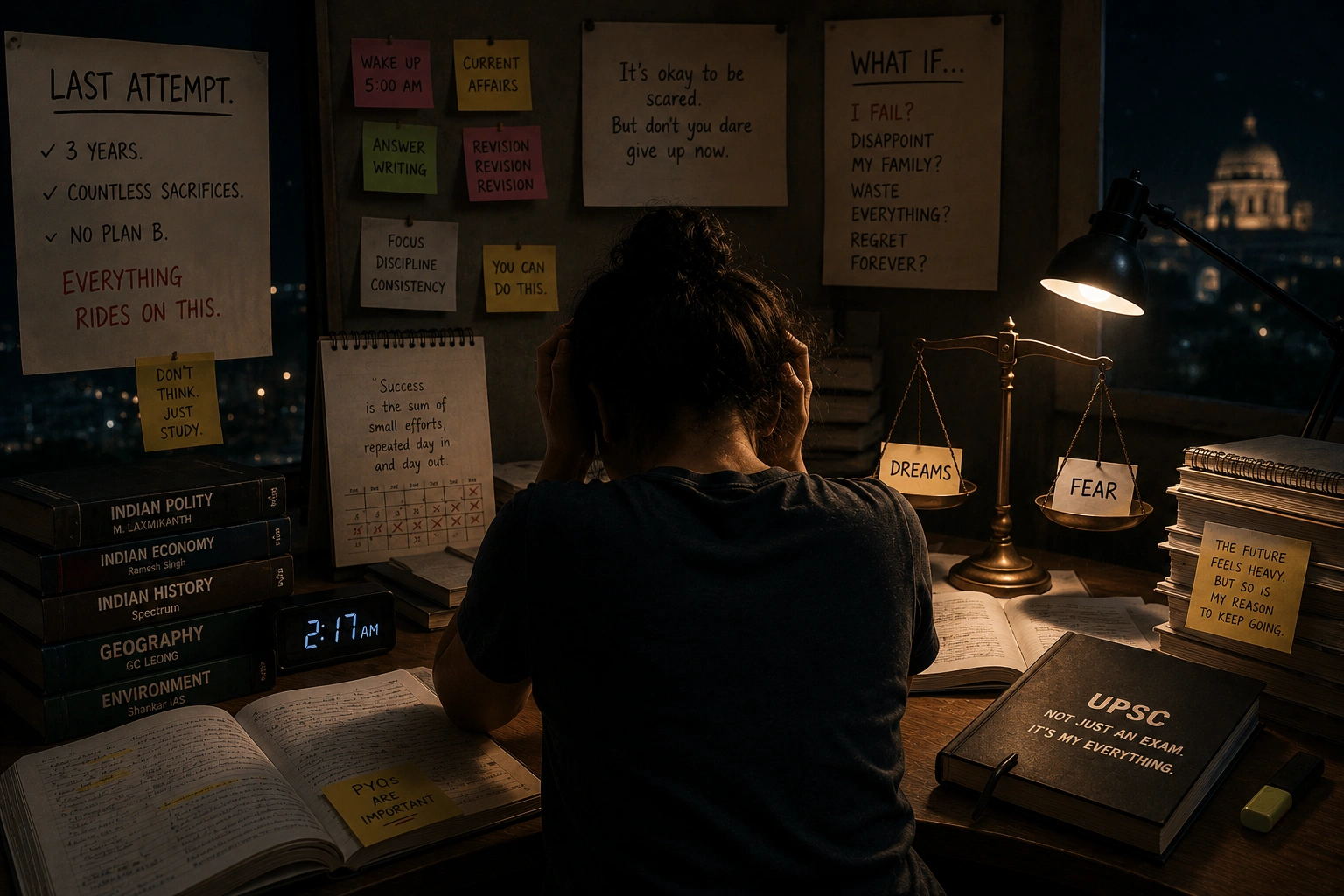
You did the math again last night, even though you already knew the answer by heart at this point. Born in a specific month, a specific year, which means this attempt is the last one the rulebook allows you, full stop, no appeal, no exception. Every attempt before this one carried "there's always next time" quietly underneath it, whether you said it out loud or not. This one doesn't have that. You open the same revision notes you've opened a hundred times, and for the first time they feel different in your hands, not because the syllabus changed, but because the ground underneath you did.
What Makes a Last Attempt Different From Every Attempt Before It
Here's the honest distinction worth naming clearly: every UPSC attempt carries real pressure, but a last attempt, whether it's your sixth as a general category candidate at 32, your ninth as OBC at 35, or simply the year you turn 37 as SC/ST, carries a specific, qualitatively different weight, because the usual coping mechanism available to every earlier attempt, telling yourself there's another shot if this one doesn't work, is gone. What's left is preparation with no safety net underneath it, and that changes the emotional experience of studying itself, not just the outcome riding on it.
That distinction matters because most general advice about exam stress assumes a next attempt exists somewhere in the background, even if unspoken. Advice built for that assumption doesn't fully transfer to a situation where the assumption itself has run out, the same way advice about family pressure built for a multi-year runway doesn't quite fit a year where the runway has visibly ended.
Why the Attempt Limits Exist, and What They Actually Are
It helps to know the exact shape of the rule you're up against, since a lot of the anxiety around this comes from a vague, half-remembered sense of the limits rather than the actual numbers. General and EWS candidates get 6 attempts, up to age 32. OBC candidates get 9 attempts, up to age 35. SC and ST candidates get unlimited attempts, but only up to age 37, which means the real constraint for that category is the age ceiling, not a fixed attempt count. PwBD candidates get further relaxations layered on top of their category. These limits have stayed structurally consistent for years, and there's no current indication of them changing.
Knowing the exact rule doesn't remove the pressure, but it does replace a vague, anxious uncertainty with something concrete you can actually plan around, which for a lot of aspirants is at least a small relief compared to not being entirely sure how many real chances remain.
The Specific Psychological Weight of "No Next Time"
Every previous attempt had a kind of built-in insurance: even a genuinely bad Prelims result could be filed away as "I'll fix this next year." A last attempt removes that filing cabinet entirely. Every mock test result, every uncertain answer in an optional paper, every current affairs gap suddenly carries the full weight of the entire multi-year project riding on it, rather than being one data point among several remaining chances.
This tends to produce two very different reactions in aspirants, sometimes in the same person at different points in the same week. One is a kind of hyper-focused intensity, longer study hours, sharper discipline, a genuine sense of finally treating the exam with the seriousness it demanded all along. The other is a paralyzing pressure that actually degrades performance, the same anxiety that makes people freeze in interviews, except stretched across months of preparation instead of a single afternoon. Neither reaction is a character flaw. Both are normal responses to genuinely high-stakes, irreversible pressure, and most aspirants cycle between the two rather than settling into one permanently.
The pressure often intensifies further on the exam days themselves, in a way that's worth naming honestly. A single careless mistake on the Prelims answer sheet, the kind that would sting but feel survivable on an earlier attempt, can trigger a specific, disproportionate panic on a last attempt, since the mind immediately calculates that this one error might be the entire multi-year project's undoing. That disproportion is real and common, not evidence of being unable to handle pressure, and recognizing it as a predictable reaction in advance, rather than a surprise in the exam hall itself, tends to blunt some of its power when it actually happens.
How This Plays Out Differently Depending on What Brought You Here
For some aspirants, the last attempt arrives after a string of near-misses, Mains cleared but not the interview, or consistently just short of the cutoff, which brings a specific kind of pressure: genuine evidence that clearing is within reach, paired with the knowledge that "within reach" has run out of remaining tries to close that final gap.
For others, the last attempt follows years spent juggling preparation with a job or family responsibilities, never quite getting the dedicated, full-time preparation window that more resourced aspirants had, which brings a different weight, less about proximity to clearing and more about whether this attempt will finally get the conditions the earlier ones never had.
For a smaller group, the last attempt is approached almost with relief, after years of preparation that have already taken a serious toll, where the fixed endpoint means a firm, external permission to stop after this one, regardless of the outcome, which some aspirants describe as oddly calming compared to the open-ended uncertainty of earlier attempts, including the uncertainty of deciding how much of the attempt to even share with people around them.
None of these three patterns is more valid than the others, and most aspirants recognize fragments of more than one in themselves over the course of a single final attempt, rather than fitting neatly into just one category from start to finish.
What Actually Helps During a Genuinely Last Attempt
Separating the outcome from your sense of self-worth, deliberately and in advance, tends to help more than most aspirants expect, not because it lowers the stakes of the exam itself, but because it protects against the collapse that happens when an external result gets fused with an internal sense of value. Aspirants who've done this groundwork beforehand tend to handle a difficult result, if it comes, considerably better than those who haven't examined the fusion until it's already happening to them in real time.
Having an honest, concrete answer ready for "what happens after this, either way" removes a surprising amount of background anxiety during preparation itself, since a lot of the dread of a last attempt comes from the unknown of life afterward, not just the exam content. Aspirants who've mapped out a real next step, even a rough one, tend to study with less of that background hum of dread than those who've left the entire question open.
Talking to someone who's actually been through a final attempt, whichever way it went, tends to help more than talking to someone still on an earlier attempt, since the emotional territory is genuinely different in kind, not just in degree, and someone who's lived through it can speak to the specific weight in a way earlier-stage encouragement usually can't.
Where Artha Fits In
The specific dread of a mock test gone wrong when there's no next year to fix it in is real, and generic "just believe in yourself" advice doesn't address the real math involved at all. When it might be time to walk away voluntarily is a genuinely different decision from a last attempt, with a different emotional shape.
A Small Thing Worth Saying Honestly
I haven't faced a last attempt at anything myself yet, still early enough in my own path that most doors are still open. But I've watched the specific tension in people close to me who were counting down attempts rather than years, a different kind of pressure than ordinary exam stress, closer to something with a hard, external deadline attached.
The rulebook decides how many attempts you get. It was never going to decide what the attempt itself would actually feel like to live through, and that part is still yours to shape.
If this attempt goes the way you're afraid it might, would the plan you've made for afterward actually hold, or is part of you still avoiding making one at all?
Quick answers
Things people usually want to know.
How many attempts do I get for UPSC Civil Services Examination?
General and EWS candidates get 6 attempts up to age 32. OBC candidates get 9 attempts up to age 35. SC and ST candidates get unlimited attempts, but only up to age 37, making the age limit the real constraint for that category rather than a fixed attempt count.
Why does a final UPSC attempt feel so different from earlier attempts?
Earlier attempts carry an implicit safety net, the option to try again next year. A final attempt removes that entirely, which changes the emotional weight of every mock result and every uncertain answer during preparation, not just the outcome itself.
How do I mentally prepare for my last UPSC attempt?
Many aspirants find it helps to deliberately separate the exam outcome from their sense of self-worth in advance, and to have a concrete, honest plan for what comes next regardless of the result, both of which tend to reduce background anxiety during preparation.
More from HeyArtha
Other things we've been writing about.
What to Do After UPSC Mains, Before the Result
The two months after UPSC Mains before results feel like nothing. Heres why the gap hits so hard, and what actually helps you get through it.
IBPS & SBI PO vs UPSC: Career, Salary, and Odds Compared
UPSC has a 0.2% pass rate and a 1-year cycle. IBPS and SBI PO offer 1-2% odds, 6-8 month cycles, and predictable banking careers. Compare both paths.
Can You Prepare for CA and UPSC Together? The Honest Truth
Can you prepare for CA and UPSC simultaneously? Why dual prep fails during articleship, how to sequence them, and how CA serves as a strong Plan B.