
Moving to Mukherjee Nagar: The Loneliness Behind the UPSC Dream
June 12, 2026 · ~10 min read · by Shivam Kushwaha, HeyArtha founder
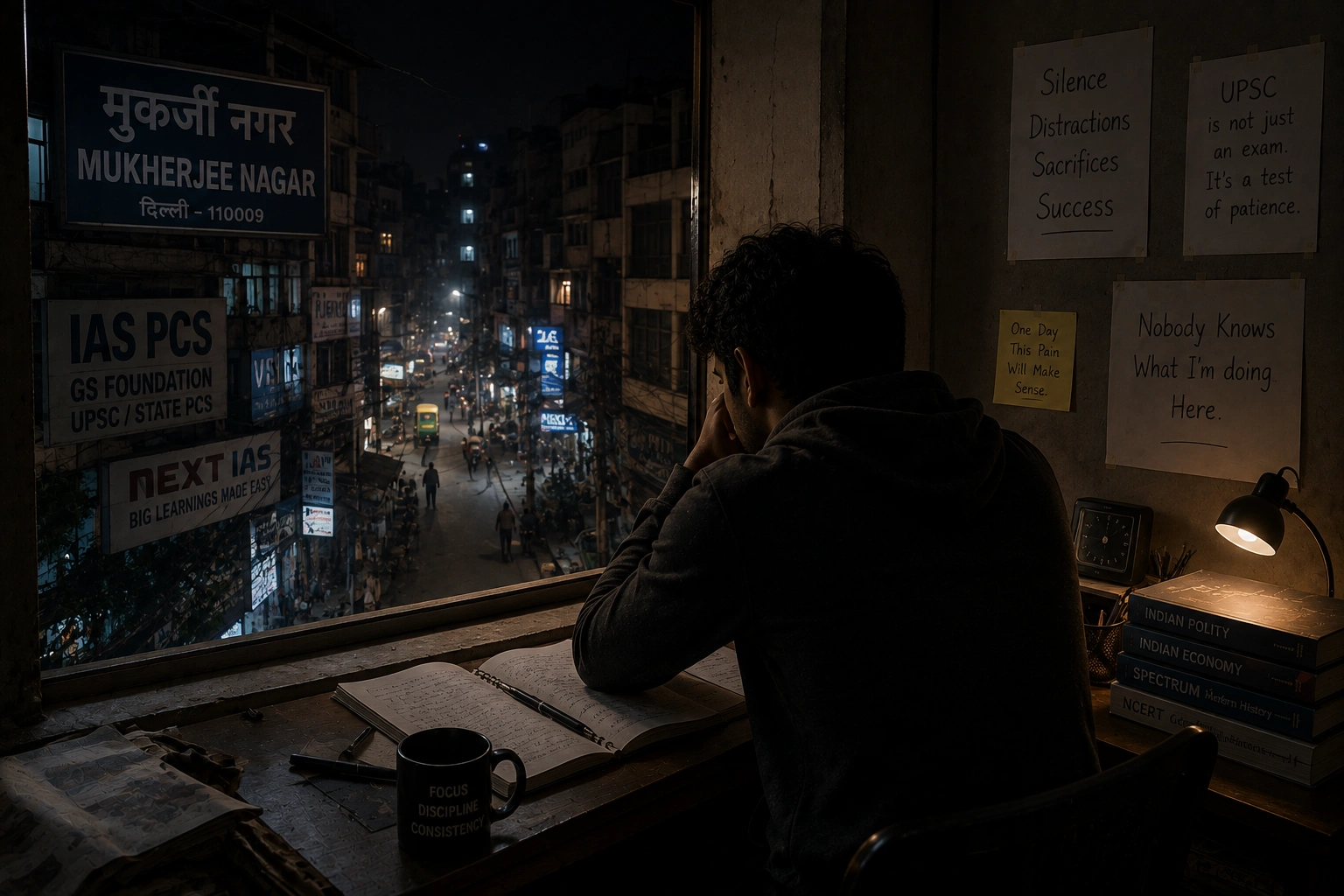
The PG room is smaller than you pictured, one window facing a wall, a shared bathroom down the corridor, a landlord who's already mentioned the electricity bill twice in the first week. You unpacked three days ago and haven't fully finished, some part of you still not ready to call this room "yours" yet. The coaching class is exactly as intense as everyone warned you it would be, dense, fast, no time to fully absorb one topic before the next begins. But the thing nobody warned you about is the specific quality of the evenings, the walk back to the PG alone, the silence of a room where nobody's waiting to hear how the day went, the phone call home you cut short because hearing your mother's voice made the homesickness worse, not better.
The Loneliness That Isn't in the Prospectus
Here's the honest thing to name directly: relocating for UPSC coaching, whether to Mukherjee Nagar, Rajinder Nagar, or any other hub, is one of the most isolating transitions a serious aspirant goes through, and that isolation is a real, common, and largely unaddressed part of the preparation, not a sign that you're handling the move badly. Coaching institutes sell the intensity of the syllabus and the credentials of the faculty. Almost none of them prepare you for the specific loneliness of a small rented room in a city where you know almost nobody, at the exact moment your brain most needs steadiness to actually retain what you're studying.
That gap between what gets marketed and what actually happens in the first few months matters, because it means most aspirants arrive believing the loneliness is a personal failure to adjust, rather than what it actually is, a predictable, well-documented part of this specific transition.
Why This Particular Move Hits So Much Harder Than Expected
Moving for a job or college usually comes with some built-in social structure, colleagues, classmates, orientation programs designed to help you meet people. Moving for UPSC coaching often doesn't have that same scaffolding. Coaching classes are large, transactional, focused entirely on content delivery, and the informal social bonds that usually form naturally around a shared routine take much longer to build when everyone around you is also anxious, exhausted, and privately consumed by their own preparation.
There's also a specific psychological trap in this particular move: the isolation directly damages the very thing you relocated to protect, your ability to focus and retain what you're studying. Loneliness isn't just an emotional cost sitting alongside preparation, it actively degrades concentration, memory, and motivation, which means the isolation and the academic struggle feed each other in a loop that can be hard to interrupt once it starts, exactly the loop a verbatim Quora post describes: an aspirant who "started feeling lonely from day 1 itself" and found it was "hampering my studies," a pairing that shows up constantly in aspirant forums.
The Ground Reality of Mukherjee Nagar Specifically
Mukherjee Nagar has functioned as one of India's most concentrated UPSC coaching hubs for years, dense with institutes, PGs, and libraries built entirely around the aspirant lifestyle, and that concentration cuts both ways. On one hand, it means you're surrounded by thousands of people living an almost identical daily routine, waking early, attending class, studying late, which should make connection easier than it often ends up feeling in practice. On the other, the sheer transience of the population, people arriving and leaving constantly depending on attempt cycles, makes it a place where deep friendships take real, deliberate effort to build rather than happening automatically the way a fixed college cohort might produce them.
The area's intensity became visible in a tragic, concrete way in July 2023, when flooding in a coaching institute's basement library led to fatalities and the Municipal Corporation of Delhi subsequently sealed over 30 coaching institutes across the area for safety violations. That event, beyond its immediate tragedy, reflects something aspirants moving there already sense, an environment built at high density and high intensity, with infrastructure not always matching the scale of ambition packed into it.
How This Actually Plays Out in the First Few Months
For a lot of aspirants, the loneliness peaks in the first six to eight weeks, the period after the initial excitement of the move has faded but before any real routine or social connection has had time to form. This window is often when study output actually dips the most, not because motivation has failed, but because the isolation hasn't been named or addressed yet, and is quietly eating into focus without being recognized as the cause.
For others, particularly those who moved with a friend or relative already in the city, the isolation is softer but still present, since even a familiar face doesn't fully replace the wider social fabric of home, family gatherings, old friendships, the casual, low-effort company that doesn't require active maintenance the way a new city's relationships do.
For a smaller group, the loneliness resolves relatively quickly through library study groups or PG-mates who become genuine friends, a reminder that the isolation, while common, isn't universal or permanent, and that the same density that makes Mukherjee Nagar feel anonymous at first can eventually produce real, sustaining connection once enough time has passed. That's worth holding onto especially for aspirants already carrying the specific weight of a genuinely final attempt, since isolation on top of that pressure compounds in a way that's worth addressing early rather than treating as a minor discomfort to just push through.
What Actually Helps in Those First Disorienting Months
Treating the first few months as an adjustment period with its own legitimate difficulty, rather than expecting to feel settled immediately, tends to reduce the added layer of self-criticism that often makes the loneliness worse. Struggling to adjust isn't a sign you're not cut out for this. It's what adjusting to a genuinely hard transition actually looks like from the inside.
Building small, low-stakes routines that put you around the same people regularly, a consistent library seat, a regular tea stall, a recurring study group, tends to produce connection more reliably than waiting for a single, meaningful friendship to appear fully formed. Familiarity, even without deep conversation at first, does real work in reducing the isolation over time.
Keeping contact with home consistent but bounded, rather than either avoiding calls because they intensify the homesickness or over-relying on them in a way that keeps you emotionally anchored elsewhere instead of building a life where you actually are, tends to help more than either extreme.
What tends not to help is assuming the loneliness will simply resolve itself once results come through, since that framing puts the entire burden of feeling okay onto an outcome that's genuinely uncertain and months or years away. Addressing the isolation directly, now, tends to matter more for both wellbeing and actual study output than waiting for a result to fix it.
Where Artha Fits In
This is exactly the kind of loneliness that's hard to admit to people back home, because saying "I'm surrounded by thousands of aspirants and I still feel completely alone" can sound like you're failing at something that should be simple. How much of the attempt to even tell people back home is often running in the background of this exact same stretch, as is the marriage and family timeline pressure. Two separate weights that frequently land on the same person in the same year, even though nobody talks about them as connected.
A Small Thing Worth Saying Honestly
I've never relocated for coaching myself, but I recognize this specific shape of loneliness from watching people close to me move cities for something they cared about deeply, the particular ache of being surrounded by people and still feeling unseen by any of them. It's part of why UPSC Talk exists the way it does, a place where that first disorienting stretch gets to be named honestly instead of quietly endured as if it were a personal weakness.
The dream that brought you to that small rented room was never the problem. It was just big enough to make the quiet, ordinary loneliness of adjusting to a new city feel like it wasn't allowed to matter too, right alongside it.
If a friend described feeling exactly what you're feeling right now, surrounded by people, still profoundly alone, would you tell them it meant they weren't cut out for this, or that they just needed some real time to land?
Quick answers
Things people usually want to know.
Why do I feel so lonely after moving to Mukherjee Nagar or Rajinder Nagar for UPSC coaching?
It's a common and well-documented experience. Coaching hubs are dense with people living a similar routine, but the social bonds that usually form around a shared environment take real time to build, and the transactional nature of large coaching classes doesn't provide much natural scaffolding for connection.
Is it normal for loneliness to affect my UPSC study output?
Yes, very normal. Isolation genuinely affects concentration, memory, and motivation, which means the emotional difficulty and the academic struggle often feed into each other, rather than being two separate, unrelated problems.
How long does the loneliness usually last after relocating for UPSC prep?
For many aspirants, it peaks in the first six to eight weeks after the move, once the initial excitement fades but before any real routine or connection has had time to form, and it tends to ease as familiar faces and habits build up over subsequent months.
What happened in Mukherjee Nagar in 2023?
In July 2023, flooding in a coaching institute's basement library led to fatalities, and the Municipal Corporation of Delhi subsequently sealed over 30 coaching institutes in the area for safety violations, an event that reflected the high density and intensity of the environment aspirants move into.
How can I make friends while preparing for UPSC in a new city?
Building small, consistent routines, a regular library seat, a recurring tea stall visit, a study group that meets often, tends to produce genuine connection more reliably than waiting for one deep friendship to form all at once.
Should I call home often if I'm feeling homesick during UPSC prep?
Keeping contact consistent but bounded tends to work better than either extreme, avoiding calls because they intensify homesickness, or relying on them so heavily that you stay emotionally anchored elsewhere instead of building a life where you actually are.
Is it a bad sign if I'm struggling to adjust to my new city during UPSC prep?
No. Struggling with a genuinely difficult transition is what adjustment actually looks like, not evidence that you're unsuited for this path. Treating the first few months as a legitimate adjustment period tends to reduce unnecessary self-criticism.
Does living with a friend or relative eliminate this loneliness?
It often softens it, but doesn't fully replace the wider social fabric of home, family gatherings, and old friendships that don't require the same active effort a new city's relationships do, so some degree of the adjustment still applies.
Will the loneliness go away once I clear an exam stage?
Not automatically, and waiting for a result to resolve it can leave the isolation unaddressed for a long time, since results are uncertain and often months or years away. Addressing the loneliness directly tends to matter for both wellbeing and study output in the meantime.
Are coaching hubs like Mukherjee Nagar actually isolating despite being crowded?
Yes, paradoxically. The sheer density and transience of the population, people arriving and leaving constantly across attempt cycles, means being surrounded by people doesn't automatically translate into feeling connected to any of them.
Is it common for UPSC aspirants to talk about this loneliness openly?
Not as openly as the prevalence would suggest. It's a recurring theme in aspirant forums and personal accounts, but it rarely gets acknowledged in coaching marketing or family conversations, which can make it feel more isolating than it statistically is.
Where can I talk to other UPSC aspirants who understand this specific loneliness?
Anonymous peer spaces built for aspirants, like Artha's UPSC Talk room, connect you with people living through the exact same disorientation, wherever their preparation has taken them, without it needing to reach family back home.
More from HeyArtha
Other things we've been writing about.
What to Do After UPSC Mains, Before the Result
The two months after UPSC Mains before results feel like nothing. Heres why the gap hits so hard, and what actually helps you get through it.
IBPS & SBI PO vs UPSC: Career, Salary, and Odds Compared
UPSC has a 0.2% pass rate and a 1-year cycle. IBPS and SBI PO offer 1-2% odds, 6-8 month cycles, and predictable banking careers. Compare both paths.
Can You Prepare for CA and UPSC Together? The Honest Truth
Can you prepare for CA and UPSC simultaneously? Why dual prep fails during articleship, how to sequence them, and how CA serves as a strong Plan B.