UPSC Mains Result Not Cleared: When the Dream Crashes
October 30, 2026 · 9 min read · by Shivam Kushwaha, Artha founder
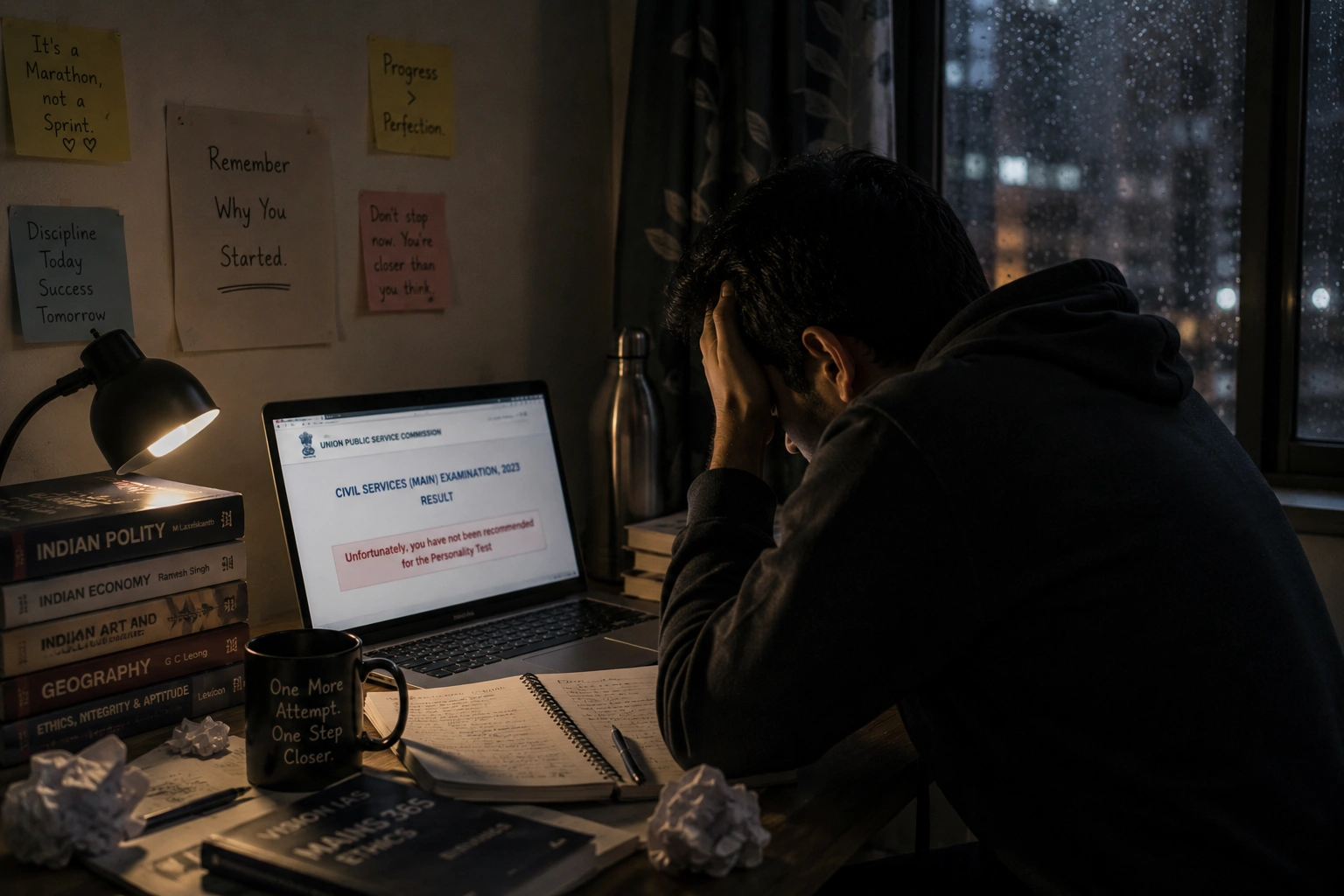
The result page loads and for a second the words don't register, your roll number isn't there. You check again, scroll up, scroll down, refresh, sure you've made some kind of mistake in reading it. You haven't. Somewhere in the apartment your phone starts buzzing, someone's already asking. You don't answer. You sit there on the edge of the bed with the laptop still open, and the thing that hits first isn't sadness exactly, it's a strange kind of silence, like someone just muted the last three years of your life all at once.
What This Result Actually Takes From You
Here's the honest thing nobody says plainly enough about not clearing UPSC Mains: it isn't just a missed exam, it's the sudden collapse of a very specific, very detailed future you'd been mentally living in for months. The posting you'd pictured. The moment you'd imagined telling your parents. The version of yourself you'd already started to become, in your head, before the result made it clear that version isn't happening this cycle. Grieving that imagined future is real grief, even though nothing about it was ever guaranteed.
This particular kind of loss doesn't get treated with the seriousness it deserves, partly because from the outside it looks like "just" not passing a test, something that happens to most people who attempt this exam, statistically speaking. But the emotional weight isn't proportional to how common the outcome is. It's proportional to how much of yourself you put into pursuing it, and if you gave this attempt everything you had, the fact that thousands of others also didn't clear it this cycle doesn't make your own grief any smaller or less legitimate.
Psychologists actually have a term for grief that doesn't get social recognition as real grief, disenfranchised grief, loss that isn't openly acknowledged, socially validated, or publicly mourned, precisely because it doesn't fit society's narrow template for what counts as a legitimate loss, usually reserved for death (Psychology Today on how disenfranchised grief gets validated). An exam result fits that pattern almost exactly. Nobody sends condolences for a missed UPSC attempt. There's no ritual, no time off, no script anyone follows. That absence of recognition doesn't mean the loss isn't real. It just means you'll likely have to name it and hold space for it yourself, since the world around you generally won't do it for you.
There's also a very real identity disruption underneath the disappointment. If "UPSC aspirant" has been your primary identity for years, this result doesn't just say "not this time," it forces an uncomfortable, unscheduled confrontation with who you are outside of that pursuit, a question you probably hadn't needed to answer directly in a long time, and definitely didn't expect to be answering today.
If this result follows months spent in the strange limbo between Mains and the wait for it, the grief lands on top of an already exhausted nervous system, one that's been mildly braced for this exact possibility for a long stretch already. That doesn't make the news easier, even a well-anticipated loss still lands as a real loss, but it does mean part of what you're feeling right now is accumulated exhaustion from the entire waiting period, not just the result itself.
Why the First Few Days Feel So Disorienting
The first few days after a result like this often don't look like classic sadness, they look more like numbness, a strange flatness where you go through basic motions, eating, replying to messages, without actually feeling present in any of it. That's not you failing to grieve properly. It's a fairly normal early response to a loss this significant, your mind buffering before it lets the full weight of the news land all at once.
Sleep and appetite often go sideways too, not dramatically, just off, harder to fall asleep, less interested in food, a general sense of your body running slightly out of sync with itself. That's a physiological echo of the psychological hit you just took, and it usually settles over the following weeks as the initial shock wears off, even though it feels alarming in the moment.
There's also a specific kind of exhaustion that arrives almost immediately, the exhaustion of already knowing you'll need to explain this to dozens of people, relatives, family friends, that one neighbor who always asks. Before you've even had a private moment to process the result yourself, some part of your mind is already drafting the sentence you'll need to repeat over and over for the next several weeks, and that anticipatory labor is its own quiet burden layered right on top of the actual grief.
Physical symptoms sometimes show up too, a tightness in the chest, a headache that won't quite resolve, a strange restlessness that makes it hard to sit still or, alternately, hard to get off the couch at all. Grief doesn't stay neatly in the emotional register, it moves through the body as well, and noticing that physical layer without judging it as an overreaction tends to help people move through this stretch a little more gently than fighting against it does.
The Comparisons That Make It Worse
If a close friend cleared in the same cycle you didn't, the grief gets an extra edge to it, watching someone you genuinely care about step into the exact future you'd imagined for yourself, at the precise moment that future closed off for you. That combination of real happiness for them and real grief for yourself is disorienting to sit with, and it's worth knowing in advance that both feelings can be true at once without either one being a character flaw.
Social media makes the immediate aftermath harder too. Result season means a wave of celebratory posts, and even without meaning to, you'll likely see them, toppers' interviews, cleared candidates thanking their families, a steady stream of the exact outcome you didn't get. It's worth deliberately limiting your exposure to that content in the first couple of weeks, not out of denial, but because repeatedly reopening the wound while it's still fresh rarely helps and usually just prolongs the sharpest part of the pain. Muting keywords, unfollowing temporarily, or simply staying off the apps that funnel that content to you hardest, none of that is avoidance, it's a reasonable boundary while the wound is still this fresh.
What Actually Helps in the Weeks After
Give yourself a real window, at least a couple of weeks, before making any decisions about reattempting, switching paths entirely, or making any big pronouncements to family about "what's next." Grief this fresh distorts judgment. Decisions made in week one about the entire shape of your future tend to look very different, and often regrettable, by week four, once the acute shock has actually settled.
Physical movement, even something as simple as a daily walk, tends to help more than it sounds like it should during this stretch. Grief this heavy has a way of making you want to stay completely still, curled up with your phone, replaying the result over and over. That stillness feels protective in the moment but often deepens the low mood rather than easing it. You don't need to force yourself into a full routine right away, just enough movement to interrupt the loop for a while each day.
It helps enormously to say the real, unedited version of how you're feeling to at least one person, not the polished "I'm okay, I'll try again" version you give relatives, but the actual "I feel like three years just evaporated and I don't know who I am without this" version. Grief that stays fully private tends to calcify. Grief that gets spoken out loud, even once, tends to start moving.
It's also worth pre-deciding a short, honest line for relatives and acquaintances, so you're not improvising an explanation under pressure every single time someone asks, sometimes multiple times a day during the first couple of weeks. Something like "it didn't go my way this time, still figuring out next steps" covers the practical question without requiring you to relive the disappointment in full detail for every distant cousin who wants an update.
It's also worth deliberately separating the practical question, will I reattempt, from the emotional one, am I allowed to feel this bad right now. You don't need to have resolved the first question before you're allowed to fully feel the second. Plenty of people rush toward "okay, next attempt, let's regroup" as a way of skipping past grief they haven't actually let themselves feel yet, and that unfelt grief tends to resurface later, often at a worse time, if it doesn't get real space now.
If your relationship took a hit during the long stretch of prep leading up to this result, it's worth being gentle with yourself and your partner right now rather than trying to immediately repair everything on top of an already fresh wound. The strain UPSC prep puts on relationships doesn't disappear just because the exam cycle is technically over, and processing a result this heavy alongside relationship repair, all at once, is genuinely a lot to carry in the same few weeks.
Where Artha Fits, If It Does
A lot of what makes this result so hard to sit with is that the people most eager to comfort you are often the same people whose expectations you're now grieving disappointing, parents, relatives, your own coaching batch. That makes it genuinely hard to fall apart honestly in front of them, even when falling apart honestly is exactly what you need to do. That's part of why UPSC Talk exists inside Artha, a space to say the unfiltered version of this grief to someone anonymous who's actually sat exactly where you're sitting tonight, without having to manage anyone else's reaction to your pain.
This result doesn't erase the years you put in, and it doesn't decide who you become from here. It's a genuinely hard thing that happened to you, not a verdict on your worth or your future, even though it will take real time before that distinction feels true instead of just sounding true. Right now, tonight, it's enough to just let yourself feel exactly as bad as this actually is, without rushing toward a silver lining you're not ready to see yet.
What's the specific imagined future you're grieving right now, the one that isn't happening this cycle?
Quick answers
Things people usually want to know.
Why does not clearing UPSC Mains feel like more than just failing an exam?
Because it's the sudden collapse of a very specific imagined future you'd been mentally living in for months, the posting, the moment of telling your parents. Grieving that imagined future is real grief, even though it was never guaranteed.
Is it normal to feel numb right after a bad UPSC result instead of sad?
Yes, very common in the first few days. It's your mind buffering before it lets the full weight of the news land, not a sign you're failing to grieve properly.
What is disenfranchised grief and how does it apply to a UPSC result?
It's a term for loss that isn't socially recognized or validated because it doesn't fit the usual template for what counts as a legitimate loss. An exam result fits that almost exactly, nobody sends condolences, so you often have to name and hold the grief yourself.
How long should I wait before deciding whether to reattempt UPSC?
Give yourself at least a couple of weeks before any big decisions. Grief this fresh distorts judgment, and choices made in week one about your whole future often look very different, and regrettable, by week four.
Why can't I sleep or eat properly after a bad UPSC result?
That's a fairly normal physiological echo of the psychological hit you just took. Sleep and appetite going slightly sideways usually settles over the following weeks as the initial shock wears off.
What do I tell relatives who keep asking about my UPSC result?
Pre-decide a short, honest line so you're not improvising under pressure each time, something like "it didn't go my way this time, still figuring out next steps." That covers the practical question without reliving the full disappointment repeatedly.
Should I stay off social media after a bad UPSC Mains result?
It's worth deliberately limiting exposure for the first couple of weeks. Result season brings a wave of celebratory posts, and repeatedly reopening the wound while it's fresh usually just prolongs the sharpest part of the pain.
How do I deal with a friend clearing UPSC in the same cycle I didn't?
Know in advance that real happiness for them and real grief for yourself can both be true at once without either being a character flaw. That combination is disorienting but not unusual.
Does physical movement actually help after a UPSC result setback?
It tends to help more than it sounds like it should. Grief this heavy makes you want to stay completely still, but that stillness often deepens low mood rather than easing it, even a daily walk helps interrupt the loop.
Does a bad UPSC Mains result mean my years of preparation were wasted?
No. It's a genuinely hard thing that happened, not a verdict on your worth or your future, even though it takes real time before that distinction feels true instead of just sounding true.