
Should You Tell People Youre Preparing for UPSC?
August 18, 2026 · ~6 min read · Updated September 4, 2026 · by Shivam Kushwaha, HeyArtha founder
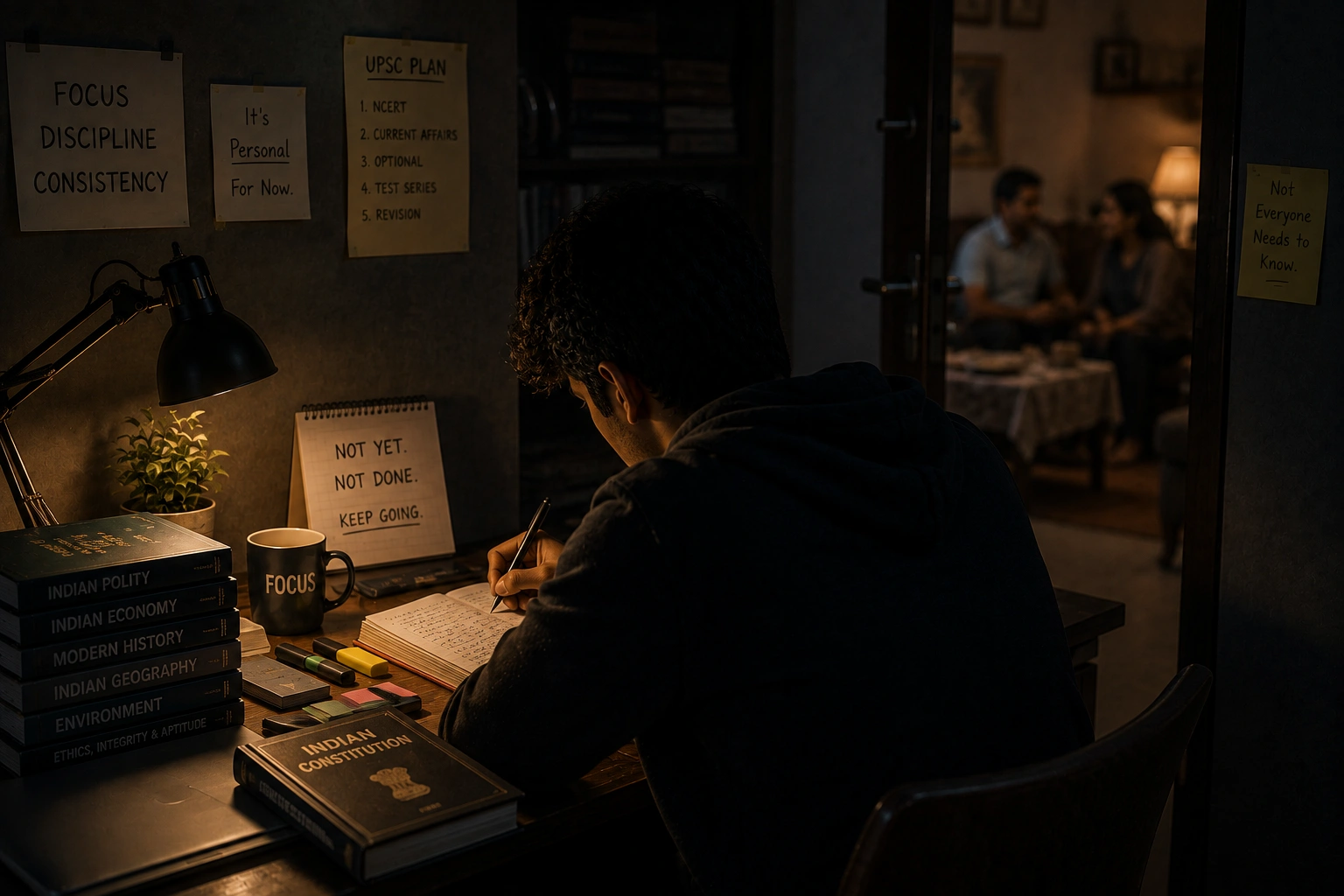
Your cousin's wedding is in three weeks. You already know how this goes. Someone's uncle will ask what you're "doing these days," and the honest answer, preparing for UPSC, will trigger the same four follow-up questions it always does. Which attempt. How many marks last time. Do you have a backup. Sharma ji ka beta already cleared something similar, no? You've started rehearsing a vaguer answer in your head, something about "studying for competitive exams," just to skip the whole exchange. And then you feel a little guilty for wanting to hide something you're actually proud of trying.
The Real Question Underneath "Should I Tell People?"
The honest answer is that keeping your UPSC preparation private is a legitimate, common choice, not a red flag about your commitment or your confidence. Coaching platforms increasingly acknowledge that many serious aspirants treat their attempt as a private battle on purpose, specifically to avoid the noise, the comparisons, and the "well-meaning" advice that comes with going public before there's a result to show for it.
That framing matters, because most advice online assumes secrecy means shame. For a lot of aspirants, it's the opposite. It's protection.
Why the Instinct to Stay Quiet Is So Strong
UPSC prep is unusual among competitive exams in how long it asks you to stay uncertain, often two, three, four attempts stretched across years, with no guaranteed outcome even for people who work hard and prepare well. Telling people early means every one of those years comes with an audience. Every family function becomes a status check. Every "any updates?" from a relative lands like a mild verdict on your worth, even when nobody means it that way.
There's real research behind why this feels so heavy. Columbia Business School's work on the psychology of secrecy found that secrets, especially ones tied to shame or judgment, act as a genuinely persistent mental burden, showing up as low-grade anxiety even outside the moments you're actively hiding something. But the same body of research also found something less talked about: secrets kept by autonomous choice, rather than forced by fear, don't carry the same weight. Some can even feel energizing rather than draining. In other words, deciding on your own terms to keep UPSC private is a very different experience from hiding it because you're scared of how people will react.
Weighing Privacy Against Isolation
Total secrecy has a real cost too, and it's worth naming honestly, the same way it does for traders who hide their losses from family until the silence itself becomes the bigger problem.
In practice, privacy isn't just about the big reveal, it's a hundred small decisions. Whether to skip the family group's "what are you up to" thread. Whether to tell your college friends you're taking a gap year, or say something vaguer. Whether to keep your books out of sight when relatives visit. None of these decisions is dramatic on its own. Together, they add up to a fairly demanding, ongoing performance, which is exactly why having somewhere to drop the performance for a while matters. If literally nobody in your life knows you're preparing, you also lose the people who might've celebrated a good mock score with you, or noticed you were struggling before it got bad. Some aspirants land on a middle path: telling one or two trusted people, a sibling, one close friend, while keeping it off the family radar and off social media entirely. Others go fully private and lean on anonymous aspirant communities instead, precisely because those spaces let you talk about attempt anxiety and mock scores with people who understand the exam without any of it reaching your relatives.
Neither path is more "serious" than the other. The aspirants who do best long-term tend to be the ones who picked their level of privacy on purpose, instead of just defaulting into secrecy out of avoidance and never revisiting the choice.
Where Artha Fits In
Keeping an attempt to yourself means there's a rough mock test, the fourth relative who asked "kab tak clear karoge," the exhaustion of carrying it alone, and eventually the harder question of when it might be time to stop trying, none of which can go anywhere at home without turning into information your family didn't ask for.
Keeping something private was never the same as hiding it out of shame. Sometimes it's just deciding who gets to be part of the story before it has an ending.
If nobody in your life ever asked you about attempts or backup plans again, would you still choose to keep this private, or would you actually want to talk about it more openly?
Quick answers
Things people usually want to know.
Should I tell people I'm preparing for UPSC?
There's no single right answer. Some aspirants find that privacy protects their focus and mental space, while others do better with a small support circle who knows. What matters more is choosing on purpose rather than defaulting into either option.
Is it normal to keep UPSC preparation a secret from family?
Yes, it's a common and increasingly acknowledged choice among serious aspirants, often specifically to avoid constant comparison and unsolicited advice before there's a result to share.
Does keeping UPSC prep private mean I'm not confident?
Not necessarily. For many aspirants it's the opposite, a way of protecting their focus from noise, not a sign of doubting themselves.
Is hiding something bad for mental health, according to research?
Research from Columbia Business School found that secrets tied to fear or shame do carry a real psychological burden. But the same research found that secrets kept by choice, rather than out of fear, don't carry that same weight.
How do I answer relatives who keep asking about my UPSC attempts?
A short, neutral answer, like "still preparing, will share when there's something to share," usually closes the conversation faster than a detailed one. You don't owe anyone a full explanation of where you're at.
Should I post about my UPSC preparation on social media?
Most aspirants who keep prep private also avoid posting about it, since public posts invite the same comparison pressure they were trying to avoid in the first place.
What's the risk of keeping my UPSC attempt completely secret from everyone?
The main risk is isolation, losing access to people who could support you through a hard mock result or a tough stretch simply because nobody knows to check in.
Is it better to tell just one or two people instead of staying fully private?
For many aspirants, yes. A small circle, one sibling or one close friend, can offer support without opening the door to family-wide scrutiny.
How do serious UPSC aspirants usually handle the pressure of "log kya kahenge"?
Many either limit who knows about their attempt or find spaces, often anonymous ones, where they can talk about the pressure honestly without it reaching people who'd add to it.
Where can I talk to other UPSC aspirants without my identity being known?
Anonymous, intent-based spaces built specifically for aspirants, like Artha's UPSC Talk room, let you discuss attempts, mock scores, and family pressure with people who understand the exam, without any of it being traceable back to you.
More from HeyArtha
Other things we've been writing about.
What to Do After UPSC Mains, Before the Result
The two months after UPSC Mains before results feel like nothing. Heres why the gap hits so hard, and what actually helps you get through it.
IBPS & SBI PO vs UPSC: Career, Salary, and Odds Compared
UPSC has a 0.2% pass rate and a 1-year cycle. IBPS and SBI PO offer 1-2% odds, 6-8 month cycles, and predictable banking careers. Compare both paths.
Can You Prepare for CA and UPSC Together? The Honest Truth
Can you prepare for CA and UPSC simultaneously? Why dual prep fails during articleship, how to sequence them, and how CA serves as a strong Plan B.