
How Do You Know When to Stop Trying for UPSC?
August 25, 2026 · ~6 min read · Updated September 4, 2026 · by Shivam Kushwaha, HeyArtha founder
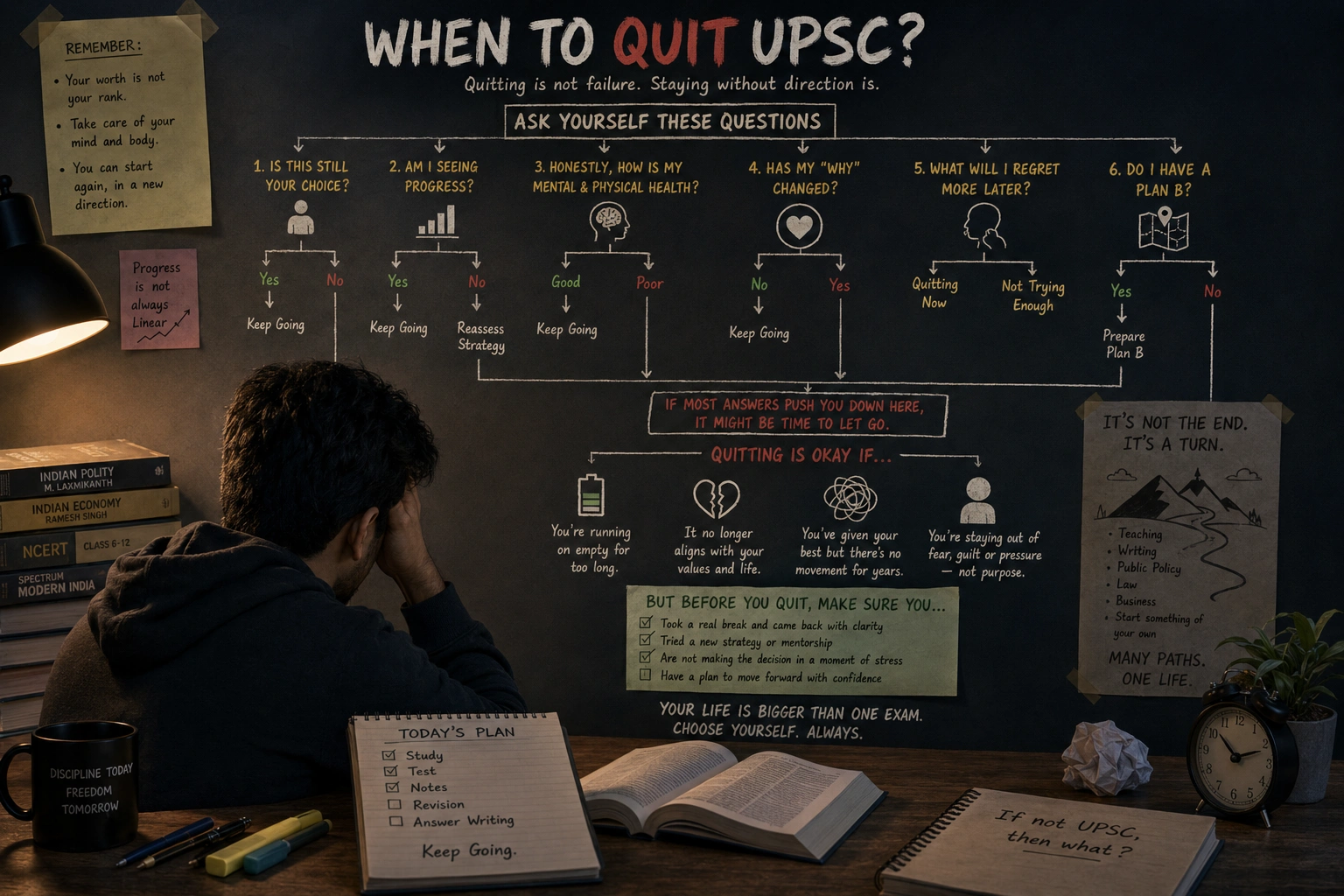
Three years in, and the answer sheet still comes back the same way. Not a disaster, just short. Nine marks here, thirteen there, always close enough to make you believe next time is the one, never close enough to actually make it through. You've stopped telling people your prelims date. You catch yourself doing the math on your remaining attempts more often than the math on the syllabus. And somewhere underneath the discipline you've built over three years, there's a quieter question you haven't said to anyone yet: what if this just isn't going to happen?
The Question Nobody Prepares You to Ask
There's no official signal that tells an aspirant it's time to stop, no rank cutoff for "walk away now." UPSC's own final result numbers make the scale of the exam clear: for the Civil Services Examination 2025, only 958 candidates were finally recommended out of roughly 10 to 11 lakh applicants who applied that year, a selection rate of about a tenth of a percent. Most aspirants who try, including genuinely capable, hardworking ones, do not get through, not because they lacked ability, but because the exam simply has room for very few.
Knowing that doesn't make the decision easier. It just means the decision was never really about whether you're good enough. It's about how many more years of your life you're willing to give an exam that rejects almost everyone who takes it, however qualified they are.
There's a financial side to this most aspirants can recite without thinking, coaching fees, Delhi or a coaching-hub rent, years without a salary while friends from the same batch are three promotions ahead. None of that alone tells you when to stop. But pretending it isn't part of the calculation usually just delays a decision that was going to have to include it eventually anyway.
Why This Is So Hard to Figure Out From the Inside
Every UPSC aspirant has heard a version of the story where someone cleared it on their fifth or sixth attempt, after everyone had written them off. Those stories are real, and they're also the reason so many people stay in far longer than serves them, because there's always a chance the next attempt is the one, the same sunk cost pull that makes quitting CA after Inter feel so much harder than it logically should. That possibility is exactly what makes this decision so different from quitting a job or leaving a course. There's no clear failure point. Just an increasingly expensive maybe.
Coaching blogs rarely help here, for an understandable reason: their incentive is for you to attempt again, not to walk away. So the honest version of this conversation mostly happens in forums, in engineer-turned-aspirant threads on Teamblind describing giving two attempts, reaching Mains, and going back to a dev job, in Careers360 comments from people who gave three years and are now weighing government jobs, private sector roles, or moving abroad instead.
What People Actually Look At When They Decide
Aspirants who land on a decision they feel okay about later tend to look at a few honest signals together, not just one bad attempt. Whether their score has genuinely been trending closer over multiple attempts, or basically flat. Whether they still have a real financial and family runway to keep going, or whether continuing means real strain on people who depend on them. And, maybe hardest to admit, whether they still want this specifically, or whether they're continuing mostly because stopping feels like admitting defeat to people who never had to make this call themselves.
None of those signals gives a clean yes or no on their own. Together, they tend to make the decision feel less like a guess and more like something you actually chose, on purpose, instead of something that happened to you after enough attempts ran out.
Where Artha Fits In
The version of this conversation worth having includes people who are seriously weighing an exit, people who've chosen to keep this attempt private from everyone around them, and people who already walked away and are living on the other side of it. Not a coaching pep talk telling you to try once more. Just people who understand exactly what three lakh rupees and three years of your twenties tied up in one exam actually feels like.
Walking away from UPSC was never proof that you weren't serious enough. Sometimes it's proof you finally got honest about what the odds were always going to be.
If nobody was watching how this ends, not your parents, not your batchmates, not the coaching institute that wants you to attempt again, what would you actually choose to do next?
Quick answers
Things people usually want to know.
How do I know when it's time to quit UPSC preparation?
There's no single sign, but most aspirants who feel okay about their decision later look at whether their scores are actually improving across attempts, whether they still have the financial and family runway to continue, and whether they genuinely still want this, not just fear the alternative.
What is the actual selection rate for UPSC Civil Services?
For the 2025 cycle, 958 candidates were finally recommended out of roughly 10 to 11 lakh applicants, a selection rate of around a tenth of a percent.
Is it normal to fail UPSC multiple times before deciding to stop?
Yes, very normal. Most aspirants who eventually clear it do so after more than one attempt, and most who never clear it also tried more than once before deciding to move on.
What can I do after quitting UPSC preparation?
Common paths include state-level PSC exams, private sector jobs, further study, or roles that value the analytical and writing skills built during preparation, even without the exam itself being cleared.
How many attempts does the general category get for UPSC?
General category candidates get 6 attempts, up to age 32. Reserved categories get more attempts and a higher age limit, varying by category.
Is quitting UPSC a waste of the years spent preparing?
Not in terms of skills built, current affairs knowledge, and discipline, all of which transfer to other paths. It can feel like a waste emotionally, especially early on, even when it isn't one in practical terms.
Why do coaching institutes rarely talk about when to stop trying?
Their business model is built around aspirants continuing to attempt and re-enroll, so there's little incentive for them to counsel someone toward stopping, even when that might genuinely be the better call for that person.
How do I talk to my family about stopping UPSC preparation?
Coming with a clear next step, rather than an open-ended "I'm done," tends to make the conversation land better. Families usually respond less to the decision itself and more to whether you seem to have a plan.
Did the Supreme Court grant an extra UPSC attempt after COVID?
No. The Supreme Court dismissed the plea for an additional attempt on 24 February 2021. No bonus attempt was ever granted, despite the idea circulating widely at the time.
Where can I talk to people who've actually walked away from UPSC?
Anonymous aspirant communities built for this exact conversation, like Artha's UPSC Talk room, connect you with people who've weighed this decision honestly, including some who chose to stop, without any judgment about which way you lean.
More from HeyArtha
Other things we've been writing about.
What to Do After UPSC Mains, Before the Result
The two months after UPSC Mains before results feel like nothing. Heres why the gap hits so hard, and what actually helps you get through it.
IBPS & SBI PO vs UPSC: Career, Salary, and Odds Compared
UPSC has a 0.2% pass rate and a 1-year cycle. IBPS and SBI PO offer 1-2% odds, 6-8 month cycles, and predictable banking careers. Compare both paths.
Can You Prepare for CA and UPSC Together? The Honest Truth
Can you prepare for CA and UPSC simultaneously? Why dual prep fails during articleship, how to sequence them, and how CA serves as a strong Plan B.