
Why You Can Paper Trade Perfectly and Still Freeze With Real Money
June 16, 2026 · ~6 min read · Updated September 4, 2026 · by Shivam Kushwaha, HeyArtha founder
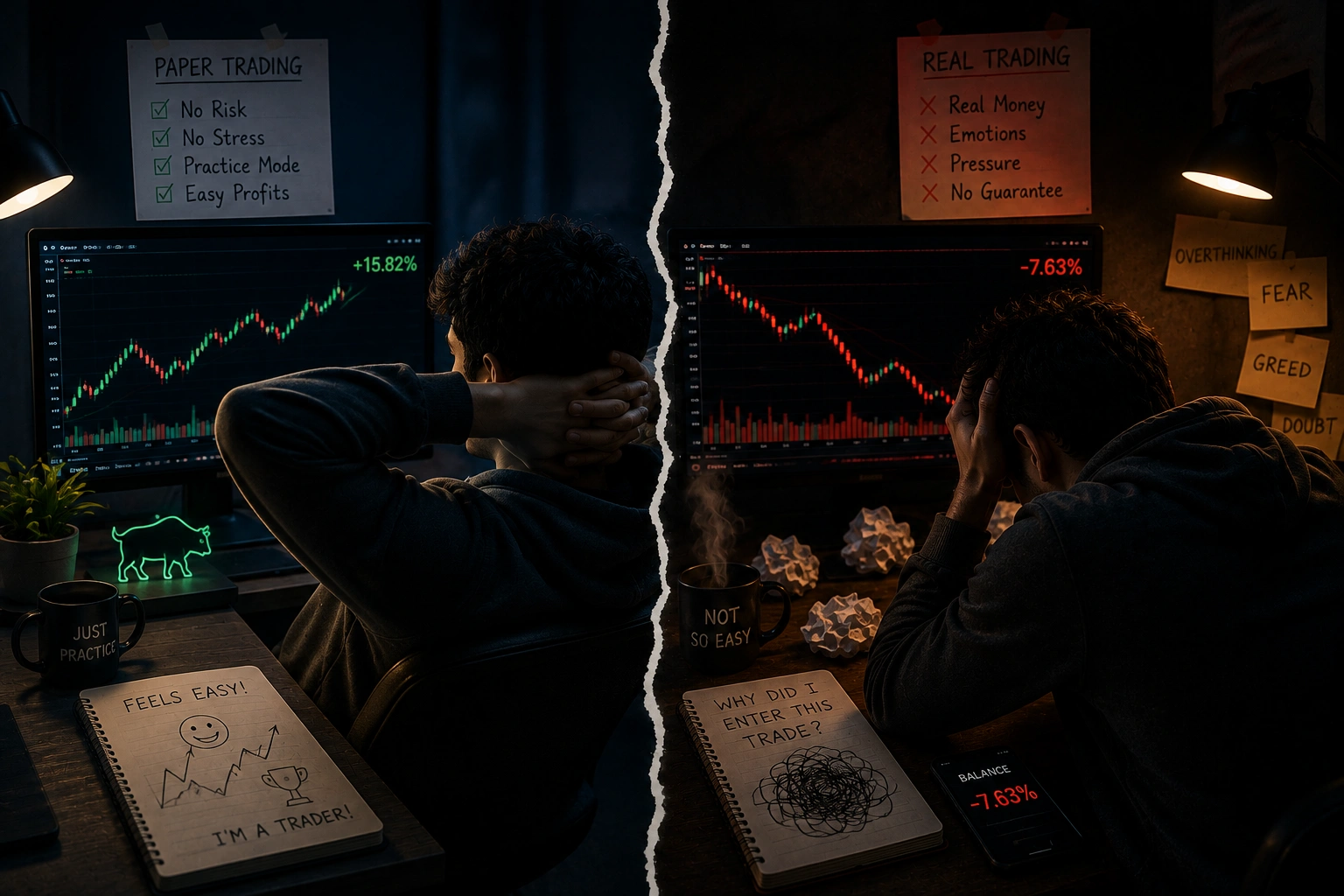
Three months of paper trading, and the account curve looked like something you'd screenshot and be proud of. Clean entries, disciplined exits, a strategy that clearly worked. Then you funded a real account, took the identical setup you'd taken forty times before, and hesitated for two full seconds before clicking buy — two seconds that never existed in three months of practice. The trade worked out fine. The hesitation didn't go away.
Why the exact same setup feels completely different
The strategy didn't change between paper and real trading. What changed is that a loss now means something it never meant before. In paper trading, a losing position is a number that goes red on a screen, then resets. In real trading, that same red number represents money you can't spend on something else, money that might have taken real hours of work to earn, money whose loss will need explaining to nobody or to everybody depending on your situation. The setup is identical. The stakes attached to getting it wrong are not, and your nervous system knows the difference even when your strategy doesn't.
The research behind why this actually degrades performance
This isn't just a vague feeling — it's been studied directly. Researchers Andrew Lo, Dmitry Repin, and Brett Steenbarger, in research published through the National Bureau of Economic Research, found that traders whose emotional reactions to both gains and losses were more intense showed significantly worse trading performance than those with more muted emotional responses. The finding cuts against a common assumption that strong emotional investment signals commitment or seriousness. In practice, the traders whose nervous systems reacted the hardest to money moving — in either direction — performed worse, not better, than those who felt it less intensely.
This matters directly for the paper-to-real transition, because paper trading structurally cannot produce that intense reaction. There's no real money to trigger it. Which means paper trading can genuinely teach you the mechanics of a strategy while leaving the actual emotional test — the part the research shows matters most for performance — completely untouched until real money is on the line for the first time.
What paper trading actually tests, and what it doesn't
Paper trading is useful for exactly what it's built for: pattern recognition, entry and exit mechanics, getting comfortable with a platform, seeing whether a strategy's logic holds up over enough repetitions to mean something. What it can't test, no matter how many months you run it, is your personal maximum-drawdown tolerance — the same math that makes a real losing streak so much harder to climb back from than it looks on paper — how you actually behave once a losing streak is costing money you can feel the absence of. You can know your strategy's theoretical max drawdown from backtesting. You cannot know your own emotional reaction to living through it until you've lived through it with something real attached.
This is often described using a fairly apt comparison: paper trading is like practicing a golf swing at a driving range, hitting ball after ball with no consequence for a bad shot. Real trading is the same swing on an actual course, with something riding on the outcome — and the swing that looked identical in practice can fall apart under that pressure in ways that have nothing to do with whether you learned the mechanics correctly.
Why this isn't a sign you did something wrong
The instinct, when the hesitation or the fear shows up in real trading despite months of clean paper performance, is to conclude something's broken — the mirror image of the false confidence an early lucky win can produce — that you don't actually understand the strategy, or that you're not cut out for this. That conclusion usually isn't accurate. The gap you're experiencing is the expected, well-documented difference between simulated and real financial risk, not evidence that your preparation was wasted or that your strategy is flawed. The strategy was never the part being tested by paper trading. Your emotional response to real risk was always going to need its own separate, harder proving ground.
What actually helps bridge the gap
Starting with real money at a genuinely small size — small enough that a loss barely registers financially but still registers as real — tends to work better than either staying in paper trading indefinitely or jumping straight to a full-size account. The goal of that small-size stage isn't the money itself. It's letting your nervous system start learning what a real loss actually feels like, at a scale where the lesson doesn't cost you meaningfully, before scaling up to size that would actually hurt if the same fear shows up unprepared for.
It also helps to expect the hesitation rather than being thrown by it. Traders who've navigated this transition well tend to treat the first few weeks of real trading as a second, different kind of practice — not a test of whether the strategy works, which paper trading already answered, but a test of how you personally respond to real stakes, which is a separate skill that develops on its own timeline.
Where Artha fits into this
The same kind of honest comparison that's easier to make out loud than alone with a chart is what actually helps here, rather than assuming it's a personal failure that nobody else has experienced.
The test paper trading never gave you
A clean paper trading record proves your strategy has logic. It doesn't prove anything about how you'll behave once that logic has to survive contact with money you can actually lose. Both things are worth building — but they're different skills, tested in different ways, and confusing one for the other is how a solid strategy ends up feeling like a personal failure the moment real stakes enter the picture.
Quick answers
Things people usually want to know.
Why do I trade differently with real money even when using the exact same strategy I used in paper trading?
Real money attaches genuine financial and emotional stakes to a loss that paper trading structurally cannot replicate, so your nervous system responds differently even though the strategy and setup are identical.
Does research actually show emotional intensity affects trading performance?
Yes — research published through the National Bureau of Economic Research found that traders with more intense emotional reactions to both gains and losses performed significantly worse than those with more muted responses.
What does paper trading actually prepare you for?
Paper trading is useful for testing a strategy's logic, practicing entry and exit mechanics, and building pattern recognition — but it doesn't test your personal emotional tolerance for real financial risk.
Is it normal to hesitate or feel fear the first time trading with real money, even after successful paper trading?
Yes, it's an extremely common experience and doesn't indicate a flawed strategy — it reflects the well-documented psychological gap between simulated and real financial risk.
How can I make the transition from paper trading to real money easier?
Starting with a genuinely small real-money position si
More from HeyArtha
Other things we've been writing about.
Brokerage & Tax on Trading Income in India (2026 Guide)
What Zerodha actually charges, how STT changed in 2026, and how F&O, intraday and delivery profits are taxed, in a real numbers breakdown.
Budget Day Brain: Why Feb 1 Turns Disciplined Traders Reckless
Union Budget day making your trading brain go haywire? Heres an honest look at the psychology of high-volatility event days, no calls, just the mindset.
What the CFA Charter Actually Gets You in India: A Realistic View
₹32.4 lakh average for recent charterholders, ₹66.6 lakh overall. Heres what those numbers actually mean, and what they dont.