
Revenge Trading — Why You Cant Stop After a Big Loss
June 17, 2026 · ~5 min read · Updated September 4, 2026 · by Shivam Kushwaha, HeyArtha founder
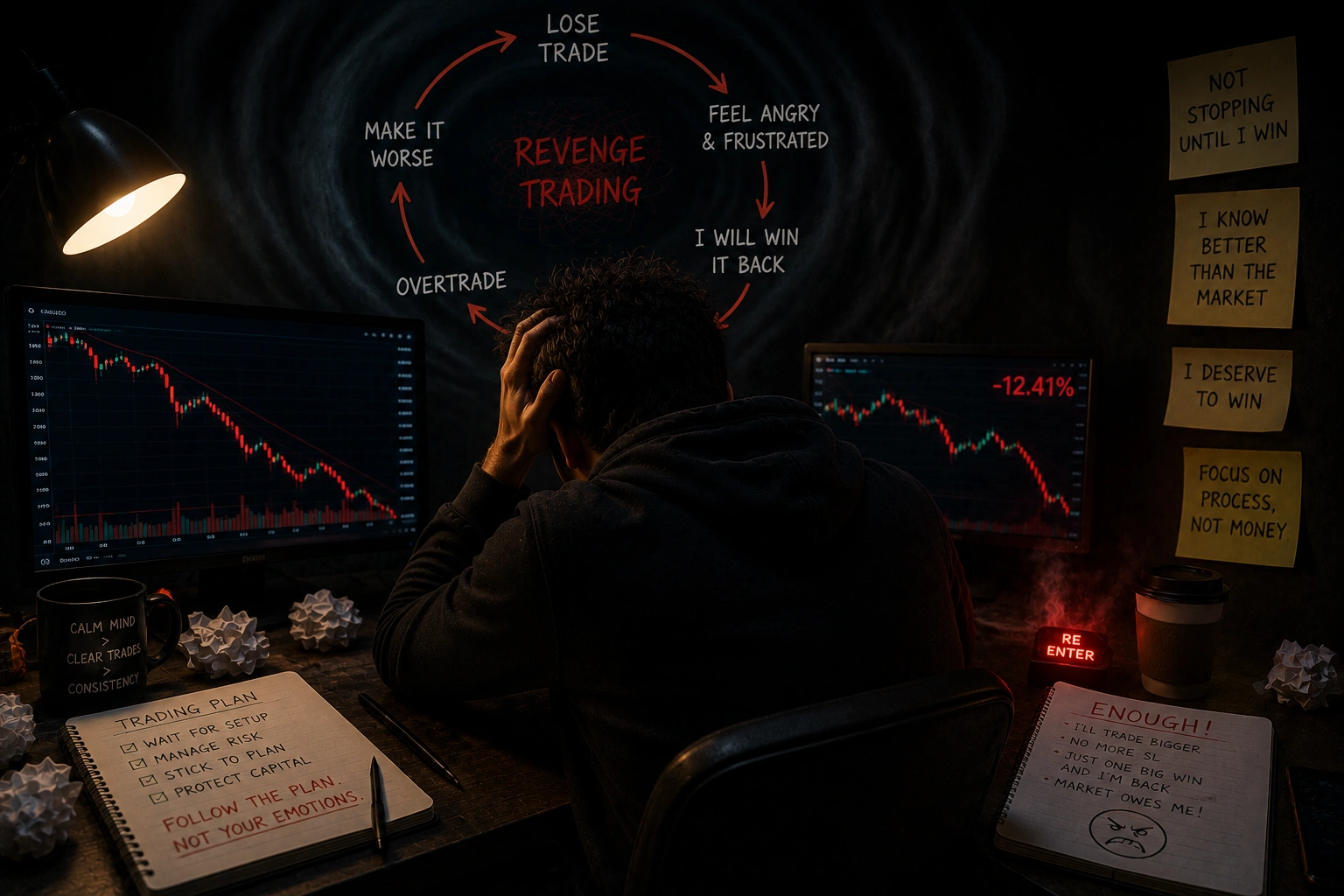
You take the loss. Then, within minutes, you're already sizing up the next position — bigger this time, because a bigger win recovers the damage faster. You know, somewhere in the back of your mind, that this isn't your usual process. You do it anyway.
That second trade was never really about the setup. It was about the first trade.
How common this actually is
According to SEBI's own study, 93% of individual F&O traders in India lost money between FY22 and FY24, with aggregate losses crossing ₹1.8 lakh crore — and the pattern got worse the following year, not better. This isn't a fringe mistake a few undisciplined traders make. It's close to the default experience for most people who trade actively, and revenge trading is one of the clearest mechanisms behind why losses compound instead of staying contained.
What's actually happening in your head
Revenge trading isn't really about strategy at all — it's a fight-or-flight response to a threat, except the threat is a number on a screen instead of something physical. That surge of adrenaline after a loss doesn't feel like "let me think this through." It feels like "I need to fix this right now." The trade that follows is driven by that urgency, not by whatever setup you'd normally wait for.
There's also a specific kind of bias at work: loss aversion, the well-documented tendency to feel a loss more intensely than an equivalent gain. Your brain isn't just processing "I lost money." It's processing something closer to "I need to get back to where I was before this happened," which is a psychological need, not a market opportunity.
What the cycle actually looks like
It rarely stops at one revenge trade. The pattern that shows up again and again: take a loss, enter a bigger position to recover it, lose that one too because it was sized by emotion rather than plan, then feel even more urgency to recover the now-larger hole — the same spiral that leaves nobody to actually talk to about the red day that started it. Each loop typically involves ignoring a stop-loss, oversizing a position, or abandoning whatever rules were in place an hour earlier. The cycle doesn't end because the market cooperates — it usually ends because the account runs out of room to keep going.
What actually helps break it
The traders who describe successfully breaking this cycle usually point to one specific habit: building in a mandatory pause after any loss past a certain size, before the next trade is allowed, no exceptions. Not a vague "calm down" instruction — a hard rule, decided in advance, that removes the decision from the exact moment you're least equipped to make it well.
The other thing that consistently helps is having someone to actually talk to in that window — not for a strategy fix, but to interrupt the loop itself, the same way talking through a missed setup closes a loop a chart never will. Saying "I just lost X and I want to take it back right now" out loud to another person tends to break the urgency in a way that sitting alone with the same thought doesn't.
Where Artha fits into this
Talking through the exact hour after a bad loss with someone who's actually had that hour too, before the next trade gets placed, tends to matter more than the same conversation after the damage is already done.
The trade you don't need to take
A loss is a closed event the moment it happens. The urge to immediately undo it is a separate, later decision — one you're allowed to not make. The traders who avoid the worst of this cycle aren't the ones who never feel the urge. They're the ones who've built something, or someone, into the process that interrupts it before the next click.
Quick answers
Things people usually want to know.
What exactly is revenge trading?
It's the pattern of making impulsive, often larger trades right after a loss, driven by the emotional urge to recover money quickly rather than by your usual strategy or analysis.
How common is revenge trading among Indian retail traders?
Very common — SEBI's own study found that over 90% of individual F&O traders in India lost money in recent years, and impulsive loss-recovery behavior is widely cited as a key driver of those losses.
Why does a loss make me want to trade again immediately instead of stepping back?
It's largely a fight-or-flight response combined with loss aversion — a well-documented psychological bias where losses feel more intense than equivalent gains, creating urgency to "undo" the loss rather than process it calmly.
What's the difference between a normal trade and a revenge trade?
A normal trade follows your predetermined strategy and risk rules. A revenge trade is typically si
More from HeyArtha
Other things we've been writing about.
Brokerage & Tax on Trading Income in India (2026 Guide)
What Zerodha actually charges, how STT changed in 2026, and how F&O, intraday and delivery profits are taxed, in a real numbers breakdown.
Budget Day Brain: Why Feb 1 Turns Disciplined Traders Reckless
Union Budget day making your trading brain go haywire? Heres an honest look at the psychology of high-volatility event days, no calls, just the mindset.
What the CFA Charter Actually Gets You in India: A Realistic View
₹32.4 lakh average for recent charterholders, ₹66.6 lakh overall. Heres what those numbers actually mean, and what they dont.