When Your UPSC Friend Cleared and You Didn't
October 5, 2026 · 9 min read · by Shivam Kushwaha, Artha founder
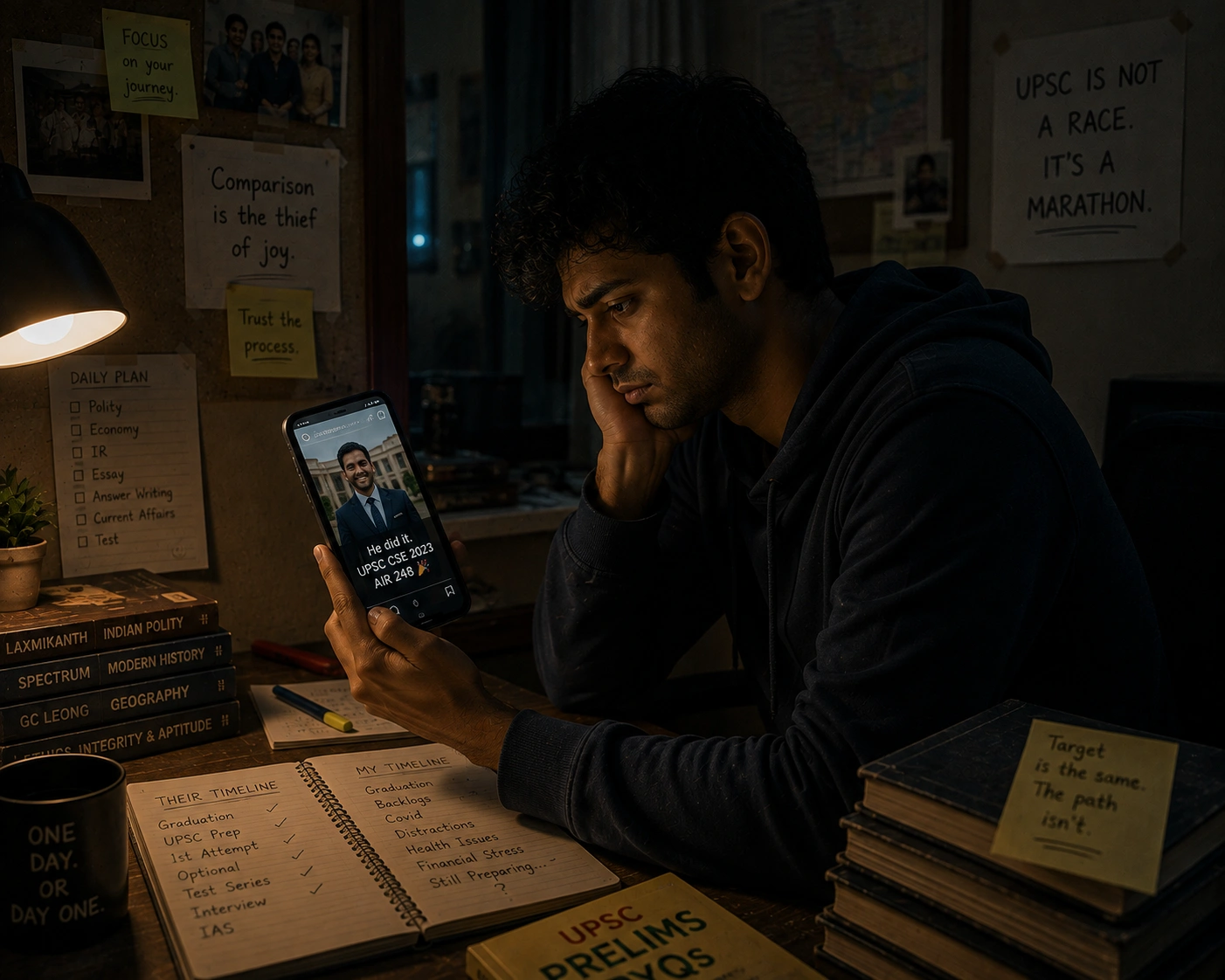
The message arrives at 11:14pm, a screenshot of the final result list, her name highlighted, three friends already replying with fire emojis and "so proud of you." You type "congratulations!!" almost instantly, add the confetti emoji, hit send. It's not fake, exactly, you are happy for her. But there's a second feeling arriving right behind the first one, quieter, uglier, one you'd never admit out loud, and you sit there staring at your own phone screen wondering what's actually wrong with you that you can't just feel one clean emotion about your friend's biggest win.
Why This Specific Grief Feels So Shameful
Here's the honest truth about watching a friend clear UPSC while you didn't, this time: the guilt about feeling bad is often worse than the sadness itself. You know, rationally, that her success takes nothing away from your own chances. You know jealousy toward a friend is supposed to be an ugly, small feeling you shouldn't have. And that knowledge doesn't make the feeling go away, it just adds a second layer of shame on top of the first one, now you're sad about not clearing and ashamed of being sad about someone you genuinely love.
This particular grief is uniquely hard to talk about because there's no acceptable script for it. Grief over a breakup gets sympathy. Grief over a job loss gets sympathy. But grief over a friend's success, even when it's tangled up with your own unrelated disappointment, doesn't get the same social permission. Saying it out loud risks sounding petty or ungenerous, so most people just swallow it, smile through the celebration, and let it sit somewhere uncomfortable in their chest instead, sometimes for months, quietly, without ever finding a safe place to actually put it down.
It's also worth naming what's actually happening underneath the discomfort, this isn't really about begrudging her win. It's about the sudden, sharp visibility of your own outcome standing right next to hers. Before her result came out, your own uncertain status existed in a kind of private fog, still possible, still undecided. Her cleared exam turns that fog into a spotlight, and the spotlight happens to be pointed directly at the gap between where she is now and where you still are.
There's also a specific version of this that hits even harder when the friendship was genuinely built inside the prep itself, a study partner, a coaching batchmate, someone you shared notes and mock test scores with for years. That kind of friendship was partly built on shared uncertainty, both of you not knowing yet, both of you carrying the same open question. The moment one of you gets an answer and the other doesn't, the friendship has to find a new shape almost overnight, and that adjustment period is its own quiet kind of loss, even alongside real happiness for her.
What's Actually Happening Psychologically
Social comparison is one of the most well-documented, most automatic processes in human psychology, people instinctively evaluate their own standing by measuring it against people close to them, especially peers in the same specific pursuit, far more than against strangers or distant benchmarks (foundational research on social comparison theory). That's exactly why a stranger topping the UPSC exam barely registers emotionally, but a close friend clearing it lands like a direct, personal measurement of your own progress. The comparison isn't a character flaw. It's how human brains are built to process relative standing among people we consider peers, and it fires automatically, well before any conscious decision about whether the comparison is fair or useful.
This gets sharper the closer the friendship, and the more similar your prep journeys looked from the outside, same coaching batch, same optional subject, similar mock test scores right up until results day. The more alike two paths appeared, the more her outcome feels like direct, comparable evidence about your own trajectory, even though exam results, especially an exam this competitive, involve enough variance that two similarly prepared candidates can land in genuinely different places for reasons that have little to do with relative ability, a slightly different interview panel, one optional question that happened to favor her preparation over yours, factors neither of you controlled.
There's also something specific happening around identity here. For years, "UPSC aspirant" has probably been a core part of how you see yourself, maybe even how your friend group defines itself. When one member of that identity group crosses over into "civil servant" and you're still on the aspirant side of the line, it can feel like the group itself has quietly fractured, even if nothing about the friendship has actually changed yet.
Family comparisons make this specific grief harder to escape, too. Relatives who know both of you will almost certainly bring her up, sometimes as encouragement, "see, if she can do it," sometimes just as innocent conversation, "how's your friend doing, isn't she posted somewhere now." Either way, you end up processing your own disappointment while also fielding other people's casual references to the exact thing you're trying not to think about for five minutes.
The Specific Ways This Shows Up
Sometimes it shows up as genuine, uncomplicated joy for the first hour, followed by a delayed crash once you're alone later that night, the version of the feeling you didn't let yourself have in front of her. Sometimes it shows up as a subtle urge to withdraw, replying a little slower to messages, finding a reason to skip the celebration dinner, not out of malice but because being physically present with the reminder feels like more than you can handle right now.
Sometimes it shows up as an unfair, unspoken resentment toward the friend herself, for things that aren't actually her fault, for seeming too happy, for not immediately checking in on how you're doing, for existing, for a while, as living proof of an outcome you wanted badly and didn't get. None of those reactions make you a bad friend. They make you a person going through the specific grief of an exam result that didn't go your way at the exact moment someone close to you is going through the opposite.
And sometimes, confusingly, it shows up as the opposite of withdrawal, an almost frantic overinvolvement in her celebration, organizing the party, being the loudest cheerleader in the group, partly because staying that busy leaves no quiet moment for your own feelings to catch up with you. That overcompensation can look, from the outside, like you're handling it beautifully. From the inside it often just delays the crash rather than preventing it, and the crash tends to arrive eventually regardless.
What Actually Helps
The most useful thing you can do is stop treating the jealousy as something that needs to be eliminated before you're allowed to feel happy for her. Both feelings can exist at the same time, genuine happiness for your friend and genuine grief about your own result, without either one canceling the other out or making you a worse person. Trying to force the guilt away by pure willpower usually just pushes it underground, where it tends to leak out sideways, in irritability or distance you can't quite explain even to yourself.
It also helps to get specific about what exactly you're grieving, because "I feel bad" is too vague to actually work with. Are you grieving the timeline, feeling like you're now behind a peer you used to be exactly level with. Are you grieving the specific outcome, the posting, the title, the sense of arrival. Are you grieving how your parents will inevitably compare the two of you at the next family gathering. Each of those is a slightly different feeling requiring a slightly different response, and naming the actual source tends to shrink the vague, overwhelming version of the feeling into something more manageable.
It helps to give yourself permission to step back a little during the loudest part of the celebration, not disappearing entirely, but not forcing yourself into every group hangout either, if you're also still in the middle of your own limbo or freshly processing your own result. A short, honest message, "so proud of you, going through a lot with my own result right now, might be a little quiet for a bit," protects the friendship far better than gritting your teeth through every celebration and slowly resenting her for it.
It's also worth finding at least one person, ideally someone outside this specific friend group, who you can say the unfiltered version of the feeling to, the jealousy, the comparison, the shame about having those feelings at all, without it risking the friendship you actually want to protect. Venting the raw version somewhere safe usually makes it much easier to show up generously for your friend everywhere else.
Give the friendship real time to find its new shape, too, rather than expecting it to snap back to exactly how it was before the results came out. Her life is about to change quickly, training, posting, a completely new set of demands on her time, and yours is, for now, staying largely the same. That asymmetry doesn't mean the friendship is ending. It just means both of you are entering a stretch that requires more deliberate effort to stay close than the easy, parallel-track closeness you had while you were both still just aspirants, waiting on the same uncertain future.
Where Artha Fits, If It Does
A lot of what makes this feeling so hard to sit with is that there's genuinely nowhere safe to say it, telling your friend risks the friendship, telling mutual acquaintances risks it getting back to her, and keeping it entirely to yourself just lets it fester. That's part of why UPSC Talk exists inside Artha, a place to say the complicated, unflattering version of this feeling to someone anonymous who's actually stood exactly where you're standing, watching someone they care about cross a finish line they're still running toward.
Feeling both joy and grief at once, about the same piece of news, doesn't make you petty or ungrateful. It just means you're human, watching two true things happen at the same time, one about your friend's life and one about your own. Your own outcome is still being written, and hers clearing first says nothing final about how yours ends.
Is there someone you can actually say the honest, complicated version of this feeling to, or has it just been sitting there unspoken, getting heavier the longer it stays that way?
Quick answers
Things people usually want to know.
Why do I feel jealous when my friend clears UPSC and I don't?
It's social comparison, one of the most automatic processes in human psychology. People instinctively measure themselves against close peers in the same pursuit far more than against strangers, so a close friend's result lands like a direct measurement of your own progress.
Is it normal to feel both happy and jealous about a friend's UPSC success?
Completely normal, and both feelings can exist at once without either canceling the other out or making you a bad friend. Trying to force the jealousy away usually just pushes it underground where it leaks out sideways later.
Why do I feel guilty for being jealous of my friend's result?
Because there's no accepted script for this kind of grief. Sadness over a breakup gets sympathy, but envy over a friend's success doesn't get the same social permission, so most people swallow it and feel ashamed on top of the original feeling.
How do I act around my friend after she cleared and I didn't?
You don't have to force yourself into every celebration. A short, honest message like "so proud of you, going through a lot with my own result, might be a little quiet for a bit" protects the friendship better than gritting your teeth through everything.
Will my friendship change now that she cleared UPSC and I didn't?
It's likely to shift shape for a while, her life is about to change fast with training and posting, while yours stays largely the same for now. That asymmetry doesn't end the friendship, it just means it needs more deliberate effort to stay close.
Why does it feel worse when the friend who cleared was in my exact prep circle?
Because that friendship was partly built on shared uncertainty, similar coaching batch, similar scores. When one of you gets an answer and the other doesn't, the friendship has to find a new shape almost overnight.
Is it okay to skip my friend's UPSC celebration party?
Yes, if you're honest about why rather than silently resenting it. Stepping back a little while you process your own result is reasonable, especially if you're also dealing with your own limbo or fresh disappointment.
How do I stop comparing my UPSC timeline to hers?
Get specific about what you're actually grieving, the timeline, the outcome, or how relatives will compare you both. Naming the real source tends to shrink the vague, overwhelming version of the feeling into something more manageable.
Does one friend clearing UPSC mean I won't?
No. Exam results involve enough variance that two similarly prepared candidates can land in different places for reasons that have little to do with relative ability. Her outcome says nothing final about how yours turns out.
Who can I talk to about feeling jealous of a friend's success?
Ideally someone outside that specific friend group, so you can say the unfiltered version, the jealousy, the shame about having it, without risking the friendship you're trying to protect. Venting it safely usually makes it easier to show up generously for her elsewhere.