
Presumptive Tax Calculator India: Every Field and Result (2026-27)
October 15, 2026 · 10 min read · by Shivam Kushwaha, HeyArtha founder
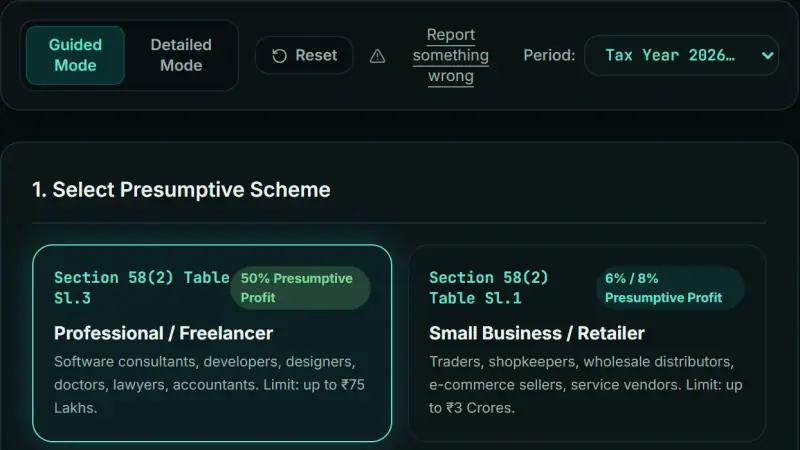
Presumptive Tax Calculator
Compute deemed profits for small businesses and professionals under the presumptive scheme.
You have a small business or a professional practice, you do not want to track every expense, and you want to know what the tax bill looks like. The Presumptive Tax Calculator is built for that question. This guide goes through what to type in each field, what each result line means, and where the tool stops. Treat everything here as general information and check your own case with a practising CA.
What does a presumptive tax calculator India taxpayers can use actually do?
A presumptive tax calculator India taxpayers can use works out tax by assuming a fixed profit instead of tracking expenses. Under s.58(2) of the Income-tax Act 2025 [s.44AD/44ADA], a business is taken to earn 6% of banking receipts and 8% of other receipts, and a specified profession 50% of gross receipts. You enter receipts; the tool does the rest.
The 2025 Act renumbered the old sections, so the old numbers appear in square brackets in this guide. If you pick the FY 2025-26 option in the tool, it switches back to Section 44ADA, 44AD and 44AB.
The rules behind the tool are written out on the presumptive tax methodology page. The primary source is the Act itself: section 58 of the Income-tax Act, 2025 holds the presumptive Table.
Who can use the scheme, and what are the limits?
Eligibility depends on receipts and, for a business, on your cash share.
| Business (s.58(2) Table Sl.1) | Specified profession (Table Sl.3) | |
|---|---|---|
| Presumptive profit | 6% of banking or online receipts, 8% of the rest | 50% of gross receipts |
| Receipt ceiling | Rs 2 crore | Rs 50 lakh |
| Higher ceiling if cash is 5% or less | Rs 3 crore | Rs 75 lakh |
| Higher actual profit | You may declare it | You may declare it |
The ceilings are strict. At Rs 75,00,000 a professional is eligible; at Rs 75,00,001 the tool says not eligible. The same applies at Rs 50,00,000 with 6% cash and Rs 50,00,001.
If you declare less profit than the presumptive figure and your total income is above the exemption limit, s.58(3) [s.44AD(4)] sends you to books of account (s.62) and a tax audit (s.63). Section 58(4) says you cannot then claim losses, allowances or deductions against presumptive income.
What do I type in each field?
Open the tool in Guided Mode (Detailed Mode adds a "Detailed controls" card). Check the Period drop-down first: it offers "Tax Year 2026-27 (2025 Act)", which is the default, and "FY 2025-26 (AY 2026-27)". The inputs, in the order the page shows them:
- Scheme card. Two cards: "Professional / Freelancer" (Section 58(2) Table Sl.3, 50% presumptive profit) and "Small Business / Retailer" (Table Sl.1, 6% / 8%). The cards show the higher limits, Rs 75 lakh and Rs 3 crore, which apply only if your cash share stays at 5% or less.
- Specified profession. A drop-down that appears with the professional card. It starts at "Not specified" and lists ten professions: Legal Profession, Medical Profession, Accountancy Profession, Engineering / Technical Consultancy, Architectural Profession, Information Technology, Interior Decoration, Company Secretary, Authorized Representative and Film Artist (some labels add a note in brackets). Pick the one that matches your work.
- Qualifying non-cash receipts. Money that came through a bank or online: bank transfer, UPI, NEFT, RTGS, account-payee cheques. A cheque or draft that is not account payee counts as cash (s.58(9)). Receipts by these modes up to the return due date under s.263(1) also count (s.58(2) Table Sl.1). Enter the total for the year.
- Cash and other receipts. Everything else. The tool adds the two boxes to get gross receipts and works out your cash ratio.
- TDS deducted by clients. Tax already deducted from your receipts, as it appears in your Form 26AS or AIS. The whole TDS is credited against your tax.
- Advance tax paid on or before 15th March. Only what you actually paid by that date.
There is no filing date box. The tool assumes 31 August 2027, the due date for business or profession income when no tax audit applies (Section 263(1)(c), Table Sl.3), and says filing later adds 1% a month.
Below the result, Scenario Lab lets you change receipts, TDS, advance tax, the Tax Regime Preference ("Compare both (shows the lower tax)", "New regime (Section 202)" or "Old regime") and a higher declared profit, and compare the outcome with your base case. The result card does not name the regime it used, so note which option you picked.
Type this: a professional with Rs 30 lakh of receipts
Choose the "Professional / Freelancer" card and pick your profession. Put Rs 30,00,000 in qualifying non-cash receipts and nothing else.
| Result line | Tool shows |
|---|---|
| Presumptive profit (50%) | Rs 15,00,000 |
| Total tax (including 4% cess) | Rs 1,09,200 |
| Add: paying less than the whole advance tax by 15 March (Section 425(3)) | Rs 1,092 |
| Add: paying less than 90% of the tax (Section 424) | Rs 5,460 |
| Rounding to the nearest Rs 10 (Section 516) | -Rs 2 |
| Tax to pay | Rs 1,15,750 |
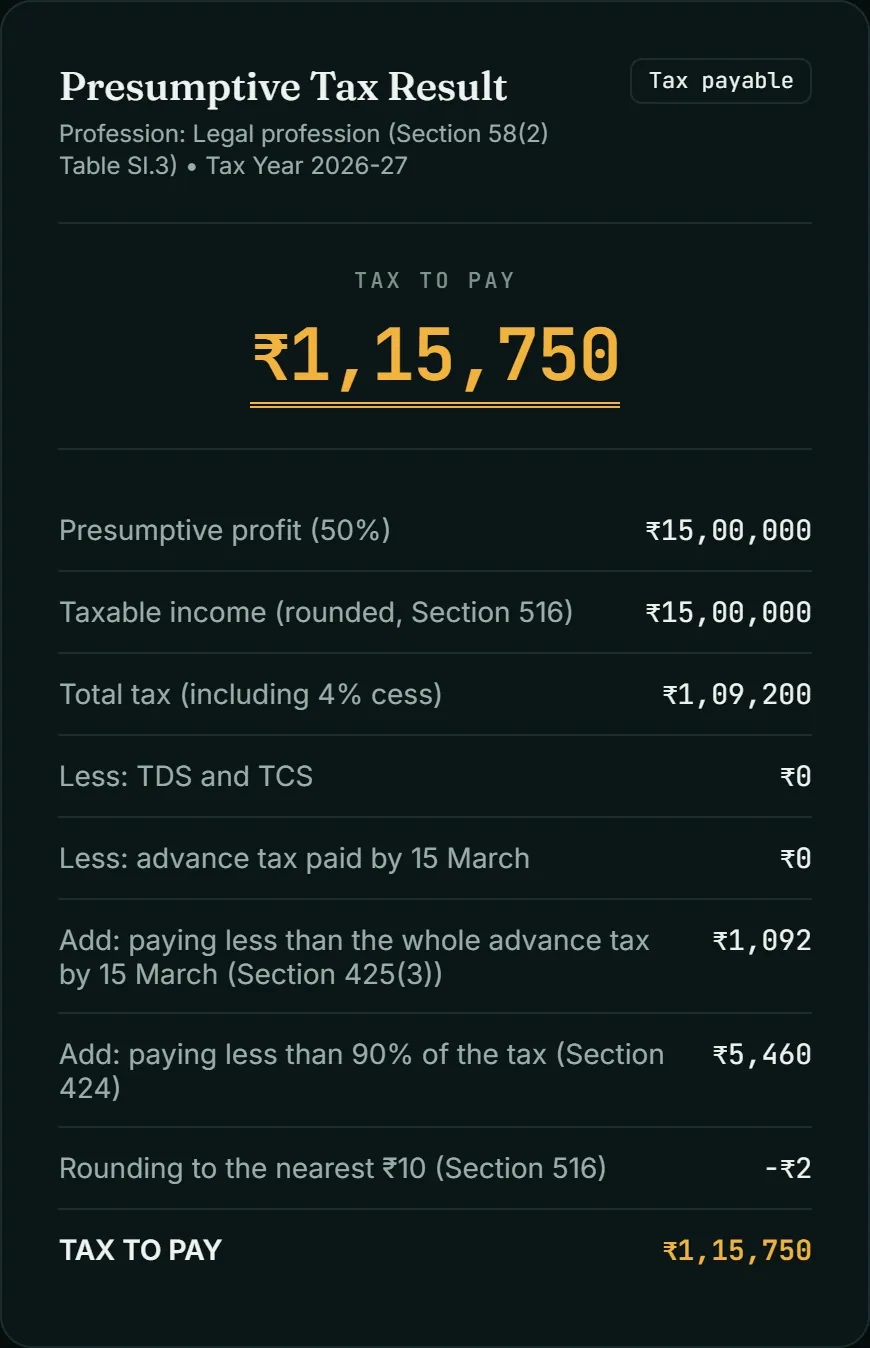
Slab tax on Rs 15,00,000 in the new regime is Rs 20,000 (5% on 4-8 lakh) plus Rs 40,000 (10% on 8-12 lakh) plus Rs 45,000 (15% on 12-15 lakh), which is Rs 1,05,000. With 4% cess that is Rs 1,09,200. The interest lines are there only because no advance tax was paid.
Now add Rs 60,000 in TDS and Rs 49,200 in advance tax paid by 15 March. Together that covers the Rs 1,09,200 of tax, so the tax to pay falls to Rs 0 and the interest lines disappear. Advance tax timing is explained in After the Calculator: Advance Tax and What Traders File, which uses the same s.424 and s.425 rules.
How do I read the result card?
The card runs top to bottom as a bill:
- Presumptive profit. Labelled (50%) or (6% / 8%) depending on your choice.
- Taxable income (rounded, Section 516). The profit rounded to the nearest Rs 10.
- Total tax (including 4% cess). Slab tax plus cess, after any rebate.
- Less: TDS and TCS and Less: advance tax paid by 15 March. Credits you entered.
- The two "Add" lines. Interest for paying advance tax late or short, under s.425(3) [s.234C] and s.424 [s.234B]. Interest runs on the tax rounded down to Rs 100.
- Rounding to the nearest Rs 10. A small adjustment either way.
- Tax to pay.
Two tiles sit beside it. Presumptive rate shows the blended percentage, for example 50.0%, 6% or 6.08%. Rebate (Section 156) shows the rebate under s.156(2)(a) [s.87A], which is Rs 60,000 up to Rs 12 lakh of total income in the new regime, with marginal relief just above it.
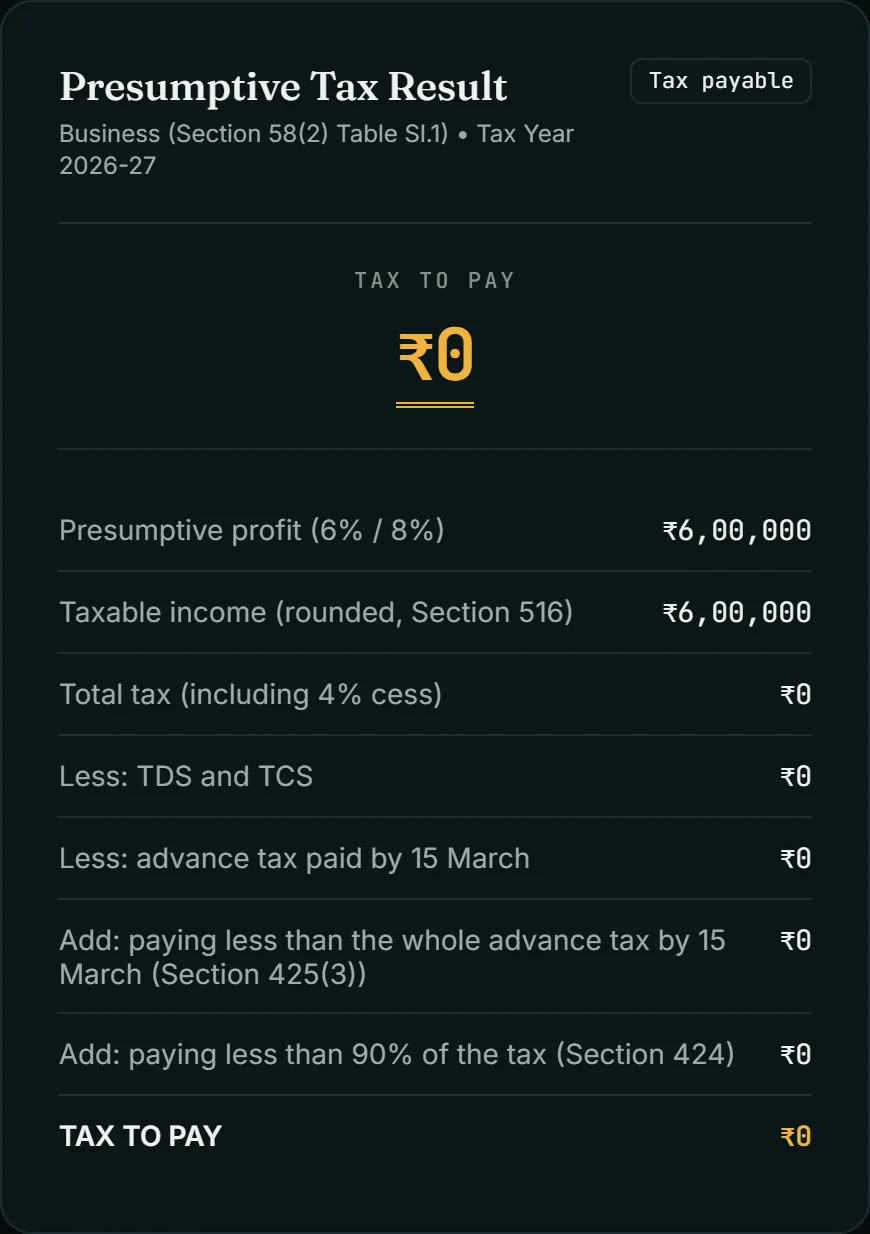
A business with Rs 1 crore of non-cash receipts gets Rs 6,00,000 of presumptive profit. The slab tax is fully rebated, so the card shows tax of Rs 0 and a rebate tile reading Rs 10,000 with "Slab tax fully rebated".
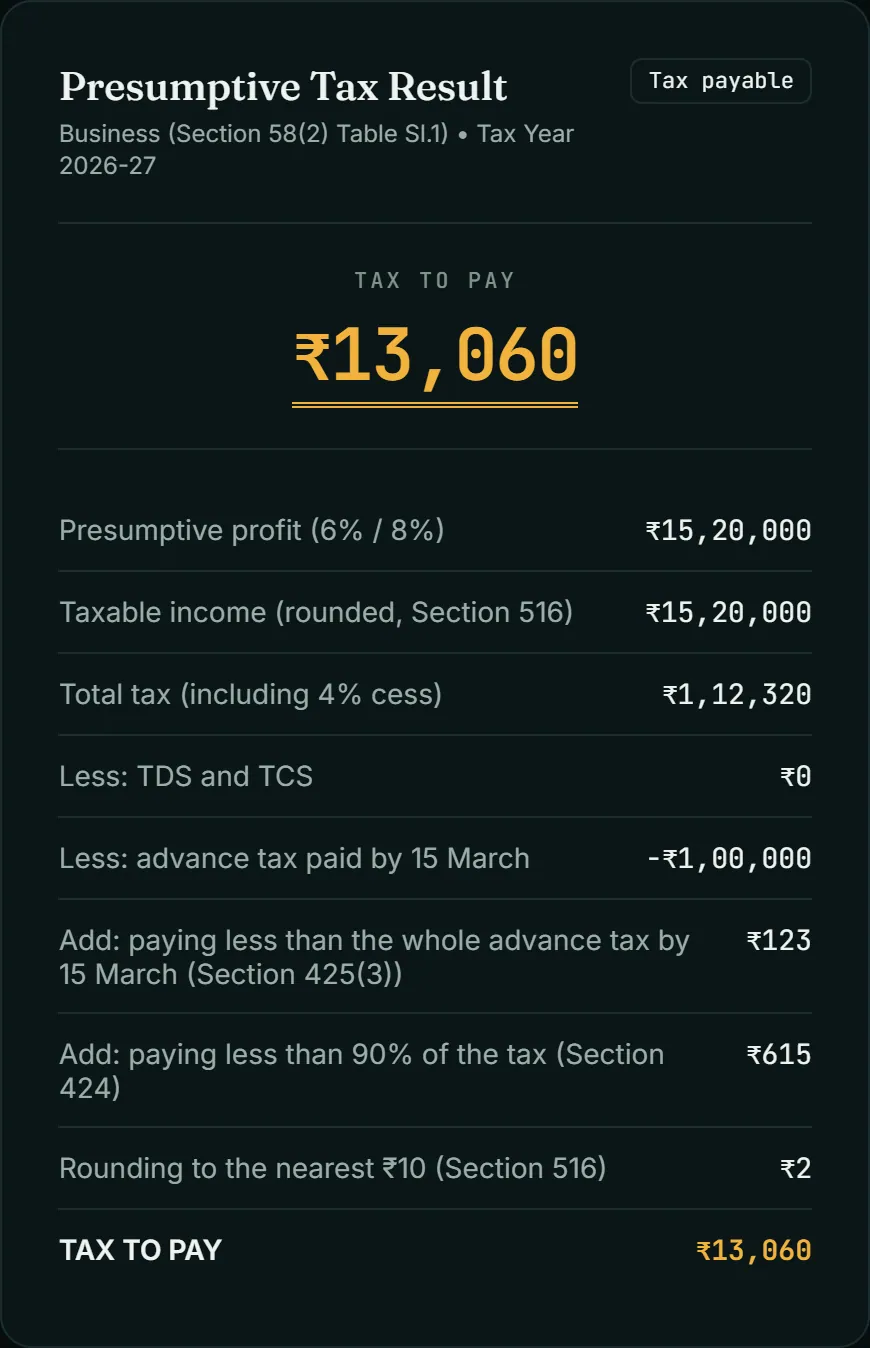
Type this: a business with a mixed cash ratio
Choose the "Small Business / Retailer" card. Put Rs 2,40,00,000 in non-cash receipts, Rs 10,00,000 in cash, and Rs 1,00,000 as advance tax paid by 15 March.
Profit is 6% of Rs 2.4 crore (Rs 14,40,000) plus 8% of Rs 10 lakh (Rs 80,000), which is Rs 15,20,000. The rate tile shows 6.08%. Total tax with cess is Rs 1,12,320. The advance tax of Rs 1,00,000 is below 90% of that tax (Rs 1,01,088), so interest applies: Rs 123 under s.425(3) and Rs 615 under s.424. After rounding of Rs 2, the tax to pay is Rs 13,060. The tool also shows three "Please Check" notes under the card. One is the five-year lock-in note mentioned in the limits below; the other two explain the interest in words: Rs 123 for deferring the 15 March instalment, and Rs 615 because the Rs 1,00,000 paid is below 90% of the assessed tax (Rs 1,01,088).
Total receipts here are Rs 2.5 crore and cash is 4%, so the Rs 3 crore ceiling applies. Raise cash above 5% and the ceiling drops to Rs 2 crore; the tool would then say not eligible.
What does the not-eligible result mean?
If receipts cross the applicable ceiling, the tool stops showing a tax figure. The headline reads "Not eligible for presumptive taxation". The body explains that your gross receipts are above the ceiling that applies at your cash ratio, that presumptive profit cannot be used, and that you work out profit from regular books of account and file ITR-3. It adds that whether a tax audit applies depends on Section 63. The meter badge changes to "RECEIPTS ABOVE CEILING".
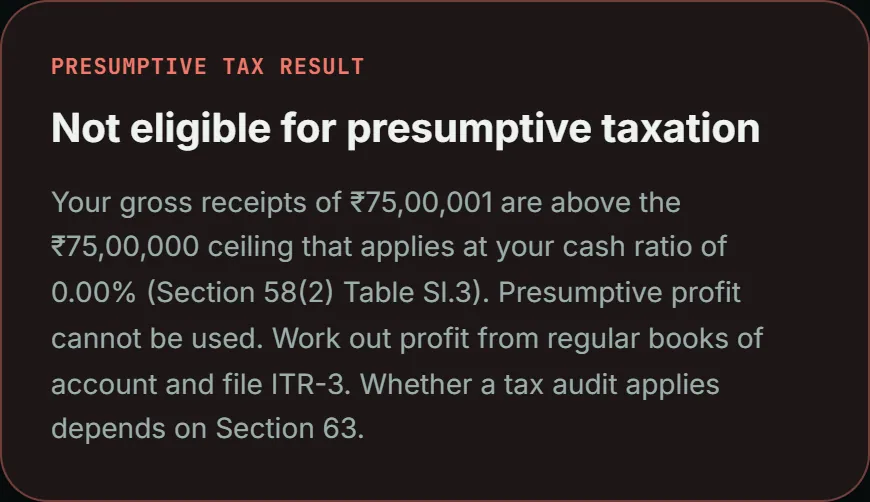
That wording is deliberate. The calculator does not claim an audit is definitely required, because that depends on facts it cannot see.
What the calculator does not do
Being clear about the limits is part of using it well.
- It does not decide whether your work is a specified profession or whether your business qualifies. That is a classification question for your CA.
- It does not tell you whether a tax audit applies to you. It points to Section 63.
- It does not file your return or replace a Chartered Accountant.
- It does not ask for a filing date. It assumes 31 August 2027, so interest will differ if you file later.
- For the business scheme it also shows a note about a five-year lock-in. This guide does not cover that rule, so ask your CA before opting in or out.
- The page's own disclaimer asks you to consult a qualified Chartered Accountant about your specific claims and filing. Not reviewed by a Chartered Accountant.
- If a number looks wrong, use the "Report something wrong" button on the tool page.
- It uses current-year rules. Older years use the FY 2025-26 option.
- The Cash Safe-Harbor Meter's headroom line is 5% of your current total receipts less your cash. It does not move for cash you add later, because the total would grow too, so use it as a signal.
- Trading income and F&O have their own rules. See How Trading Income Is Taxed in India rather than forcing them into this tool.
If you are still choosing between a proprietorship and a company, Sole Proprietorship vs Pvt Ltd vs LLP covers that decision.
Last reviewed: October 2026, for tax year 2026-27. The sections behind each step are listed on the sources page. For other tools, see the HeyArtha guides.
Next in series: After the Calculator: Advance Tax and What Traders File.
Quick answers
Things people usually want to know.
What is a presumptive tax calculator?
It estimates tax on a fixed, assumed profit instead of your actual expenses. You enter receipts, the calculator applies the presumptive rate from s.58(2) of the Income-tax Act 2025, then adds slab tax, cess, rebate and interest to show the amount payable.
What profit does the presumptive scheme assume for a business?
For a business under s.58(2) Table Sl.1 [s.44AD], profit is taken as 6% of banking or online receipts plus 8% of all other receipts. The law also lets you declare a higher actual profit if you have one.
What profit does it assume for a specified profession?
For specified professions under s.58(2) Table Sl.3 [s.44ADA], profit is taken as 50% of gross receipts. You may declare more if your actual profit is higher. Whether your work counts as a specified profession is a question for your CA.
What are the receipt limits for presumptive taxation in 2026-27?
A business can use the scheme up to Rs 2 crore of turnover, or Rs 3 crore if cash receipts are 5% or less. A specified profession can use it up to Rs 50 lakh, or Rs 75 lakh at 5% cash or less.
Why does the calculator ask for cash receipts separately?
Cash share decides two things: the profit rate for a business (6% on non-cash, 8% on the rest) and which ceiling applies. At 5% cash or less the higher ceiling applies, so the split changes both the profit and eligibility.
Does the calculator say whether a tax audit is mandatory?
No. It points to Section 63 and says whether an audit applies depends on it. Audit depends on your declared profit, total income and turnover facts that a calculator cannot fully judge, so confirm with your CA.
What does the result card show beyond the tax?
It shows presumptive profit, taxable income, total tax with 4% cess, TDS and TCS, advance tax paid by 15 March, interest under s.425(3) and s.424, rounding to the nearest Rs 10, and the final tax to pay.
Why does the tool show interest if I have not filed yet?
The tool has no filing date box. It assumes 31 August 2027 for this tax year and counts s.424 interest to that date, noting that filing later adds 1% a month. Paying enough advance tax on time removes these lines.
What happens if my receipts are above the ceiling?
The tool shows a not-eligible result instead of a tax figure. It says presumptive profit cannot be used, that profit must come from regular books of account, and that ITR-3 applies. Audit applicability depends on Section 63.
Is this calculator a substitute for my CA?
No. It is a general-information tool for illustrative planning. Check eligibility, profession classification and return filing with a practising Chartered Accountant before relying on any figure.
More from HeyArtha
Other things we've been writing about.
After the Calculator: Advance Tax and What Traders File (2026-27)
Advance tax for traders in India, 2026-27: the Rs 10,000 test, four instalment dates, s.424 and s.425 interest, which ITR form applies and a records checklist.
Sole Proprietorship vs Pvt Ltd vs LLP: 2026 Guide
Which structure actually fits your startup: liability, funding, ESOPs, and compliance cost compared honestly, not as a sales pitch.
How Trading Income Is Taxed in India (2026-27)
How trading income is taxed in India for 2026-27: delivery, intraday, F&O, currency, commodity and prop payouts, with the head, section and loss rule for each.