
The UPSC Interview Wait — What Nobody Prepares You For
June 19, 2026 · ~7 min read · Updated September 4, 2026 · by Shivam Kushwaha, HeyArtha founder
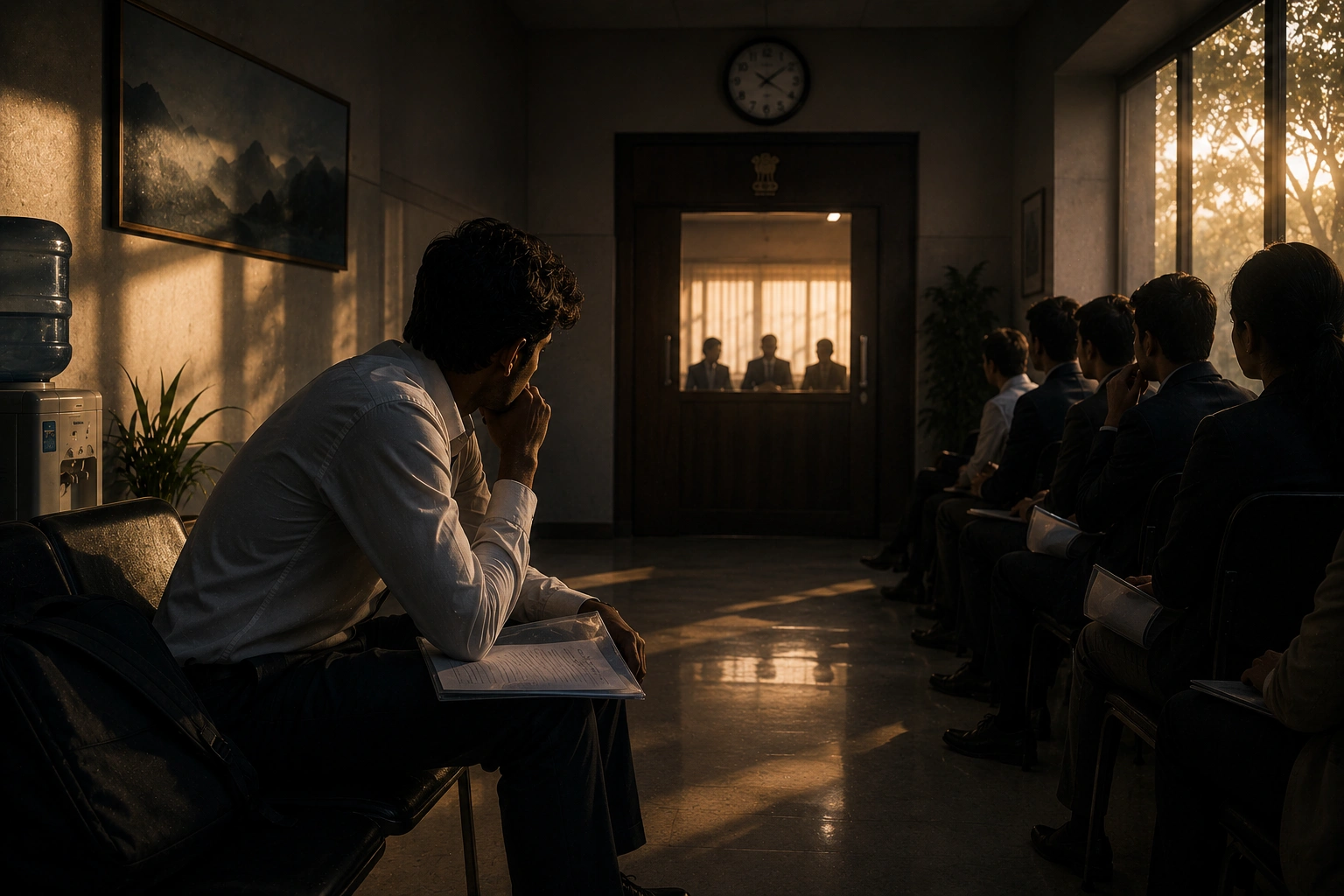
The Mains result is out. Your name is on the list. For about a day, it feels like the whole thing is over — the relief is real, people are calling, congratulating you like the hardest part is behind you. Then the actual date for your Personality Test arrives in an email, weeks or months away, and you realize you're not done at all. You're just moving into a different kind of hard: waiting, with nothing left to study and everything still riding on twenty minutes you haven't lived through yet.
How narrow this room actually is
Getting a Mains result that clears you for interview puts you somewhere very few people ever reach. In a typical cycle, somewhere around 1,000 to 2,800 candidates get called for the Personality Test, out of the 5-6 lakh who sat Prelims that year — the same razor-thin selection ratio that shapes so much of what comes after, whether you clear it or not. The exact number shifts cycle to cycle, but the shape stays the same: this is an extraordinarily narrow room, and simply being in it is already a real, rare achievement — even before the interview itself happens.
That narrowness is part of what makes the waiting period so strange. You're not waiting to find out if you're good enough to be considered. You already are. You're waiting for one specific, unrepeatable conversation to decide how the rest of a multi-year effort gets weighed.
The waiting is built into the exam's own calendar
This isn't a psychological exaggeration — the structure of the exam itself creates the wait. Interview schedules for a single cycle typically span three to four months. In one recent cycle, interviews for 2,845 candidates ran from early January through mid-April — meaning even after the Mains result comes out, individual candidates are assigned a specific date somewhere inside that multi-month window, with no ability to request a change once it's set.
So the wait isn't just "waiting for a result." It's waiting to even find out your slot, then waiting for that slot to arrive, then waiting again — often for weeks — to hear the actual outcome once the interview itself is done. Three distinct waiting periods, stacked one after another, each with its own specific flavor of nothing-left-to-do.
Why this particular kind of waiting is so disorienting
Every other stage of UPSC prep has a clear, structured activity attached to it. Prelims has a syllabus and a study plan. Mains has answer writing and test series. The interview stage has neither, not in the same sense — most of the actual preparation (reading your DAF closely, mock interviews, current affairs revision) can only occupy a fraction of the actual waiting period, because there's a limit to how much genuine interview prep any one person can sustain for months on end without it turning into anxious over-preparation.
That leaves a strange gap: too high-stakes to fully relax, but with nothing left that meaningfully moves the needle day to day. A lot of candidates describe this specific stretch as harder to sit with than the actual studying was, precisely because studying gave you something to do with the anxiety. Waiting doesn't.
What people actually do with the wait
There's no single right way to spend this period, and that's part of what makes it hard — without a syllabus telling you what to do, everyone ends up improvising their own version of coping, not unlike the blank-page paralysis that shows up when there's no clear next step in answer writing either. Some candidates throw themselves into mock interview panels and DAF-based question drilling, trying to convert the waiting energy into something productive, even past the point of diminishing returns. Others deliberately step back from anything UPSC-related for weeks at a time, trying to reset before the interview itself, worried that months of low-grade anxiety will show up as visible exhaustion in the room.
A quieter group tries to half-live a normal life during this stretch — picking up a hobby, spending time with people outside the exam world, taking a short trip — while still carrying the interview date somewhere in the back of their mind the entire time, never fully present in either mode. None of these approaches is wrong. They're just different ways of managing a wait that the exam itself doesn't offer any real structure for.
The part that comes after, which is its own separate wait
Even once the interview happens, the waiting isn't over. Final results, incorporating both the Mains score and interview marks, are typically announced weeks after the last interview slots in that cycle's window close — meaning candidates who interview early in the cycle can end up waiting even longer for their final result than candidates who interview near the end. There's a specific cruelty to that timing that rarely gets discussed: doing well or poorly in your twenty minutes, and then having to carry that uncertainty, unresolved, for weeks more, often while watching later batches of candidates go through their own interviews in the meantime.
Where Artha fits into this
This is exactly the kind of stretch that coaching content covers badly, not for interview strategy, which it covers extensively, but for the specific, under-discussed experience of the wait itself. Mock panels and question banks don't address the actual problem: not a lack of preparation, but the strange, structureless stretch of time where there's genuinely nothing left to prepare.
The wait that deserves to be named
If you're in this stretch right now — Mains cleared, interview date set or still pending, weeks or months of nothing-left-to-do stretching out ahead of you — the disorientation you're feeling isn't a sign you're handling it badly. It's a structural feature of the exam's own calendar, the kind of alone that has nothing to do with how many people actually care about you, one that almost nobody talks about honestly because most UPSC content is built to help you prepare for the interview, not to help you survive the waiting around it.
What's the hardest part of this specific wait been for you — the not-knowing, or having nothing left to actually do about it?
Quick answers
Things people usually want to know.
How many candidates typically get called for the UPSC interview each year?
The number varies by cycle, but it typically ranges from roughly 1,000 to 2,800 candidates called for the Personality Test, out of the 5-6 lakh people who sat the Prelims exam that year.
How long is the gap between the UPSC Mains result and the actual interview date?
It varies by individual candidate, since interviews for an entire cycle are scheduled across a multi-month window — in a recent cycle, interviews ran from early January through mid-April for all 2,845 candidates called that year.
Why does the UPSC interview waiting period feel harder than studying for Prelims or Mains?
Unlike Prelims or Mains, the interview stage doesn't come with an ongoing structured activity to occupy the full waiting period, which leaves many candidates in a high-stakes but low-activity stretch that can feel more psychologically difficult than active studying.
How long do candidates wait for the final result after their UPSC interview?
Final results, which combine Mains and interview scores, are typically announced weeks after the last interview slots in that year's cycle close — meaning candidates interviewed earlier in the cycle may wait longer for the final result than those interviewed later.
Is it normal to feel anxious with nothing productive to do during the interview wait?
Yes, it's a very common experience — since there's a natural limit to how much interview-specific preparation is genuinely useful, many candidates find themselves with real anxiety but limited productive outlets for it during this stretch.
Should I keep studying or take a break during the wait for my UPSC interview?
There's no single right approach — some candidates continue structured mock interview practice throughout, while others deliberately step back for periods to avoid burnout before the actual interview, and both strategies are common among successful candidates.
Can I request a different date for my UPSC Personality Test if it doesn't work for me?
No — UPSC has stated that requests to change the date or time of an assigned Personality Test are not ordinarily entertained, making the assigned slot generally fixed once notified.
Why don't more people talk about the emotional experience of the UPSC interview wait?
Most UPSC-related content focuses on interview technique and preparation strategy, since that's more directly actionable, leaving the emotional experience of the surrounding waiting period comparatively under-discussed.
Does getting called for a UPSC interview mean I'm likely to be selected?
Being called for interview means you've cleared an extremely competitive stage and are among a very small group of candidates, though the interview itself still carries real weight in the final selection outcome.
More from HeyArtha
Other things we've been writing about.
What to Do After UPSC Mains, Before the Result
The two months after UPSC Mains before results feel like nothing. Heres why the gap hits so hard, and what actually helps you get through it.
IBPS & SBI PO vs UPSC: Career, Salary, and Odds Compared
UPSC has a 0.2% pass rate and a 1-year cycle. IBPS and SBI PO offer 1-2% odds, 6-8 month cycles, and predictable banking careers. Compare both paths.
Can You Prepare for CA and UPSC Together? The Honest Truth
Can you prepare for CA and UPSC simultaneously? Why dual prep fails during articleship, how to sequence them, and how CA serves as a strong Plan B.