
Why Professional Loneliness Feels Different From Regular Loneliness
August 19, 2026 · ~7 min read · Updated September 4, 2026 · by Shivam Kushwaha, HeyArtha founder
Dinner with your closest friends, the good kind — easy conversation, real laughter, nobody checking their phone. Someone tells a story about their weekend and everyone leans in. Someone else orders a second round of something. It's the kind of evening you'd point to if anyone asked whether you have people in your life.
And somewhere between the second course and dessert, you catch yourself thinking about something you haven't said out loud all night. A number. A decision you're sitting on. A fear about work you can't quite shape into a sentence that would make sense to anyone at this table. You could say it. Everyone here would listen, and they'd mean it. But you already know, before you even try, that saying it wouldn't actually land the way you need it to.
So you don't. You laugh at the next thing someone says, and the evening continues, warm and full and slightly hollow in one specific corner you've gotten used to not mentioning.
That's not the loneliness people usually mean when they use the word.
What professional loneliness actually is
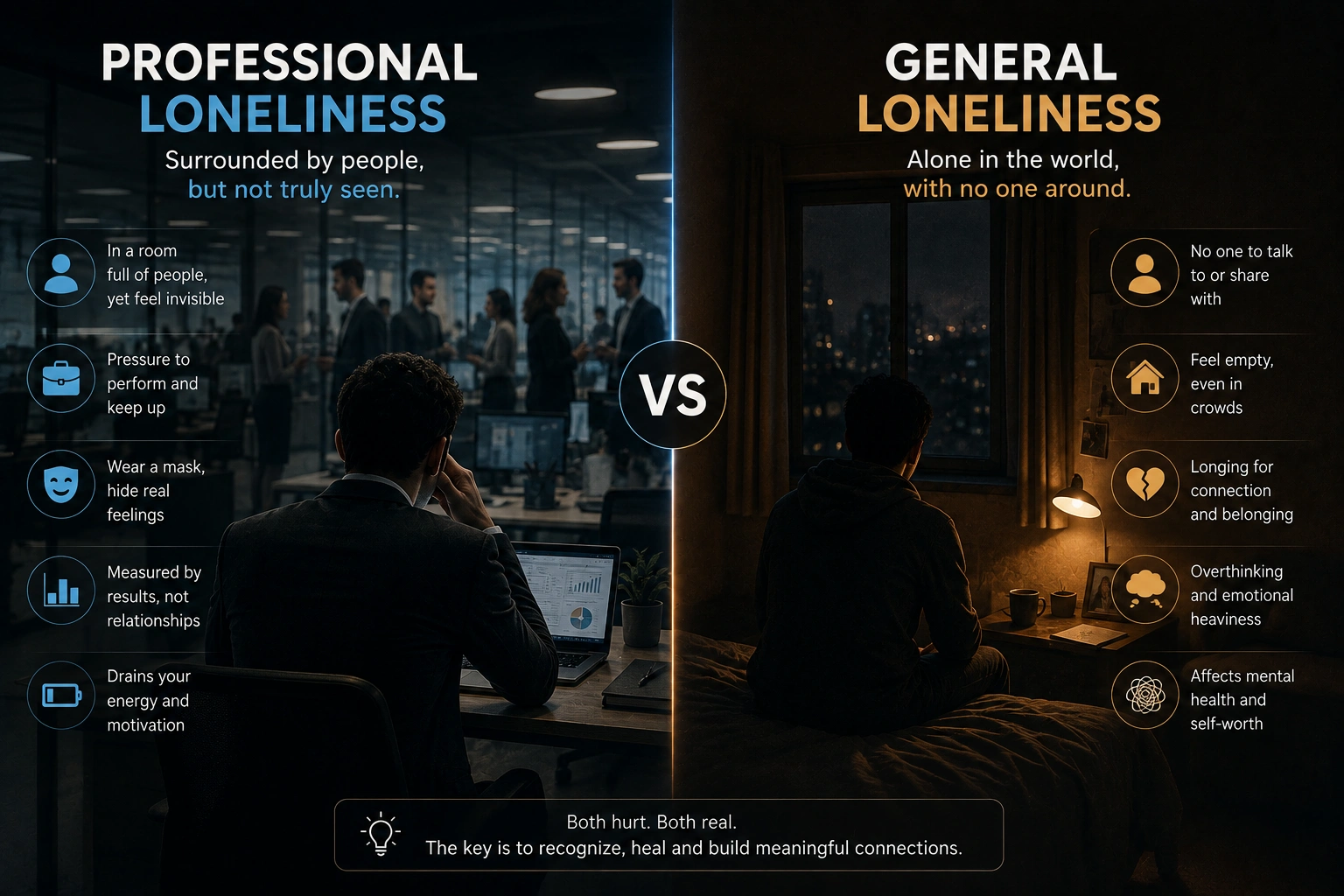
Professional loneliness is the specific isolation of carrying something no one in your immediate life is positioned to actually understand — not because they don't care, but because the thing itself requires context they don't have. It can exist alongside a full, warm social life. You're not friendless. You're not isolated in the way the word usually implies. You're just structurally alone with a particular category of thought, because the people who love you and the people who'd genuinely get it aren't the same people.
This is different from being introverted, and different from having a small social circle. Plenty of people with wide, active social lives experience this constantly. It's not about quantity of connection. It's about a specific kind of connection that doesn't exist in the relationships you already have, no matter how many of them there are or how good they are.
Why this gets missed so often
Most loneliness content — the articles, the wellness posts, the advice threads — assumes the problem is a lack of people. Build community. Make more friends. Reach out more. That's genuinely good advice for the kind of loneliness it's addressing. But professional loneliness is often the opposite situation entirely: plenty of people, none of them positioned for this specific conversation.
Think about how this actually plays out. A CA student preparing for exams can have a full friend group from school, a loving family checking in regularly, a hostel room full of people to eat dinner with — and still be completely alone with the exact texture of what a bad mock test feels like three weeks before Finals. A trader can come home to a family that asks how the day was, genuinely wants to know, and still be alone with what a red week actually does to your sense of your own judgment. A founder can be surrounded by people cheering for the idea, believing in them, checking in constantly — and still be alone with the specific quiet of a month where nothing moved and there's no visible sign to anyone outside the business that something's wrong.
None of these people are failing their friends or family. Their friends and family aren't failing them either. The gap isn't relational — it's not a sign anyone did anything wrong. It's contextual. The specific content of what's weighing on you requires lived experience in that exact world to fully land, and most people's social circles simply don't include enough people who share that particular world.
Why it's harder to name than regular loneliness
Regular loneliness has a clear, legible shape. You can point to it. You can say, "I don't have enough people around me," and even if the solution is hard, it's at least obvious what direction to move in — build community, make friends, put yourself in more rooms with more people.
Professional loneliness resists that framing almost entirely, because on paper you're not isolated at all. You might be constantly surrounded — by roommates, by family, by a full calendar of plans. The mismatch between "I objectively have people" and "I still feel completely alone with this specific thing" is confusing enough that a lot of people never actually name it as loneliness. Instead, they quietly assume something is wrong with them — that they're ungrateful, or dramatic, or not appreciating what they have — rather than recognizing that this is simply a different, structural gap that "having people" was never going to close on its own.
There's also a quieter reason it goes unnamed: admitting to this specific loneliness can feel like an insult to the people who do love you, even though it isn't one. Saying "you don't fully get this" to someone who's clearly trying feels unkind, so most people just don't say it, to anyone, and the feeling stays unprocessed instead of just being correctly identified.
The pattern across every kind of ambition
What's striking, once you start looking for it, is how identically this shows up whether the specific pressure is an exam, a trade, or a company. The domain changes. The underlying shape doesn't.
A CA student's version is the particular exhaustion of running on a multi-year timeline that nobody in their immediate circle is running on the same clock — watching school friends get placed, get promoted, get engaged, while still explaining to relatives why "you haven't finished yet" like it's a delay instead of just how long the actual process takes. A trader's version is a P&L number that means nothing — genuinely nothing, not even as a data point — to someone who's never watched a position move against them in real time, never felt what it's like to sit with a red day and no one to explain the specific shape of that feeling to. A founder's version is a slow month that reads as completely fine to everyone outside the business, because there's no visible sign anything is wrong, no way for a supportive friend to even know there's a weight to ask about.
Different domains. Same underlying shape. The people who love you, and the people who would understand this specific thing, are two different groups — and for most people, in most seasons of their life, they only have consistent, everyday access to the first group.
Where Artha fits into this
This is the actual argument behind why Artha exists as multiple rooms instead of one general anonymous chat space. CA Talks, Traders' Talk, Founders' Room, UPSC Talk — each one exists because the specific texture of professional loneliness doesn't transfer cleanly between domains, even though the underlying feeling is nearly identical.
A trader talking to a CA student, even though both are anonymous and both are experiencing a real version of professional loneliness, won't close this particular gap the way talking to another trader would. The empathy is there, in theory. The context isn't. And it's the context — the specific, lived detail of the exact pressure someone's under — that actually closes this kind of loneliness, not just general kindness from someone who cares. That's why the match has to be to the actual world someone's in, not just to "someone else who understands loneliness in general."
A note from me
And I still notice the specific quiet that shows up when something is CA-specific, or Artha-specific — a study setback, a hard product decision, a day where nothing about the business moved forward. Even the most supportive person outside those exact worlds can only meet me partway on the actual content of it, because meeting me all the way would require having lived some version of it themselves. That gap isn't a flaw in the people around me. It's just the honest shape of professional loneliness. It's the entire reason this platform has rooms instead of one general feed — because closing this particular kind of alone requires matching the context, not just matching the willingness to listen.
The loneliness worth naming correctly
If you've ever felt strangely alone in a room full of people who love you, it's worth sitting with the idea that the problem was probably never a lack of people. It was a lack of the right person for that one specific thing — someone close enough to the actual context to meet you there, not just someone willing to try.
That's a solvable gap. It's just a genuinely different one than most loneliness advice is built to address, which is probably why it's taken this long for either of you to name it correctly.
What's the last thing you sat on at a table full of people who love you, because you already knew it wouldn't quite land?
Quick answers
Things people usually want to know.
What is professional loneliness, and how is it different from regular loneliness?
Professional loneliness is feeling isolated with a specific, domain-related pressure — an exam, a trade, a business — even while surrounded by people who care about you. Unlike general loneliness, it's not caused by a lack of people, but by a lack of people positioned to understand that specific context.
Can I be professionally lonely even if I have a strong social life?
Yes — this is actually the defining feature of professional loneliness. It exists alongside genuine friendships and close family relationships, because those relationships simply aren't structured around the specific professional context causing the isolation.
Why don't my friends or family understand what I'm going through, even though they care?
It's usually not about how much they care — it's that certain professional experiences (exam pressure, trading losses, startup uncertainty) require specific context that people outside that world genuinely don't have, regardless of how supportive they are.
Is professional loneliness the same across different fields like trading, CA prep, or startups?
The specific content differs, but the underlying pattern is nearly identical — a domain-specific pressure that the people closest to you emotionally aren't positioned to fully understand, because they lack direct context in that field.
Why does it feel confusing to call this "loneliness" when I'm not actually alone?
Because most loneliness advice assumes isolation means a lack of people, so when you have plenty of people but still feel unreached on a specific topic, it doesn't immediately register as the same kind of problem — even though it functions similarly.
Does talking to a professional therapist solve professional loneliness?
A therapist can help you process the feeling, but they may not have the specific domain context (trading psychology, articleship culture, startup dynamics) that makes the conversation feel fully understood the way a peer in that exact world would.
Why do CA students, traders, UPSC aspirants, and founders all describe a similar kind of isolation?
Because each group is carrying a domain-specific pressure that their immediate social circle usually can't fully access, even with good intentions — the shape of the gap is consistent even though the content of the pressure differs by field.
Is it normal to feel guilty about being lonely when I have people who love me?
Yes, it's a common reaction — people often assume the presence of loving relationships should be sufficient, and feel confused or guilty when it doesn't fully address a specific kind of professional isolation. That guilt isn't warranted; it's simply a different, contextual gap.
What actually closes the gap of professional loneliness?
Usually, access to someone with direct context in the same specific domain — not more general social support, but a conversation with someone who's actually navigated the same particular pressure recently.
More from HeyArtha
Other things we've been writing about.
Getting Rejected in Arranged Marriage: The Real Toll
A biodata isnt a person, but rejection after rejection stops feeling that way. Heres what repeated arranged-marriage rejection actually does to you.
Explaining a Career Gap at a Wedding, Mid-Conversation, With a Plate in Hand
So what are you doing these days? at a wedding, and youre between things right now? Heres an honest look at that specific small-talk dread.
When Your Friends Earn More Than You
Finding out a friends salary can wreck your whole week, even when your own life is genuinely fine. Heres why salary comparison hits so hard, and what helps.