Republic Day as a UPSC Aspirant: A Hard Day to Watch
October 27, 2026 · 9 min read · by Shivam Kushwaha, Artha founder
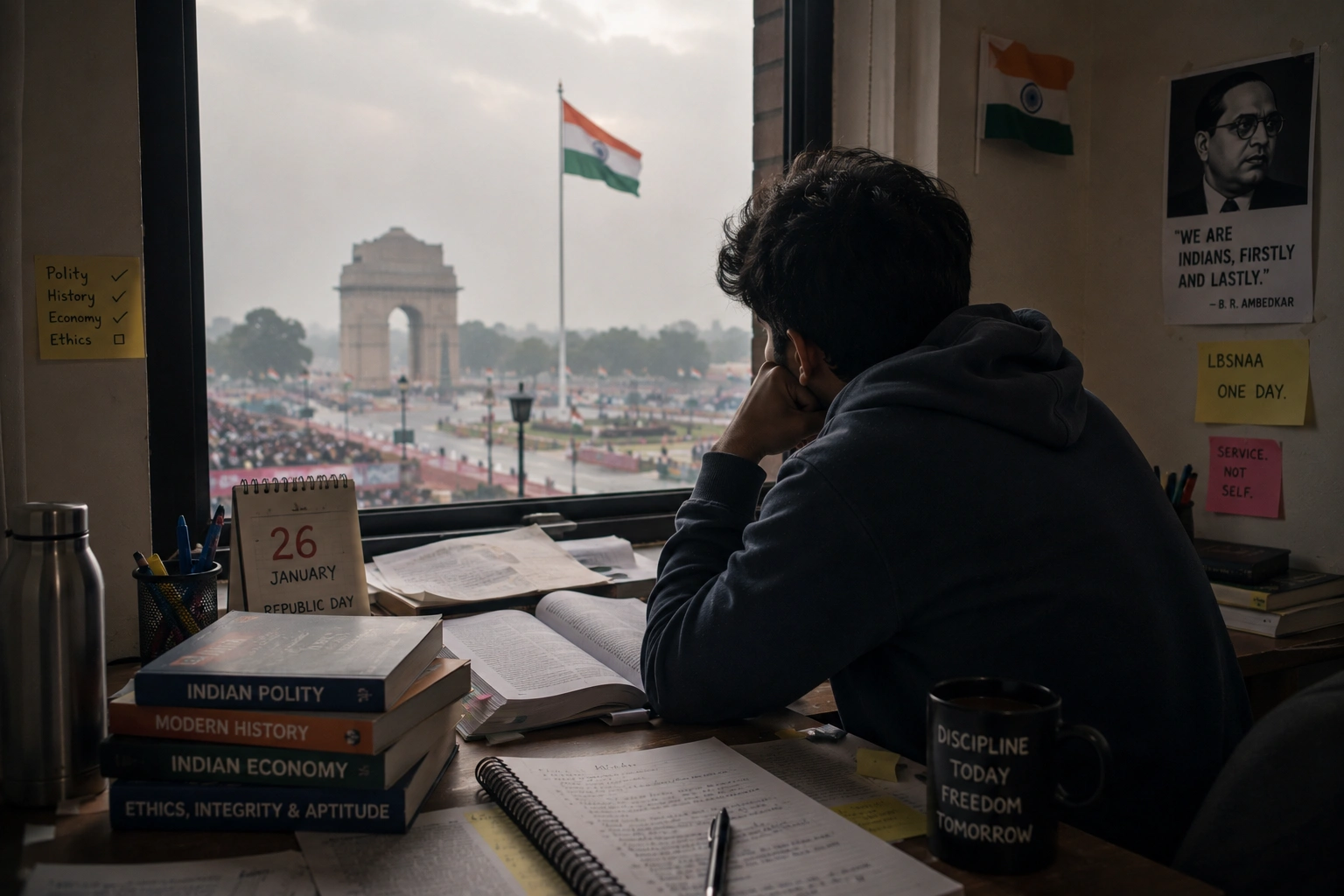
Republic Day morning, and the television's on before anyone's fully awake. Tanks rolling down Rajpath, the President's salute, tableaux from twenty-eight states you've probably memorized the capitals of at some point during your prep. Your family's genuinely enjoying it, the way families do every year, mildly festive, faintly patriotic, someone commenting on how sharp the Army contingent looks this time. And you're sitting there too, watching the same parade, except something in your chest has gone quiet and heavy in a way nobody else at the table seems to notice.
Why This One Day Hits Differently
Here's the honest version of why Republic Day feels different once you're deep into UPSC prep: it's the one day a year the entire country performs, on loop, the exact vision of public service you've spent years trying to become part of. The parade isn't just a parade to you anymore. It's a very literal, very televised reminder of the institution you're trying to enter, playing out in front of your entire family while you sit there as, for now, still an outsider to it.
For most people watching, Republic Day is background noise to a day off work, a reason for good breakfast and a lazy morning. For a UPSC aspirant, especially one deep into another attempt, it can feel closer to watching a wedding video of a relationship you're still trying to get into. Nothing about the day is actually about you, and yet everything about it seems to be asking, silently, where do you stand in all this.
That question gets sharper the more attempts you've already been through. A first-year aspirant might watch the parade with mostly excitement, this is what I'm working toward. Someone on a third or fourth attempt often watches with something closer to complicated ambivalence, the goal still means everything, but the road to it has gotten longer and harder than they expected, and the parade doesn't know or care how many attempts you've already made.
There's also a specific, uncomfortable irony in how the day is celebrated. Republic Day marks the day India's constitution came into force, the same constitution you've probably read cover to cover multiple times for GS papers, articles and schedules more familiar to you than to almost anyone else at your family gathering. You understand the day's actual significance more deeply than most people casually enjoying the parade, and that depth of understanding can make the gap between "I know this system intimately" and "I'm not yet part of it" feel sharper rather than smaller.
And the gap really is steep by design, not by accident. Civil services recruitment is built to be one of the most selective processes in the country, with UPSC's own 2024 final results confirming just over a thousand candidates were recommended out of the lakhs who originally applied that cycle (the PIB press release on UPSC's 2024 final results). Watching the parade while sitting inside that funnel, at whatever stage you're currently at, means you're watching a celebration of an institution that, structurally, only lets in a tiny fraction of the people who try. That's worth remembering the next time the gap between where you are and where you want to be feels like a personal failing rather than simply how the system was built.
The Family Dynamic That Makes It Harder
Family gatherings around national holidays have a specific rhythm to them, and if you're a UPSC aspirant, especially one on a second or third attempt, that rhythm often includes at least one relative asking, with varying degrees of tact, how prep is going, when the exam is, whether "this is the year." It's rarely meant cruelly. But timed against a parade celebrating the exact institution you're trying to join, that question lands with more weight than it would on an ordinary Tuesday.
Younger cousins asking what you actually do all day, in that innocently blunt way children ask things, can sting more than you'd expect too. Explaining a multi-year, uncertain exam process to a ten-year-old who just wants a simple answer forces you to compress years of complicated effort into a sentence that inevitably sounds smaller than it feels from the inside.
There's also the specific discomfort of family friends who show up for the holiday gathering and haven't seen you since last Republic Day, or the one before. Their questions come from an outdated snapshot of your prep timeline, "oh you're still doing that?", not out of unkindness, but because a year has passed for them in a normal, linear way, while your year has been measured entirely in exam cycles and results, a completely different unit of time that doesn't translate easily into small talk.
And if this Republic Day follows a friend from your prep circle clearing while you didn't, or you're currently in the anxious wait between mains and the result, the day carries even more weight, a whole nation performing the very dream you're either still chasing or currently unsure you'll reach. Watching that performance while genuinely uncertain about your own path is a specific, quiet kind of hard that's difficult to explain to anyone who hasn't lived inside a UPSC attempt.
What's Actually Happening When You Watch
It's worth naming plainly what's going on underneath the discomfort, you're watching a symbolic representation of belonging to something you don't yet belong to, and your brain treats that gap the way it treats most meaningful gaps between where you are and where you want to be, with a mix of longing, comparison, and low-grade grief. That combination is uncomfortable, but it's not a sign anything is wrong with you or your prep. It's just what it feels like to want something this specific and this large while it's still out of reach.
There's also something worth noticing about why this particular imagery hits harder than most other reminders of your goal. The parade is deliberately, cinematically emotional, drums, flags, coordinated formations, built to stir a sense of pride and belonging in every viewer. For most people that stirred feeling resolves into simple, uncomplicated patriotism. For you, sitting there mid-prep, it resolves into something more layered, patriotism tangled together with your own unresolved ambition, which is a genuinely harder feeling to sit with for three straight hours of television coverage.
This is close to what psychologists describe when they talk about anniversary reactions, moments tied to a recurring date or symbol that trigger a disproportionately strong emotional response because of what they represent, not because of what's actually happening in the moment. You're not actually upset about a parade. You're reacting to everything the parade has come to symbolize for you personally, which is a completely different thing wearing the same television broadcast as its costume. Recognizing that distinction, that the parade itself is neutral and your reaction is about something else entirely, can make the feeling easier to sit with without needing to suppress it or explain it away.
What Actually Helps on Days Like This
It helps to decide, ahead of time, how much of the parade you actually want to watch, rather than defaulting to the full broadcast because everyone else in the room is watching it. There's no rule that says you have to sit through three hours of a ceremony that stirs up this much complicated feeling. Stepping out for a walk during part of it, or watching only the parts you're genuinely interested in, is a completely reasonable way to protect your own headspace on a day that's harder for you than for most people around you.
It's also worth separating, consciously, your feelings about the country from your feelings about your own exam timeline. The two get tangled together on a day like this, but they're not actually the same thing, and letting the parade's imagery stand in for a referendum on your own progress isn't a fair trade. You can feel genuine pride in the day and genuine frustration about your prep timeline, both at once, without either one canceling the other out.
If a relative's question about your prep catches you off guard, a short, calm answer, "it's going, I'll know more soon," is a complete response. You don't owe anyone a detailed status report on a UPSC attempt just because the television happens to be playing a parade at the moment they ask. Having that line ready in advance, rather than improvising an answer under the mild pressure of a room full of relatives, takes a surprising amount of weight off the day before it even arrives.
It also genuinely helps to talk to someone else going through this specific version of the day, because the particular flavor of feeling this, watching a national celebration of the institution you're trying to enter, is hard to explain to someone who's never lived inside a UPSC prep cycle. Someone in your same position will simply get it without you having to build the whole context first.
It's also worth planning something small for yourself after the broadcast ends, not a reward exactly, just something that belongs to you and has nothing to do with the exam. A walk, a call with a friend outside the UPSC world entirely, a film you've been meaning to watch. The parade takes up a few hours of the day. It doesn't have to take up the whole day's emotional weather if you can help it.
Where Artha Fits, If It Does
A lot of what makes days like Republic Day quietly hard is that the discomfort feels almost inappropriate to admit out loud, everyone around you is celebrating, and saying "actually this parade makes me feel kind of hollow" can land as strange or even unpatriotic, even though that's not remotely what it is. That's part of why UPSC Talk exists inside Artha, a place to say the complicated version of a day like this to someone who's sat through the exact same parade with the exact same knot in their chest, anonymously, without having to justify the feeling first.
Feeling this way on Republic Day doesn't mean you love the country less, or that your prep isn't going well. It just means you're standing close enough to something you want badly that its public celebration reaches you differently than it reaches everyone else in the room. Next year's parade will find you further along than you are today, one way or another, and it's worth trusting that even when today doesn't feel like proof of it.
What's the moment during the parade that gets to you the most, if there is one?
Quick answers
Things people usually want to know.
Why does Republic Day feel so heavy when you're a UPSC aspirant?
Because the parade is basically a live broadcast of the institution you're trying to join, playing out in front of your whole family while you're still on the outside of it. It's not really about the parade itself, it's about what the parade represents to you specifically.
Is it normal to feel sad watching the Republic Day parade during UPSC prep?
Yes, genuinely common, especially for aspirants a couple attempts in. It's less about patriotism and more a mix of longing and comparison that gets triggered by watching a symbol of something you want but haven't reached yet.
How many people actually clear UPSC each year?
Going by UPSC's own 2024 final results, just over a thousand candidates were recommended out of the lakhs who applied that cycle. It's one of the most selective processes in the country, so the gap you're feeling isn't a personal failing, it's how the system is built.
What do I say when relatives ask about my UPSC prep at family gatherings?
A short, calm line works fine, something like "it's going, I'll know more soon." You don't owe anyone a full status report just because the TV happens to be playing a parade when they ask.
Why do relatives' questions feel worse on Republic Day specifically?
Timing. The same question that'd be neutral on an ordinary Tuesday lands differently right after watching a parade that celebrates the exact institution you're trying to enter. The context makes the question feel heavier than it actually is.
Should I watch the whole Republic Day parade if it makes me feel low?
Not if you don't want to. There's no rule saying you have to sit through all three hours because everyone else in the room is. Watching part of it, or stepping out for a walk during it, is a completely reasonable way to protect your headspace.
Does feeling hollow during Republic Day mean I don't love my country?
No, not at all. It usually means you're standing close enough to something you want badly that its public celebration hits you differently than it hits everyone else. You can feel genuine pride and genuine frustration about your prep at the same time.
How is this feeling different for first-attempt vs repeat UPSC aspirants?
A first-year aspirant often watches with mostly excitement, this is what they're working toward. Someone on a third or fourth attempt tends to feel more complicated ambivalence, since the road's gotten longer than they expected and the parade doesn't know or care how many attempts they've made.
What's an anniversary reaction and how does it relate to this?
It's a term psychologists use for a disproportionately strong emotional response to a date or symbol, tied to what it represents rather than what's actually happening in the moment. You're not really upset about the parade, you're reacting to everything it's come to symbolize for you.
How do I get through Republic Day without spiraling about my UPSC timeline?
Plan something small for yourself after the broadcast that has nothing to do with the exam, a walk, a call with a friend outside the UPSC world, anything that's just yours. It helps to talk to someone else going through the same thing too, since they'll get it without needing the backstory explained.