Career Gap and Wedding Small Talk: Questions That Cut
October 13, 2026 · 9 min read · by Shivam Kushwaha, Artha founder
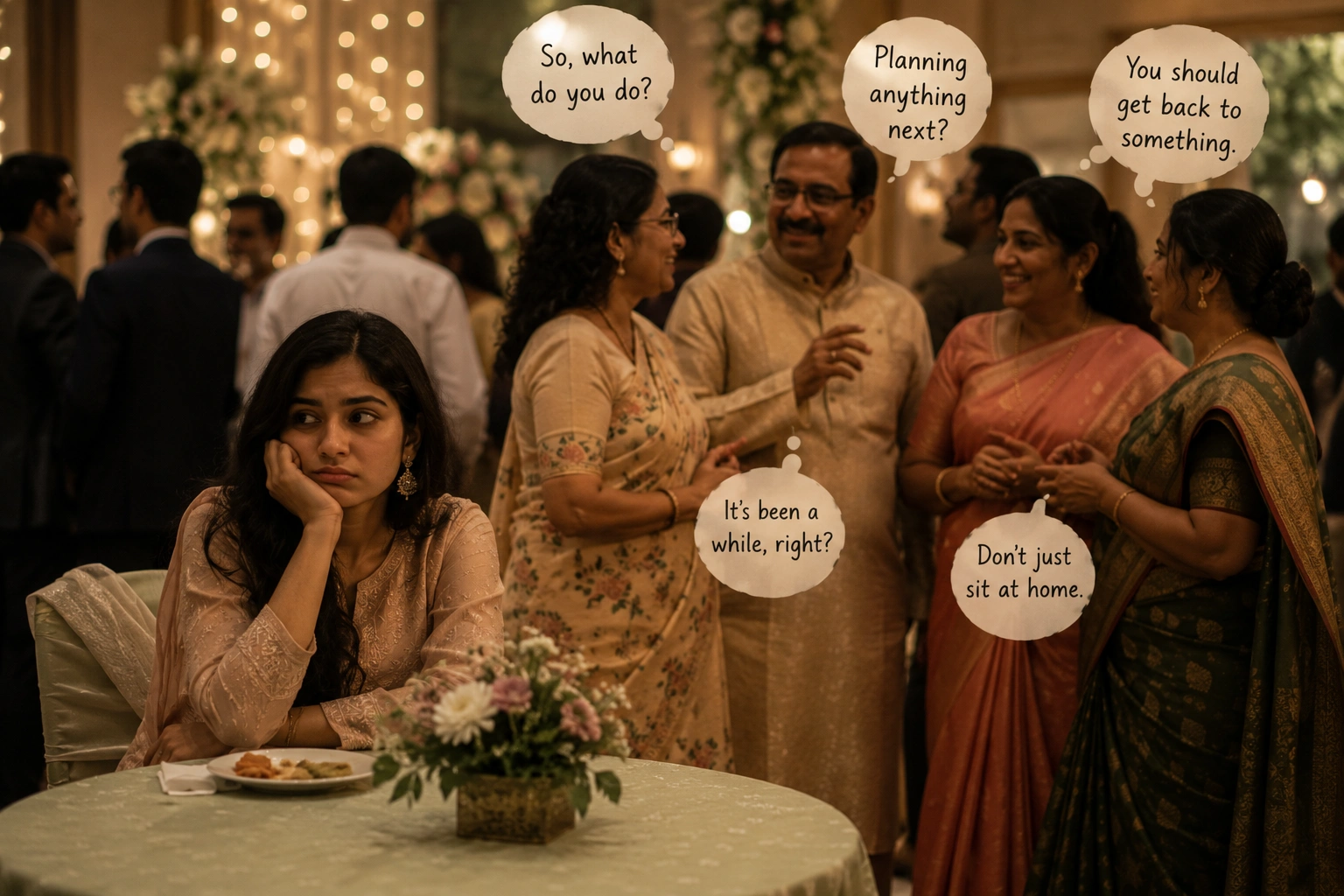
The aunty settles into the seat next to you at the reception, sweets already balanced on her plate, and asks the question you knew was coming the moment you accepted the invite. "So beta, what are you doing these days?" You've rehearsed an answer in the auto on the way here, something vague enough to not invite follow-ups, specific enough to not sound like you're hiding something. It comes out anyway a little too fast, a little too rehearsed, and you watch her face do the thing it always does, a small pause before the next question arrives.
Why Weddings Are the Hardest Place to Have a Career Gap
Here's the honest truth about navigating a career gap at a wedding: it's not really the question itself that's hard, "what are you doing these days" is a completely normal thing to ask. What's hard is the compressed, repetitive nature of a wedding specifically, the same question, asked by a dozen different relatives across a single event, each one requiring a fresh version of an answer you're already tired of giving by the third round, with no real way to escape once you're seated at that table.
This gets sharper because weddings function as a kind of informal, unspoken status check within extended families, everyone quietly comparing notes on who's doing what, who got married, whose kid is earning well, all through the same casual small talk that's technically just people catching up. A career gap, in that environment, becomes the one detail that doesn't fit neatly into the usual script, and not fitting the script tends to draw more attention than actually being asked about directly ever would.
There's real research behind why a gap feels this heavy to carry into a room full of people, even beyond the family context. A Harvard Business Review analysis of hiring research found that resume gaps genuinely hurt job seekers, both in their ability to land jobs and in the pay they're eventually offered, confirming that gaps carry a real, measurable penalty in professional evaluation, not just an imagined one (HBR's research on how resume gaps still affect hiring outcomes). Knowing that the anxiety around a gap has a real basis, rather than being purely self-generated, doesn't make the wedding small talk easier exactly, but it does explain why the dread feels so disproportionate to what is, technically, just a casual conversation at a family function.
If you're also dealing with relatives who treat every family gathering as an opportunity to ask about your marriage timeline, a career gap adds a second front to that same interrogation, now there are two categories of personal questions to field simultaneously, often from the same relative, in the same five-minute conversation.
The Specific Shame of Repeating the Same Vague Answer
A lot of the exhaustion here comes from how many times the same conversation has to happen in a single event. You give the vague version to the first aunty, a slightly different vague version to the next uncle, and by the fifth or sixth repetition, you're not even sure which version you've told to whom, which adds a strange layer of self-monitoring on top of an already uncomfortable topic, tracking your own cover story across an entire evening like it's something to actually manage rather than just an honest, ordinary answer to a normal question.
This compounds if the gap followed something genuinely difficult, a layoff, a health issue, a caregiving responsibility that pulled you out of work for reasons that had nothing to do with ambition or effort. Explaining a gap that resulted from real, hard circumstances in the same breezy tone the conversation demands, sandwiched between someone's comment about the food and someone else's question about when you're getting married, can feel like it flattens something genuinely significant into small talk it was never meant to be reduced to.
There's also a specific comparison trap that shows up at weddings more than almost any other setting, because weddings gather cousins and family friends of roughly the same age all in one place, making it easy to mentally rank everyone's trajectory against your own in real time. Watching a cousin's parents beam while describing their kid's new promotion, right after you've just given your third vague answer of the evening, has a way of making the gap feel bigger and more defining than it probably deserves to feel.
If you're currently living back at home during this gap, the wedding adds a second, quieter discomfort on top of the small talk itself, the awareness that some of these same relatives may already know your living situation before you've even said a word, which means the vague answer you're giving isn't really hiding anything, it's just buying you a slightly gentler version of a conversation everyone in the room can already partly guess the shape of.
This gets harder still at weddings that draw a wider circle than usual, distant relatives, family friends you only see once every year or two, people whose only real update on your life comes from whatever the last person told them at the last function. That secondhand information tends to travel faster and less accurately than anything you'd actually choose to share yourself, and correcting a version of your story that's already circulated through three other conversations before it reaches you directly is its own particular kind of exhausting.
What's Actually Happening Underneath the Small Talk
It's worth naming that most relatives asking this question aren't trying to corner you, even when it feels that way in the moment. For a lot of them, "what are you doing these days" is simply the standard opener, the same question they'd ask anyone your age at any gathering, without any real awareness of how loaded it might land for someone currently in a gap. That doesn't make the discomfort less real, but it does mean the intent behind most of these questions is closer to routine curiosity than judgment, even when the effect feels identical in the moment.
There's a small but useful distinction worth holding onto here too, between the relatives who ask once and genuinely move on, and the handful who circle back to the topic repeatedly across the evening, sometimes with a slightly pointed edge to how they phrase it the second or third time. The first group is just making conversation. The second group is a much smaller number of people than it feels like in the moment, usually one or two specific relatives whose questions have always carried this same edge, at every gathering, about every topic, not something specific to your current gap at all.
There's also a specific anxiety that builds before the event even starts, sometimes worse than anything that actually happens once you're there. Anticipating the question, rehearsing answers, imagining worst-case follow-up questions, often takes up more emotional energy than the actual conversations end up requiring, since most exchanges move on to the next topic within a minute or two, however heavy that minute felt while you were in it.
What Actually Helps
The most useful preparation is deciding on one honest, brief answer in advance, rather than improvising a fresh version each time you're asked. It doesn't need to include every detail, just something true and short enough that it doesn't invite an uncomfortable follow-up, "I'm figuring out my next move right now" or "I took some time for family reasons and I'm getting back into it" both work better than a vague deflection, mostly because a genuine, settled answer tends to close a conversation faster than an evasive one that signals there's more being hidden underneath it.
It also helps to have a planned way to redirect the conversation once you've given your answer, a question back to them about their own work, their kids, anything that moves the spotlight elsewhere. Most people are happy to talk about themselves once given the opening, and a well-placed question back tends to end the interrogation faster than trying to out-vague your way past it.
It's worth giving yourself permission to keep some interactions genuinely short, a warm greeting, a brief answer, a natural exit toward the buffet or another relative, rather than treating every single conversation as an obligation to fully explain your situation. Not every aunty needs the full picture, and a short, friendly exchange is a completely acceptable way to handle a question you don't feel like unpacking at length in the middle of a wedding hall.
It also helps enormously to have one person at the event, a cousin, a sibling, a friend who came along, who already knows the real situation and can run interference when a conversation starts heading somewhere you don't want to go. Having even one ally in the room changes the whole texture of the evening, from something you're navigating completely alone to something you're getting through together.
It's worth pacing yourself through the event too, rather than treating it as one continuous block of exposure to get through from start to finish. Stepping outside for air between conversations, taking a longer break at the food table than strictly necessary, finding the one cousin you can actually relax around for a stretch, all of these small resets add up over a multi-hour function, and there's no rule that says you have to be fully "on" for every single minute you're there.
Where Artha Fits, If It Does
A lot of what makes this specific kind of small talk so draining is that there's rarely a place to actually process the exhaustion afterward, you get home from the wedding, and the tiredness of having explained yourself a dozen times has nowhere left to go. That's part of why Just Talk Shop exists inside Artha, a place to say "I just spent three hours giving the same vague answer to every relative and I'm exhausted" to someone anonymous who understands exactly what that specific kind of tired actually feels like, without needing the whole backstory of the gap explained first.
A career gap is one chapter, not the whole story, whatever a wedding hall full of casual questions might make it feel like for a few uncomfortable hours. The people asking will mostly forget the conversation by the next course. You don't have to carry it nearly as long as it feels like you will while you're sitting at that table.
What's the honest, short version of your answer that you'd actually feel okay giving, if you let yourself stop editing it down to something smaller and vaguer than the truth actually is?
Quick answers
Things people usually want to know.
Why does the "what are you doing these days" question feel so exhausting at weddings?
It's not the question itself, it's the compressed, repetitive nature of a wedding, the same question from a dozen relatives across one event, each requiring a fresh version of an answer you're already tired of giving by the third round.
Does having an employment gap actually hurt my career prospects?
Research on hiring has found resume gaps genuinely hurt job seekers, both in their ability to land jobs and the pay they're eventually offered, so the anxiety around a gap has a real basis, not just an imagined one.
What should I say when relatives ask about my career gap at a wedding?
Decide on one honest, brief answer in advance rather than improvising each time, something like "I'm figuring out my next move" or "I took time for family reasons and I'm getting back into it." A settled answer tends to close the conversation faster than a vague one.
Why do I feel like I'm managing a cover story at family events during a career gap?
Giving the same vague answer to multiple relatives in one evening means tracking which version you told to whom, which adds a layer of self-monitoring on top of an already uncomfortable topic.
Are most relatives asking about my career gap trying to judge me?
Usually not. For most of them, "what are you doing these days" is just the standard opener they'd ask anyone your age, without much awareness of how loaded it might land for someone currently in a gap.
How do I redirect conversations away from my career gap at a wedding?
Have a question ready to ask back about their own work or family. Most people are happy to talk about themselves once given the opening, and it tends to end the interrogation faster than trying to out-vague your way past it.
Is it okay to keep some conversations at weddings short during a career gap?
Yes. Not every relative needs the full picture, and a warm, brief exchange followed by a natural exit toward the buffet is a completely acceptable way to handle a question you don't want to unpack at length.
Why does a career gap after a layoff feel harder to explain than other gaps?
Explaining a gap that resulted from real, hard circumstances, a layoff, a health issue, in the same breezy tone a wedding demands can feel like it flattens something significant into small talk it was never meant to be.
Should I bring someone with me to a wedding during a career gap?
It helps enormously. One ally, a cousin or sibling who knows the real situation, can run interference or redirect a conversation when it starts heading somewhere you don't want it to go.
Is the anxiety before a wedding worse than the actual conversations during a career gap?
Often, yes. The days of rehearsing answers and imagining worst-case follow-ups tend to take up more emotional energy than the actual exchanges require, since most conversations move on within a minute or two.