New Year Trading Resolutions Meet Market Reality
October 23, 2026 · 9 min read · by Shivam Kushwaha, Artha founder
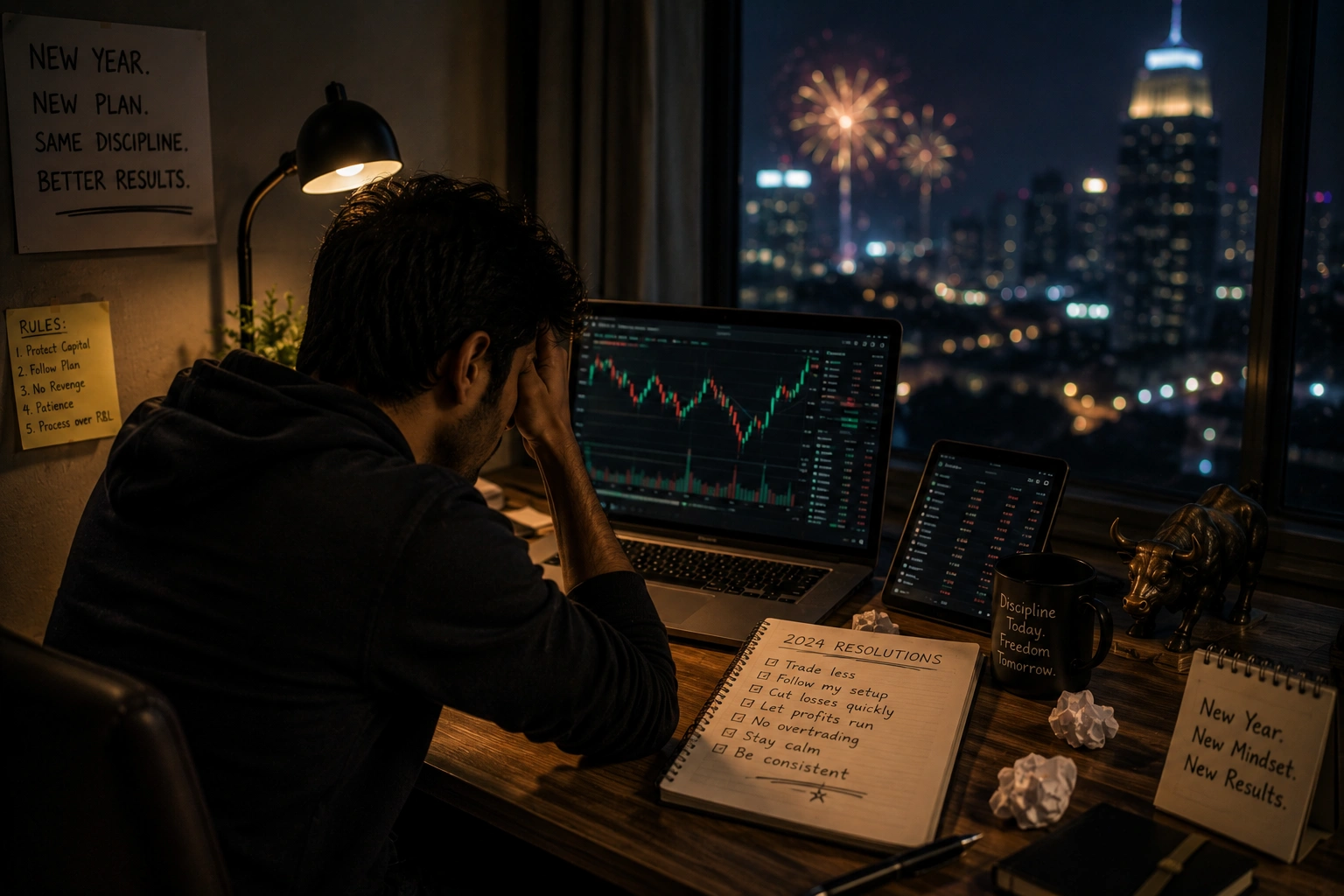
January 1st, 11:47pm. You're scrolling through last year's trading journal, red numbers stacked on red numbers, and you type out a note to yourself. This year is different. Three trades a week, max. Always a stop loss. No revenge trades after a red day. You screenshot it, maybe even set it as your phone wallpaper.
Fourteen days later you're watching a candle wick straight past your stop, except you'd moved that stop twenty minutes earlier because "it'll come back." It didn't come back. And somewhere in your head, quietly, you already know the resolution is dead. You just haven't said it out loud yet.
Why the January Resolution Never Survives February
Here's the honest version: new year trading resolutions fail because they're built on motivation instead of mechanics. A resolution like "I'll be disciplined this year" isn't a rule the market can enforce, it's a mood, and moods don't survive contact with a red candle. The traders whose habits actually change are the ones who replace the feeling with a number they can't argue with, a fixed stop-loss percentage, a hard cap on trades per week, something that doesn't ask how you feel before it kicks in.
This isn't just a trading problem either. Research on resolutions in general backs it up. Psychologist John Norcross's long-running work at the University of Scranton found that most resolutions fail within weeks, not because people lack willpower, but because the resolution itself was never specific enough to act on (Scranton news coverage of the research). Trading just makes the failure louder and faster, because the market hands you a scoreboard every single day.
January itself sets you up for this. The new year carries a kind of manufactured optimism, a sense that the calendar flipping somehow resets your relationship with risk. It doesn't. Your account balance on January 1st has the exact same relationship with volatility it had on December 31st. The only thing that changed is your mood.
What's Actually Happening in Your Head
Trading resolutions collapse for a specific psychological reason, and it's worth naming it plainly: optimism bias plus zero enforcement equals a promise with no teeth. You made the resolution while calm, rested, probably a little proud of yourself for reflecting on last year's mistakes. But you didn't make it while staring at a position that's down four percent and dropping. Those are two completely different mental states, and the second one is the one that actually places trades.
There's also a quieter thing going on. A lot of traders don't actually want a system. They want the feeling of having tried to be disciplined, without the boring, restrictive reality of actually being disciplined. A journal you never fill in. A stop-loss rule you "adjust" when it's inconvenient. These aren't failures of character, honestly, they're just what happens when a rule has an escape hatch built into it.
And when a loss does hit, especially early in January when you're still riding that fresh-start high, it doesn't feel like a normal loss. It feels like a personal failure, like proof the whole plan was naive. That's exactly the moment revenge trading shows up, not because you forgot your rules, but because the emotional hit made the rules feel irrelevant for the next fifteen minutes. Fifteen minutes is all it takes to blow a week's worth of discipline.
There's a near-miss effect at play too, the same one that keeps people pulling a slot machine lever even on a losing streak. A trade that almost hit target before reversing feels psychologically closer to a win than a clean loss does, even though your account doesn't know the difference. That near-miss feeling is what convinces you the next trade will finally be the one, and it's a huge part of why "I'll stop after this one" so rarely means what it sounds like it means. Recognizing that pull for what it is, a known cognitive bias and not a genuine read on the market, is often the first real step toward a resolution that sticks.
The Difference Between a Resolution and a System
Most trading advice tells you to "be more disciplined," which is a bit like telling someone to "just be less anxious." Sure. Thanks. Here's what actually separates the traders who change from the ones who don't, and it's less inspiring than it sounds: they stop trusting themselves in the moment and start trusting rules they set up in advance.
A resolution says: I'll trade less this year. A system says: I get three entries a week, tracked in this sheet, and if I hit three, the platform stays closed until Monday. A resolution says: I'll be careful with risk. A system says: two percent per trade, no exceptions, position size calculated before I even look at the chart. The specificity is the whole point. Vague intentions leave room for the exact rationalizations that got you into trouble last year, "just this once," "this setup is different," "I'll make it back on the next one."
Some traders try to build this alone, through spreadsheets and willpower, and for a few weeks it works. But willpower is a depleting resource, especially under financial stress, and most people underestimate how much a losing streak erodes it. That's where external structure starts to matter more than internal resolve, an accountability partner who actually asks to see your trade log, a mentor who calls out the pattern before it becomes a spiral, or honestly, just someone to talk to before you click the "confirm" button on a trade you already suspect is a mistake made out of frustration, not analysis. Writing in a journal helps too, but a journal doesn't push back. A person does.
It's also worth being honest about the data here, because a lot of resolution advice pretends discipline alone solves everything, when the deeper problem for most retail traders in India is structural. SEBI's own research found that 93% of individual traders in equity Futures & Options lost money between FY22 and FY24, with aggregate losses crossing ₹1.8 lakh crore over three years (SEBI press release, September 2024). That's not a discipline problem you can journal your way out of entirely. It's the actual math of why most retail traders lose money in the first place, and no January resolution changes those odds. Which is a hard thing to sit with in the middle of setting fresh goals for the year, but it's also why the traders who last tend to treat trading less like a get-rich plan and more like a skill they're slowly, imperfectly getting less bad at.
None of this means you shouldn't set a resolution. It means the resolution should be the boring kind, the kind that sounds almost too small to matter. Not "I'll be a better trader this year." More like "I review my last ten trades every Sunday, and I don't add a new position type to my strategy without paper-trading it first." Boring rules survive Februaries. Inspiring ones rarely do.
If you actually sit down and write yours out, a realistic version usually has three parts to it, a maximum risk per trade you won't move for any reason, a cooling-off period after a loss that's long enough to actually calm down in, and a weekly review where you look at what you did, not what the market did to you. That third part gets skipped constantly, mostly because it's uncomfortable to sit with your own trade log after a bad week. But it's also the only part of the process that turns this year's mistakes into next year's better rules, instead of just next year's identical resolution.
The Three Patterns That Break Every Resolution
Almost every broken trading resolution I've heard about falls into one of three shapes, and naming them helps, because a named pattern is easier to catch than a vague feeling of "I messed up again."
The first is FOMO entries. Bank Nifty is ripping on an expiry Thursday, some Telegram channel you half-trust is posting screenshots of a "sure shot" call, and your carefully planned three-trades-a-week rule quietly becomes four, then five, because "this one's different." It rarely is. The fix isn't willpower in the moment, it's deciding in advance, while calm, which setups even qualify as a trade at all, so there's nothing left to negotiate with when the excitement hits.
The second is revenge trading, and this is the one that does the most damage in a single sitting. A loss stings, and instead of closing the terminal, you go looking for the trade that "gets it back." The position size creeps up without you really deciding it should, because some part of you is trying to solve an emotional problem with a financial tool. This is exactly where a hard rule like "no new positions for the rest of the day after a stop-loss hit" earns its keep. It's not a suggestion. It's the one rule that has to survive contact with anger.
The third is the quiet one, position sizing creep. You start the year risking one percent per trade like you promised yourself. Three winning trades in, you're risking two percent, telling yourself you've "earned" the extra confidence. Five trades after that, you're at four percent on a single Nifty options position and you didn't consciously choose any of those jumps, they just happened, one small justified step at a time. Sizing creep rarely announces itself. It shows up looking exactly like confidence, right up until the one trade that erases three weeks of gains in an afternoon.
None of these three patterns are really about the market. They're about what's happening in your body in the sixty seconds before you click buy or sell, and that's precisely why a resolution written in a calm mood in January can't reach you there. A rule that lives outside your head, written down, ideally checked by someone else, can.
Where Artha Fits, If It Does
A lot of what actually breaks a trading resolution isn't the market, it's the isolation around the losses, the same isolation that shows up every year around muhurat trading and the Diwali FOMO. You take a bad trade, you don't tell anyone, the shame sits there, and three days later you're revenge trading to try to erase the feeling before anyone finds out. That silence is where I built Artha to sit, a place where you can be anonymous and just say "I broke my own rule again" to someone in Traders' Talk who actually gets what that means, without it turning into a lecture or a stock tip.
The Resolution That Actually Lasts
The version of this that survives past January isn't louder willpower. It's smaller, more specific rules, backed by something outside your own head that holds you to them when the market gets emotional and you, understandably, stop trusting your own judgment for a minute.
Discipline, it turns out, was never a resolution to begin with. It was always just a habit, built slowly, mostly in the boring weeks nobody writes a New Year's post about.
What's the one rule from last year that you already know you're going to break first this time?
Quick answers
Things people usually want to know.
Why do new year trading resolutions fail?
Resolutions are driven by optimism, not strategy. The market doesn't care about your January intentions. When reality hits, losses, volatility, emotional triggers, the resolution crumbles because it wasn't built on sustainable habits.
What trading resolutions actually work?
Specific, measurable, and system-based. Instead of 'trade less,' set 'maximum 3 trades per week.' Instead of 'be disciplined,' set 'stop loss at 2% per trade.' The specificity creates actionable behavior instead of a vague mood.
How do I stick to trading resolutions?
Build systems that enforce the resolution instead of relying on willpower. Automated stop losses, a hard weekly trade cap, a cooling-off period after a loss, and someone who actually checks your trade log all do work that motivation alone can't.
Should I start the new year with a trading plan?
Yes, but keep it realistic. Review last year's actual trades, not just the outcome. Identify the pattern that hurt you most, and write one boring, specific rule around it instead of a long wishlist.
What if I break my resolution?
Don't let one broken rule become a spiral. Reset the same day, not the following Monday. A resolution isn't all-or-nothing, it's a direction you keep returning to, and the return matters more than the perfect streak.
How much of my capital should I risk per trade as a beginner?
Most experienced traders cap risk at 1-2% of capital per trade, not per position size. That way a string of losses, which will happen, dents the account instead of wiping it out in a single bad week.
Is revenge trading a real psychological pattern or just bad luck?
It's a real, well-documented pattern, not bad luck. A loss triggers an emotional urge to 'get it back' immediately, and that urge overrides whatever plan you had. Naming it as a pattern, not a personal failure, is usually the first step to catching it.
Should I take a break from trading after a big loss?
Often, yes. A short cooling-off period, even just the rest of the day, gives the emotional spike time to fade before you make a decision you'll regret. Trading through anger rarely produces your best analysis.
How do I know if I'm sizing creep without realizing it?
Check your position size against your original rule after every trade, not just after a loss. If your risk percentage has quietly climbed after a few wins and you can't point to a reason you consciously decided on, that's sizing creep.
Does journaling my trades actually help?
It helps, but only if you actually read it back. A journal that just lists entries and exits without a weekly review is a diary, not a system. The value is in noticing the repeated pattern, not in the writing itself.