Expiry Day Trading Psychology: India's Roulette Wheel
September 11, 2026 · 6 min read · by Shivam Kushwaha, Artha founder
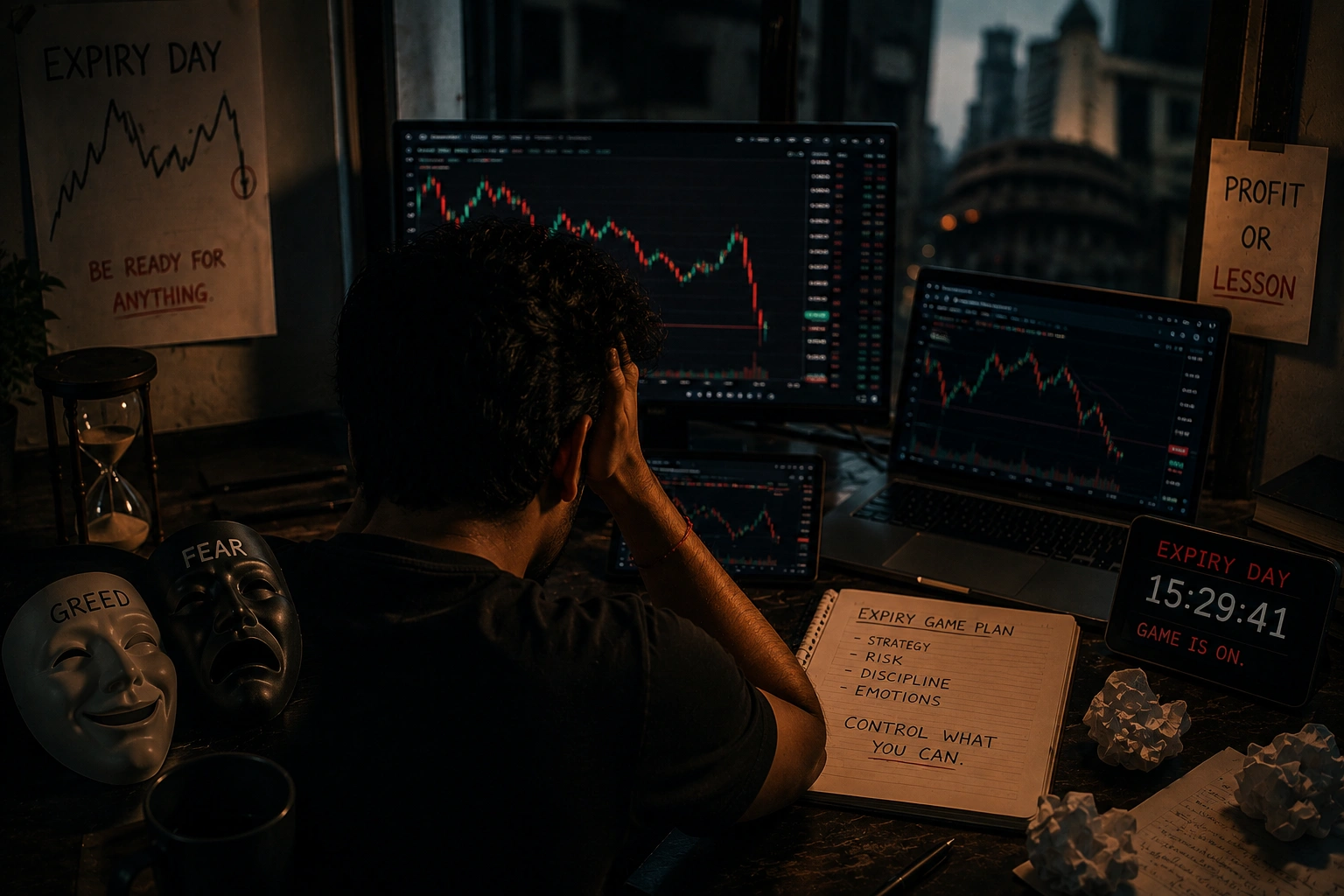
The Clock Is Ticking
It's 11 AM. Nifty expires at 3:30 PM. You've got four and a half hours to make or lose a month's salary. The options are moving 200%, 300%, 500% in minutes. Every tick is a heartbeat. Every green candle is a "what if." Every red candle is a "just this once."
Expiry day is the most psychologically intense day in Indian markets. And for retail traders, it's the most dangerous.
Why Expiry Day Is Different
Normal trading is slow. Decisions play out over hours, days, weeks. Expiry day compresses everything into minutes. The speed creates a psychological state that's fundamentally different from regular trading:
Urgency The clock forces decisions. You can't wait and see. You can't "sleep on it." The deadline compresses your decision-making window, which makes impulsive choices more likely.
Volatility Options prices swing wildly on expiry day. A 50% gain can become a 50% loss in minutes. The volatility creates an emotional rollercoaster that bypasses rational thought.
Lottery psychology The possibility of turning 10,000 into 1,00,000 in a single trade triggers the same brain response as a lottery ticket. The odds don't matter. The dream does.
Near-miss effect When your option goes from 100 to 490 and then crashes back to 50 before expiry, your brain registers it as almost winning. Near-misses are psychologically more powerful than complete losses because they reinforce the belief that you almost had it.
The Anatomy of an Expiry Day
Here's what typically happens to a retail trader on expiry:
Morning confidence You start with a plan. Maybe you'll just watch. Maybe one small trade. The market opens. The energy is electric. You're ready.
The first trade You enter a position. It goes your way immediately. The rush is intoxicating. You feel like you've cracked the code. This is easy. Why don't you do this every day?
Escalation The first win gives you confidence. You take bigger positions. You add to winners. You ignore stop losses. The green P&L is proof that you're right.
The reversal Markets don't go up forever. The position turns. Your profit evaporates. Now you're losing. The urge to "get back to even" is overwhelming.
Revenge trading You enter new positions to recover. Bigger. Faster. More desperate. The logic is gone. Only the need to not end the day losing remains.
The close The bell rings. You either lost money or gave back most of your profit. Either way, you feel empty. The adrenaline crashes. The reality sets in.
The Neuroscience of Expiry
Your brain on expiry day is hijacked:
Dopamine surge The potential for rapid, large gains triggers massive dopamine release. Dopamine doesn't motivate pleasure — it motivates pursuit. It makes you want the next trade regardless of the outcome.
Cortisol spike When positions go against you, stress hormones flood your system. Cortisol impairs decision-making, which leads to worse decisions, which increases cortisol. The cycle is vicious.
Prefrontal shutdown The prefrontal cortex — the part of your brain responsible for rational decision-making — is suppressed under stress and excitement. You're literally trading with a compromised brain.
What Smart Traders Do
Experienced traders have learned to protect themselves from expiry day:
Stay away entirely The simplest strategy. Don't trade on expiry day. The risk/reward is unfavorable for retail traders, and the psychological cost is too high.
Set hard limits If you must trade, set strict limits on position size and stop losses. Then actually follow them. This requires discipline that most people don't have under expiry day pressure.
Trade spreads, not naked options Hedged strategies reduce the wild swings that trigger emotional responses. The potential profit is smaller, but so is the potential for catastrophic loss.
Accept the outcome Whatever happens on expiry day, accept it without revenge trading. The market will be there tomorrow. Your account balance doesn't have to be finalized at 3:30 PM.
The Pattern You Can't See
The most dangerous thing about expiry day is the pattern you can't see because your memory edits it.
You remember the big win from three months ago. You don't remember the twelve losses since. You remember the time you caught a 500% move. You don't remember the months of net losses that followed.
This selective memory keeps you coming back. The data, if you tracked it honestly, would tell a different story than the one your brain tells you.
Expiry day carries a weight that's hard to explain to non-traders. Artha is a space where you can talk about the obsession, the losses, and the decision to keep going or step back.
Quick answers
Things people usually want to know.
Why is expiry day so addictive?
Expiry day combines multiple psychological triggers — extreme volatility, potential for massive gains in minutes, and the deadline pressure that makes every decision feel urgent. The brain's reward system is overwhelmed by the speed and magnitude of possible outcomes.
How much do retail traders lose on expiry day?
Studies suggest the vast majority of expiry day options expire worthless. Retail traders, who often buy out-of-the-money options hoping for a big move, bear the brunt of these losses. The asymmetry between potential gain and actual outcome is extreme.
Can you make consistent money on expiry day?
Consistent profitability on expiry day is extremely rare. The volatility is unpredictable, the spreads widen, and the timing required is nearly impossible to replicate consistently. Most successful traders avoid expiry day entirely or use sophisticated hedging strategies.
Why do I keep trading expiry day if I always lose?
The near-misses and occasional wins create a powerful reinforcement cycle. Your brain remembers the big wins vividly and minimizes the small losses. The intermittent reinforcement pattern is the same one that makes slot machines addictive.
How do I break the expiry day cycle?
Start by tracking every expiry day trade honestly — entry, exit, profit, loss. The data usually reveals a pattern of net losses that your memory conveniently hides. Set a hard rule: no trading on expiry day. Remove the apps from your phone. Create barriers to impulsive action.