Muhurat Trading FOMO: When Tradition Meets Market Obsession
September 28, 2026 · 9 min read · by Shivam Kushwaha, Artha founder
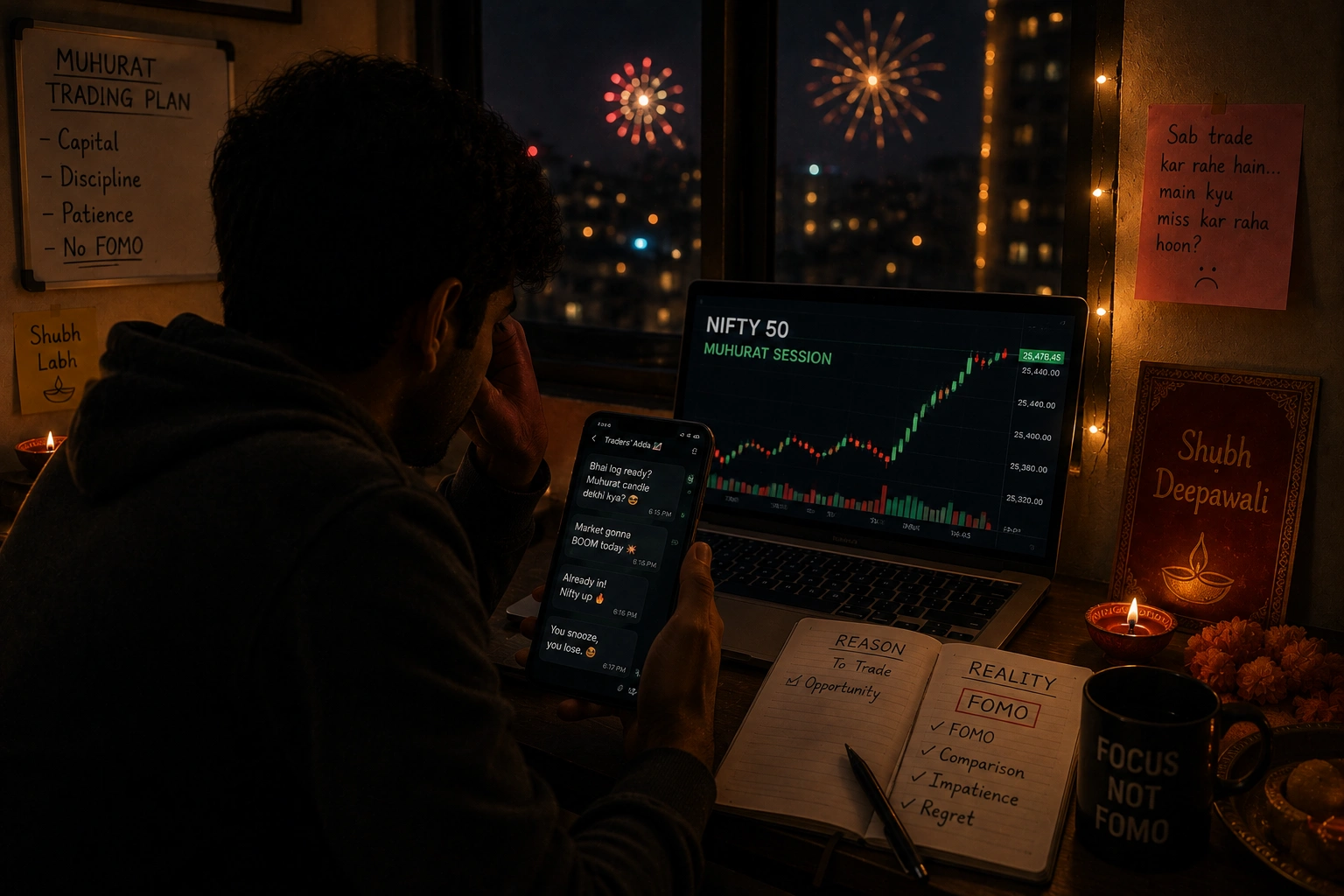
Muhurat trading opens for exactly one hour, sometimes less, on Diwali evening, and somehow that single auspicious hour has turned into the loudest trading event of the entire year. Your family's still in the living room, diyas lit, sweets going around, someone's phone playing devotional music low in the background. And you're sitting slightly apart from all of it, phone angled away from view, watching a countdown timer for a market session that isn't even about making money, not really, it's about not being the one person who didn't participate in whatever everyone else is calling "the year's luckiest trade."
Why This One Hour Feels So High Stakes
Here's the honest truth about muhurat trading: the ritual itself is genuinely old and genuinely meaningful, a symbolic first trade of the new financial year according to the Hindu calendar, meant to invite prosperity, done in a spirit closer to a puja than a serious trading strategy. Somewhere along the way, especially online, that symbolic ritual got quietly rebranded into something closer to a trading event, with predictions, "hot picks," and a very real sense that missing it means missing out on some kind of cosmic head start for the year ahead.
That rebranding matters because it changes the psychology completely. A ritual is something you participate in for meaning. A trading event is something you participate in to win, and once muhurat trading starts feeling like the second thing instead of the first, the pressure to actually profit from that single hour, rather than simply honor the tradition, creates exactly the kind of high-stakes urgency that leads to decisions you wouldn't normally make with real money. Somewhere along the way, a gesture of gratitude toward the year ahead quietly turned into one more performance metric to hit.
Family expectations add another layer that's specific to this particular trading occasion. In a lot of households, muhurat trading is a small, symbolic family activity, a parent buying a token quantity of a familiar stock, more ritual than strategy. If you're the family member who actually trades seriously, there's an unspoken pressure to make the moment count in a bigger way, to justify your usual trading with a visibly good showing on the one day everyone's actually paying attention to what you do.
That pressure gets sharper if trading itself has ever been a slightly tense subject within your family, if relatives have quietly worried about how much time or money you put into it. Muhurat trading, ironically, becomes the one day a year your trading is fully visible and openly discussed, which turns a low-stakes symbolic session into a performance review you never asked for, happening in real time, in front of the people whose approval matters most to you.
The FOMO Underneath the Ritual
A huge amount of the pressure around muhurat trading comes from social visibility rather than the market itself. Trading Telegram channels and finance influencers ramp up muhurat-specific content for weeks beforehand, stock picks, "auspicious" sectors, screenshots of last year's supposed gains, all of it creating a sense that everyone else already has a plan and you're the only one showing up without one. That manufactured urgency has very little to do with the actual, quiet ritual origins of the practice.
If checking prices compulsively is already a pattern you struggle with during ordinary weeks, muhurat trading tends to intensify it sharply, a symbolic hour that gets treated as unmissable, surrounded by influencer content stoking urgency, is close to the perfect setup for exactly that compulsive checking pattern to spike even higher than usual.
There's also a specific comparison trap that shows up around this exact time of year. If you're already dealing with the broader pull of Diwali bonus season trading pressure, watching everyone else's festive posts, cousins with new cars, colleagues with bonus announcements, muhurat trading can feel like your one chance to have a comparable win to show off, a symbolic trade that turns into a story you can tell at the next family gathering. That's an enormous amount of pressure to put on a single, deliberately short trading window that was never designed to carry that weight.
The short duration of the session itself amplifies the pressure too. Because the window is so brief, often under an hour, there's a felt sense that decisions have to happen fast, no time for the slower, more considered research you'd normally do before putting money into a position. That artificial time compression pushes traders toward exactly the kind of rushed, FOMO-driven entries that tend to produce the worst outcomes, regardless of what day of the year it happens to be.
This is a close cousin of the pressure that shows up around expiry Thursdays, a tight, artificial time window that compresses decision-making into far less time than it deserves, and pushes even careful traders toward faster, less considered choices. Muhurat trading just adds a festive, family-centered backdrop on top of that same underlying time pressure, which somehow makes the rushed decisions feel more meaningful rather than less risky, even though the actual mechanics of a compressed decision window haven't changed at all.
What Actually Happens to Trading Volume and Prices
Muhurat trading sessions typically see unusually thin liquidity compared to normal trading days, since volumes are naturally lower during a symbolic, shortened session with many participants making token trades rather than serious ones. That thinness matters more than people realize, even a small number of buy or sell orders can meaningfully move a stock's price when overall volume is this low, since there simply isn't enough trading activity to absorb them smoothly (Kotak Neo's explainer on thinly traded stocks). A stock jumping two or three percent in this environment isn't necessarily a genuine signal about anything, it might just be a handful of large orders moving a thin, low-volume market.
This dynamic matters because it directly feeds the FOMO loop. A sharp move in a thin market looks exciting and urgent on a screen, exactly the kind of movement that triggers an instinct to jump in before you miss it. But that same movement, examined outside the emotional context of "everyone's watching, it's Diwali, this is the auspicious hour," would probably get treated with far more caution on an ordinary trading day with ordinary volume behind it.
What Actually Helps During Muhurat Trading
If you want to participate in the ritual, and there's nothing wrong with wanting to, it helps enormously to decide, in advance, that this is specifically a ritual trade rather than a serious trading opportunity. A small, symbolic position, sized the way you'd size a gesture rather than a strategy, protects both your capital and your ability to actually be present with your family during the one hour a lot of people set aside specifically to be together.
Setting that size limit before the session opens, and treating it as genuinely non-negotiable regardless of how the first few minutes move, does more to protect you than any amount of in-the-moment willpower. Decide the number while you're calm and surrounded by diyas and family, not once the session is live and a stock you didn't plan to touch suddenly looks tempting.
It's worth being honest with yourself about which version of the pressure you're actually responding to, genuine interest in a specific stock, or the sense that everyone else seems to be doing something and you don't want to be left out. If it's mostly the second one, that's worth naming plainly, because FOMO-driven trades rarely improve just because they happen to fall on an auspicious day. The market doesn't know it's Diwali. It behaves according to the same underlying mechanics it does every other day, dressed up in a more festive mood.
That distinction matters even more if this Diwali comes on the heels of a rough trading year. A single symbolic session can start to feel like a chance to prove something, to yourself or to family who've watched a difficult year unfold, that the losses don't define you. That's an understandable impulse, but it's also exactly the kind of emotional weight that turns a small ritual trade into a much bigger, much riskier bet than you originally intended.
If the session does move sharply while you're deciding, resist the urge to chase it. A move that's already happened by the time you notice it is, by definition, a move you missed, and trying to jump in after the fact usually means buying into exactly the kind of thin, volatile spike described above, right before it reverses.
It also helps to remember that the actual financial year, and the actual market, doesn't reset or restart because of this one symbolic hour. Whatever happens in muhurat trading has no bearing on your broader trading performance for the year ahead, no matter how many posts frame it as a lucky first step. Treating it as separate from your real strategy, rather than a meaningful opening move, keeps the pressure appropriately small.
Where Artha Fits, If It Does
A lot of what makes this specific hour harder than it needs to be is that admitting you feel pressured into a trade you don't actually believe in, on a night that's supposed to be about family and gratitude, feels almost embarrassing to say out loud, even to people close to you. That's part of why Traders' Talk exists inside Artha, a place to say "I don't actually know if I should be trading right now, or if I'm just scared of missing out" to someone anonymous who's felt that exact pull on the exact same evening, without it interrupting the actual Diwali happening in the next room, and without needing to explain the whole backstory of your trading year first.
The most auspicious thing you can do in that one hour might not be a trade at all. It might just be closing the laptop, rejoining the people in the next room, and trusting that a symbolic ritual never actually needed to be a high-stakes bet to mean something. The sweets are still on the table either way.
If you weren't worried about missing out, what would you actually want to do with that one hour on Diwali evening, the trade, or the room full of people you only get to sit with a few times a year?
Quick answers
Things people usually want to know.
Why does muhurat trading feel so high stakes even though it's symbolic?
Because online content, hot picks, prediction posts, screenshots of last year's gains, has quietly rebranded a symbolic ritual into something that feels like a trading event you need to win, rather than a gesture you're just meant to honor.
Is muhurat trading actually meant to be a serious trading strategy?
No, traditionally it's closer to a puja than a trading strategy, a symbolic first trade of the new financial year meant to invite prosperity. The pressure to profit from it is a newer, social-media-driven layer on top of the original ritual.
Why is liquidity lower during muhurat trading sessions?
Because it's a short, symbolic session with many participants making token trades rather than serious ones, so overall volume is naturally thin. That means even a small number of orders can move a stock's price more than they would on a normal day.
Should I take muhurat trading seriously or just treat it as a ritual?
If you want to participate, it helps to decide in advance that it's specifically a ritual trade, not a serious opportunity. Sizing it like a gesture rather than a strategy protects both your capital and your ability to actually enjoy the evening with family.
Why do I feel FOMO during the one-hour muhurat trading window?
A lot of it comes from social visibility rather than the market itself, Telegram channels and influencers ramp up muhurat content for weeks beforehand, creating a sense that everyone else already has a plan and you don't.
Does a sharp price move during muhurat trading actually mean something?
Not necessarily. In a thin, low-volume market, even a handful of large orders can move a stock two or three percent, so a sharp move isn't automatically a genuine signal, it might just be noise in low liquidity.
How do I decide my muhurat trading position size in advance?
Decide the number while you're calm, before the session opens, and treat it as non-negotiable regardless of how the first few minutes move. Deciding in the moment, once a stock looks tempting, rarely goes well.
Is it bad if my family treats muhurat trading differently than I do?
Not at all, in a lot of households it's a small, symbolic activity, a token quantity of a familiar stock. If you trade seriously the rest of the year, there's no rule that says this one hour has to match that intensity.
Does muhurat trading actually reset or improve my year's performance?
No, the actual market and your broader trading year don't reset because of one symbolic hour, no matter how many posts frame it as a lucky first step. It's worth treating it as separate from your real strategy.
What if I'd rather skip muhurat trading and just be with family?
That's a completely valid choice. The most auspicious thing you can do in that hour might not be a trade at all, closing the laptop and rejoining the people in the next room counts just as much.