Why Retail Traders Lose Money: India's Trading Culture
September 8, 2026 · 6 min read · by Shivam Kushwaha, Artha founder
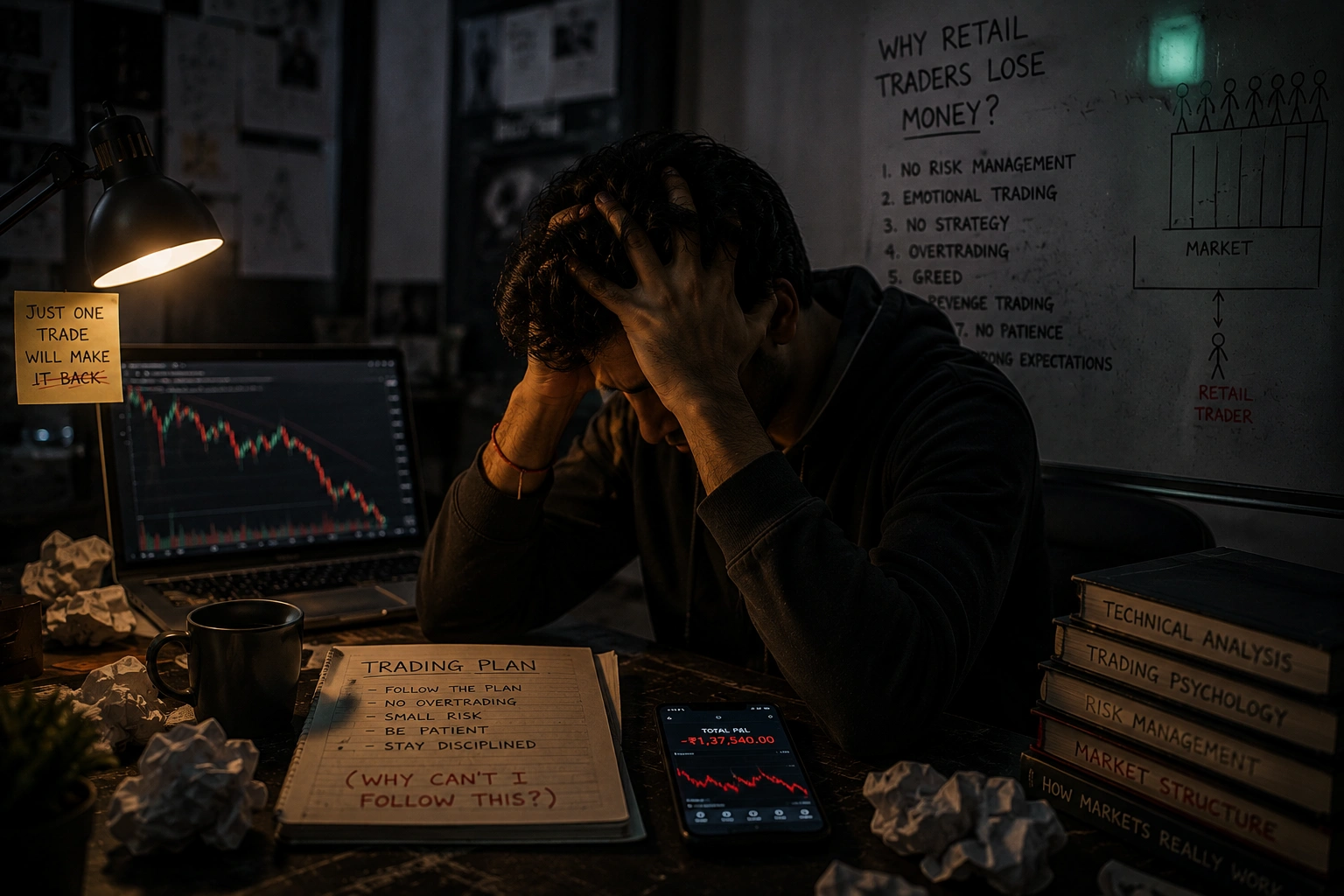
The Numbers Don't Lie
90% of retail traders lose money. Not sometimes. Not occasionally. Consistently. Over time. This isn't a guess — it's what the data shows across markets and decades.
Yet every day, new traders enter the market with confidence that they'll be the exception. They've watched YouTube videos. They've read articles. They've seen people on Twitter posting profits. Surely they can do it too.
They can't. And here's why.
The Structural Disadvantage
Before you even place a trade, you're at a disadvantage:
Information asymmetry Institutional traders have access to data, research, and analysis that retail traders don't. They know things you don't know, and they know them before you do.
Technology gap Algorithms execute thousands of trades per second. High-frequency trading firms have microsecond advantages. Your phone and your fingers can't compete.
Capital disadvantage Professional traders have deep pockets. They can absorb losses, hold positions longer, and take advantage of opportunities that retail traders can't afford.
Cost disadvantage Spreads, slippage, commissions — these costs eat into retail profits. Institutions get better execution and lower costs because of their volume.
The market isn't a level playing field. It never has been.
The Psychological Trap
The real enemy isn't the market — it's your brain:
Overconfidence After a few winning trades, you feel invincible. The confidence is intoxicating. It makes you take bigger risks, ignore warning signs, and believe you've figured out the market. You haven't.
Loss aversion Losing hurts twice as much as winning feels good. This asymmetry makes you hold losing positions too long and cut winning positions too short. The exact opposite of what you should do.
Revenge trading After a loss, the urge to "get it back" is overwhelming. You enter impulsive trades to prove the market wrong. The market doesn't care about your ego.
Confirmation bias You see what you want to see. You focus on analysis that supports your position and ignore signals that contradict it. The market punishes this kind of selective attention.
Recency bias Recent events feel more important than they are. A few winning trades make you think you've found a pattern. A few losing trades make you think the market is against you. Neither is true.
The YouTube Illusion
Indian trading culture is fueled by YouTube gurus who show profits while hiding losses:
Survivorship bias You see the traders who succeeded. You don't see the thousands who lost everything. The successful ones get screenspace. The failures disappear into silence.
Curated content Nobody posts their losing trades. The social media feed is a highlight reel that creates the illusion that everyone is winning. They're not.
Selling the dream Gurus make money from courses, not trading. Their business model depends on your belief that trading is easy and profitable. The truth would kill their revenue.
No accountability When a guru's trade goes wrong, they don't post a follow-up. There's no accountability for bad advice. Just the next confident prediction.
What Actually Works
If you want to make money in markets, forget trading. Consider these instead:
Long-term investing Put money in diversified funds. Let compound interest do the work. This strategy beats 90% of active traders over any meaningful time period.
Systematic investing Invest a fixed amount every month regardless of market conditions. This removes emotion from the equation and takes advantage of market dips automatically.
Education before action If you want to trade, spend at least a year learning before risking real money. Understand probability, risk management, and behavioral finance. Most traders skip this step entirely.
Accept the odds The market is designed for you to lose. Accepting this isn't pessimistic — it's realistic. It means you approach markets with the caution they deserve.
The Hardest Truth
The hardest truth about retail trading is that most people would be better off not doing it. The time, energy, and emotional cost of trading rarely produces returns that justify the effort.
But admitting this feels like admitting defeat. The culture tells you that anyone can succeed if they just try hard enough. The market tells a different story.
If you're trading and losing, you're not failing. You're experiencing the normal outcome of a rigged game. The smartest move isn't to try harder — it's to recognize when the game isn't worth playing.
Trading losses carry a weight that's hard to share with the people around you. Artha is a space where you can talk about the losses, the frustration, and the decision to keep going or walk away.
Quick answers
Things people usually want to know.
Why do 90% of retail traders lose money?
The combination of emotional decision-making, poor risk management, overtrading, and the structural disadvantage of competing against institutions with better technology, information, and capital creates an environment where consistent profitability is nearly impossible for retail traders.
Is trading a viable career in India?
For most people, no. Professional trading requires years of disciplined practice, significant capital, emotional regulation, and a statistical edge. The people who succeed are the exception, not the rule. The glorified stories on social media represent survivorship bias.
How much money do I need to start trading?
The question isn't how much you need to start — it's how much you can afford to lose entirely. If losing your trading capital would affect your rent, food, or family obligations, you shouldn't be trading. Start with money you'd be okay setting on fire.
Can I make consistent money from options trading?
Consistent profitability from options is extremely difficult. Options are designed to be zero-sum — for every winner, there's a loser. Professional options traders have sophisticated models, hedging strategies, and institutional backing that retail traders lack.
What should I do instead of trading?
For most people, long-term investing in diversified funds outperforms trading. It requires less time, less emotional energy, and produces better results. If you enjoy markets, invest with a long-term perspective rather than trying to beat the market through active trading.