US CPA vs ACCA vs US CMA: The Fully-International Route
November 25, 2026 · 11 min read · by Shivam Kushwaha, Artha founder
Someone just cleared their first year of articleship, and the LinkedIn feed is full of three different acronyms from three completely different countries. One says US GAAP, one says IFRS, and one says management accounting. None of them are CA. All three lead to serious finance careers, just in very different directions.
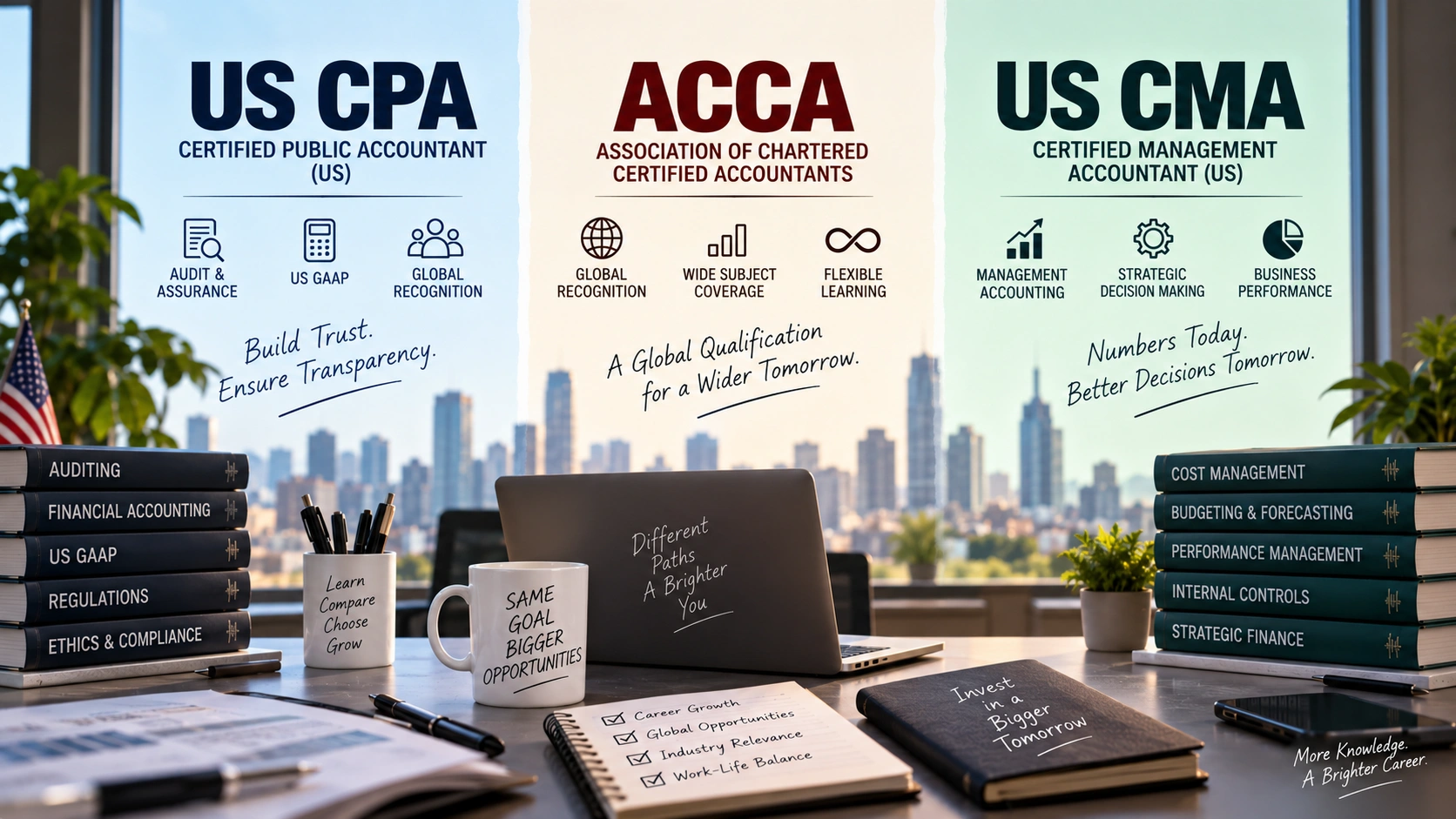
US CPA grants attestation authority under US GAAP and is built around four exam sections. ACCA is the broadest IFRS credential recognised across 180 countries with 13 papers. US CMA is the fastest route into internal management accounting, consisting of just two parts. They are three different doors into three different rooms, not three rankings of the same thing.
The numbers, side by side
| US CPA (AICPA) | ACCA (ACCA Global) | US CMA (IMA) | |
|---|---|---|---|
| Governing body | American Institute of Certified Public Accountants | Association of Chartered Certified Accountants (UK-headquartered) | Institute of Management Accountants (US-headquartered) |
| Structure | 4 exam sections: AUD, FAR, REG, plus one discipline section | 13 papers across 4 levels: Applied Knowledge, Applied Skills, Ethics, Strategic Professional | 2 parts: Part 1 (Financial Planning, Performance, Analytics), Part 2 (Strategic Financial Management) |
| Typical duration | 12 to 18 months after 150 credit hours | 3 to 4 years | 6 to 12 months |
| Exam format | Computer-based, multiple choice plus task-based simulations | Computer-based MCQs, constructed response, case studies | Computer-based MCQs plus essay questions |
| Pass rates | Roughly 45 to 55 percent per section, AICPA 2025 data | Applied Knowledge: 45 to 55 percent; Strategic Professional: 30 to 40 percent | Part 1: 44 percent; Part 2: 45 percent, IMA 2024 data |
| Core focus | US GAAP, US tax law, audit and attestation, SEC reporting | IFRS, international audit, tax, financial reporting, ethics | Management accounting, cost management, internal finance, budgeting, performance analysis |
| Where it's valued | US accounting firms, SEC-reporting companies, multinational US GAAP operations | Global practice across 180 countries, Big Four international desks, cross-border roles | Corporate finance, manufacturing, cost accounting, FP&A, internal finance leadership |
US CPA: The US attestation door
CPA is built around a specific legal function in the US: the authority to attest to financial statements under US GAAP. That authority carries weight in any US-linked financial environment, whether you're working at a Big Four office in New York or handling US reporting for a multinational in Mumbai.
The credential's structure is deliberately narrow. Four sections covering audit, financial accounting and reporting, regulation, and one of three discipline choices. The 150-credit-hour requirement before sitting for the exam is a real barrier for many Indian commerce graduates who typically complete 120 to 130 credits in a standard three-year degree.
The real limitation is jurisdiction. CPA is a US licence. It grants statutory authority within US states. Outside the US, it carries recognition at multinational firms but zero statutory weight. If your career path doesn't involve US GAAP or US regulatory frameworks, CPA is solving a problem you don't actually have.
ACCA: The broadest international door
ACCA was designed from the ground up as a global credential. Recognised in over 180 countries, it covers IFRS-based financial reporting, international audit and assurance, tax across multiple jurisdictions, and a mandatory ethics module. It's the widest net any accounting credential currently casts.
The 13-paper structure is long but progressive. Applied Knowledge covers the basics. Applied Skills builds technical depth. The Ethics and Professional Skills module sits between skills and strategic levels. Strategic Professional caps it off with optional specialisation. The pathway allows exemptions for commerce graduates in India, meaning some papers can be skipped depending on prior academic qualifications.
The real limitation is that ACCA grants no statutory attestation authority in India and has limited recognition in the US. Its strength is in countries that operate under IFRS or where the credential's global brand carries hiring weight. For someone targeting a UK, Middle Eastern, Southeast Asian, or Africa-based career, ACCA has the most established footprint.
US CMA: The fastest internal finance door
CMA targets a completely different career surface: internal management accounting. It's not about auditing or attesting to financial statements. It's about the finance function inside a company, cost management, budgeting, performance analysis, strategic financial planning, and decision support.
The two-part structure is intentionally compact. Part 1 covers financial planning, performance, and analytics. Part 2 covers strategic financial management. Most candidates sit both parts within 6 to 12 months, making it the fastest of the three credentials to complete.
The real limitation is scope. CMA grants no statutory authority anywhere. It doesn't authorise audit work, tax filings, or external attestation. Its value is entirely within corporate finance roles where management accounting expertise is the actual skill being hired for. Outside that context, it carries limited brand recognition.
Where people get this three-way decision wrong
The most visible mistake is treating all three as alternatives to CA. They're not. CA carries Indian statutory authority that none of these three credentials replicate. If your career goal requires Indian audit-signing rights, you need CA regardless of which international credentials you add alongside it.
The second mistake is chasing all three because they sound impressive together. CPA plus ACCA plus CMA is a massive time commitment, and most career paths need at most two of the three, chosen deliberately.
The third mistake is picking based on prestige without checking which accounting framework your target market actually uses. US GAAP and IFRS are different systems. A US CPA in a pure IFRS environment or an ACCA in a pure US GAAP environment both end up needing to learn the other framework anyway.
The actual decision
The real question isn't which credential is hardest or most impressive. It's which accounting framework and which career function you need to operate in.
If you need to sign off on US GAAP financial statements or handle SEC reporting, US CPA is the credential built specifically for that.
If you need the broadest international portability under IFRS across multiple countries, ACCA currently covers the most ground.
If you need a fast, focused path into corporate finance and management accounting where the actual daily work is budgeting, cost analysis, and internal decision support, US CMA is the quickest route.
Three different doors, not three different ladders
US CPA, ACCA, and US CMA aren't ranked against each other. They're entry points into three distinct professional functions. One is legal attestation in the US. One is broad IFRS practice globally. One is internal management accounting for corporate finance.
Which room do you actually want to work in?
Quick answers
Things people usually want to know.
Which is better, US CPA, ACCA, or US CMA?
No single credential beats the other. US CPA carries attestation authority for US GAAP and SEC filings. ACCA has the broadest IFRS recognition across 180 countries. US CMA is the fastest path into internal management accounting and finance controller roles. The right choice depends on which jurisdiction and accounting framework you actually need.
Can I sign audit reports with ACCA or CMA?
Only US CPA grants US statutory attestation rights, and only within US jurisdictions. ACCA grants practicing rights in the UK and several other countries under specific agreements. US CMA does not grant any statutory audit or attestation authority anywhere.
How long does each credential take?
US CPA typically takes 12 to 18 months to complete four exam sections after meeting the 150-credit-hour requirement. ACCA takes 3 to 4 years across 13 papers including ethics, applied knowledge, applied skills, and strategic professional levels. US CMA takes roughly 6 to 12 months across two parts.
What is the pass rate for each exam?
US CPA sections have pass rates ranging from roughly 45 to 55 percent per section, per AICPA. ACCA Applied Knowledge and Skills levels have pass rates between 40 and 55 percent, with Strategic Professional dropping closer to 30 to 40 percent. US CMA Part 1 and Part 2 have pass rates around 45 percent each, per IMA.
Can I do all three credentials?
Technically yes, but it's rarely practical or necessary. Each credential targets a different jurisdiction and function. US CPA plus ACCA makes sense for someone working across US and international standards. CMA alongside either adds management accounting depth but takes time away from practice.
Which is recognised in more countries?
ACCA has the widest geographic footprint, recognised in over 180 countries through its member network and mutual recognition agreements. US CPA is primarily US-focused but gains recognition in multinational firms worldwide. US CMA is recognised globally but specifically valued in corporate finance and manufacturing environments.
Do any of these give exemptions from CA?
None of these three credentials grant any exemption or reciprocal pathway with ICAI's CA qualification. Each operates under its own governing body and does not recognise the others for any form of credit or exemption.
Which pays the most?
US CPA holders in the US earn a median salary of around $75,000 to $85,000 early career, per AICPA surveys. ACCA holders in the UK earn £35,000 to £50,000 starting out. US CMA holders earn a median of roughly $70,000 to $100,000 depending on role, per IMA's annual survey. Comparisons across countries need purchasing power context.
Is ACCA better than CA for working abroad?
For broadest international portability, ACCA currently has a wider recognised footprint than most national CA qualifications. CA carries more statutory weight in India specifically. The best credential depends on which country or countries you plan to work in.
Which should a commerce student in India pick?
If the goal is US-based accounting or audit work, US CPA is the direct route. If the goal is international mobility across multiple countries under IFRS, ACCA covers the most ground. If the goal is a fast entry into corporate finance or management accounting without years of study, US CMA is the quickest path.