
UPSC Coaching vs Self-Study — The Question Everyone Gets Wrong
June 18, 2026 · ~4 min read · Updated September 4, 2026 · by Shivam Kushwaha, HeyArtha founder
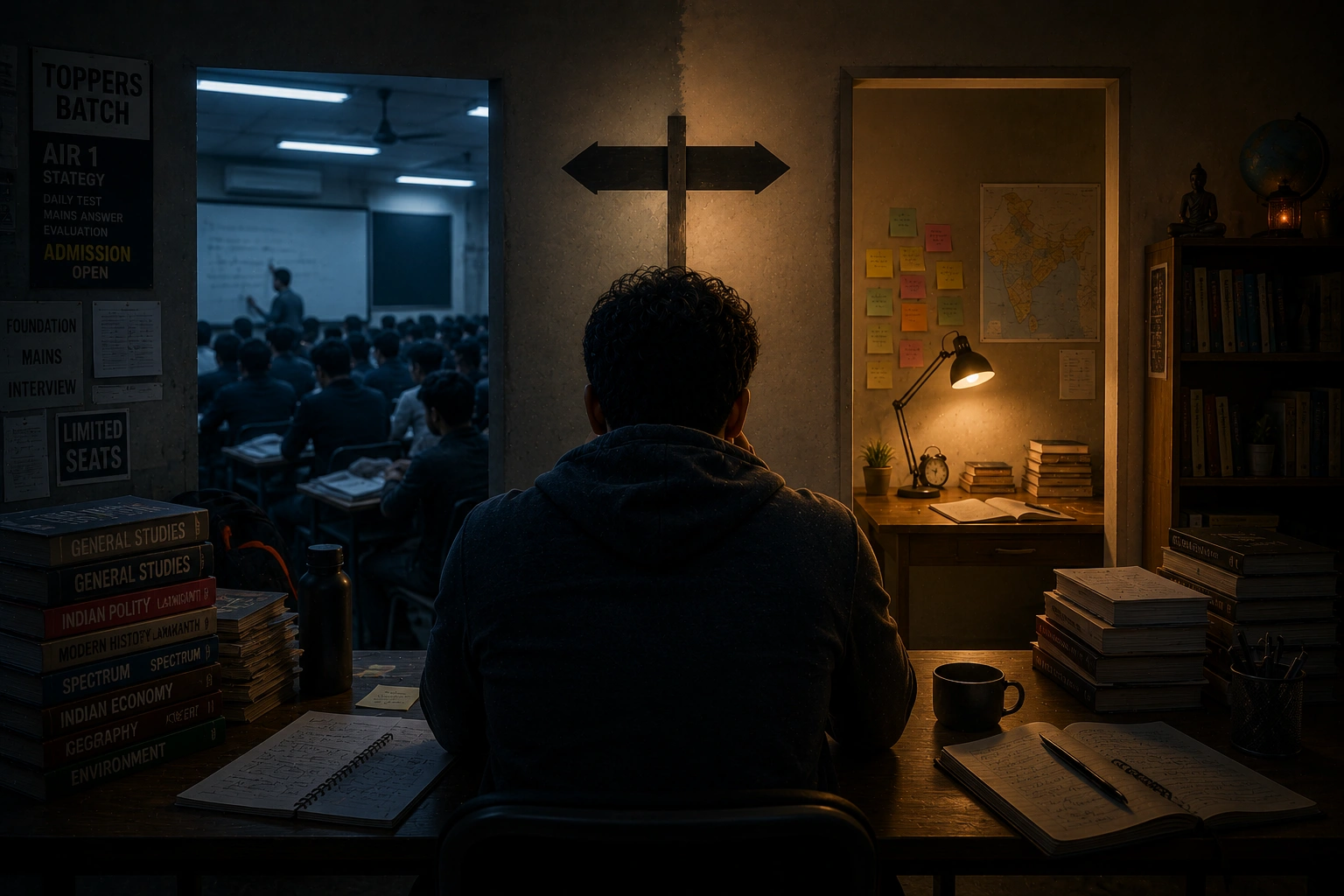
You've read the debate a dozen times — coaching gives structure, self-study builds discipline, pick one. What almost nobody tells you upfront is that most people who actually clear the exam didn't pick one. They picked pieces of both, deliberately, and the real decision was never "coaching or self-study" in the first place.
The number that reframes the whole question
Roughly 5 lakh aspirants sit for Prelims each year. Around 0.2% make it through the full process to selection. No coaching institute anywhere has a pass rate above 5-7% of its own enrolled students — because the overall qualification rate itself sits around 2-3%. That single fact deflates most of the marketing around "the best institute": no coaching center has cracked some secret formula the rest of the exam-taking population doesn't have access to. Coaching is a multiplier of effort you're already putting in. It isn't a substitute for it.
What actually separates the people who clear it
A disciplined self-studier consistently outperforms an undisciplined coaching student — every year, across every batch. The variable that matters most isn't which institute logo is on your notes. It's whether you're actually doing the work, consistently, regardless of who's structuring it for you.
That said, this isn't an argument for going purely solo either. Even people who lean heavily self-study rarely skip one specific piece: some form of a structured test series, for both Prelims and Mains — the same external check that breaks the blank-page perfectionism trap in answer writing too. Self-evaluation has real blind spots — you genuinely cannot see your own weak areas as clearly as an external, standardized check can show you.
The hybrid pattern that actually shows up
Among people who clear the exam, the dominant recent pattern isn't full coaching or full self-study — it's self-study as the base (standard books, NCERTs, daily newspaper) with specific, targeted additions: a test series for benchmarking, sometimes an optional-subject-specific coaching module, the same targeted-not-total approach that helps with an optional-subject decision, sometimes a mentorship check-in rather than a full classroom course. The total cost of this hybrid approach tends to run at roughly 25-50% of full coaching, often with comparable or better outcomes — not because it's cheaper for its own sake, but because self-study forces a kind of genuine engagement that passively sitting through a lecture doesn't.
The real question to ask yourself instead
Rather than "coaching or self-study," a more useful framing is: which specific parts of this process do I need external structure for, and which parts am I disciplined enough to run myself? If you're new to the UPSC ecosystem entirely and don't know where to start, some structure early on can genuinely help. If you already know how to build a study routine and just need benchmarking and feedback, a full coaching program may be paying for far more than you actually need.
Where Artha fits into this
This is exactly the kind of decision UPSC Talk makes easier to think through honestly — talking to another aspirant about what they actually outsourced versus did themselves, closer to the decision than a coaching institute's sales pitch ever gets, and what they'd change in hindsight.
The decision that's actually yours
There's no universal right answer between coaching and self-study, because the real decision was never that binary. It's a series of smaller calls about which specific gaps you need outside structure for — and those calls are much easier to make well after an honest conversation with someone who's actually navigated them, not a coaching institute's sales pitch.
Quick answers
Things people usually want to know.
Is coaching necessary to clear UPSC, or can self-study alone work?
Neither is strictly necessary on its own — many aspirants clear the exam through self-study alone, though most successful candidates use some hybrid of self-study with targeted, specific additions like a test series.
What is the actual pass rate for UPSC coaching institutes?
No institute has a pass rate above roughly 5-7% of its own enrolled students, since the overall Prelims-to-selection qualification rate across all aspirants is only around 2-3%.
Is a test series necessary even if I choose full self-study?
It's widely considered close to non-negotiable — self-evaluation has genuine blind spots that a structured, external test series helps reveal, regardless of whether you're doing full coaching or self-study otherwise.
What does a typical hybrid coaching and self-study approach actually look like?
Commonly: self-study as the foundation using standard books, NCERTs, and daily newspaper reading, combined with a Prelims and Mains test series, and sometimes targeted coaching just for a specific optional subject or mentorship check-ins.
Is full coaching a waste of money if I'm already disciplined?
It can be, for some aspirants — a highly disciplined self-studier may be paying for structure and pacing they don't actually need, when a test series alone could provide the external benchmarking that's genuinely useful.
How much does the hybrid approach typically cost compared to full coaching?
Roughly 25-50% of full coaching costs, based on common cost breakdowns, though exact figures vary significantly by city, institute, and specific combination of resources chosen.
Does joining a "top" coaching institute significantly improve my chances?
Not as much as often assumed — since no institute's pass rate is dramatically higher than the overall qualification rate, the institute name matters less than consistent, disciplined effort on your part.
How do I know if I need coaching structure or if I can manage self-study alone?
It depends on whether you're new to the UPSC ecosystem and need initial direction, versus already knowing how to build a study routine and mainly needing feedback and benchmarking, which self-study plus a test series can often provide.
Can I switch from full coaching to self-study, or vice versa, partway through prep?
Yes, many aspirants adjust their approach as they learn what specifically they need — it's common to start with more structure and gradually shift toward self-directed study, or the reverse, based on what's actually working.
More from HeyArtha
Other things we've been writing about.
What to Do After UPSC Mains, Before the Result
The two months after UPSC Mains before results feel like nothing. Heres why the gap hits so hard, and what actually helps you get through it.
IBPS & SBI PO vs UPSC: Career, Salary, and Odds Compared
UPSC has a 0.2% pass rate and a 1-year cycle. IBPS and SBI PO offer 1-2% odds, 6-8 month cycles, and predictable banking careers. Compare both paths.
Can You Prepare for CA and UPSC Together? The Honest Truth
Can you prepare for CA and UPSC simultaneously? Why dual prep fails during articleship, how to sequence them, and how CA serves as a strong Plan B.