
State PSC or UPSC? Making Peace With Settling
June 24, 2026 · ~10 min read · by Shivam Kushwaha, HeyArtha founder
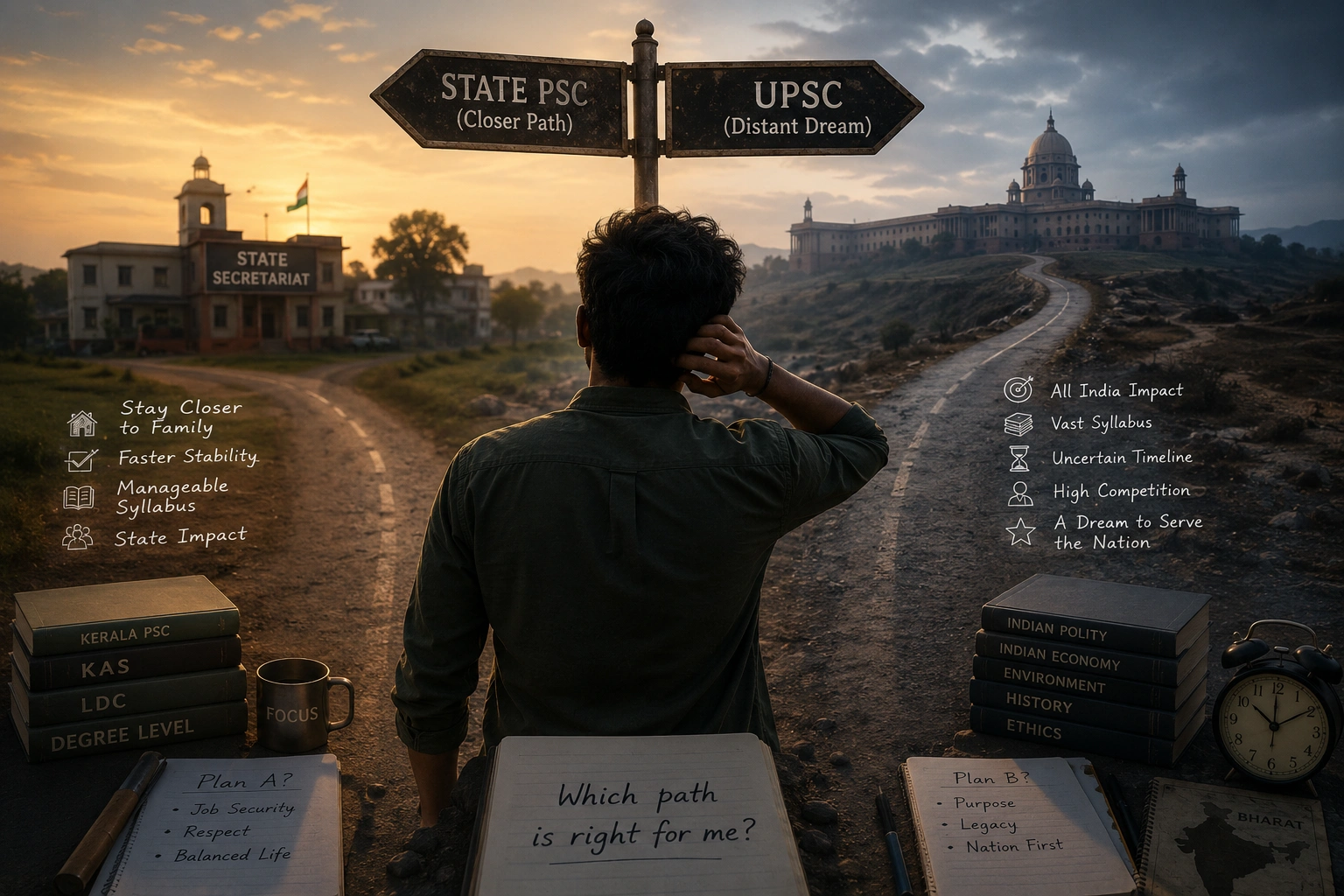
Someone in your study group mentioned it almost apologetically, like admitting something shameful, that they'd started prepping for the state PSC alongside UPSC, "just as a backup, obviously UPSC is still the real goal." You nodded along, the way everyone does. Privately, you've been thinking about it too, for weeks now, and every time the thought surfaces you talk yourself out of it within minutes, because some part of you has decided that even considering it means you've already given up on the bigger dream. Nobody in your group has said the word "settling" out loud. It's sitting in the room anyway.
Why This Feels Like Giving Up, Even When It Isn't
Here's the honest reframe worth starting with: choosing to seriously prepare for a State Public Service Commission exam, whether alongside UPSC or instead of it, is not inherently a lesser choice or a sign of reduced ambition, it's a different, entirely legitimate civil services path with its own real scope, responsibility, and impact, and treating it as a consolation prize says more about how UPSC culture frames prestige than about what the actual roles involve.
That reframe doesn't erase the feeling, because the feeling isn't really about the job itself, it's about the story you'd have to tell people, and yourself, about a dream that felt singular for years suddenly having a second option attached to it. The honest work here is separating the actual career decision from the identity story wrapped around it, since the two get tangled together far more than they need to.
Why the Comparison Feels So Loaded
UPSC occupies a specific, outsized place in Indian aspirational culture, amplified constantly by coaching marketing, family conversations, and a decades-old cultural weight attached specifically to the IAS in particular, in a way no state service, however genuinely prestigious within its own state, quite carries at the national conversational level. That imbalance in cultural visibility isn't a reflection of the actual difference in impact or responsibility between the roles. It's simply which one gets talked about more, at weddings, in coaching center hoardings, in family group chats.
This gap in visibility means aspirants weighing this decision are often comparing a mythologized version of one path against an under-discussed, under-appreciated version of the other, which makes the comparison feel far more lopsided than the reality actually is. A District Magistrate through a State PSC track and an IAS officer through UPSC are both exercising real administrative authority over real people's lives. The difference in how each gets discussed at a family function has very little to do with the actual substance of either job.
The Structural Reality Behind the Decision
It's worth being precise about the actual constraint driving a lot of these conversations, since vague pressure often feels heavier than the concrete numbers underneath it. UPSC attempt limits are fixed and unforgiving, General and EWS candidates get 6 attempts up to age 32, OBC candidates get 9 attempts up to age 35, SC and ST candidates get unlimited attempts up to age 37. Most State PSC exams have their own separate, often more generous attempt and age provisions, which means a State PSC path can genuinely remain open even after a UPSC clock has run its course, rather than being a fallback with an equally harsh countdown attached.
That structural difference matters practically, not just emotionally. It means the decision isn't always a strict either-or made once and locked in. For a meaningful number of aspirants, preparing for both simultaneously, at least for a stretch, is a genuinely reasonable strategy, not evidence of divided commitment or wavering ambition, precisely because the syllabi overlap substantially and the preparation invested in one carries over considerably into the other.
How This Actually Plays Out for Different Aspirants
For some aspirants, the switch to primarily state-level preparation comes after a specific number of unsuccessful UPSC attempts, once the remaining attempt-and-age math starts to feel genuinely tight, and the decision, while still emotionally difficult, tends to feel less like giving up and more like a realistic recalibration once the numbers are laid out honestly.
For others, the decision comes earlier and more strategically, a deliberate choice to weight state-level preparation more heavily from the start, particularly for aspirants with strong ties or specific interest in serving their home state, where a State PSC role can offer more direct, local impact than a UPSC posting that could send them anywhere in the country.
For a third group, the pull toward state services isn't really about the exam odds at all, it's about a genuine preference discovered somewhere along the way, realizing during preparation that the specific administrative work available at the state level, closer to home, more directly connected to a particular region's issues, actually appeals more than the more centralized, generalist nature of the IAS track. That discovery often surprises the aspirant themselves, since it rarely shows up until they've actually spent real time learning what the state-level role involves, rather than dismissing it sight unseen the way the surrounding culture tends to.
What Actually Helps With This Decision
Getting honest about the actual attempt-and-age math for both tracks, rather than making the decision on vague emotional grounds alone, tends to clarify things considerably. A candidate with three UPSC attempts left and a State PSC exam with no comparable ceiling is in a genuinely different position than the anxious, undifferentiated dread of "running out of time" makes it feel like from the inside.
Talking to people who've actually made this switch, particularly those now working in state services, tends to correct the mythologized comparison more effectively than any amount of internal reasoning, since hearing directly what the day-to-day role actually involves tends to dissolve a lot of the "lesser path" framing that thrives mainly on distance and assumption.
Separating the syllabus-overlap strategy from the identity question is worth doing explicitly. Preparing for both exams simultaneously is a purely practical decision about efficient use of study time. Whether you've quietly begun preferring one path over the other is a separate, more personal question that deserves its own honest answer, rather than getting buried under the logistics, the same separation that matters when deciding how much of any of this to actually tell people around you in the first place.
There's a specific version of this worth naming too: some aspirants find that once they start seriously researching state-level roles, the "settling" feeling fades faster than expected, replaced by a genuine curiosity about work that's more concrete and locally rooted than the more abstract, distant version of civil service that UPSC preparation tends to romanticize from the outside.
What tends not to help is treating the decision as permanent and irreversible the moment it's made. Aspirants regularly move between primary focus on UPSC and primary focus on state-level prep more than once across a multi-year preparation window, and that flexibility is a feature of how the overlapping syllabi work, not a sign of indecisiveness.
Where Artha Fits In
This is exactly the kind of decision that's hard to voice honestly inside a study group built entirely around the UPSC dream, where even raising the idea of a state-level exam can feel like admitting a crack in your commitment to everyone else's shared goal. It sits somewhere between genuinely walking away from UPSC and the specific pressure of a final allowed attempt, since this decision often lands somewhere between those two, neither a full exit nor an unchanged continuation.
A Small Thing Worth Saying Honestly
I've watched the specific hesitation around this decision up close, in people who talk about their state PSC prep in a lowered voice, almost as if admitting to it out loud makes it more real and more final than they're ready for. What strikes me is how much of the reluctance is about the story, not the job, a fear of what choosing the "other" path says about the years already spent chasing the first one.
The dream was never really the exam itself. It was the actual work, serving people, holding real administrative responsibility, and that work exists just as genuinely on one track as the other, whichever letters end up on the appointment order.
If nobody at the wedding table ever asked which service you're in, only what the work actually involves, would this decision still feel like settling for anything?
Quick answers
Things people usually want to know.
Is choosing State PSC over UPSC considered "settling" for a lesser career?
Not in any meaningful, substantive sense. State PSC roles carry real administrative authority and impact; the perception gap comes mainly from how much more cultural visibility UPSC gets, not from an actual difference in the significance of the work.
Can I prepare for both UPSC and a State PSC exam at the same time?
Yes, and many aspirants do, since the syllabi overlap substantially. Preparing for both is a common, practical strategy, not a sign of divided commitment, particularly given UPSC's harder attempt-and-age ceiling compared to many State PSC exams.
Do State PSC exams have the same attempt and age limits as UPSC?
No, they vary by state and are often more generous than UPSC's limits, meaning a State PSC path can genuinely remain open even after UPSC attempts have been exhausted.
What are the UPSC attempt and age limits by category?
General and EWS candidates get 6 attempts up to age 32. OBC candidates get 9 attempts up to age 35. SC and ST candidates get unlimited attempts up to age 37, with additional relaxations for PwBD candidates.
How do I know when it's time to shift focus from UPSC to State PSC preparation?
Many aspirants find it clarifying to lay out the actual remaining attempts and age window for both exams honestly, rather than deciding on vague emotional grounds, since the concrete numbers often reveal more flexibility than the anxious feeling suggests.
Is the work of a State PSC officer really different from an IAS officer's work?
Both roles involve real administrative authority and responsibility over people's lives, though a State PSC role is typically more geographically concentrated within one state, which can mean more direct, locali
More from HeyArtha
Other things we've been writing about.
What to Do After UPSC Mains, Before the Result
The two months after UPSC Mains before results feel like nothing. Heres why the gap hits so hard, and what actually helps you get through it.
IBPS & SBI PO vs UPSC: Career, Salary, and Odds Compared
UPSC has a 0.2% pass rate and a 1-year cycle. IBPS and SBI PO offer 1-2% odds, 6-8 month cycles, and predictable banking careers. Compare both paths.
Can You Prepare for CA and UPSC Together? The Honest Truth
Can you prepare for CA and UPSC simultaneously? Why dual prep fails during articleship, how to sequence them, and how CA serves as a strong Plan B.