Indian CMA vs US CMA: Same Name, Different Institute (2026)
November 21, 2026 · 10 min read · by Shivam Kushwaha, Artha founder
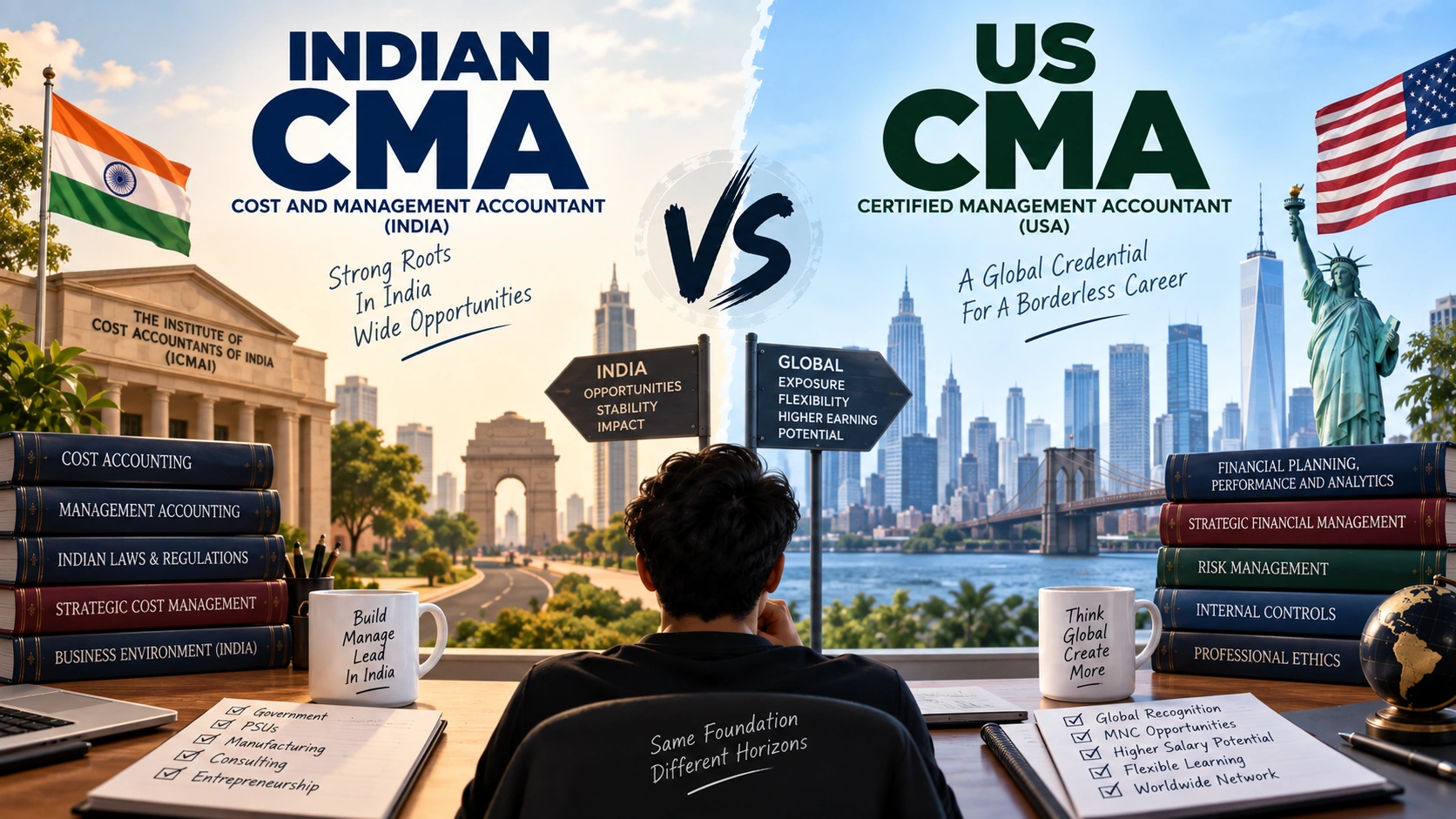
Someone in the batch group just posted about registering for US CMA, and a few messages down, someone else is asking about Indian CMA like they're the same exam with a different logo. They're not. One is run by ICMAI in India and grants a statutory signing right. The other is run by IMA in the United States and is a global certification with no signing authority anywhere. The name overlap creates more confusion than it resolves, and the actual comparison is straightforward once you strip away the branding.
Indian CMA is a three-level, 3 to 4-year credential run by ICMAI that grants cost-audit signing authority under the Companies Act, with India-specific scope and eligibility starting after class 12. US CMA is a two-part, 6 to 18-month certification run by IMA with global recognition in over 150 countries, no signing authority, and a requirement that you hold a bachelor's degree before earning the credential. They share a name. That's about where the similarities end.
The actual numbers, side by side
| Indian CMA (ICMAI) | US CMA (IMA) | |
|---|---|---|
| Governing body | Institute of Cost Accountants of India (ICMAI) | Institute of Management Accountants (IMA, US-headquartered) |
| Structure | 3 levels: CMA Foundation, CMA Intermediate, CMA Final, plus 15 months practical training | 2 parts: Part 1 (Financial Planning, Performance and Analytics), Part 2 (Strategic Financial Management) |
| Typical duration | 3 to 4 years including practical training | 6 to 18 months depending on pacing |
| Eligibility | Open after class 12 through CMA Foundation; direct entry to Intermediate for commerce graduates | Bachelor's degree required before credential is awarded; professional certification can substitute |
| Pass rate | CMA Final both-groups pass rates have historically ranged from approximately 10 to 20 percent | Part 1: approximately 45 percent; Part 2: approximately 50 percent, per recent IMA data |
| Statutory rights in India | Cost-audit signing authority under the Companies Act, 2013 | None. No statutory authority anywhere |
| Global recognition | Primarily recognised in India; limited formal equivalence outside India | Recognised in over 150 countries; widely accepted in MNCs and shared-service centres globally |
| Core focus | Cost accounting, cost audit, and management accounting under Indian accounting and regulatory standards | Financial planning, analysis, control, and decision support under US GAAP and international frameworks |
| Fee range (approximate) | ₹60,000 to ₹1,00,000 across all levels including practical training | ₹1.5 to ₹2.5 lakh including IMA membership, entrance fee, and exam fees for both parts |
What Indian CMA is actually for
Indian CMA exists to serve a specific legal function: the authority to sign cost audit reports under the Companies Act. The entire path, from CMA Foundation through to CMA Final and the 15 months of mandatory practical training, is designed to produce professionals who can legally execute that role.
The curriculum is built around Indian cost accounting standards, the Companies Act provisions on cost records, and the practical requirements of cost-audit reporting. This is not a generic management-accounting credential with an Indian label. It's a domestic statutory qualification for a specific legal function.
The real limitation is international portability. While ICMAI has agreements with some international bodies, Indian CMA as a standalone credential carries limited recognition outside India. Someone aiming at a purely international career will find that Indian CMA alone doesn't open those doors as directly as a globally recognised certification.
What US CMA is actually for
US CMA was built for a different kind of work: financial planning, analysis, control, and decision support in a management-accounting context. The two-part structure moves from foundational financial planning through to strategic financial management, covering topics like cost management, internal controls, investment decisions, and professional ethics.
The credential's real strength is in roles where analytical and strategic financial skills matter more than statutory compliance. FP&A roles, management accounting, cost analysis at MNCs, and decision-support functions in shared-service centres all value US CMA's curriculum.
The real limitation is that US CMA grants zero statutory authority anywhere. It cannot be used to sign cost audit reports, audit opinions, or any other statutory filing. It's a certification, not a licence, and the distinction matters in any context where legal signing authority is required.
The eligibility trap
One structural difference that catches people off guard: Indian CMA allows entry after class 12 through CMA Foundation. US CMA requires a bachelor's degree before the credential can be awarded.
This means a commerce graduate or someone early in their career can start the Indian CMA path immediately. US CMA requires you to have already completed a degree, which shifts the timeline significantly for anyone who hasn't yet finished their bachelor's.
The practical implication is that the two credentials don't compete for the same entry point. A class-12 student choosing between them isn't making a like-for-like comparison unless they also factor in the degree requirement for US CMA.
Where people get this decision wrong
The most visible mistake is treating US CMA as an "upgrade" to Indian CMA, assuming the international label makes it objectively superior. In the specific context of cost-audit practice in India, Indian CMA holds a statutory right that US CMA simply does not have.
The reverse mistake shows up in people committing to the full Indian CMA path without checking whether their actual career goal involves international management-accounting or FP&A work where US CMA's 150-country recognition carries weight.
A third pattern involves people assuming that because US CMA is faster and has higher pass rates, it's the easier or less valuable option. Speed and pass rates reflect structural design choices, not the actual difficulty or career value of the credential.
The actual decision
The real question isn't which credential is faster or more internationally recognised in the abstract. It's whether your actual career goal requires a domestic statutory signing right or a global management-accounting certification.
If you're picturing cost-audit practice, manufacturing-sector compliance, or any role where ICMAI's specific signing authority under the Companies Act matters, Indian CMA is the credential built for exactly that, and US CMA cannot substitute for it.
If instead you're picturing FP&A, management accounting, or a role at an MNC where the credential needs to be portable across 150 countries, US CMA is built specifically for that, and Indian CMA's narrower international footprint is a real limitation.
Different institutes, different legal realities, not different prestige levels
Indian CMA and US CMA aren't really ranked against each other the way the search results make it look. One is a domestic statutory qualification with a signing right. The other is a global certification with no signing authority but broad international acceptance.
Which career and legal reality do you actually want to be working inside? The answer determines which credential you need, not which one the internet thinks is better.
Quick answers
Things people usually want to know.
Are Indian CMA and US CMA the same thing?
No. They are run by entirely different institutes with different structures, different curricula, and different legal rights. Indian CMA is governed by ICMAI and grants cost-audit signing authority under Indian law. US CMA is governed by IMA and is a global certification with no statutory signing authority anywhere.
Can I do both Indian CMA and US CMA?
There is no structural conflict preventing you from pursuing both, but you should have a specific career reason. Indian CMA gives you domestic cost-audit authority. US CMA gives you a global management-accounting certification. Doing both without a clear target role is years of effort without a clear return.
Which is harder, Indian CMA or US CMA?
Indian CMA has three levels with historically low pass rates and 15 months of mandatory practical training, making it a longer and more demanding path overall. US CMA has two parts with pass rates generally above 40 percent and can be completed in 6 to 18 months. Difficulty is subjective, but the structures are fundamentally different in scope and duration.
Can a US CMA sign cost audit reports in India?
No. Only ICMAI-qualified Cost Accountants can sign cost audit reports under the Companies Act. US CMA, or any other international certification, grants no statutory signing authority in India.
Is US CMA valid in India?
US CMA is recognised by many Indian employers, particularly MNCs, consulting firms, and shared-service centres. It is not recognised as a substitute for Indian CMA in any statutory context within India.
What are the fees for Indian CMA vs US CMA?
Indian CMA costs approximately ₹60,000 to ₹1,00,000 across all levels including practical training. US CMA costs approximately ₹1.5 to ₹2.5 lakh including IMA membership, entrance fee, and exam fees for both parts, depending on when you register and whether you qualify for student or professional pricing.
Can I start Indian CMA after class 12?
Yes. Indian CMA allows entry through CMA Foundation after class 12. US CMA requires a bachelor's degree or a related professional certification as an eligibility requirement before you can earn the credential.
Which pays more in India?
It depends on role and sector rather than credential alone. Indian CMAs in cost-audit roles and US CMAs in FP&A or management-accounting roles at MNCs can both command strong packages. No single dataset directly compares both credentials' average compensation in India.
Is US CMA recognised globally?
Yes. US CMA is recognised in over 150 countries and is a well-established credential in management accounting and financial planning and analysis roles worldwide.
What kind of work does an Indian CMA do that a US CMA doesn't?
Cost audit reporting under the Companies Act is exclusive to ICMAI-qualified Cost Accountants. US CMA does not cover Indian cost-accounting standards or grant any statutory signing right.