Going Home for Diwali With Nothing to Show
September 25, 2026 · 5 min read · by Shivam Kushwaha, Artha founder
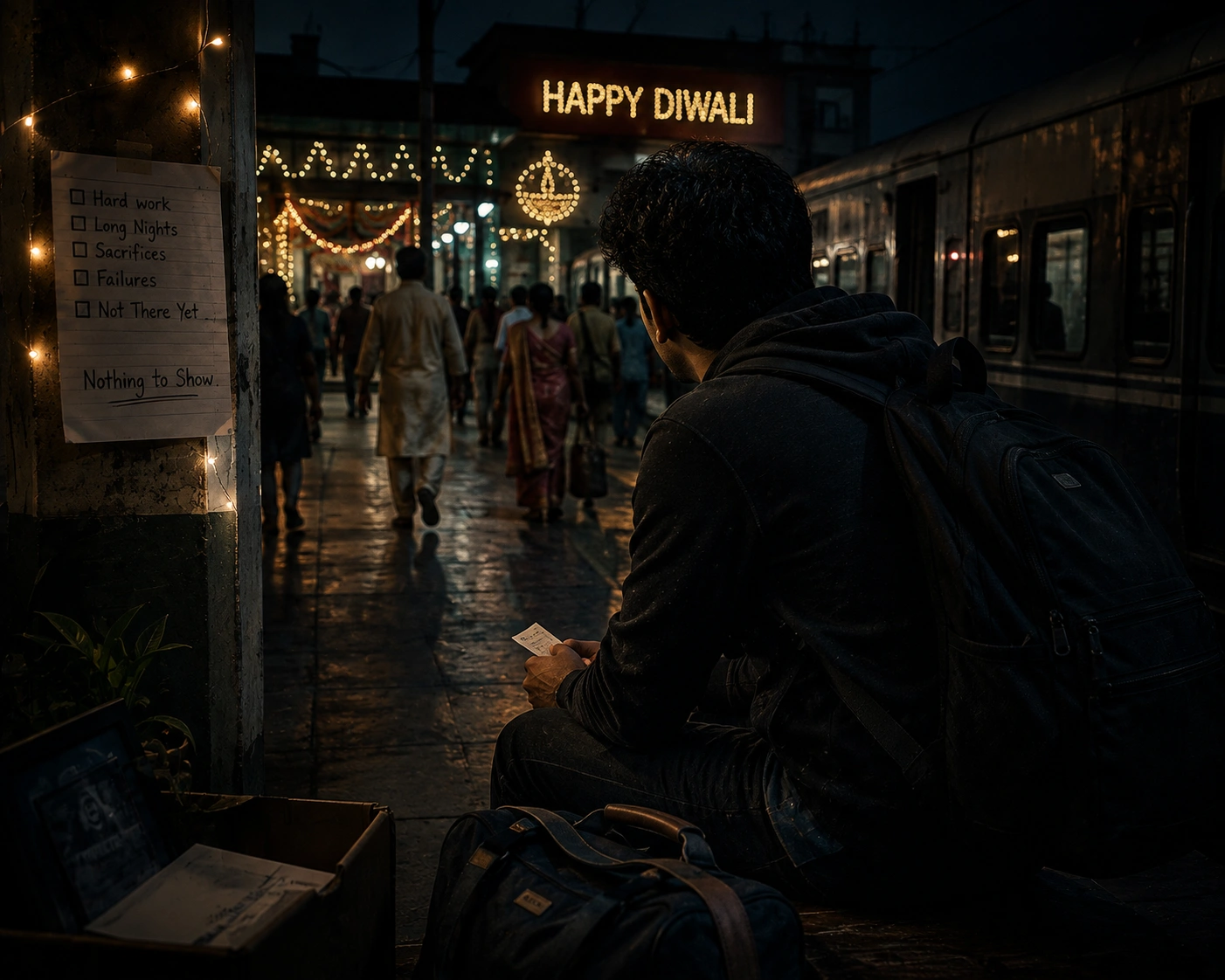
The Journey Home
The train is moving. The landscape outside is familiar. And inside your head, a running commentary of everything you haven't achieved this year.
No promotion. No salary increase. No new apartment. No relationship progress. Just you, going home with the same suitcase and the same story you had last Diwali.
The pressure to come home with something to show — a ring, a car key, a promotion letter, a business card with a better title — is one of the most painful aspects of Indian family life.
What "Nothing to Show" Actually Means
The phrase hides a deeper fear:
The measurement stick Indian families measure progress through visible outcomes. A new job. A new house. A marriage. A baby. If you don't have a visible marker of progress, you're measured against the absence.
The comparison game Your cousin got promoted. Your sister bought a car. Your friend got married. The comparison isn't explicit — it's ambient. It's in the way relatives ask questions, the way parents talk about other people's children.
The expectation gap Your parents expected certain milestones by now. You haven't hit them. The gap between expectation and reality creates a silence that's louder than any argument.
The self-judgment The worst part isn't their judgment — it's yours. You agree with the assessment that you should have more to show. The internal critic echoes the external expectations.
The Ride Home
The closer you get to home, the heavier it becomes:
The rehearsed answers You've practiced what you'll say. "Work is going well." "I'm focusing on growth." "Things are taking time." The answers are diplomatic, not honest.
The arrival Walking through the door. The hug. The "how are you?" that you can't answer truthfully. The immediate assessment in your parents' eyes — are you doing okay?
The first meal The food is the same. The love is the same. But there's an unspoken question hanging over the table: what have you done with your life?
What Nobody Says
The things nobody tells you about going home:
You don't owe anyone a progress report Your life is not a quarterly review. You don't have to justify your timeline to anyone — including your parents.
Nothing to show doesn't mean nothing gained Maybe you learned more this year than any previous year. Maybe you survived something difficult. Maybe you grew in ways that aren't visible on a resume.
The comparison is rigged You're comparing your behind-the-scenes to everyone else's highlight reel. Their visible success hides invisible struggles.
Home is supposed to be safe The pressure you feel at home isn't love — it's cultural expectation. Real love doesn't require you to perform success.
Surviving Diwali
Set boundaries You don't have to answer every question. You don't have to attend every gathering. Protect your mental space.
Find your person One person at home who gets it. Who you can be honest with. Who won't judge. That connection makes everything else bearable.
Create your own metrics What did you achieve this year? Not what they expected — what you actually did. Maybe you survived. Maybe you learned. Maybe you grew. These count.
Give yourself grace You're doing the best you can. The fact that you're going home — despite the pressure, despite the fear — is itself an act of courage.
The Morning After Diwali
The festival ends. The relatives leave. The house quiets down. And in that quiet, you might find something unexpected: the realization that "nothing to show" was never the truth. You showed up. You tried. You're still here.
That's not nothing. That's everything.
The weight of going home is heavy. Artha is a space where you can talk about the pressure, the comparison, and the things you can't say to the people you love most.
Quick answers
Things people usually want to know.
Why does going home feel so stressful?
Home represents the place where your progress is measured against expectations. Going home without visible achievements feels like returning with evidence of failure. The pressure to perform — financially, professionally, personally — makes homecoming anxiety-inducing.
How do I handle relatives' questions about my life?
Prepare short, confident answers. You don't owe anyone a detailed report. 'I'm working on something I'm excited about' or 'Things are going well' is enough. Redirect conversations to their lives if needed.
Should I fake success to avoid judgment?
No. Authenticity is more sustainable than performance. You can be honest without being vulnerable. You don't have to share every detail — but pretending creates its own burden.
How do I deal with comparison at home?
Recognize that comparison is a game you can't win. Someone will always have more. Focus on your trajectory, not their current position. Your path is yours, not theirs.
What if I genuinely have nothing to show?
Having 'nothing to show' doesn't mean you've failed. Building something takes time. The fact that you're in the process — trying, learning, growing — is itself an achievement. Not all progress is visible.