CS vs CA: Which Is Actually Harder, and Which Pays More?
November 13, 2026 · 11 min read · by Shivam Kushwaha, Artha founder
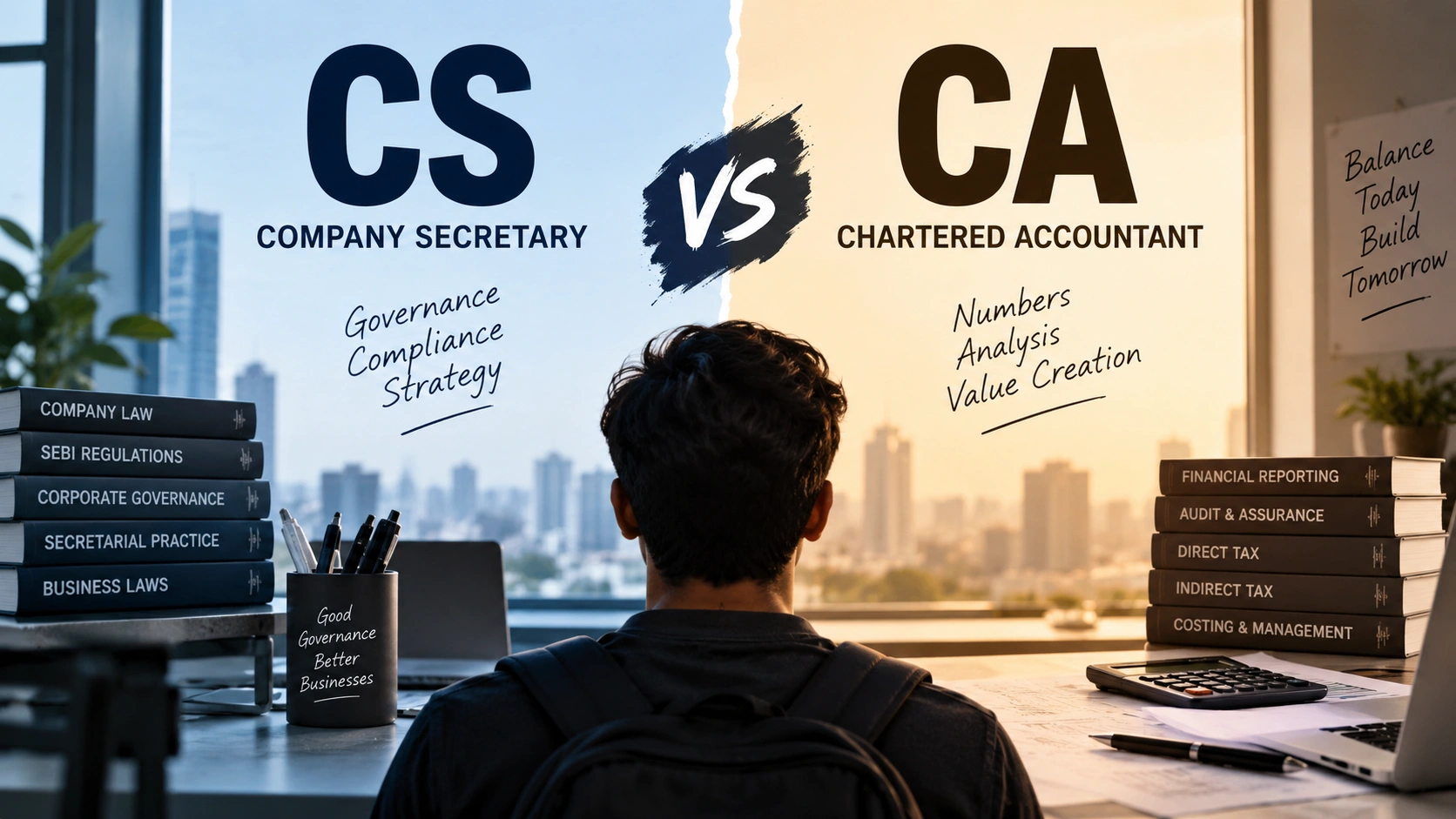
Study group chat is blowing up again. Someone just shared a meme about CA students ageing five years during articleship, and the CS folks in the corner are quietly wondering whether their path is actually the smarter move. Both groups are convinced the other has it easier. Both are partially wrong.
CA takes roughly 4.5 to 5 years including mandatory articleship and carries statutory audit-signing authority that no other Indian credential replicates. CS takes roughly 3 to 4 years and grants governance and secretarial authority under the Companies Act and SEBI LODR regulations. Comparing them on difficulty alone, without looking at what each credential actually authorises you to do, misses the point entirely.
The actual numbers, side by side
| CS (ICSI) | CA (ICAI) | |
|---|---|---|
| Governing body | Institute of Company Secretaries of India | Institute of Chartered Accountants of India |
| Structure | Foundation, Executive, Professional | Foundation, Intermediate, 3-year Articleship, Final |
| Typical duration | 3 to 4 years | 4.5 to 5 years including articleship |
| Professional pass rate | Roughly 20 to 25 percent (ICSI publishes less consistently) | 19.88% both-groups combined (May 2024); 13.44% (Nov 2024), per ICAI |
| Statutory rights in India | Governance and secretarial authority under Companies Act and SEBI LODR | Audit and taxation authority, including statutory audit sign-off |
| Core focus | Corporate governance, regulatory compliance, secretarial practice | Statutory audit, taxation, financial reporting |
| Where it's valued most | Listed company compliance, corporate governance roles, secretarial practice | Audit firms, tax practice, industry finance roles |
What CS is actually for
CS exists to fill a specific legal role: ensuring companies comply with governance requirements under Indian corporate law. The Company Secretary is the designated officer responsible for board meeting procedures, regulatory filings with the Registrar of Companies, and compliance with SEBI's Listing Obligations and Disclosure Requirements for listed companies.
The day-to-day reality of the CS path looks different from CA's. There is no mandatory three-year articleship in the same structured sense, which is why the overall timeline is shorter. The work itself is heavily procedural and compliance-oriented: drafting board minutes, filing annual returns, managing share transfers, and handling secretarial audits.
The real strength is governance authority. In listed companies, the CS holds a statutory position that no CA can substitute. The Companies Act and SEBI regulations specifically designate certain functions to the Company Secretary, and that authority is non-transferable.
What CA is actually for
CA exists to protect a different legal function: the authority to sign an Indian statutory audit report. Everything about the credential's structure, especially the three-year articleship, is built around making sure that authority is earned through supervised practice.
The day-to-day texture of the CA path is grinding in a very particular way. Long hours during articleship, exam cycles stacked on top of ongoing client work, and a Final exam that historically passes well under a quarter of both-group attempters.
The real strength is audit and tax authority. Only CAs can sign statutory audit reports, handle tax assessments, and prepare financial statements under Indian accounting standards. That legal authority is the core of CA's professional identity.
Difficulty: the honest comparison
This is where people get emotional, so let's stick to the data.
CA Final both-groups pass rates have run between roughly 13 and 20 percent across recent sessions. CS Professional pass rates tend to sit around 20 to 25 percent. The gap exists, but it's not as dramatic as either camp likes to claim.
CA's articleship adds a layer of difficulty that CS doesn't replicate. Three years of supervised practice while studying for Final exams creates sustained pressure that goes beyond exam difficulty alone. CS doesn't have this requirement in the same form, which contributes to the shorter overall timeline.
Neither credential is easy. CA is arguably harder on the exam front, but CS compensates with the complexity of its compliance and governance curriculum, which requires a different kind of analytical thinking.
Where the money actually goes
Fresher salary data tells one part of the story. CA graduates sourced through ICAI's campus placements typically land in the 7 to 12 LPA range. CS graduates tend to start lower, around 3 to 7 LPA, depending on the employer and whether the role is in a listed company or a smaller firm.
The gap narrows with experience. Senior CS professionals in listed company governance roles, especially in industries like banking, insurance, and manufacturing, command salaries comparable to mid-career CAs. The trajectory depends more on industry and specialisation than on the credential alone.
Where people get this decision wrong
The most visible mistake is assuming CS is simply "CA for people who couldn't clear CA." It's not. CS and CA grant different authorities and lead to different career paths. One isn't a consolation prize for the other.
The reverse mistake shows up in people who commit to the full CA path without checking whether their actual career goal is governance and compliance work, where CS would be the more direct and efficient route.
A third, quieter pattern involves people choosing CS purely because it's shorter, without considering whether the governance-focused daily work actually interests them. Duration isn't a career strategy.
The real question
The question isn't which credential is harder or more respected in the abstract. It's whether your actual interest is in the audit and taxation work CA authorises, or the governance and compliance work CS is built around.
If you're picturing statutory audit, tax practice, or any role where ICAI's specific legal signing rights matter, CA is the credential built for exactly that, and CS cannot substitute for it.
If instead you're picturing board meeting coordination, regulatory filings, listed company compliance, or secretarial practice, where the actual daily work is governance rather than auditing, CS is built specifically for that.
Different jobs, not different tiers
CS and CA aren't really ranked against each other the way the comparison posts make it look. One is a governance authority anchored in corporate law compliance. The other is an audit and taxation authority anchored in financial statement integrity.
Which room do you actually want to spend the next several years working inside, the governance and compliance side, or the audit and taxation side?
Quick answers
Things people usually want to know.
Which is harder, CS or CA?
CA is generally considered harder in terms of exam difficulty and lower pass rates. CA Final both-groups pass rates have ranged from roughly 13 to 20 percent in recent sessions, while CS Professional pass rates tend to hover around 20 to 25 percent, though ICSI publishes less consistently than ICAI. Both are demanding, but CA's extended articleship and lower pass rates make the overall path more gruelling.
Which pays more, CS or CA, in India?
CA typically commands higher fresher salaries, with coaching-sourced placements averaging roughly 7 to 12 LPA. CS fresher salaries tend to be lower, roughly 3 to 7 LPA. The gap narrows significantly with experience and specialisation, especially in governance-heavy industries where CS professionals are in high demand.
Which takes less time, CS or CA?
CS generally takes 3 to 4 years from registration to qualification. CA typically takes 4.5 to 5 years including the mandatory three-year articleship. The difference is primarily driven by CA's articleship requirement, which CS does not have in the same structured form.
Is CS a backup for CA?
No. CS and CA are distinct credentials with different statutory authorities and career paths. CS grants governance and secretarial authority under the Companies Act and SEBI LODR regulations. CA grants audit and taxation authority. Neither is a fallback for the other; they serve different professional functions.
Can a CA get exemptions in CS?
ICAI and ICSI have limited mutual recognition agreements, but exemptions are narrow and depend on specific qualification stages. A qualified CA may get some relief at the CS Executive level, but must still sit for CS Professional. Always check the latest ICSI exemption circular, as these agreements change periodically.
What does a CS do that a CA doesn't?
CS professionals handle board meeting coordination, minutes drafting, regulatory filings with the Registrar of Companies, SEBI LODR compliance for listed companies, and secretarial audits. These are governance functions that fall outside a CA's statutory scope.
What does a CA do that a CS doesn't?
CAs sign statutory audit reports, handle tax filings and assessments, conduct tax audits, and prepare financial statements under Indian accounting standards. These are audit and taxation functions that CS professionals are not authorised to perform.
Is the CS Professional pass rate really 20 to 25 percent?
Roughly, yes, though ICSI's pass rate data is less consistently published than ICAI's. In recent sessions where data is available, CS Professional both-groups pass rates have generally fallen in the 20 to 25 percent range. This is higher than CA Final's recent lows, but the difference isn't enormous.
Can I do both CA and CS together?
Technically yes, and some professionals pursue both. The overlap in accounting and corporate law content helps, but the two paths have distinct exam structures and requirements. Pursuing both extends your total timeline significantly unless you strategically overlap study periods.
Should I choose CS just because it's shorter?
Duration alone isn't a sufficient reason. CS is shorter because it lacks a structured articleship, but its career outcomes and statutory authorities are different from CA's. Choose based on whether governance and compliance work aligns with your goals, not just timeline.