MBA After CA: Is It Actually Worth the Cost and Pause? (2026)
November 26, 2026 · 9 min read · by Shivam Kushwaha, Artha founder
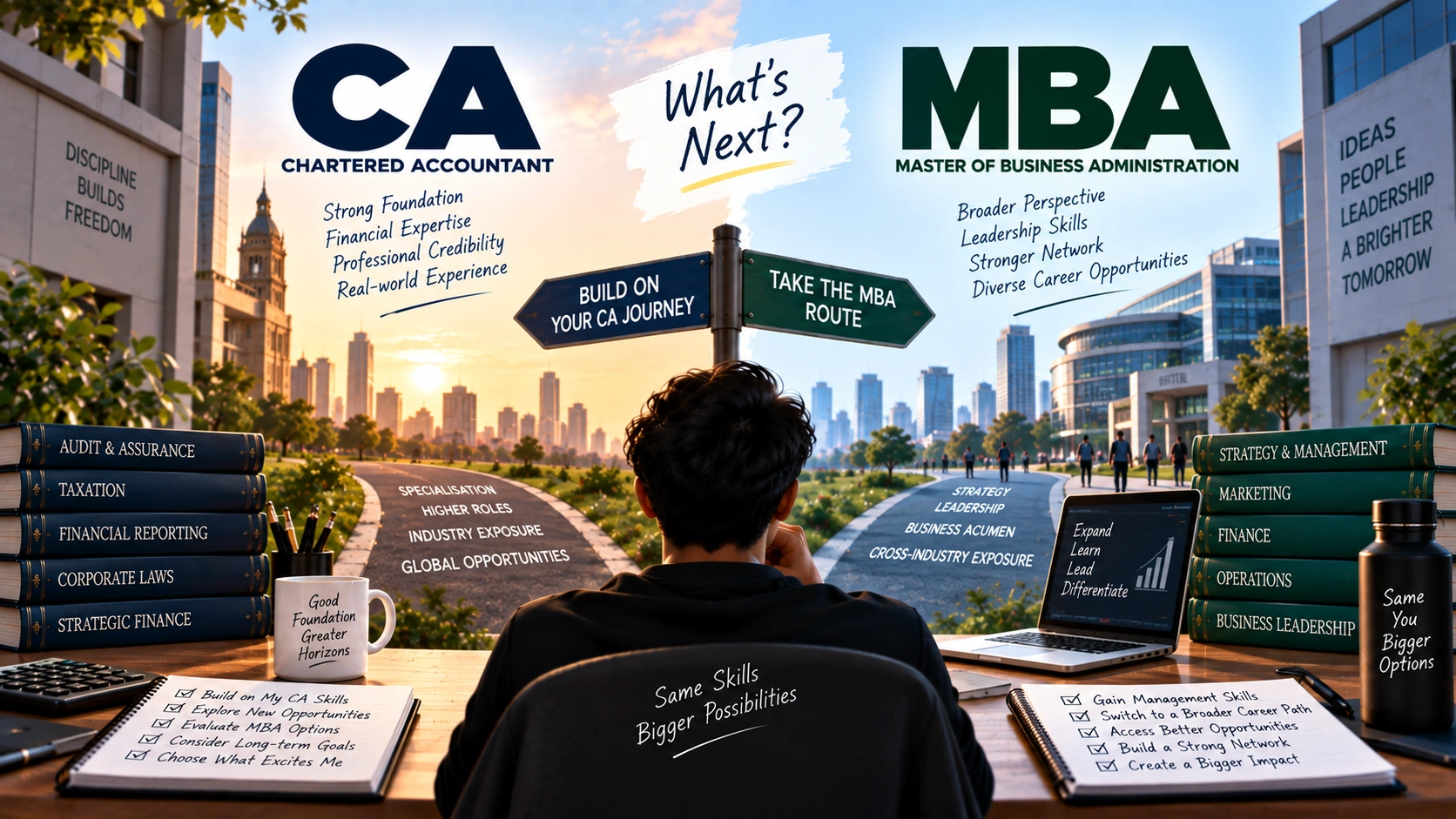
Qualified CA, a few years into a stable role, and the question keeps coming up. Does adding an MBA actually change anything about the trajectory, or is it just paying a lot of money and pausing a perfectly good career to collect another credential that looks impressive on LinkedIn?
For qualified CAs, MBA isn't an alternative to CA. It's a potential accelerator for a specific type of career move. The real question is whether the career pivot you're after actually requires an MBA, or whether CA experience alone gets you there faster and cheaper. Most qualified CAs who add a top-20 MBA do see a meaningful career shift. Mid-tier or distance MBA programs rarely justify the cost.
The actual numbers, side by side
| Qualified CA alone | MBA (Top-20 Indian Institute) | MBA (Executive/One-Year Program) | |
|---|---|---|---|
| Time required | Already completed, 4.5 to 5 years total | 2 years full-time | 1 year full-time |
| Cost in 2026 | Sunk cost for qualified CAs | 15 to 25 lakh including living expenses and opportunity cost | 30 to 40 lakh for ISB, similar tier |
| Opportunity cost | Already earning, typically 6 to 12 lakh starting | 2 years of forgone salary, typically 12 to 25 lakh | 1 year forgone salary |
| CA admission treatment | N/A | CA is treated as postgraduate equivalent, strengthens application | CA plus work experience is a strong profile |
| Placement access | ICAI campus placement for CA graduates | Institute placement cell, alumni network, consulting and corporate roles | Network-driven, lateral placement, often self-sourced |
| Starting salary range | 6 to 12 lakh CTC via ICAI campus placement | 25 to 35 lakh CTC for IIM-equivalent graduates | 30 to 50 lakh CTC depending on prior experience and program |
| Career paths unlocked | Audit, tax, statutory compliance, finance roles | General management, consulting, strategy, leadership roles beyond finance | Leadership roles, cross-functional moves, international assignments |
What MBA actually adds for a qualified CA
MBA doesn't teach you to be better at accounting. It teaches you to operate across functions, manage people and budgets at a broader level, and think about business problems beyond the financial statements.
For a CA who's been in audit or tax for a few years, the career pivot is real. MBA opens doors to consulting, strategy, general management, and leadership tracks that CA alone doesn't typically reach. The placement access at a top institute is a genuine differentiator, especially for lateral moves into industries or roles that don't recruit through ICAI channels.
The network effect matters more than people expect. An IIM or ISB alumni network gives you access to people in roles you'd otherwise have no organic way to reach. For career switches, this is often more valuable than the curriculum itself.
What MBA doesn't add
If you're already in a strong finance role, say FP&A, corporate finance, or financial controller at a mid-to-large company, an MBA may not move the needle as much as you think. The skill gap between where you are and where a finance leadership role requires you to be is often better closed through targeted certifications, CMA or CFA, or direct experience rather than a two-year generalist program.
Mid-tier and distance MBA programs are the most common waste of money for qualified CAs. The brand, network, and placement access are what you're paying for, and those are concentrated at the top 20 or so institutes. A distance MBA from a lower-ranked institute adds very little for someone who already has CA.
The cost that nobody calculates properly
The sticker price of MBA is straightforward. What most people undercount is the two years of forgone salary. A qualified CA earning 8 to 10 lakh per year is giving up 16 to 20 lakh in income on top of the 15 to 25 lakh tuition and living cost. The real total cost of a two-year MBA at a top institute is closer to 30 to 45 lakh when opportunity cost is included.
For a one-year executive program at ISB or equivalent, the opportunity cost drops to one year of forgone salary, but the tuition itself runs higher, 30 to 40 lakh. The calculus changes based on what you're currently earning and what the MBA placement outcome realistically looks like.
Where people get this decision wrong
The most visible mistake is doing MBA because everyone in the batch group is doing it, without a clear picture of what career move it's supposed to enable. Without a target role, MBA becomes an expensive pause.
The second mistake is choosing a mid-tier institute because the application process for top-tier programs feels daunting. The value of an MBA is heavily concentrated at the top few institutes. A mid-tier MBA rarely justifies the cost and time away from a CA career that's already progressing.
The third mistake is treating MBA as a solution to being stuck in a specific role. If the issue is burnout, a bad team, or a poorly matched company, a two-year break may not fix that. A job change within the same field is often faster and cheaper.
The actual decision
The real question isn't whether MBA is worth it in the abstract. It's whether the career move you're trying to make requires the specific things MBA provides: a placement network, a brand signal, cross-functional training, or access to a field like consulting or strategy that doesn't recruit through accounting channels.
If you want to stay in audit, tax, or statutory compliance, CA alone is sufficient and well-compensated. MBA doesn't add much here.
If you want to move into general management, consulting, strategy, or senior leadership roles outside pure finance, a top-tier MBA is a legitimate accelerator, and the investment can pay for itself within a few years.
If you're unsure about the target role, the most efficient move is to work for a few more years, clarify what you actually want, and then decide whether MBA is the right tool. Burning 30 to 45 lakh on a two-year pause without a clear direction is the most expensive way to figure it out.
CA plus MBA isn't always better than CA alone
CA is already a strong professional qualification. MBA adds value only when the career you want requires skills, access, or credentials that CA doesn't provide. For the right target, it's a genuine accelerator. For the wrong target, it's an expensive detour.
Quick answers
Things people usually want to know.
Should I do MBA after CA?
It depends on what you're trying to change. If you want to move from audit or compliance into general management, strategy, or leadership roles, a top-tier MBA adds real value. If you're already in a strong finance role, a mid-tier MBA may not justify the cost and career pause.
Is CA enough without an MBA?
For audit, tax, and statutory compliance roles, CA alone is sufficient and well-compensated. For movement into general management, consulting, or senior leadership in non-finance functions, MBA is often a faster or more direct route than CA alone.
What does a top MBA cost in India in 2026?
A two-year full-time MBA at an IIM or equivalent top-20 institute costs roughly 15 to 25 lakh including tuition, living, and opportunity cost. Executive MBAs at ISB or similar one-year programs run 30 to 40 lakh. International programs at US or European schools range from 50 lakh to 1 crore plus.
Does a CA get any MBA admission advantage?
Yes. ICAI CA is treated as a postgraduate equivalent for MBA admission at most Indian institutes. Some top programs also value CA holders for their analytical rigor and professional exposure. GMAT score, work experience, and interview performance still matter significantly.
Can I do MBA while doing CA articleship?
Technically possible but impractical for full-time programs. Part-time or executive MBA formats exist for working professionals, but they require employer support and significant time management. Most CA holders complete articleship first, then decide on MBA.
Which MBA specialisation is best after CA?
Finance is the natural extension if you want to deepen your finance expertise. Strategy or general management makes sense if the goal is to move into leadership roles beyond pure finance. Consulting is a strong fit for CAs who want broader problem-solving exposure.
Is distance MBA worth it for a qualified CA?
A distance or online MBA from a non-top-tier institute adds limited value for someone who already holds CA. The network, placement access, and brand recognition of a top full-time program are the main differentiators that justify the cost.
Does MBA after CA increase salary significantly?
At a top-20 institute, yes. IIM placement data shows average CTCs of 25 to 35 lakh for fresh MBA graduates, with experienced professionals commanding higher. At mid-tier or distance programs, the salary uplift over CA alone is minimal.
Should I do CA first or MBA first?
CA first, then MBA if needed, is the more common and efficient path. CA gives you a professional qualification with statutory authority that MBA alone cannot replicate. MBA is easier to add later as a career pivot tool than CA is to add after an MBA.
Can MBA replace CA entirely?
No. MBA and CA serve different purposes. MBA provides business and leadership breadth. CA provides accounting depth and statutory authority. For audit and tax practice, MBA is not a substitute. For general management and strategy roles, CA alone is not enough.