
CA vs CS vs CMA: The Three-Way Commerce Comparison (2026)
July 18, 2026 · 10 min read · by Shivam Kushwaha, HeyArtha founder
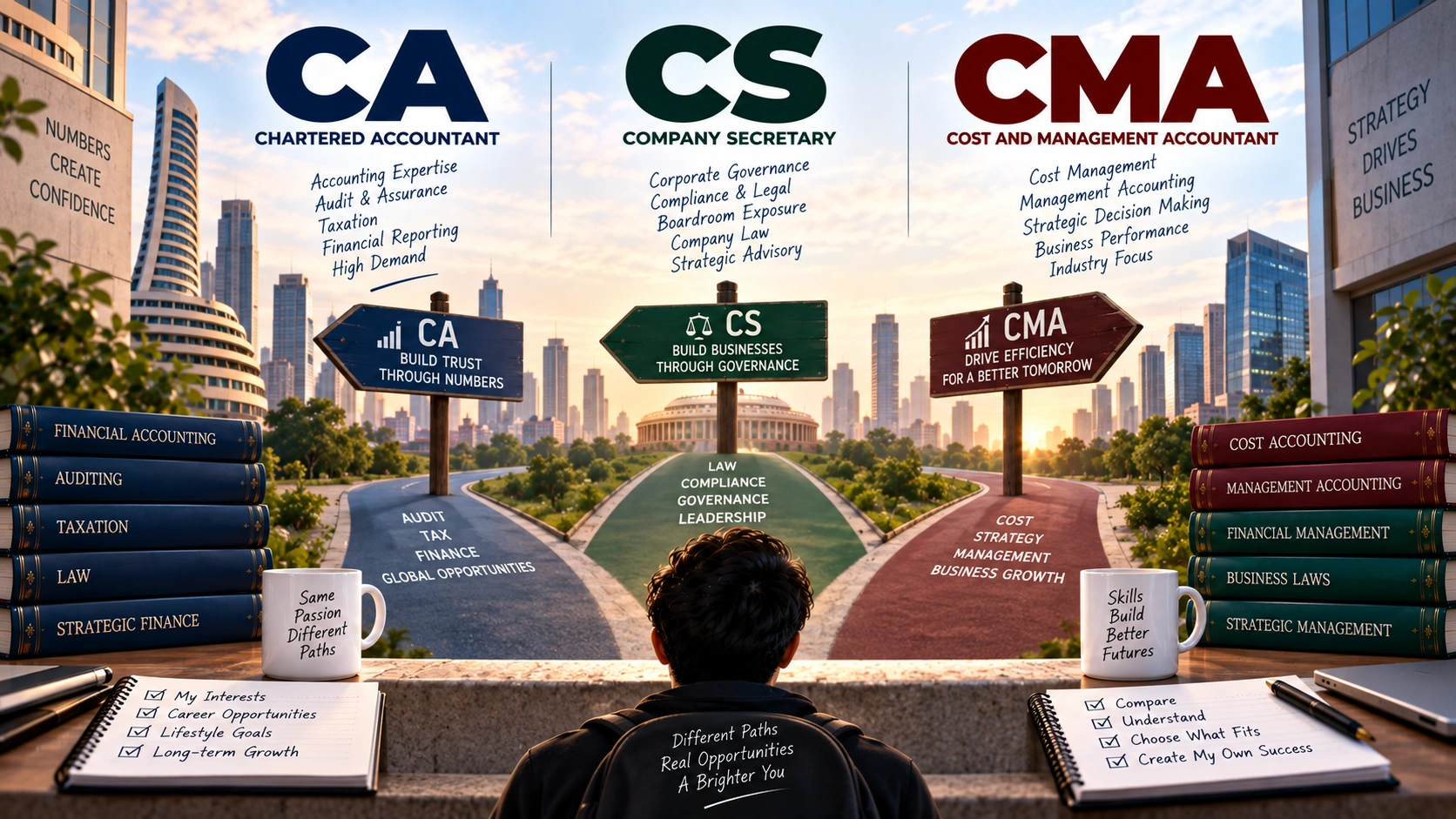
Second year of B.Com, and the family WhatsApp group has three different opinions running simultaneously. An uncle swears by CA because it's "the safest." A cousin's friend did CS and is apparently drafting board resolutions somewhere in Mumbai. Someone else mentions CMA and gets met with confused silence, because nobody in the group actually knows what a Cost and Management Accountant does day to day.
One careers360 thread captures the confusion honestly: someone simply asking which course is good, CS or CA, no further detail given, as if there's a single obvious answer sitting behind the question. There usually isn't, and adding CMA as a third option only makes the honest answer more complicated, not less.
CA, CS, and CMA are three separate institute-run credentials, each carrying a different specific legal authority in India: CA can sign statutory audit reports, CS holds secretarial and governance authority under the Companies Act, and CMA can sign cost audit reports. They're often compared as if they're competing for the same job. They aren't. Each one opens a genuinely different door.
The actual numbers, side by side
| CA (ICAI) | CS (ICSI) | CMA (ICMAI) | |
|---|---|---|---|
| Governing body | Institute of Chartered Accountants of India | Institute of Company Secretaries of India | Institute of Cost Accountants of India |
| Structure | Foundation, Intermediate, 3-year Articleship, Final | CSEET, Executive, Professional | Foundation, Intermediate, Final |
| Typical duration | 4.5 to 5 years including articleship | 3 to 4 years including mandatory training | 3 to 4 years including practical training |
| Statutory authority | Can sign statutory audit reports under the Companies Act | Secretarial and governance authority; certifies compliance for listed companies under Companies Act and SEBI regulations | Can sign cost audit reports under the Companies Act |
| CA Final pass rate | 19.88% both-groups combined (May 2024 session); 13.44% both-groups combined (Nov 2024 session), per ICAI | Not applicable | Not applicable |
| Core focus | Audit, taxation, statutory compliance, financial reporting | Corporate governance, secretarial compliance, board processes, regulatory filings | Cost accounting, cost audit, budgeting, management accounting |
| Where it's valued most | Statutory audit practice, tax practice, industry finance roles requiring CA specifically | Listed companies, governance and compliance roles, company secretary mandates under SEBI LODR | Manufacturing, PSUs, cost-audit mandated companies, cost-control roles |
| Daily work texture | Client audits, tax filings, financial statement review, often in a professional-services office environment | Board meeting minutes, regulatory filings, compliance calendars, governance advisory | Cost sheets, variance analysis, budgeting cycles, often closer to factory-floor or plant-level operations |
Salary figures for all three circulate widely and conflict substantially across sources, since coaching institutes selling each credential have an obvious incentive to present their own course favourably. Treat any specific salary comparison across all three as a reported estimate rather than a verified fact.
What CA is actually for
CA exists to protect one specific legal function: the authority to sign an Indian statutory audit report. The three-year articleship, spent doing real client work inside a live CA firm at trainee pay, is the mechanism by which that authority gets earned through practice, not just exam performance. Someone taking CA seriously is usually picturing statutory audit, tax practice, or an industry finance role where the credential's specific legal weight matters directly.
The daily texture of CA work, especially post-qualification, often runs through professional-services environments: audit engagements, tax filings, financial statement reviews, frequently in an office setting with structured hours built around client deadlines and filing cycles. It's demanding, particularly during audit season, but it's a fundamentally different daily rhythm from either CS or CMA work.
The real limitation is scope, not prestige. CA's authority is specifically audit and tax-focused. Someone whose actual interest is corporate governance or cost management will find that CA's training, while broad within accounting, doesn't build the specific secretarial or cost-accounting skill set those other two paths are built around.
What CS is actually for
CS exists to protect a different legal function entirely: secretarial and governance compliance, particularly for listed companies operating under SEBI's LODR regulations. A qualified Company Secretary certifies that a company's board processes, filings, and governance practices meet regulatory requirements, work that runs through board meeting minutes, compliance calendars, and regulatory filings rather than financial statement audits.
One Quora answer describing a CA-versus-CMA decision put the daily contrast in blunt, concrete terms that applies just as well against CS: CA work tends to happen in a structured office environment on a fixed schedule, while the other two paths pull toward genuinely different physical and procedural environments, board rooms and compliance calendars for CS, factory floors and cost data for CMA.
The real limitation CS shares with CMA is that its legal authority is narrower and more specific than CA's broader audit mandate. A CS cannot sign a financial statement audit. It's deep in governance and compliance specifically, not broad across accounting the way CA's training is, and that's exactly the trade-off worth understanding before committing years to it.
What CMA is actually for
CMA exists to protect yet another function: cost audit authority, specifically the legal right to sign a cost audit report where Indian company law requires one. That statutory weight is why CMA's structure, three levels spread across several years including practical training, mirrors CA's slower, practice-anchored design rather than a faster certification model.
The daily work leans toward cost sheets, variance analysis, and budgeting cycles, often with real exposure to manufacturing or plant-level operations in a way CA and CS work typically doesn't involve as directly. Someone drawn to being closer to actual production and cost data, rather than either audit engagements or board-level governance work, will find CMA's daily rhythm distinctly different from the other two paths.
The real limitation, much like CS, is that CMA's signing authority is limited specifically to cost audits, not general statutory audits the way CA's is. It's a specialist credential protecting one specific function well, not a broader accounting qualification, and someone expecting CA-level breadth from CMA will find the scope narrower than anticipated.
Where people get this decision wrong
The most common mistake is choosing based on which one sounds more prestigious in the family conversation rather than which daily work actually fits someone's temperament. CA often gets chosen by default because it's the most widely recognised name, even by people who would genuinely prefer CS's governance-and-compliance rhythm or CMA's more operations-adjacent, factory-connected work, simply because nobody explained that these are three meaningfully different jobs wearing similar-sounding credential names.
A second pattern shows up in people assuming CS or CMA are simply "easier, backup" versions of CA, chosen specifically because CA's pass rates look intimidating. That framing misunderstands what each credential is actually for. CS and CMA aren't lesser versions of CA, they're specialist credentials protecting entirely different legal functions, and someone who picks CS purely as a CA fallback, without genuine interest in governance and compliance work, often finds the daily reality doesn't match what they expected from a "backup plan."
A third pattern involves people pursuing all three simultaneously or in close succession without a specific role in mind that actually needs the combination. Holding CA, CS, and CMA together can be a genuinely powerful differentiator for senior finance, governance, or CFO-track roles specifically, but pursuing all three without that clear destination in view means years of additional study for credentials whose value depends heavily on whether the target role actually screens for all three together.
The actual decision
The real question isn't which of the three is objectively best. It's which specific legal authority and which daily work rhythm you actually want. If your picture involves statutory audit, tax practice, or broad industry finance work, CA's structure and authority is built for exactly that, even though it's the longest and most competitive of the three paths by pass-rate difficulty.
If instead you're drawn to governance, board processes, and regulatory compliance, particularly for listed companies, CS is the credential built specifically for that world, and it's a genuinely distinct career from either CA or CMA, not a lesser version of either. If cost accounting, budgeting, and closer operational involvement with manufacturing or production data appeals to you more than audit or governance work, CMA is the specific credential protecting that function. Some professionals do pursue combinations, particularly CA plus CS or CA plus CMA, deliberately for senior finance and governance leadership roles, but the sequencing matters, and starting with the one that matches your actual interest tends to beat collecting credentials reflexively.
Where Artha fits
I built CA Talks on Artha because these three-way decisions get flattened into "which is the safest choice" far too often, without anyone pointing out that CA, CS, and CMA are genuinely different jobs with different daily textures, not three difficulty tiers of the same career.
I'm not selling any of the three. I just wanted this comparison written by someone with nothing riding on which one you pick.
Three doors, not one ranking
CA, CS, and CMA aren't stacked in order of prestige the way family conversations sometimes make it sound. Each one protects a specific legal function nobody else can perform, audit, governance, or cost audit, and each leads toward a genuinely different daily working life. The comparison only gets useful once "which is best" becomes "which room do I actually want to work inside."
Which of the three, audit, governance, or cost accounting, actually sounds like work you'd want to be doing five years from now?
Quick answers
Things people usually want to know.
Which is better, CA, CS, or CMA?
None is universally better. CA carries statutory audit authority, CS carries secretarial and governance authority, and CMA carries cost audit authority, three distinct legal functions. The right choice depends on which specific work and authority genuinely interests you.
Can I do CA, CS, and CMA together?
Yes, though it's a significant time and cost commitment. Holding all three can be a strong differentiator for senior finance, governance, or CFO-track roles, but it's worth pursuing only with a specific target role in mind, not as a default "more is better" strategy.
Which is the hardest, CA, CS, or CMA?
CA is generally considered the most competitive by both-groups pass rate, which has run between roughly 13 and 20% across recent ICAI sessions. CS and CMA pass rates are less consistently published, but both involve genuinely demanding multi-level structures with mandatory practical training.
What does a Company Secretary actually do day to day?
CS work centers on board meeting minutes, regulatory filings, compliance calendars, and governance advisory, particularly for listed companies operating under SEBI's LODR regulations. It's meaningfully different from CA's audit-focused work.
What does a CMA actually do day to day?
CMA work centers on cost sheets, variance analysis, budgeting cycles, and cost audit, often with real exposure to manufacturing or plant-level operations, distinct from both CA's audit focus and CS's governance focus.
Is CMA a backup option for people who can't clear CA?
No, and treating it that way often leads to disappointment. CMA is a specialist credential with its own statutory authority (cost audit signing rights) and its own daily work texture, closer to operations and manufacturing, not a lesser version of CA.
Which pays more, CA, CS, or CMA?
Salary comparisons across all three online are almost entirely coaching-sourced and conflict significantly, since each institute's own marketing has an incentive to present its credential favourably. Pay depends heavily on specific role, sector, and company rather than credential alone.
Can a CS sign statutory audit reports?
No. Only ICAI-qualified Chartered Accountants can sign statutory audit reports under the Companies Act. A CS's authority is specifically secretarial and governance-related, not audit-related.
Can a CMA sign the same audit reports as a CA?
No. A CMA's statutory signing authority is limited specifically to cost audit reports, not the general statutory financial audits that only CAs can sign.
Should I choose based on which one my family recommends?
Family input matters, but the daily work of CA, CS, and CMA genuinely differs, office-based audit work, governance and compliance work, and operations-adjacent cost accounting work respectively, so it's worth understanding which one actually fits your interests before committing years to any of the three.
More from HeyArtha
Other things we've been writing about.
Passed All the Exams, Still Not Qualified: The ACCA/CFA Limbo
You cleared every paper. Youre still not a member or a charterholder. Heres why that gap exists, and what to actually do about it.
ACCA Exemptions After CA or B.Com: What You Actually Skip
A CA can skip up to 9 of 13 ACCA papers. A B.Com grad usually skips 3-4. Heres exactly what you keep, what you still sit, and what it costs.
ACCA Job Prospects in India: Beyond the Only Useful Abroad Myth
ACCA freshers in India earn 4-10 LPA, and GCCs actively prefer it. Heres the honest picture of what ACCA actually opens up domestically.