CA vs ACCA: The Real Cost, Duration and Rights Compared (2026)
November 11, 2026 · 10 min read · by Shivam Kushwaha, Artha founder
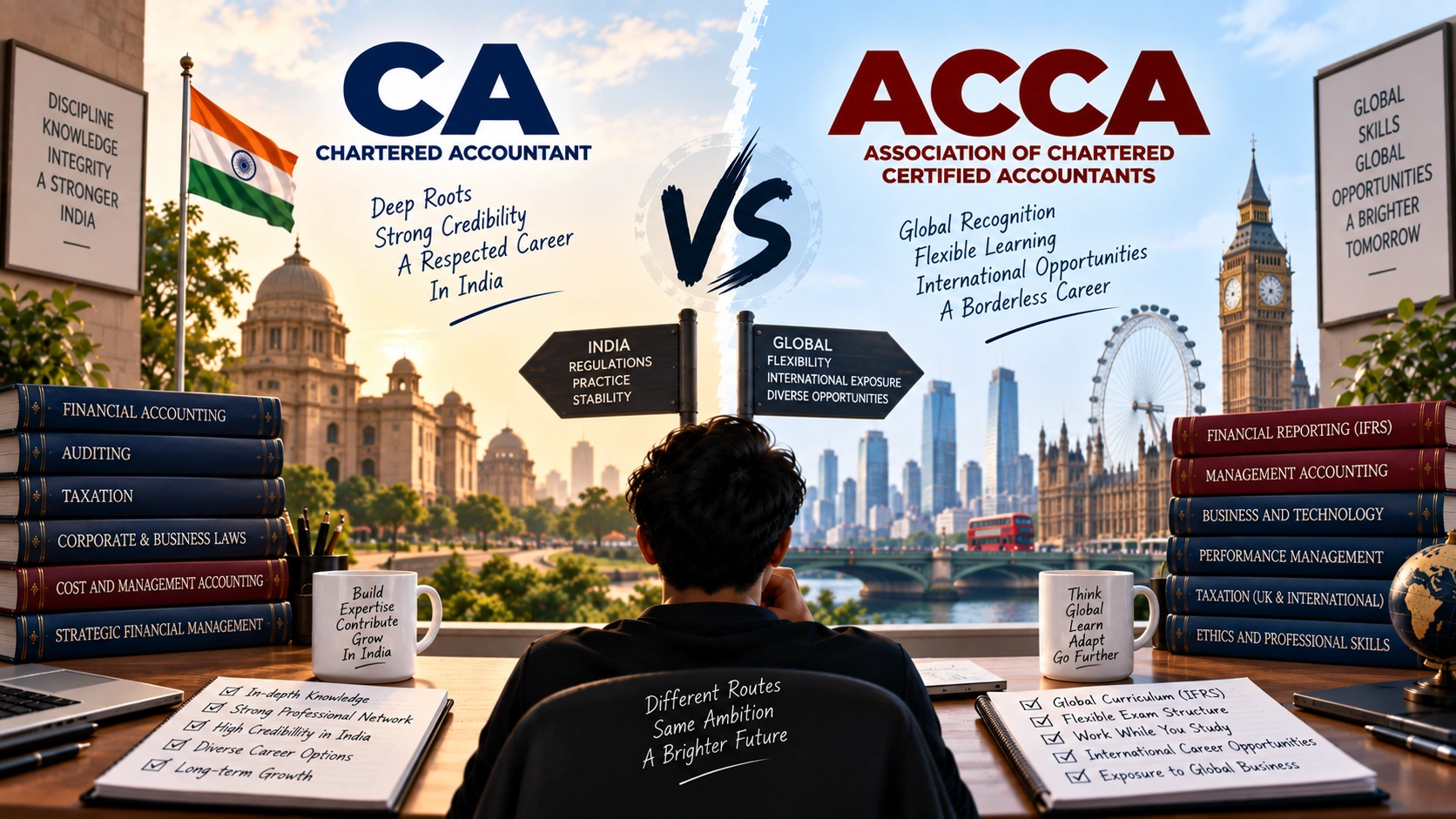
Second year of B.Com, and half the batch has started saying "ACCA" in the same breath they used to only say "CA." Someone's older cousin is already qualified through it, working out of a Big 4 office abroad, and suddenly the five-year Indian path looks a lot slower by comparison.
Search "CA vs ACCA" right now and almost every result comes from an institute that sells ACCA coaching. Their tables aren't wrong exactly, but their verdict was decided before the article was written. Nobody selling ACCA coaching is going to lead with the one thing ACCA structurally cannot give you in India.
CA takes roughly 4.5 to 5 years and is the only credential with statutory audit-signing authority under Indian law. ACCA typically takes 2 to 3 years for someone with exemptions, offers globally recognised membership across 180 countries, but carries no signing rights in India. They solve different problems for different careers.
The actual numbers, side by side
| CA (ICAI) | ACCA (ACCA Global) | |
|---|---|---|
| Governing body | Institute of Chartered Accountants of India | Association of Chartered Certified Accountants (UK-headquartered, global) |
| Structure | Foundation, Intermediate, 3-year Articleship, Final | 13 papers across Applied Knowledge, Applied Skills, Strategic Professional, plus Ethics module |
| Typical duration | 4.5 to 5 years including articleship | 2 to 3 years for candidates with CA/CMA exemptions; longer without them |
| Statutory rights in India | Only CAs can sign statutory audit reports under the Companies Act | None. ACCA membership carries no signing authority under Indian law |
| Global recognition | Primarily India-specific | Roughly 180 countries, officially benchmarked to Master's level |
| Exemptions for Indian CAs | Not applicable | Up to 9 paper exemptions covering Applied Knowledge and Applied Skills entirely |
What CA is actually for
CA's entire structure exists to protect one thing: the legal weight behind an Indian statutory audit signature. That's why the path runs through three years of articleship inside a live CA firm, doing real client work at trainee pay, well before the Final exam is even attempted.
ICAI's own placement data gives a sense of scale: the institute's May 2024 session alone admitted over a lakh candidates to CA Final and qualified more than 20,000 new CAs across 484 centres nationwide.
The real limitation is geography, not rigor. CA's authority lives almost entirely inside Indian law.
What ACCA is actually for
ACCA was built from the ground up as a global qualification. Thirteen papers across three levels, but Indian CAs and CMAs typically qualify for exemptions covering the entire Applied Knowledge and Applied Skills levels.
ACCA's real strength shows up in roles that need IFRS fluency and cross-border recognition. UK firms, Middle East finance teams, and multinational companies operating across Commonwealth-linked jurisdictions frequently list ACCA specifically.
The real limitation runs the other way from CA's. ACCA membership carries zero signing authority under Indian company law.
Where people get this decision wrong
The most common mistake is choosing based on which path sounds faster without checking what the destination role actually requires. Someone drawn to ACCA purely because 2 to 3 years sounds better than 5 sometimes skips checking whether their actual target, an Indian statutory audit career, is even reachable through ACCA at all.
The reverse mistake happens just as often. Someone commits to the full CA path specifically because they're chasing an international or UK-facing career, assuming CA's difficulty alone will translate into global recognition. It often doesn't translate as cleanly as expected.
A third pattern shows up specifically because of how conflicted the ranking content is. Since most institutes writing comparisons are themselves selling ACCA prep, students sometimes absorb a framing where ACCA is presented as the modern choice and CA as the outdated one.
The actual decision
The real question isn't which one is objectively better. It's which authority and which geography you're actually building toward. If your five-year picture involves Indian statutory audit, tax practice, or any role where a client or employer specifically needs ICAI's legal signing rights, CA is the credential structurally built for that.
If instead you're picturing IFRS-based reporting, a UK or Middle East-facing role, or a multinational finance team where ACCA's specific global recognition matters more than Indian statutory authority, ACCA gets you there in a shorter, more predictable timeline.
Two doors, not one better path
CA and ACCA aren't really competing for the same job. One buys you legal authority inside India. The other buys you a globally portable credential built around a different accounting standard entirely.
Which world are you actually trying to build a career inside, Indian statutory work, or something global and IFRS-facing?
Quick answers
Things people usually want to know.
Is ACCA better than CA in India?
Neither is objectively better. CA carries statutory audit-signing rights under Indian law that ACCA does not have here. ACCA offers broader global recognition and IFRS-focused training. The right one depends entirely on whether your target career is India-anchored or internationally facing.
Can a CA get exemptions in ACCA?
Yes, qualified Indian CAs are typically eligible for up to 9 paper exemptions with ACCA, covering the entire Applied Knowledge and Applied Skills levels.
Does ACCA allow you to sign audit reports in India?
No. Only ICAI-qualified Chartered Accountants can sign statutory audit reports under Indian company law, regardless of ACCA membership or seniority.
Which takes longer, CA or ACCA?
CA typically takes 4.5 to 5 years including mandatory articleship. ACCA can take as little as 2 to 3 years for candidates with CA or CMA exemptions, though it takes considerably longer for someone starting from scratch.
Is ACCA recognised in India for jobs?
Yes, ACCA is recognised by many MNCs, Big 4 firms, and GCCs operating in India, particularly for roles involving IFRS reporting or global finance functions. It is not recognised as equivalent to CA for Indian statutory audit purposes.
How much does ACCA cost compared to CA?
Reported figures put ACCA's total cost, before tuition, at roughly Rs.2.4 to 3.5 lakh based on ACCA Global's published fee schedule, and CA's total cost at roughly Rs.2 to 3 lakh based on coaching-sourced estimates.
Can I do both CA and ACCA?
Yes, and it's a genuinely common path. Many candidates complete CA first for Indian statutory authority, then pursue ACCA's exempted route afterward to add IFRS-facing global recognition on top.
Is the ACCA exam easier than CA Final?
They're difficult in different ways. ACCA's Strategic Professional papers are individually demanding, but the qualification is broken into smaller, more frequently-sittable exams. CA Final concentrates difficulty into fewer, larger attempts with historically low both-groups pass rates.
What jobs actually require ACCA specifically in India?
Roles at Big 4 firms' global delivery centres, MNC finance teams reporting under IFRS, and companies with UK or Middle East-linked operations frequently list ACCA by name in job descriptions.
Should I choose ACCA over CA just because it's faster?
Only if your target career doesn't require Indian statutory audit authority. Choosing ACCA purely for speed without checking whether your actual target role needs CA's specific legal rights is one of the most common regretted decisions.