CA Foundation First Attempt Fear: What It Feels Like
November 6, 2026 · 9 min read · by Shivam Kushwaha, Artha founder
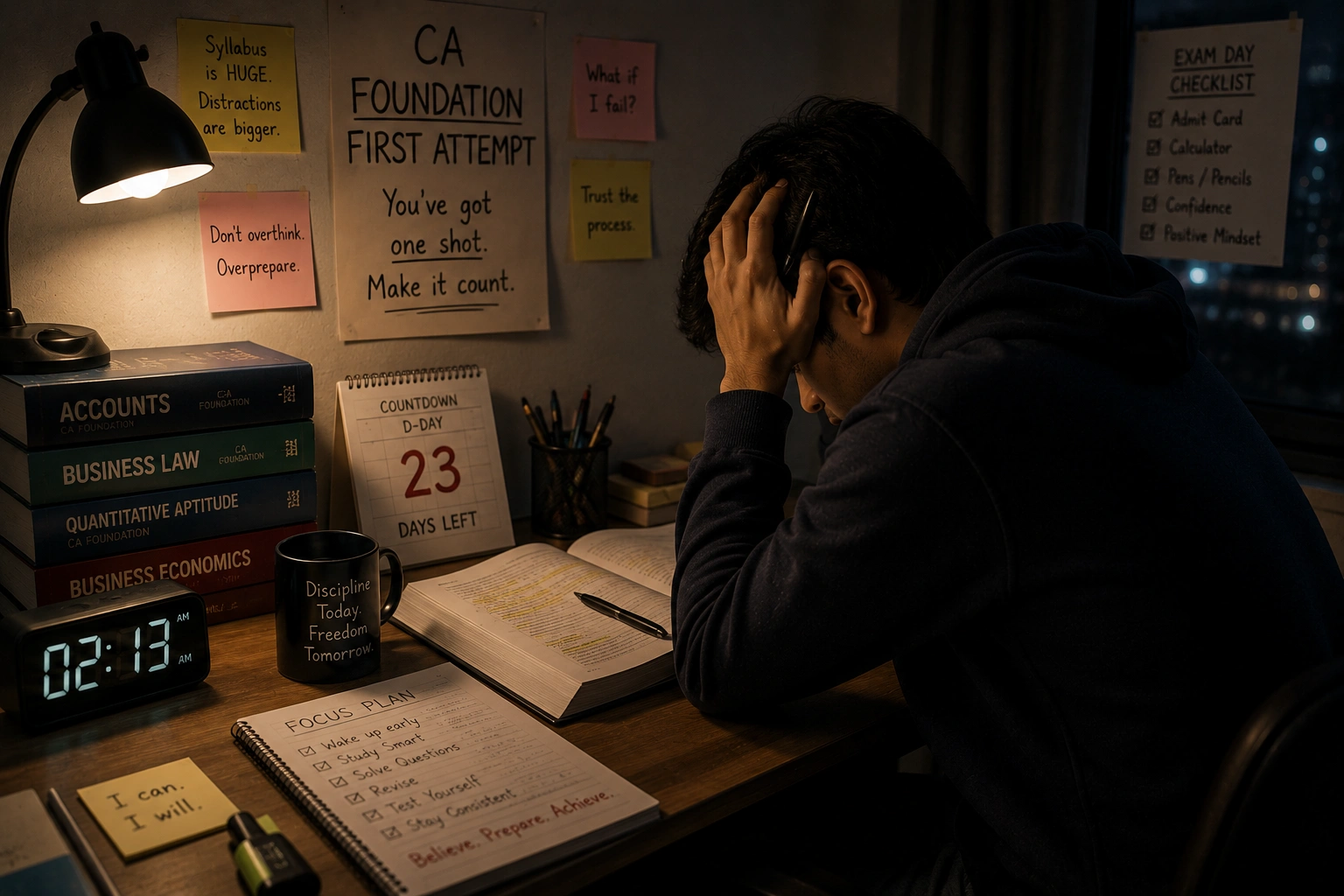
6:40am, the day of your first CA Foundation paper. You're re-reading a formula you've read maybe two hundred times this month, and it still doesn't feel like it's actually inside your head. It feels borrowed, like you memorized someone else's understanding and you're about to be found out. Your mother knocks and asks if you've eaten. You say yes. You haven't. Downstairs someone's already telling a neighbor "beta CA kar raha hai" like it's already decided, like the exam hasn't even started yet and the outcome is already promised to people who aren't sitting for it.
Why the First Attempt Feels Bigger Than It Is
Here's what's actually true about CA Foundation first attempt fear: it's rarely about the syllabus. Most students who freeze up before this exam know the material reasonably well. What they're actually afraid of is what the attempt represents, the first real test of whether the decision to pursue CA, a decision often made at seventeen or eighteen based on very little real information about what the path involves, was the right one. That's an enormous amount of meaning to load onto four papers.
Everyone tells you "it's just the first attempt, no pressure," and it's meant kindly, but it doesn't land the way people intend. Because if it's genuinely no pressure, why does everyone in the family already know the exam date? Why has your name already come up in three different conversations with relatives who aren't even that close to your parents? The pressure is real even when people insist it isn't, and pretending otherwise just makes you feel like you're overreacting to something that clearly isn't imaginary.
There's also a specific kind of fear that comes from not yet knowing your own capacity under this kind of exam pressure. You've done board exams, sure, but CA Foundation is often the first time the stakes feel connected to an actual identity, chartered accountant, rather than just a grade on a report card. Nobody's ever tested that particular nerve in you before, so of course it feels enormous. You don't have a reference point yet for how you handle it.
And unlike board exams, where almost everyone around you was going through the exact same thing at the exact same time, CA Foundation splits people apart early. Some of your school friends went straight into a regular BCom or engineering, and they're already three weeks into a fairly relaxed first semester while you're still deep in cost accounting formulas at 6am. That divergence adds its own quiet ache, a sense of having chosen a harder, lonelier road, even if you don't regret the choice itself.
What Fear Actually Does to Your Preparation
Here's something that actually surprised me when I first read about it: research on test anxiety suggests it doesn't mainly hurt you by scrambling your brain during the exam itself. A review by researchers Theobald, Breitwieser, and Brod found that once you control for how much a student actually knows, test anxiety stops predicting exam performance, meaning the damage isn't happening in the exam hall, it's happening in the weeks before, in how anxious students end up preparing (The Learning Scientists' summary of the research). Fear doesn't break your brain on result day. It quietly sabotages the studying that happens beforehand.
That tracks with what actually seems to happen to CA Foundation students who are scared. Fear doesn't just sit in the background while you study, it changes how you study. You feel behind, so you panic-study longer hours with less sleep, which makes your retention worse, which makes you feel further behind, which increases the panic. Around and around it goes, and it can eat weeks of prep time without you ever consciously deciding to waste them.
The other thing fear does, quietly, is make you avoid diagnostic honesty. It's genuinely uncomfortable to sit a mock test and see exactly where you're weak when you're already scared of the real exam, so a lot of students under-test themselves, doing endless reading and revision instead of the more useful, more anxiety-provoking work of taking timed papers and confronting actual gaps. Reading feels safer than testing. It's also far less effective, and somewhere underneath the fear, most students already sense that, which is exactly why the research above matters. The fear isn't lying to you about how serious the exam is. It's lying to you about what actually helps.
There's a specific version of this that hits particularly hard in the final two or three weeks, something a lot of students going through the last stretch before CA Final describe too, even though that's a different exam entirely, the isolation and the narrowing focus start early. You stop replying to friends. You eat at odd hours. The exam becomes the only thing that exists, and while that might sound like dedication, past a certain point it stops helping and starts just adding more raw fear to the mix.
What the Fear Is Actually Protecting
It's worth asking, honestly, what the fear is trying to protect you from, because fear almost always has a job it's trying to do, even when it's doing that job badly. A lot of CA Foundation fear is protecting a specific self-image, the version of you that told your extended family you're going to be a CA, the version that would have to face them if this doesn't go the way it's supposed to. The fear isn't really about the exam content. It's about not wanting to be seen as having failed at something you announced publicly.
That's a heavy thing to be quietly carrying into an exam hall, and it's worth naming it plainly, because once you can see the fear for what it actually is, a fear of social consequence rather than a fear of the syllabus, it becomes a little easier to separate "did I understand this material" from "what will people think." Those are two completely different questions, and only one of them is something you can actually control in the exam hall.
If the result doesn't go your way this time, there's a very real grief that follows, and it's worth knowing in advance that that grief is a real thing, not an overreaction. It's not just disappointment about a number. It's grief for the version of the story you'd already told people, the one where this attempt was supposed to be the whole plan. That grief deserves space, not a rushed "it's okay, try again next time" from someone who wants the discomfort to end quickly.
It also helps to remember that CA Foundation, specifically, was never designed as a one-shot filter. It exists earlier in the CA journey precisely so students get an honest, lower-stakes read on where they stand before the much longer and more expensive Intermediate and Final stages. Treating your first attempt as the entire verdict on your CA prospects skips over the fact that the exam itself was built with room for more than one attempt in mind.
What Actually Helps Before an Attempt Like This
Talking about the fear out loud, to literally anyone, tends to shrink it faster than any amount of additional revision. Fear that stays unspoken tends to grow in the dark, mostly because your imagination fills in worse outcomes than reality usually delivers. Saying it out loud, even just "I'm really scared about this exam," to a friend, a sibling, anyone who won't immediately try to fix it or minimize it, does something that more studying can't.
Mock tests under real timing conditions matter more than most students believe, not because they teach new content, but because they let you rehearse the actual physical experience of exam pressure in a lower-stakes setting, so the real exam feels a little more familiar and a little less like free fall. If you've genuinely done that groundwork, and most people who are scared have actually done more preparation than their fear is telling them, the fear at this point is mostly noise, not signal.
There's also a specific, small thing that helps more than it should, writing down what you're actually afraid of, in plain words, instead of letting it stay a vague cloud of dread. "I'm afraid I'll blank on the accounting standards" is a fear you can prepare against directly. "I'm afraid of everything" isn't, and it's usually a stand-in for something more specific your brain hasn't let you look at yet. Naming the actual fear shrinks it down to a size you can actually work with.
It also helps to remember what happens after, whichever way this goes. Most CA students eventually go through a version of the wait between finishing your papers and the result more than once across the full CA journey, and by the third or fourth time, the waiting itself stops feeling like the end of the world, even though it never stops being uncomfortable. This is your first time in that particular waiting room. It won't feel small right now, but it does get more familiar.
Something smaller, and easy to skip, actually matters more than it sounds like it should, sleep in the two or three nights right before the exam. Not because eight hours will magically improve your grasp of standard costing, but because a rested brain handles fear noticeably better than an exhausted one. An anxious thought at 2am after five hours of broken sleep feels catastrophic in a way the exact same thought doesn't at 9pm after a decent night's rest. If you have to choose between one more revision pass and actual sleep the night before, choose the sleep. Your fear will thank you for it, even if it doesn't feel that way while you're lying there wide awake anyway.
Where Artha Fits, If It Does
A lot of what makes this fear so heavy is that it's genuinely hard to say "I'm terrified I'm going to fail" to the people who are counting on you the most, your parents, your relatives, even close friends who've never gone through CA prep themselves and can't quite picture what it feels like from the inside. That's part of what CA Talks on Artha exists for, a place to say the scared version of the truth to someone who's actually sat where you're sitting, anonymously, without having to manage how it lands on someone who needs you to be okay.
The fear you're carrying right now doesn't mean you're unprepared. Fear before something that genuinely matters is not a malfunction, it's a fairly ordinary response to caring about an outcome you can't fully control. Whatever the result turns out to be, the version of you sitting for this exam today already did the hard part, showing up scared and going in anyway.
What's the thing about this exam you're most afraid people will think, if it doesn't go your way?
Quick answers
Things people usually want to know.
Is it normal to feel intense fear before your first CA Foundation attempt?
Extremely normal. It's rarely about the syllabus itself, it's usually about what the attempt represents, the first real test of a decision made with limited real information about the path ahead.
Does test anxiety actually make you perform worse in the exam hall?
Research suggests the damage mostly happens before the exam, not during it. Once actual knowledge is accounted for, test anxiety stops predicting performance, meaning fear mainly hurts you by sabotaging how you prepare, not by breaking your brain in the hall.
Why do I avoid taking mock tests even though I know they help?
Because mock tests force you to see your actual weak spots, which is uncomfortable when you're already scared. Reading and revising feels safer, even though timed practice tests are far more effective preparation.
What if I fail my first CA Foundation attempt?
CA Foundation was never designed as a one-shot filter. It exists specifically to give an honest, lower-stakes read before the longer Intermediate and Final stages. A first-attempt setback is common and does not close the path.
How do I stop comparing myself to friends who took an easier academic path?
That comparison is natural, especially since CA splits you away from peers who went the regular BCom or engineering route. It helps to remember you're not on the same timeline as them, and you were never trying to be.
Should I pull all-nighters right before the CA Foundation exam?
Generally no. A rested brain handles fear and pressure noticeably better than an exhausted one. If you have to choose between one more revision pass and sleep the night before, sleep usually serves you better.
How do I deal with relatives who already assume I will clear it easily?
You don't have to manage their expectations in advance. A simple 'I'm preparing as best I can, we'll see' is enough. Their assumptions are not a responsibility you need to carry into the exam hall.
Why does naming my specific fear help more than just trying to stay positive?
A vague fear like 'I'm afraid of everything' is unusable. A specific fear like 'I'm afraid I'll blank on accounting standards' can actually be prepared against, which is why naming it plainly tends to shrink it.
Is it okay to tell someone I am scared instead of pretending I am fine?
Yes, and it often helps more than extra revision. Fear that stays unspoken tends to grow, mostly because imagination fills in worse outcomes than reality usually delivers.
How many attempts does it typically take to clear CA Foundation?
It varies widely, and multiple attempts across the CA journey overall are extremely common. One attempt not going as planned says very little about your eventual outcome as a chartered accountant.