CA Final Result Day Anxiety: Your Future on the Line
November 5, 2026 · 9 min read · by Shivam Kushwaha, Artha founder
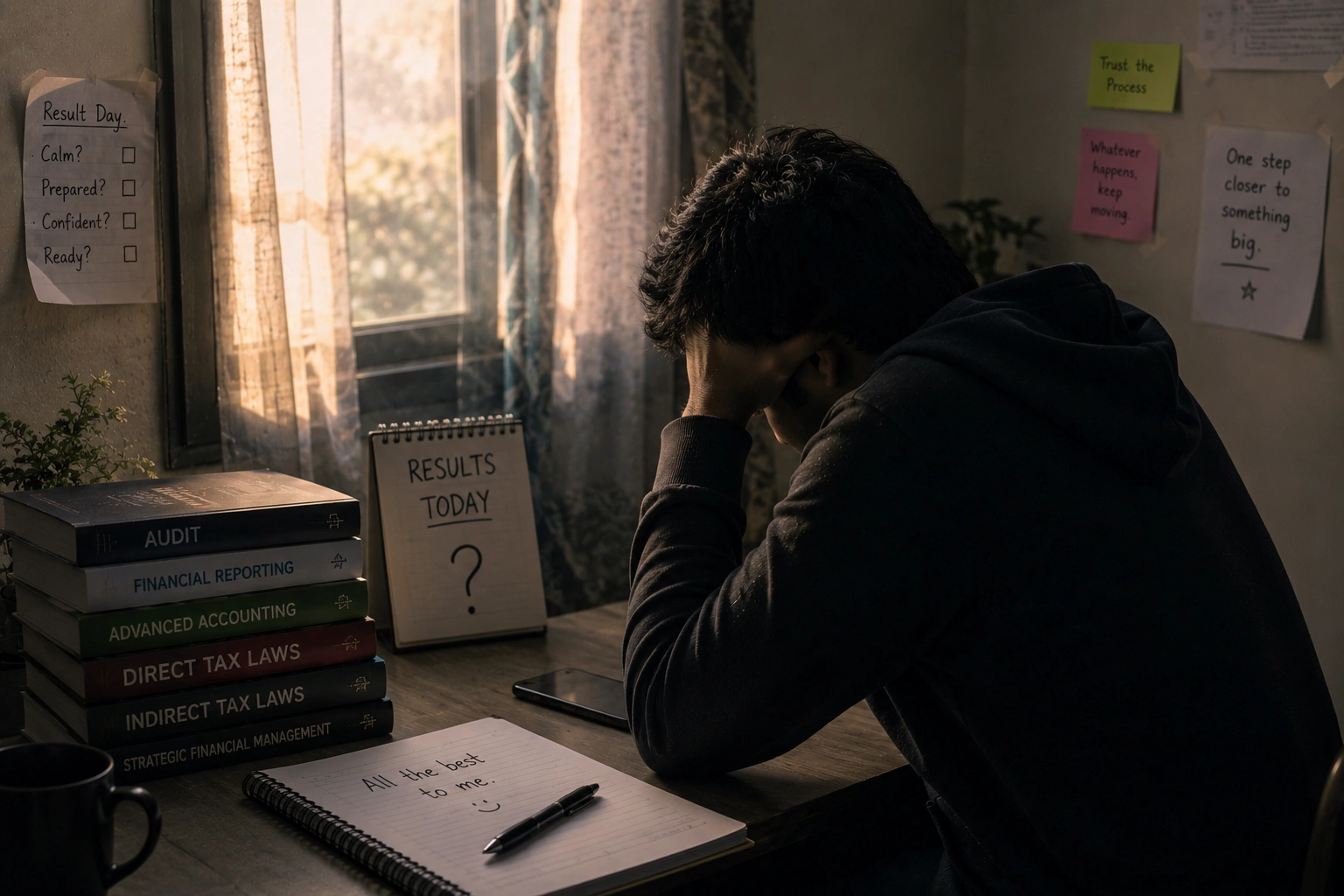
11:58am. The ICAI portal has been "loading" for six minutes. You've refreshed it so many times your thumb feels sore, and somewhere between refresh forty and refresh sixty you stopped being able to read the loading spinner as just a spinner. It looks like it's mocking you. Your mother has asked twice if the result is out. You've told her twice, in the same flat voice, "not yet." Your phone is at 94% and you're still worried it'll die before the page loads, which makes no sense, but nothing about today makes sense.
Why Result Day Feels Like Nothing Else
Here's the honest answer to why CA Final result day anxiety hits so much harder than almost any other exam result: it's not really about one exam. It's about years compressing into a single loading screen. Two attempts, maybe three. Eight, ten, twelve months of nine-hour study days per attempt. Articleship exhaustion stacked underneath all of it. By the time result day arrives, the number on the screen isn't just pass or fail, it's whether all of that was worth it, and your brain knows that even if you keep telling yourself it's "just a result."
Everyone around you calls it exciting. Your relatives are already asking what time the result comes, like it's a cricket match score. But excitement isn't really what's happening in your body right now. It's closer to dread wearing excitement's clothes, and that gap between how you're supposed to feel and how you actually feel is its own quiet kind of lonely.
The waiting itself does something specific to your nervous system. It's not the number that's hard, oddly enough, it's the not-knowing right before the number. Once it's out, whatever it is, at least your brain gets to stop running the same loop. Right now, though, you're stuck in the loop, and the loop doesn't care that you've already done everything you could do.
If you've been through the wait between finishing your papers and today, you already know this particular flavor of dread has stages. First there's relief that the exam itself is over. Then, within a week or two, a slow-building unease that gets worse the closer result day gets, not better. By the morning of, most people describe something closer to nausea than nerves. None of that is you being dramatic. It's a fairly predictable arc that almost everyone who's sat for this exam recognizes instantly, even if they never said it out loud at the time.
What's Actually Happening in Your Body Right Now
Your heart rate is up. Your hands might be slightly cold even if the room isn't. You've probably checked your phone forty times in the last hour without registering what you were checking for half those times. None of this is dramatic or unusual, it's just what acute anticipatory anxiety looks like when the stakes feel this personal.
There's a reason this particular kind of waiting is so much worse than, say, waiting for a cab. Your brain treats an uncertain, high-stakes outcome as a threat, roughly the same category of alarm as physical danger, even though nothing is actually chasing you. It floods you with cortisol and adrenaline meant for fighting or running, except there's nothing to fight and nowhere to run, so the energy just sits there, making your leg bounce and your thoughts loop.
And the loop is doing something specific too. You're probably replaying the exam itself right now, that one paper you weren't sure about, that one question where you second-guessed your answer at the last minute. Your brain is trying to predict the outcome by re-litigating the evidence, as if thinking about it hard enough will change what's already been evaluated by an examiner months ago. It won't, but the loop doesn't know that, it just keeps running because uncertainty is uncomfortable and the loop feels, falsely, like doing something about it.
Some of you are also carrying a second, quieter anxiety underneath the exam one, which is what happens to the people around you depending on which way this goes. A parent who's told the whole extended family you're "about to become a CA." A sibling who's been covering for your mood swings all season. That's a heavier kind of pressure to sit with in a waiting room, even a mental one.
There's also a physical exhaustion to today that people underestimate. You probably didn't sleep well last night, maybe not the night before either. Anticipatory anxiety keeps your system mildly activated for days before the actual event, which means by the time result day arrives, you're not just anxious, you're anxious on almost no reserves. That combination makes everything feel sharper and more catastrophic than it would on a normal, rested day. It's worth knowing that some of what you're feeling right now is sleep debt wearing the costume of doom.
How Bad Are the Odds, Actually
It's worth being straight about the numbers here instead of pretending this exam is just "hard if you don't work hard," because that framing quietly blames people the exam was never designed to be kind to. In the September 2025 ICAI CA Final exam, 16.23% of candidates who appeared cleared both groups (Careers360's coverage of the September 2025 ICAI results). That's not a typo. Roughly five out of every six people sitting for CA Final in any given attempt do not clear both groups that time. If this is your first or second attempt and the result doesn't go your way, you are not an outlier, you're most of the room.
That number matters because of what it does to the story you tell yourself while waiting. A pass rate that low means the exam is built to filter hard, not that you personally didn't try hard enough. It's genuinely difficult to hold both of those thoughts at once while your thumb is hovering over the refresh button, but it's worth trying, because whichever way today goes, that context should travel with you into whatever comes next.
Think about what that percentage actually means in a room. If you're picturing your last coaching batch, say forty or fifty people, that pass rate means maybe seven or eight of them clear it this time. Everyone else, people who studied just as many hours as you did, who took the same mocks, who understood the same concepts on a good day, doesn't clear it in that particular attempt. Multiple reattempts are baked into how this exam is designed to work, not a sign that something is uniquely wrong with anyone who needs one.
The Version of Today Nobody Talks About
Nobody really talks about the version of result day where you clear it and feel almost nothing. Not the euphoria you expected, not the relief you'd rehearsed in your head, just a strange flatness, maybe followed by tears that don't feel like celebration tears. That happens more than people admit. When you've been braced for impact for months, your body doesn't always know how to switch gears the second the impact turns out to be good news.
And nobody really talks about the version where you don't clear it and the first feeling isn't sadness, it's something closer to numbness, like the news hasn't fully landed yet. That numbness is normal too. Academic grief doesn't always arrive on schedule. Sometimes it shows up three days later, on an ordinary Tuesday, when you open your notes folder out of habit and suddenly can't breathe right.
If this result follows the isolating last stretch of prep, where you probably dropped most social contact and lived inside your own head for two months straight, the emotional whiplash on result day is even sharper. You've just spent weeks with almost no outside input, and now suddenly the whole extended family wants a reaction from you within minutes of the portal loading. That's a lot to ask of a nervous system that's been running on isolation and adrenaline for two straight months.
Whichever version today turns into, the thing that actually helps is having somewhere to put the feeling that isn't a WhatsApp family group already drafting congratulatory messages, or bracing for the opposite. A friend from coaching who gets it without needing the backstory explained. Someone who isn't going to ask "so what now?" within the first ten minutes.
What to Do With the Next 24 Hours
If it goes your way, let yourself actually feel it before you start planning the next step, articleship completion, job hunting, telling extended family. There's a pull to immediately convert good news into productivity, and it's worth resisting for at least one evening.
If it doesn't go your way, the next 24 hours are not the time to decide anything permanent about your future. Not whether to attempt again, not whether CA was the wrong path, not whether you've wasted years. Your brain right now is running on very little sleep and a fresh wound, and it will make the situation sound more final than it is. Big decisions deserve a rested brain, not a raw one.
Practically, this is also usually the moment relatives start weighing in uninvited, with comparisons to that one cousin who cleared it in the first attempt, or unsolicited advice about "trying something else." You don't owe anyone an explanation today. "I'll figure it out, give me some time" is a complete sentence.
It also helps to have one honest conversation, even just with yourself, about what a reattempt would actually look like before you're pressured into deciding in the heat of the moment. Not today, but sometime this week. What would you do differently. Whether the pattern that's been holding you back is a knowledge gap or something more like burnout. Those are useful questions on a rested Thursday. They're not useful questions at midnight on result day, and you're allowed to say that out loud to anyone pushing you for an answer before you're ready to give one.
Where Artha Fits, If It Does
A lot of what makes result day so isolating isn't the result itself, it's not having anyone around who's actually been through this specific waiting room before, the version with the loading spinner and the cold hands and the family group chat pinging in the background. That's part of why CA Talks exists inside Artha, a space where you can talk to someone who's sat exactly where you're sitting right now, anonymously, without it turning into either forced positivity or unsolicited advice about switching careers.
Whatever the screen says today, it's a measurement of one exam attempt, not a verdict on your intelligence, your discipline, or your future. That's easy to type and much harder to actually believe while you're refreshing a portal with a dying phone battery, but it stays true regardless of how believable it feels right now.
If the result has already come and gone for you, what's the one thing you wish someone had said to you in the hour right before it did?
Quick answers
Things people usually want to know.
Why is CA Final result day anxiety so much worse than other exam results?
Because it's rarely about one exam. It represents attempts, articleship years, and a huge financial and emotional investment all compressing into a single moment, which makes the anticipatory anxiety far more intense than a typical test result.
Is it normal to feel numb instead of happy when I clear CA Final?
Yes. When you've spent months braced for a difficult outcome, your body doesn't always switch to celebration instantly. A delayed or muted emotional response doesn't mean the achievement matters less to you.
What's a healthy way to wait for the result instead of constantly refreshing?
Constant refreshing keeps your nervous system activated. Setting a specific check-in time, going for a short walk, or sitting with a friend instead of your phone can genuinely reduce how intense the wait feels physically.
How common is it to not clear CA Final on the first or second attempt?
Very common. With pass percentages typically in the mid-to-high teens for both groups combined, most candidates need more than one attempt. It reflects the exam design, not individual capability.
Should I decide whether to reattempt CA Final on the same day as the result?
No. Give yourself at least a few days before deciding on reattempting, switching specializations, or changing career direction. Fresh disappointment distorts how permanent the situation feels.
How do I deal with relatives comparing me to someone who cleared it faster?
You don't have to engage with the comparison. A short, calm response like 'everyone's path is different' and changing the subject is enough. You're not obligated to justify your timeline to anyone.
What should I say to family if I don't clear it this time?
Something honest and brief works better than over-explaining. 'It didn't go my way this time, I'll figure out next steps' gives you room without inviting a debate you're not ready to have.
Does clearing CA Final on a later attempt affect job prospects?
Employers overwhelmingly care that you're a qualified CA, not which attempt you cleared it on. Once you're qualified, the number of attempts rarely comes up again in your actual career.
Why do I feel guilty about how my family reacts to the result, whichever way it goes?
Because you've likely absorbed their emotional investment as your own responsibility. Their reaction is theirs to manage, even though it's understandable that it affects you too.
Is it okay to just want to be alone on result day instead of celebrating or explaining?
Completely okay. Wanting space to process, either way, isn't ingratitude or dramatics. Give yourself permission to sit with it privately before performing a reaction for anyone else.