CA Final: The Last Two Months of Isolation
September 14, 2026 · 6 min read · by Shivam Kushwaha, Artha founder
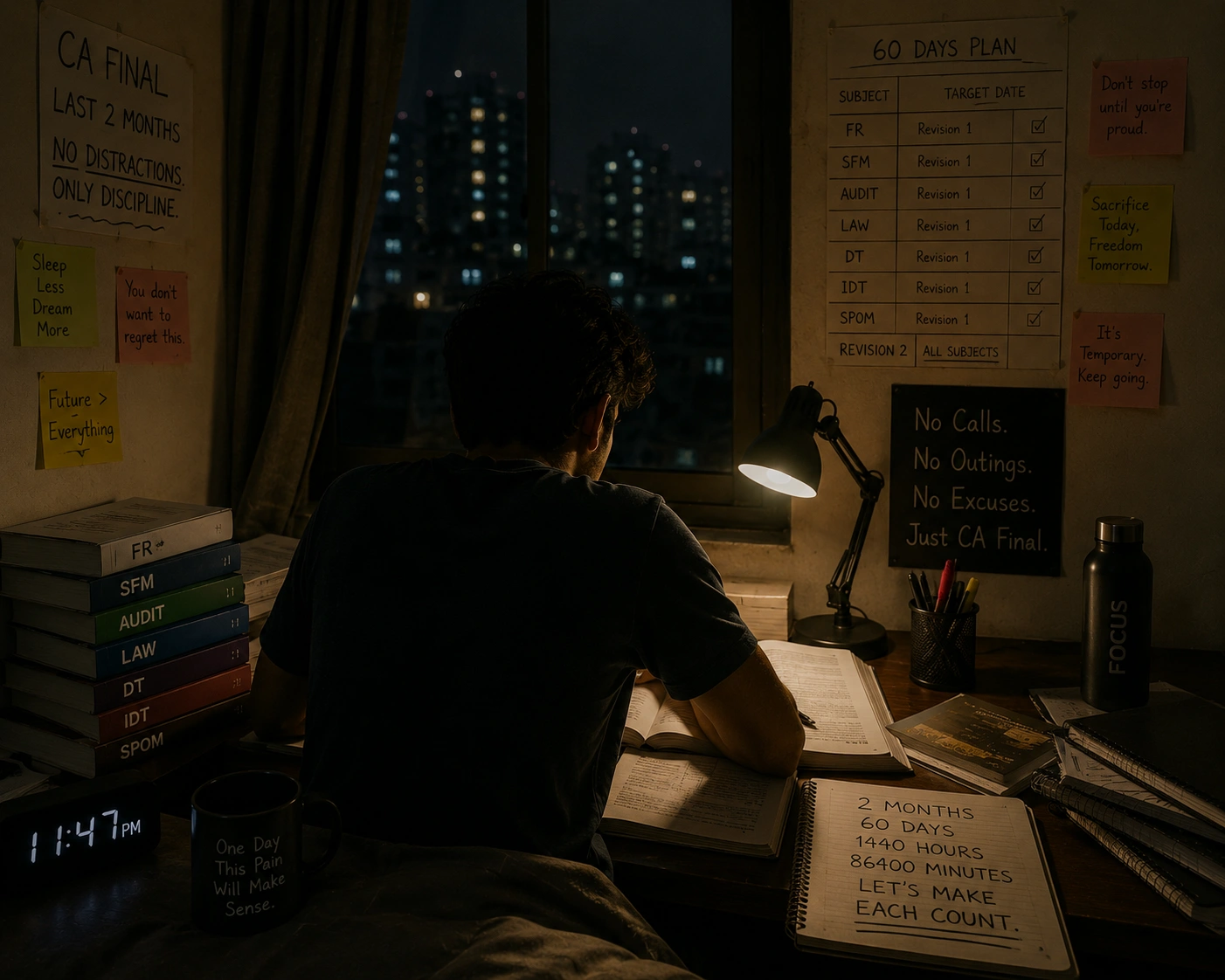
The World Shrinks
Two months before CA Final, your world contracts. The library becomes your universe. The textbooks become your companions. Social life becomes a memory. You're not just studying — you're disappearing.
This is the part of CA preparation that nobody warns you about. Not the difficulty of the material. Not the long hours. The isolation. The slow, creeping loneliness that settles in when your entire existence narrows to one exam.
How Isolation Creeps In
It doesn't happen overnight. It's gradual:
Social contraction Friends stop inviting you out — not because they don't care, but because they know you'll say no. Eventually, they stop asking. The invitations dry up. You're alone by default.
Family disconnection Your family tries to understand, but they can't. They see you studying and think you're fine. They don't see the anxiety, the doubt, the 3 AM panic. You stop sharing because explaining feels pointless.
Peer isolation Even fellow CA students are competitors. The camaraderie thins as the exam approaches. Everyone is guarding their study time, their strategies, their mental energy. The shared struggle becomes a solitary one.
Digital withdrawal You reduce social media to avoid comparison and distraction. But this also cuts you off from the casual connections that keep you human. The digital world becomes a void.
The Psychological Toll
Isolation isn't just loneliness. It's a specific kind of psychological damage:
Identity erosion When you stop engaging with the world, you lose the parts of yourself that exist in relation to others. You're not a friend, a sibling, a partner. You're just a student. The identity narrows until it's just the exam.
Cognitive distortion Isolation warps your thinking. Problems feel bigger. Failures feel permanent. The future feels hopeless. Without external perspective, your brain spirals into worst-case scenarios.
Emotional numbing You stop feeling. Not because you're calm, but because the emotional overload has caused your system to shut down. The numbness is a defense mechanism, not a strategy.
Physical deterioration Isolation affects sleep, appetite, and energy. You eat irregularly, sleep poorly, and move less. The physical decline compounds the psychological strain.
What Nobody Tells You
The things nobody says about the last two months:
You'll question everything Your choice to pursue CA. Your ability to pass. Your worth as a person. The doubt is relentless and comes from every direction — internal and external.
You'll mourn your social life Not dramatically. Quietly. You'll see friends posting about their lives and feel a pang of something — not jealousy, but grief for the version of yourself that had time for relationships.
You'll become someone you don't recognize The isolation changes you. You become shorter with people, more irritable, less patient. The person you are under exam pressure isn't the person you normally are. It's uncomfortable to see.
The last week is the hardest The final days before the exam aren't about studying. They're about managing the anxiety of facing something you've spent months preparing for. The isolation peaks because there's nothing left to do but wait.
What Helps
You can't eliminate the isolation entirely. But you can soften it:
One daily connection One call. One text. One conversation. It doesn't have to be deep. It just has to be human. Protect this connection like you protect your study schedule.
Movement Walk. Exercise. Move your body. Physical activity breaks the isolation loop and gives your brain the reset it needs. It's not wasted time — it's investment in your cognitive function.
Honest check-ins Tell someone how you're actually doing. Not the performance. Not the "I'm fine." The truth. This breaks the isolation more than any amount of studying can compensate for.
Accept the temporary This isolation has an end date. The exam will happen. The isolation will lift. Holding onto that knowledge helps you survive the worst days.
Don't study alone in your head Study groups, online forums, a study partner — even brief interactions with people who understand the experience reduce the isolation. You're not the only one going through this.
After the Exam
The isolation doesn't end the moment you walk out of the exam hall. There's a recovery period — days or weeks where you relearn how to be a person who exists in the world.
Give yourself that time. Don't rush back into everything. The transition from exam mode to normal life requires patience and compassion.
The isolation of CA Final is heavy. Artha is a space where you can talk about the loneliness, the doubt, and the things you can't say to anyone who hasn't walked this road.
Quick answers
Things people usually want to know.
Why is the last stretch of CA Final preparation so isolating?
By the final months, your social circle has shrunk. Friends who didn't take CA have moved on. Fellow students are deep in their own prep. Family doesn't understand the intensity. You're surrounded by people but completely alone with the pressure.
How do I manage isolation during exam prep?
Stay connected in small ways — a daily call with a friend, a weekly walk, brief social media check-ins. Isolation isn't about being physically alone — it's about losing all human connection. Protect at least one relationship during this period.
Is it normal to feel depressed during CA Final prep?
Very normal. The combination of isolation, pressure, uncertain outcomes, and identity fusion with the exam creates conditions where depression thrives. If feelings persist beyond two weeks or include hopelessness, talk to a professional.
Should I take a break from studying in the last two months?
Strategic breaks are essential. Your brain consolidates learning during rest. Short daily breaks and one longer break per week will improve retention and prevent burnout. Studying without rest is counterproductive.
What if I fail after all this effort?
Failure in CA Final is common and doesn't define your career. Many successful CAs failed multiple times. The exam tests a specific skill set at a specific moment — not your worth or capability. Prepare for the best, plan for all outcomes.