ACCA vs CS: Why These Aren't Really Competing Paths (2026)
November 19, 2026 · 9 min read · by Shivam Kushwaha, Artha founder
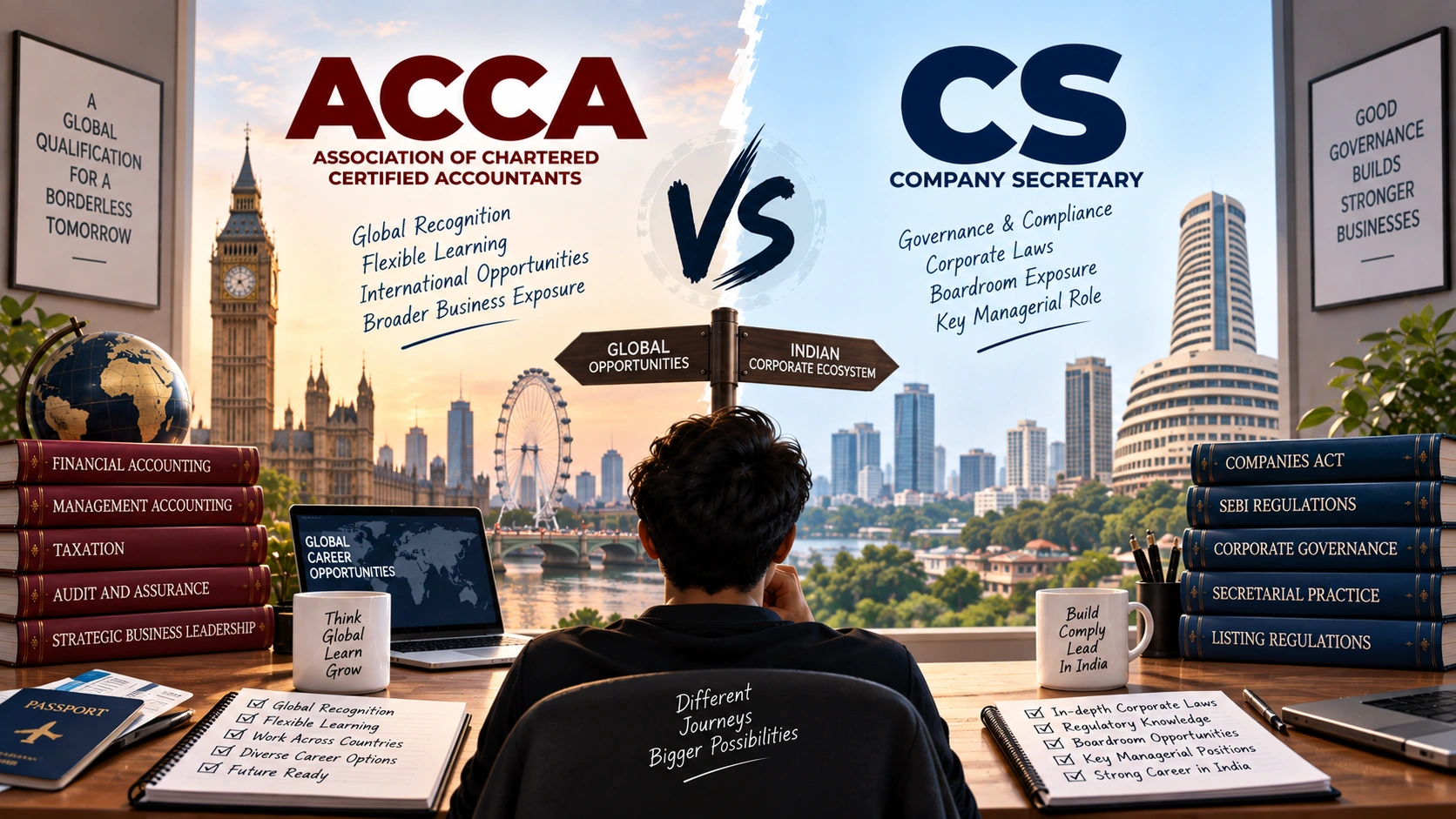
Someone in the finance group just asked the standard question: ACCA or CS? And immediately ten people jumped in with ten completely different answers, most of them describing entirely different career goals without realising it. That's the real problem with this comparison.
ACCA is UK-headquartered, trains you in IFRS, and is recognised in over 180 countries for accounting and financial reporting roles. CS is India-specific, trains you for statutory governance under the Companies Act, and takes 3 to 4 years. They're built for different countries, different standards, and different kinds of work. The comparison usually collapses because nobody clarifies which career they're actually pursuing first.
The actual numbers, side by side
| ACCA | CS (ICSI) | |
|---|---|---|
| Headquarters | UK-based Association of Chartered Certified Accountants | Institute of Company Secretaries of India |
| Accounting/legal framework | IFRS (International Financial Reporting Standards) | Indian Companies Act and related regulations |
| Structure | 13 papers across Applied Knowledge, Applied Skills, and Strategic Professional levels | Foundation, Executive, Professional (3 levels) |
| Typical duration | 2 to 3 years with exemptions for Indian CAs; 3 to 4 years from scratch | 3 to 4 years depending on attempt pace |
| Pass rates | Generally 35-50% per paper per sitting, per ACCA | Executive: typically 15-25%; Professional: similar range, per ICSI |
| Geographic recognition | Over 180 countries, particularly strong in UK, EU, Middle East, Africa, Asia-Pacific | Primarily India and Indian corporate environments |
| Signing authority in India | None | Statutory governance officer appointment under Companies Act |
| Core focus | Financial reporting, audit, tax, governance under IFRS | Corporate governance, board compliance, secretarial audit, regulatory filings |
What ACCA is actually for
ACCA was designed to be a genuinely global accounting credential. Its curriculum is built entirely around IFRS, which is the accounting standard adopted in over 140 countries. The 13-paper structure covers financial reporting, audit, tax, governance, and strategic business management across international contexts.
The real value of ACCA for an Indian professional is global mobility and IFRS alignment. If you're targeting roles in multinational firms, shared services centres, or any company that reports under IFRS, ACCA's curriculum directly trains you for that environment.
The limitation is India-specific authority. ACCA grants no statutory signing rights, no governance officer appointments, and no audit authority in India. It's built for international accounting environments, not Indian regulatory ones.
What CS is actually for
CS exists to fill a specific legal role mandated by Indian company law. Every listed company and certain classes of companies are legally required to appoint a Company Secretary. That statutory authority is the credential's real value, not exam difficulty or prestige.
The CS path is grounded in Indian corporate law, governance, compliance, and secretarial audit. The work is procedural and legal, requiring deep familiarity with how companies interact with regulators and how boards maintain compliance with statutory requirements.
The limitation is geographic and professional scope. CS training is entirely India-focused and centred on governance. Someone interested in international accounting, financial reporting under IFRS, or global audit roles will find that CS's curriculum doesn't cover those areas at all.
Where people get this decision wrong
The most visible mistake is assuming ACCA is simply a more globally recognised version of CS. They don't cover similar content. One trains you in international accounting standards. The other trains you in Indian corporate governance law.
The reverse mistake shows up in people choosing CS as a safe default without checking whether their actual interest is in global accounting, IFRS reporting, or multinational firm roles where ACCA would be more directly relevant.
A third, quieter pattern involves people picking ACCA purely because it sounds more "international," without accounting for the fact that its value is limited in Indian statutory contexts where CS or CA authority is what employers and regulators actually require.
The actual decision
The real question isn't which credential has more papers, better pass rates, or looks more impressive. It's whether you want to work in global accounting environments or Indian corporate governance environments.
If you're targeting roles in multinational firms, IFRS-reporting companies, or any position where international financial reporting and audit skills matter, ACCA is built for that.
If instead you're targeting corporate governance, secretarial compliance, or any role where Indian Companies Act authority is required, CS is built for that.
Different mandates, not different prestige levels
ACCA and CS aren't really ranked against each other. One is a global accounting credential. The other is an Indian statutory governance appointment. The right answer depends on which market you're actually trying to enter, not which credential sounds more impressive on a résumé.
Quick answers
Things people usually want to know.
Which is better, ACCA or CS, for a career in India?
Neither is universally better. ACCA trains you in IFRS for global accounting roles. CS trains you for statutory governance and compliance under Indian company law. The right choice depends on whether you want international accounting work or Indian corporate governance work.
Can I do both ACCA and CS?
The combination rarely makes sense because they prepare you for fundamentally different roles. ACCA is global accounting and financial reporting. CS is Indian corporate governance and compliance. Unless you have a specific role bridging both, the combination adds years without a clear career payoff.
Does ACCA carry any authority in India?
No. ACCA does not grant statutory audit authority, governance officer appointments, or any legal signing rights in India. Only ICAI-qualified CAs and ICSI-qualified CS professionals hold those specific statutory rights.
Is ACCA recognised in India?
Yes, particularly in multinational firms, shared services centres, and companies using IFRS reporting. However, ACCA does not replace CS for statutory governance roles or CA for audit signing authority in India.
How long does ACCA take compared to CS?
ACCA typically takes 2 to 3 years for Indian CA graduates with exemptions, or 3 to 4 years from scratch across 13 papers. CS typically takes 3 to 4 years across three exam levels depending on attempt pace.
Is the CS exam harder than ACCA?
They test completely different knowledge domains. CS exams test Indian corporate law, governance, and compliance. ACCA exams test international financial reporting, audit, tax, and strategic management under IFRS. Difficulty is subjective depending on your strengths.
Which pays more, ACCA or CS, in India?
ACCA professionals in India typically earn between 5 and 15 LPA depending on role, firm, and experience. CS professionals typically earn between 3 and 10 LPA. ACCA carries higher average pay in multinational environments, but CS offers more stability in statutory governance roles.
Does Indian CA give exemptions for ACCA?
Yes. ICAI-qualified Chartered Accountants can receive up to 9 exemptions from ACCA's Applied Knowledge and Applied Skills papers, significantly reducing the workload.
Does CS give any exemptions toward ACCA?
No formal exemption structure exists between ICSI and ACCA. CS professionals must complete ACCA's full 13-paper structure from scratch without exemptions.
What kind of work does ACCA prepare me for that CS doesn't?
Financial reporting under IFRS, international audit, tax compliance across multiple jurisdictions, and strategic business management in global accounting environments. None of these fall within CS's governance-focused mandate.