ACCA vs CPA: Which Global Route Actually Fits Indians? (2026)
November 18, 2026 · 10 min read · by Shivam Kushwaha, Artha founder
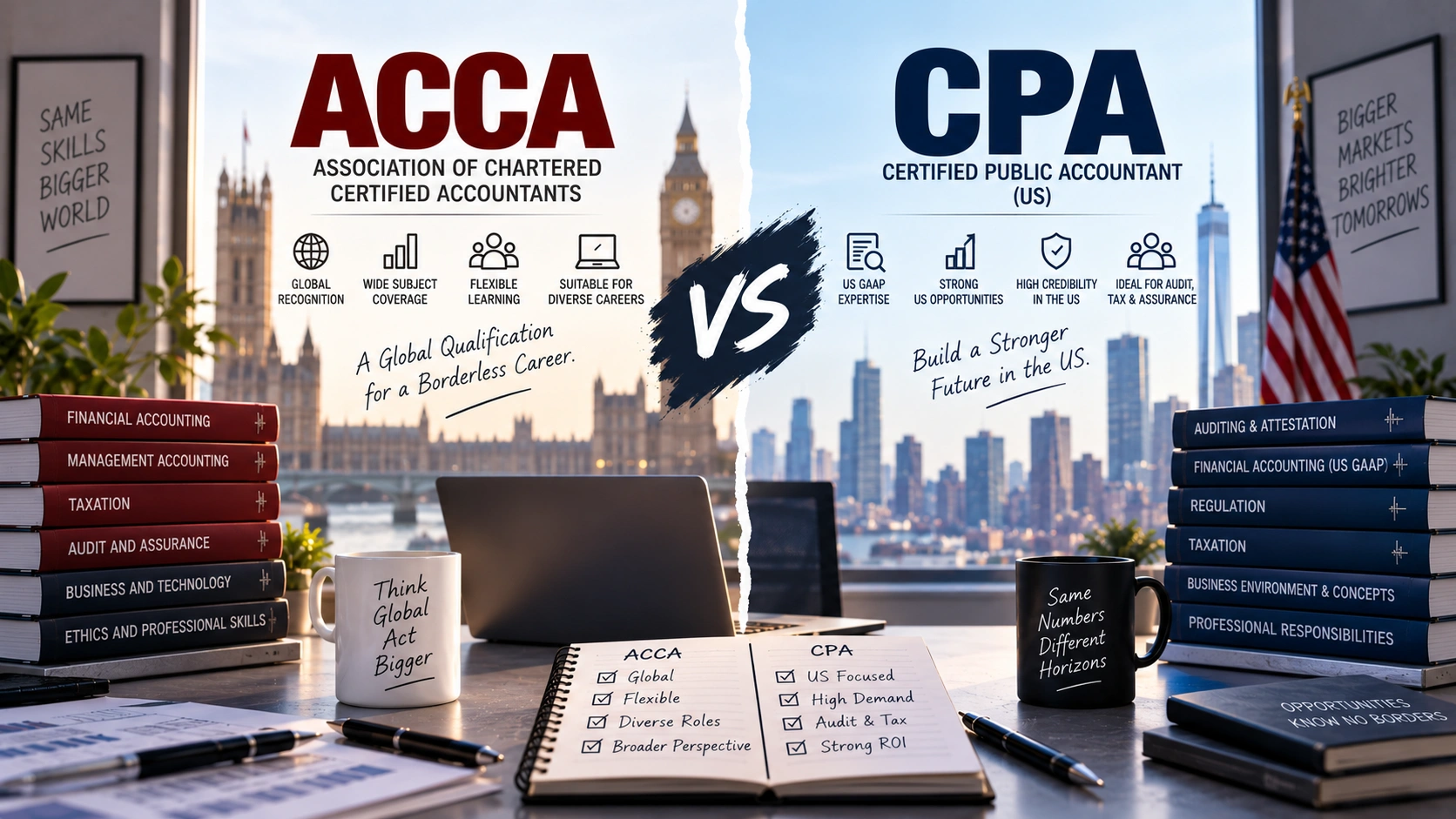
College placement season just ended and the two most common follow-up questions in every finance group are the same: should you go global with ACCA or aim for the US with CPA? The answers everyone gives are usually about which one is "better" when neither actually competes for the same job.
ACCA is UK-headquartered, trains you in IFRS, covers 13 papers, and is recognised in over 180 countries. CPA is US-licensed, trains you in US GAAP, covers 4 exam sections, and is specifically valuable for US-facing roles. The right choice isn't about prestige, it's about which geography and accounting standard you're actually building a career around.
The actual numbers, side by side
| ACCA | US CPA | |
|---|---|---|
| Headquarters | UK-based Association of Chartered Certified Accountants | US-based American Institute of Certified Public Accountants (AICPA) |
| Accounting standard | IFRS (International Financial Reporting Standards) | US GAAP (Generally Accepted Accounting Principles) |
| Structure | 13 papers across Applied Knowledge, Applied Skills, and Strategic Professional levels | 4 sections: AUD, BEC, FAR, REG |
| Typical duration (for Indian CAs) | 2 to 3 years with exemptions (4-5 papers remaining) | 12 to 18 months across 4 sections |
| Typical duration (from scratch) | 3 to 4 years | 18 to 24 months plus eligibility requirements |
| Pass rates | Varies by paper and session, generally 35-50% per sitting, per ACCA | Varies by section, generally 45-55% per section, per AICPA |
| Signing authority in India | None | None |
| Geographic recognition | Over 180 countries, particularly strong in UK, EU, Middle East, Africa, Asia-Pacific | Primarily United States and US-facing multinational roles worldwide |
| Estimated total cost | 2.4 to 3.5 lakh INR (with exemptions for Indian CAs) | 3.5 to 4.5 lakh INR including evaluation and state board fees |
What ACCA is actually for
ACCA was built to be a genuinely global accounting credential, not a regional one. Its curriculum is anchored in IFRS, which is the accounting standard used in over 140 countries. The 13-paper structure covers everything from financial reporting and audit to tax, governance, and strategic business leadership.
The real value of ACCA for an Indian professional is breadth and portability. The credential doesn't lock you into one country's regulatory framework. If you're targeting roles in the UK, EU, Middle East, or any IFRS-adopted jurisdiction, ACCA's curriculum directly trains you for that environment.
The limitation is scope. ACCA grants no statutory signing authority in India, and its recognition in the US market is limited compared to CPA. It's built for global IFRS environments, not US GAAP ones.
What CPA is actually for
CPA was built for a specific purpose: preparing accountants for US financial reporting, US tax regulations, and US audit standards. The 4-section structure goes deep into US GAAP, US tax code, and US auditing standards in a way no other credential matches.
The real value of CPA for an Indian professional is US market access. If you're targeting Big Four US advisory desks, US-based multinational roles, or any position where US GAAP reporting is the primary framework, CPA is the credential those employers specifically look for.
The limitation is geography. CPA's curriculum is entirely US-focused, which means its direct applicability is narrow if you're working in IFRS jurisdictions. It also requires specific educational eligibility that varies by US state board, adding administrative complexity for Indian candidates.
Where people get this decision wrong
The most visible mistake is assuming ACCA is simply "CPA but international." They're built around different accounting standards, and that difference shapes everything from curriculum content to the roles each credential prepares you for.
The reverse mistake is assuming CPA automatically carries more weight globally because it's US-based. In IFRS jurisdictions, ACCA's alignment with local standards makes it more directly relevant than a US GAAP credential.
A third pattern involves people picking CPA simply because the US salary numbers look higher, without accounting for the fact that those numbers reflect US cost of living and market conditions, not an inherent premium for the credential itself.
The cost reality for Indians
Both credentials require significant financial commitment, but the cost structures differ.
ACCA's total cost for an Indian CA graduate with exemptions typically falls between 2.4 and 3.5 lakh INR. This includes registration, exam fees for the remaining 4 to 5 papers, annual subscription fees, and study materials. The exemption pathway makes ACCA more affordable for those who already hold Indian CA qualifications.
CPA's total cost typically falls between 3.5 and 4.5 lakh INR. This includes credential evaluation fees (required for Indian degrees), exam fees for all 4 sections, state board application fees, and study materials. The administrative overhead of navigating US state board requirements adds variable costs that don't exist with ACCA.
Neither credential is cheap. The question is whether the investment aligns with the specific career geography you're targeting.
The actual decision
The real question isn't which credential is recognised in more countries or which one has better exam pass rates. It's whether you're building a career in an IFRS jurisdiction or a US GAAP jurisdiction.
If you're targeting roles in the UK, EU, Middle East, or any IFRS-adopted market, ACCA's curriculum directly aligns with the accounting standard those environments use.
If instead you're targeting US-facing roles, Big Four US advisory positions, or any job where US GAAP reporting is the primary framework, CPA is specifically built for that.
Different standards, not different prestige levels
ACCA and CPA aren't really competing for the same career slots. One trains you for global IFRS environments. The other trains you for US GAAP environments. The right answer depends on which market you're actually trying to enter, not which credential sounds more impressive on LinkedIn.
Quick answers
Things people usually want to know.
Which is better, ACCA or CPA, for an Indian student?
Neither is universally better. ACCA trains you in IFRS and is recognised in over 180 countries. CPA trains you in US GAAP and is specifically valuable for US-facing roles. The right choice depends on which geography and accounting standard you're actually targeting.
Can I do both ACCA and CPA?
Yes, some professionals pursue both, particularly those targeting multinational firms that operate across US and international reporting standards. However, both credentials require significant time and money, so the combination only makes sense if your specific role genuinely needs both.
Does Indian CA give exemptions for ACCA?
Yes. ICAI-qualified Chartered Accountants can receive up to 9 exemptions from ACCA's Applied Knowledge and Applied Skills papers, significantly reducing the total from 13 papers to around 4 or 5.
Does Indian CA give exemptions for CPA?
No formal reciprocal exemption structure exists between ICAI and US state boards. Indian CAs generally must sit all four CPA exam sections independently, though some state boards may evaluate foreign qualifications on a case-by-case basis.
How long does ACCA take compared to CPA?
ACCA typically takes 2 to 3 years for Indian CA graduates with exemptions, or 3 to 4 years from scratch across 13 papers. CPA typically takes 12 to 18 months for Indian CAs across 4 exam sections, assuming consistent preparation.
Which is harder, ACCA or CPA?
They test different frameworks rather than different difficulty levels. ACCA covers breadth across 13 papers including governance, audit, tax, and strategy. CPA covers depth across 4 sections focused heavily on US accounting standards and regulations.
What does ACCA cost for an Indian student?
Total cost typically ranges from 2.4 to 3.5 lakh Indian rupees including registration, exam fees, annual subscriptions, and study materials, depending on whether exemptions apply and which study route you choose.
What does CPA cost for an Indian student?
Total cost typically ranges from 3.5 to 4.5 lakh Indian rupees including evaluation fees, exam fees, state board fees, and study materials. US state board requirements can add variable administrative costs.
Does either ACCA or CPA give signing authority in India?
No. Neither ACCA nor US CPA carries statutory audit or signing authority in India. Only ICAI-qualified Chartered Accountants hold that specific legal right under Indian law.
Which has better global recognition?
ACCA is recognised in over 180 countries and is built around IFRS, which is the most widely adopted global accounting standard. CPA is specifically valued in the United States and for US-facing multinational roles. Neither is universally superior globally.